


The day I finally sailed out of Airlie Beach toward Whitehaven Beach and the island reefs I had seen in countless brochures, the Whitsundays felt both familiar and unknown. I had read about the pure white silica sand, the swirling tides of Hill Inlet and the promise of snorkelling with tropical fish, but I also knew that this part of the Great Barrier Reef is about island scenery as much as coral. My goal was simple: find out whether a combined Whitehaven and snorkelling day really delivers, without pretending it is the same as an outer-reef trip.
Leaving Port of Airlie: Boat, Weather and First Impressions
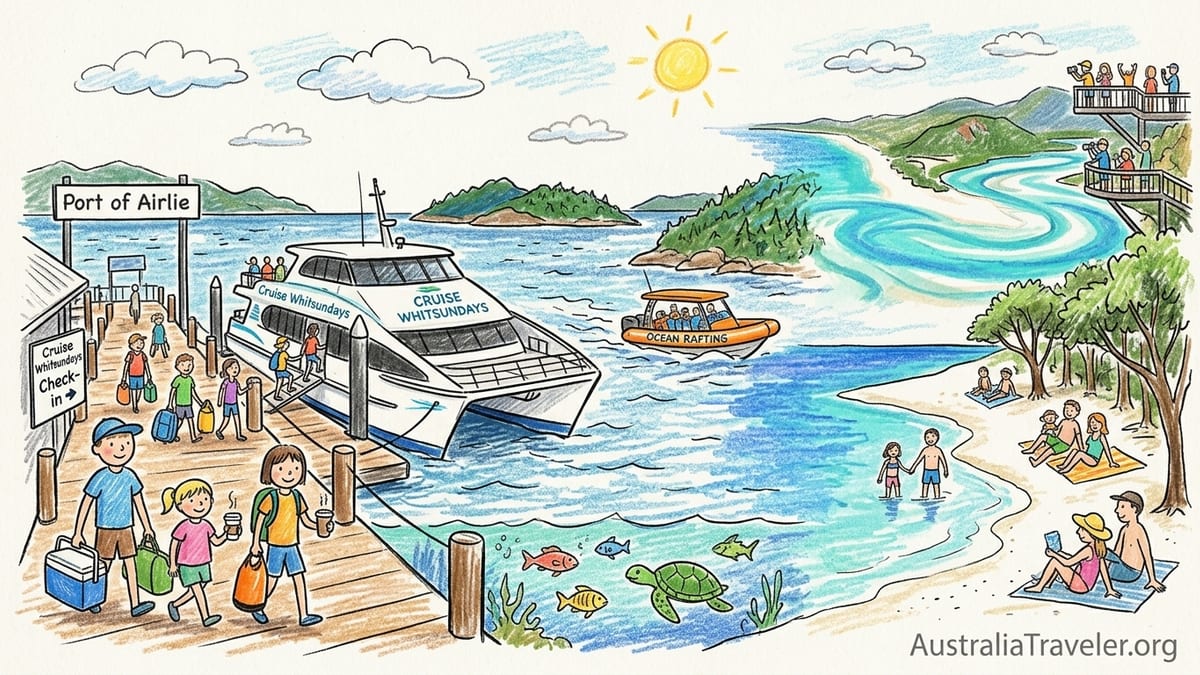
My day started at Port of Airlie, the main marina on the edge of town that now handles many of the big day boats heading out to the Whitsunday Islands. By 8.15 am the boardwalk was already busy with esky-toting families, backpackers with dry bags and couples clutching coffee cups. I checked in at the Cruise Whitsundays counter for a full-day Whitehaven and island snorkel cruise, a middle-ground option between the pure sailing trips and the high-speed rafting boats that blast out of Coral Sea Marina.
The vessel for the day was not a raft but a large, stable high-speed catamaran with indoor seating, shaded outdoor decks and a capacity of around 120 passengers. It felt closer to a normal day cruise than an adrenaline ride, which suited me; the sea forecast was 15 to 20 knots of southeasterly winds and a moderate swell in the passages between islands. Skies were bright but scattered with cloud, the classic Whitsunday mix that gives you bursts of strong sun and shifts the colour of the water from pale turquoise to deep cobalt.
On board, the layout was straightforward. There were padded booth-style seats inside, open bench seating outside and a small bar and snack counter. Announcements came from a cheerful crew of six, including a skipper, two deckhands doubling as snorkel guides, a host and a photographer. The atmosphere was relaxed rather than raucous, with a mix of families, older couples, a few groups of friends and only a handful of backpackers. As we eased out of the marina, the crew set expectations clearly: this was a Whitehaven and island-reef day, not an outer Great Barrier Reef trip, and visibility as well as coral quality would reflect that.
That distinction matters. The outer reef off Airlie Beach sits much further out than the fringing reefs around Hook Island or Border Island, and only a few high-speed products such as Viper combine Whitehaven, Hill Inlet and a true outer-reef snorkel in a single day, usually at a higher price and with a more intense pace. My boat, by contrast, stayed within the shelter of the islands, which meant shorter open-ocean stretches and more time enjoying the scenery but also slightly less dramatic coral.
Choosing the Style of Trip: Raft, Sail or Cruise
Before booking, I spent a day comparing the main Whitehaven and snorkelling options out of Airlie Beach, because the style of boat shapes your entire experience. Ocean Rafting, for example, runs semi-rigid inflatables on its Northern Exposure and Southern Lights tours that promise "three days in one" with fast rides, Hill Inlet, Whitehaven Beach and two snorkelling sites. Their Northern Exposure itinerary emphasises more time in the water and includes stinger suits and a simple tropical-style lunch on the beach. It is energetic and can be rough in choppy seas, but it also tends to reach excellent snorkel sites off Hook Island quickly.
Cruise Whitsundays sits at the other end of the spectrum with its Camira sailing catamaran and standard Whitehaven day cruises. Camira is a big, purple sailing cat that balances motoring and genuine sailing, includes a barbecue lunch and drinks, and spends more time gliding between stops than charging through chop. The dedicated Whitehaven Beach day trips, especially the half-day itineraries, focus more on the southern stretch of Whitehaven itself and often skip Hill Inlet and snorkelling entirely in favour of relaxed beach time.
There is also a newer class of high-speed catamaran and jet-boat style tours like Thundercat, Whitsunday Bullet and Viper. These push harder into the "do it all in one day" promise. Viper in particular advertises itself as the only day tour from Airlie Beach that combines an outer Great Barrier Reef snorkel with Hill Inlet and Whitehaven in a single itinerary, departing early and returning late with a price typically north of 330 Australian dollars for adults. It is ideal for travellers who want a taste of everything and have limited time, though the flipside is long hours in a fast, often bumpy boat and shorter stops at each location.
After weighing it up, I chose a mid-range Cruise Whitsundays day that explicitly included Whitehaven Beach, the Hill Inlet lookout and one island snorkelling stop. It was not purely sail, not a raft and not an outer-reef product, but it promised a more comfortable ride, a buffet-style lunch and a moderate group size without spilling into the party-boat vibe that some backpacker-focused operators lean on. In essence, I traded maximum snorkel time for a more balanced day that I felt would match what most first-time visitors are looking for.
Whitehaven Beach: Time on the Sand, Not Just a Postcard Stop
After around an hour weaving past Daydream Island and South Molle Island, the boat rounded the point of Whitsunday Island and the first full sweep of Whitehaven Beach came into view. Even on a day with shifting light, the seven-kilometre strand lived up to the brochures. The sand was almost glaringly white, thanks to its high silica content, and the water graduated from clear aqua to deep blue along a gentle curve of shore backed by low, forested hills.
We anchored off the southern section of Whitehaven rather than the Hill Inlet end, which is typical for larger day boats that share moorings and tender guests to the beach in smaller inflatable vessels. Disembarkation took a little time with a boat this size, and this is where group scale shows its downside. By the time I stepped onto the powdery sand, most of the best shade patches under the she-oaks were already claimed by earlier tenders. On the positive side, we were allocated close to two hours at Whitehaven itself, significantly more than some fast-boat tours that squeeze beach time into 60 minutes between a snorkel and a lookout walk.
On the beach, the crew reiterated a point that matters but is sometimes glossed over in marketing: Whitehaven is famous for its sand and scenery, not its off-the-beach snorkelling. The immediate shallows are mostly clear sand with small patches of seagrass and scattered rock. You can certainly swim, float and wade, and on calm days you might spot stingrays gliding over the bottom or small fish near rocky outcrops, but this is not the place to expect bommies of hard coral a few metres from shore. For that, you need to travel to other parts of Whitsunday or Hook Island, or all the way to the outer reef.
I spent my first hour simply walking, which is where Whitehaven excels. The sand felt almost squeaky underfoot, cool even in the heat, and the gradual slope of the beach made it easy to wander ankle-deep with camera in hand. There were plenty of other boats anchored along the bay, from bareboat yachts to day-trip catamarans and the occasional seaplane resting just offshore, but the sheer length of the beach meant it never felt overcrowded. The only frustration was knowing that our time here was finite; just as I settled under a tree with a book and watched hermit crabs tracing patterns in the damp sand, the call went out to begin shuttling back to the main vessel.
Hill Inlet: The Lookout Versus Time in the Water
From Whitehaven, we motored north along the inside of Whitsunday Island toward Hill Inlet, the narrow channel where tides twist the white sand into the iconic swirling patterns seen in almost every Whitsundays advertisement. Here, access and experience differ dramatically depending on your operator. Ocean Rafting promotes its special access permits that allow its rafts to land closer to the northern beach and start the Hill Inlet walk from there, while larger cats and cruise vessels usually anchor a little further away and use tenders to drop guests at Tongue Bay or nearby beaches before the walk.
In our case, the boat used a tender to land us at the national park trackhead. The walk to the main Hill Inlet lookout platforms took about 20 minutes at an easy pace, including a couple of pauses while the guide explained the Ngaro First Nations history of the islands and pointed out stingrays in the shallow waters below. The path was well graded, shaded for most of its length and suitable for anyone with reasonable mobility and closed-in shoes. At the top, three viewing platforms offered slightly different perspectives of the inlet, and here the trade-off inherent in a combined tour became obvious. With several boats scheduling their lookouts around the same tide window, the platforms filled quickly, and taking in the view without other people in your frame required patience or a tight crop.
That said, the view itself was worth the logistical juggle. The shifting tide had pulled the bright silica sand into sinuous tongues beneath the clear water, and every few minutes a thin cloud passing over changed the colours again. I was glad I had not chosen a half-day Whitehaven cruise that skipped Hill Inlet entirely. For many travellers, that overhead view is the moment when the Whitsundays click from "nice beach" to "this is somewhere truly special." The compromise is that you do not swim here; the Hill Inlet stop on this type of day trip is purely for the walk and viewpoint, not a beach-going session.
Because of that, the crew kept us tightly to the schedule. We had time for photos, a short talk about how the inlet shifts through the year and a quick refill of water bottles, but no lingering. Hill Inlet on this itinerary was an intense, concentrated visual experience rather than a relaxed swim spot, very different from the two hours of beach time earlier in the day.
Snorkelling the Island Reefs: Hook Island and Beyond
After leaving Hill Inlet, the skipper steered us toward the northern side of Hook Island, which local charter guides and marine-park materials consistently describe as home to some of the better fringing-reef snorkelling in the Whitsundays. Sites such as Manta Ray Bay, Luncheon Bay and the inlets around Stonehaven and Macona have bommies of hard and soft coral, steep coral-covered walls and sheltered bays where fish congregate. Conditions vary a lot with wind, swell and recent rain, so the crew chose on the day based on visibility and current.
Our snorkel drop was in a small bay on the eastern side of Hook Island, where the wind was blowing across the top of the reef but the water inside the bay remained reasonably protected. From the back deck, crew helped guests into stinger suits, which were included in the tour price, and handed out masks, snorkels and fins. Stinger suits are not optional fashion in the Whitsundays during the warmer months; this part of Queensland has had irukandji jellyfish incidents in the past, including off Hook Island, and operators take summer stinger season seriously with full-body suits and in-water lifeguards.
Visibility that afternoon was around 8 to 10 metres, which the crew described as "pretty good" for island reefs. Once in the water, the first few metres from the boat were a mix of sand patches and seagrass, then the bottom dropped away into coral gardens. The coral itself showed the mixed picture many snorkellers report from the Whitsundays. Some sections of branching coral and plate coral were vibrant, with healthy-looking browns, creams and pastel blues. Other patches were clearly recovering, with more algae, broken branches and hardier boulder corals dominating. Fish life, however, was pleasantly varied, with clouds of yellow and blue damsels, small schools of fusiliers, a couple of parrotfish crunching noisily at the coral and anemonefish poking out of a single large anemone. A green turtle cruised past midway through the session to general excitement, and a few nervous shrieks from the surface signalled the appearance of a harmless reef shark in the distance.
We had a little under an hour in the water, which felt enough for most of the group but slightly rushed for strong swimmers used to spending half a day on a single reef. The guides kept watch from a tender, occasionally towing tired snorkellers back or pointing out interesting features. Compared with outer-reef pontoons further offshore, there were fewer big, dramatic coral heads and the visibility was a little milkier, but the setting close to the islands gave the experience a different flavour. You could float and look back at steep, green hills and rocky headlands while fish darted beneath, a reminder that this part of the Great Barrier Reef is as much about the islands as what lies under the water.
Importantly, the crew did not pretend this was the same as an outer reef such as Hardy Reef or Bait Reef. They framed it as "good island snorkelling" rather than a once-in-a-lifetime coral extravaganza. For travellers who have snorkelled outer reefs elsewhere in Queensland, the Whitsunday island reefs can feel gentler and more subdued. For first-time snorkellers or families nervous about deep water, they provide an accessible, enjoyable way to see coral and fish without a long open-ocean crossing.
Life on Board: Group Size, Meals and Transit Time
Across the day, I became acutely aware of how much of a Whitsundays experience happens on the boat rather than on the beach or in the water. From check-in to return, we were away for around nine hours, of which roughly four were spent cruising between Port of Airlie, Whitehaven, Hill Inlet and Hook Island, plus refuelling and pick-up stops. That ratio is typical of multi-stop tours in the region. High-speed rafting trips cut some of the transit time thanks to powerful engines and more direct routes, at the cost of a much rougher ride and wetter, more exposed seating.
On a large catamaran with a mixed-age crowd, the pace felt measured. The crew used transit legs to deliver safety briefings, informal commentary about the islands and occasional wildlife-spotting calls when someone spotted a turtle or, in winter, a distant whale fluke. Meals broke up the movement. Morning tea was simple biscuits and fruit, while lunch offered a buffet of salads, cold meats, bread and vegetarian options. Soft drinks and alcoholic beverages were available for purchase at bar prices that felt high compared with mainland cafes but broadly in line with other reef and island tours I have taken along the Queensland coast.
Group size was the main trade-off. With more than 100 passengers, every disembarkation and reboarding took time, and popular vantage points at Whitehaven and Hill Inlet filled quickly. If you crave quieter moments or dislike moving in a crowd, smaller-group sailing trips or adults-only products like Lady Enid or some of the boutique Iconic Whitsunday Adventures sailings may appeal more, albeit at a higher cost and with fewer inclusions. Those vessels often carry 24 to 36 guests, serve plated lunches or grazing boards and linger longer at a select pair of stops rather than racing to fit three or four into a single daylight window.
Overall, I did not feel rushed during the key experiences but I was aware that everything ran to a timetable shaped by ferry connections and shared moorings. If I had one criticism, it would be that the snorkel stop could have run 15 minutes longer and the second tender from Whitehaven could have departed 15 minutes earlier without compromising safety or daylight. These are small adjustments, yet they illustrate how tightly choreographed a combined tour must be to deliver Whitehaven, Hill Inlet and snorkelling in one loop.
Comparing Current Tours: Inclusions, Transfers and Value
Looking back after the trip, I revisited operators' current brochures and online information to see how my experience compared with what is advertised. Ocean Rafting's Northern Exposure and Southern Lights tours, for instance, explicitly include Hill Inlet lookout walks, time on Whitehaven Beach, snorkelling at one or two island reef sites, use of stinger suits and guided national park walks, with the option to add on a packed or beach-served lunch at extra cost on some departures. Hotel transfers from central Airlie Beach accommodations are often available but may come with a modest surcharge depending on distance.
Cruise Whitsundays' Whitehaven and island cruises are generally clear about what is and is not included. Their full-day Camira sailing adventure includes morning and afternoon tea, a barbecue lunch, drinks, snorkelling gear and a visit to Whitehaven Beach, often without Hill Inlet on the same day. The more conventional high-speed catamaran tours spell out when Hill Inlet is included and when the itinerary focuses solely on southern Whitehaven, and they note that stinger suit hire is included in the fare during marine stinger season. Some packages bundle return island resort or hotel transfers from Airlie Beach and Cannonvale, while others expect guests to make their own way to Port of Airlie or Coral Sea Marina.
Third-party sellers and comparison sites sometimes add to the confusion by mixing up outer-reef products such as the Hardy Reef pontoon with island-only Whitehaven days. In 2026, only a handful of tours from Airlie Beach, such as Viper, advertise both Hill Inlet and an outer reef snorkel on the same day, and those tend to cost more than 300 Australian dollars per adult and demand a longer, often windier open-water crossing. By contrast, most island-only Whitehaven and snorkel days cluster in the 230 to 280 dollar range for adults, with children discounted and family packages available. Prices can fluctuate with season and fuel costs, so smart travellers check official operator sites shortly before booking rather than relying on outdated brochures.
For inclusions, the real differentiators are group size, style of vessel and how much the day emphasizes speed versus relaxation. Almost all reputable operators now include snorkelling equipment, stinger suits during the relevant months, tea and a substantial lunch. Hill Inlet access and guided lookout walks are not universal, so if that swirl-of-sand view is important to you, look specifically for itineraries that name Hill Inlet or Tongue Point and include national park walk time in their description. If hotel transfers matter, especially if you are staying up the hill or outside Airlie Beach itself, check whether they are bundled or cost extra. A few high-end sailings include transfers for convenience, while lower-priced, half-day or bare-bones options sometimes leave this up to you.
The Trade-offs: Short Stops, Rough Rides and Limited Snorkelling
Across conversations with other travellers on board and in town, certain criticisms cropped up repeatedly about combined Whitehaven and snorkelling days, and my own experience partially echoed them. The first is that beach stops can feel too short if you are someone who likes to settle in with an umbrella, swim several times and read. An hour to 90 minutes on Whitehaven is enough for a walk, a swim and some photos, but not enough to fully relax into a slow day on the sand. Some dedicated beach-focused tours address this by spending three to four hours at Whitehaven but then omit Hill Inlet or snorkelling entirely, so you must decide what you value most.
The second criticism relates to ride comfort, particularly on the high-speed rafts and jet boats. While I did not choose Ocean Rafting or Viper for this trip, I spoke with travellers who had returned the previous day from Northern Exposure and described the ride as "fun but punishing" when the wind picked up, with spray soaking outer seats and some guests choosing to sit out the final snorkel because they were tired or slightly seasick. For fit, thrill-seeking travellers, that energy is a feature, not a bug, but if you have back issues, young children or a low tolerance for bumpy rides, a larger, heavier catamaran or sailing vessel may be more comfortable.
The third limitation is snorkelling time and quality. On my Cruise Whitsundays day, the single island snorkel was enjoyable but not life-changing, and at under an hour in the water it felt like a taster more than a main course. Rafting tours that prioritise two snorkel locations off Hook and Border Islands offer more time and, according to several recent passengers I chatted with in Airlie Beach, sometimes better visibility and more varied coral. Yet even they admit that for truly world-class coral and fish density, the outer reef off vessels like Viper or the dedicated Hardy Reef pontoons still holds the edge.
Finally, large-group dynamics can shape your enjoyment in subtle ways. Queueing for tenders, waiting for slower walkers on the Hill Inlet trail and sharing lookouts with three other groups inevitably dilute the sense of wilderness many travellers crave. Boutique sailings with 24 to 40 guests improve this but charge accordingly. For my mid-range, mixed-group day, the crowd felt acceptable rather than oppressive, though I was glad I travelled outside the peak Australian school holiday periods when boats are at their fullest.
The Takeaway
By the time we eased back into Port of Airlie in the early evening, the sun low over the hills and salt dried on my arms, I felt I had finally put some reality behind the postcard images that drew me to the Whitsundays. The combined Whitehaven, Hill Inlet and island snorkelling day delivered precisely what it promised: a broad sampler of the region's greatest hits, without pretending to be something it is not. Whitehaven was about the almost unreal texture and colour of the sand, Hill Inlet was about that one unforgettable panoramic view and the snorkelling at Hook Island provided a pleasant, if not outer-reef-level, glimpse of coral and tropical fish.
If you are deciding whether to book a combined day like this or separate experiences, the answer depends on your priorities. If time and budget are tight, a well-chosen Whitehaven and snorkelling tour from Airlie Beach offers strong value. For around the mid-200-dollar mark, you get a full day out, a good lunch, guided walks, national-park commentary, stinger suits and at least one decent snorkel, all with transport and logistics handled. It is an efficient way to see the islands, particularly if you are unlikely to return soon.
On the other hand, if you are a keen snorkeller or diver, splitting your experiences may give more satisfaction. Booking one dedicated outer-reef trip from Airlie Beach or Hamilton Island and a separate, slower-paced Whitehaven or sailing day allows each to shine on its own terms. You can soak in Whitehaven without watching the clock and then spend several hours over healthy coral at a pontoon or outer-reef site on another day. The total cost will be higher, but so will the depth of each experience.
For me, the combined day worked as an introduction. It confirmed that Whitehaven deserves its reputation, that Hill Inlet is worth the walk and that the island reefs can still deliver attractive snorkelling when conditions cooperate, all without an exhausting outer-reef crossing. Next time, I would pair a similar Whitehaven-focused day with either an overnight sailing trip that lingers longer in quiet bays or a dedicated outer-reef cruise. The Whitsundays reward those who give them more than a single day, but if that is all you have, a carefully chosen combined tour from Airlie Beach offers a memorable and honest taste of both reef and sand.
FAQ
Q1. Is a combined Whitehaven and snorkelling day enough to experience the Whitsundays?
For a first visit with limited time, yes. You see Whitehaven Beach, Hill Inlet and at least one island reef, which gives a solid overview, though not the depth of a separate outer-reef trip.
Q2. How does snorkelling around the islands compare with the outer Great Barrier Reef?
Island reefs near Hook and Border Islands can offer enjoyable coral and fish, but visibility and diversity are usually lower than at outer-reef sites like Hardy Reef or Bait Reef.
Q3. Which operators currently include Hill Inlet, Whitehaven and snorkelling from Airlie Beach?
Ocean Rafting, Cruise Whitsundays and several high-speed cats such as Thundercat and Viper run itineraries that visit Whitehaven, include the Hill Inlet lookout and offer at least one snorkel stop, though exact details vary by tour.
Q4. Are stinger suits and snorkelling gear included, or do I pay extra?
On most reputable Whitsunday day tours, masks, snorkels and fins are included. Stinger suits are either included in the ticket price during stinger season or hired very cheaply, but you should always confirm when booking.
Q5. How rough are the high-speed rafting trips compared with larger catamarans?
Semi-rigid rafts and jet boats are faster and sit lower in the water, so they feel choppier and wetter in strong winds. Larger catamarans and sailing vessels ride more smoothly and offer more sheltered seating but move more slowly.
Q6. Can I snorkel directly off Whitehaven Beach and see good coral?
You can certainly swim off Whitehaven, but the seabed near the main beach is mostly sand with some seagrass and sparse rocks. The better coral gardens are off other parts of Whitsunday and Hook Islands, reached by boat.
Q7. Do day tours from Hamilton Island offer the same experiences?
Many Hamilton Island tours visit Whitehaven and Hill Inlet using similar vessels and timings to Airlie Beach departures, but they may skip certain snorkel sites or arrange different pickup routes. Itineraries and prices are broadly comparable.
Q8. How much of a combined day is actually spent in the water?
On multi-stop island days, expect about one to two hours total in the water split between beach swimming and a dedicated snorkel. The rest of the time is spent cruising, walking to lookouts, eating and transferring between sites.
Q9. Is it worth paying extra for a smaller-group sailing trip?
If you value quieter decks, longer stops and a more relaxed pace, smaller-group sailing trips offer a noticeable upgrade in atmosphere. You sacrifice some speed and sometimes one of the stops, but many travellers find the trade worthwhile.
Q10. Should I book a combined island day or separate reef and Whitehaven trips?
If budget or time is tight, a combined day is efficient and good value. If you love snorkelling or diving and have a few days in the region, booking a dedicated outer-reef trip and a separate Whitehaven or sailing day will deliver richer experiences overall.