


I went out to the Great Barrier Reef expecting a day of drifting over coral gardens in quiet blue water. Instead, my first big pontoon trip felt more like a floating theme park queue than a marine wilderness. That experience, on a large outer reef platform off Cairns, fundamentally changed how I look at Great Barrier Reef tours, and why I now steer most snorkel-focused travellers toward smaller boats instead.
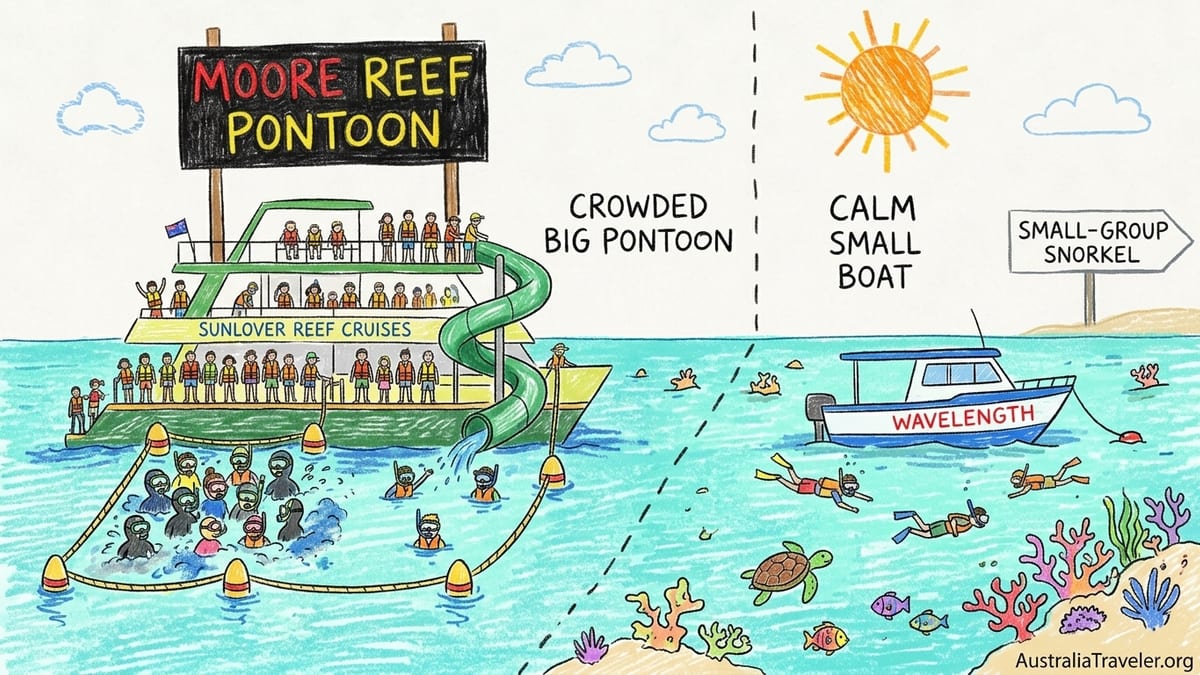
My Crowded Day At Moore Reef
My turning point came on a full-day trip with Sunlover Reef Cruises to their Moore Reef pontoon, one of the big-name platforms accessed from Cairns. At the time of writing, an adult fare for the Moore Reef full-day tour is advertised at about 317 Australian dollars, including lunch, snorkel gear and pontoon access. The brochure promises around four hours at the reef itself, on a large multi-level pontoon equipped with waterslide, semi-submersible rides and an underwater observatory.
We departed Cairns mid-morning on a high-capacity catamaran carrying what staff described as close to a full load. On busy days that can mean several hundred people on the transfer vessel, even if operators say they cap numbers on the pontoon below its engineering capacity. By the time we cleared Trinity Inlet and hit open water, every indoor seat was taken, families were standing in aisles and the outer decks were a patchwork of selfie sticks and seasick wristbands.
The schedule on paper looked generous: roughly a 90‑minute crossing each way and about four hours “on the reef.” In practice, a large chunk of that reef window disappeared into safety briefings, dive sign‑ups, stinger suit fittings and gear queues. From our arrival at Moore Reef to the moment I finally slid into the water for a first snorkel, more than 45 minutes had already passed. Much of that was spent in a tightly packed line while staff sized stinger suits and handed out masks and fins, managing hundreds of people with understandable but frustrating slowness.
When I did make it down the steps and into the lagoon, the water around the pontoon felt as busy as the decks above. Snorkellers were funneled into a roped-off rectangle that, while safe and supervised, quickly filled with fluorescent rash vests, pool noodles and nervous first-timers clutching life rings. Guides shouted instructions over the sound of the slide, the diesel generators and excited children. Any attempt to drift away for a quieter look at the coral was cut short by staff calling swimmers back inside the buoy line.
Queues, Lost Time and Limited Freedom
Over the course of the day, I counted the minutes I actually spent in the water with my face down and fins moving. On a tour sold as a long day on the Great Barrier Reef, I managed perhaps two hours of meaningful snorkel time, broken into short sessions by announcements, scheduled activities and crowd management. The rest was devoted to waiting: waiting to get gear, waiting for the semi-submersible, waiting for the buffet lines to shorten, waiting for my allocated time on the slide or in the supervised snorkel tour.
The equipment queues were the worst bottleneck. With so many passengers arriving at once, the snorkel platform became a small production line. Staff did what they could, but the process of assigning fin sizes, exchanging leaky masks, and finding prescription options for those who needed them meant that each person took precious seconds longer. Multiplied across hundreds of people, those seconds became whole swathes of lost reef time.
Fixed activity schedules added another layer of rigidity. Semi‑submersible rides ran to specific times, underwater observatory talks started on the hour and guided snorkels left in groups. If you wanted to join a particular activity, you often had to get out of the water early, dry off and join another queue to secure a spot. The pontoon absolutely delivered on variety, especially for non-swimmers, but the price of that variety was constant trade-offs and clock‑watching.
Even simple things like toilets and freshwater showers became chokepoints. Shared facilities are convenient compared with a small boat, but when several hundred people decide to rinse off at once before the lunch sitting, the result is a line snaking up the stairs and a sense that you are always in someone else’s way. By mid-afternoon, I felt more like I was managing a schedule at a busy aquatic centre than inhabiting a world‑class natural wonder.
The Atmosphere On And Under The Pontoon
The atmosphere on the platform itself was noisy, energetic and undeniably fun for many families. Children shrieked as they came off the spiral slide into the sea. Loudspeakers crackled with announcements about glass‑bottom boat departures and lifejacket reminders. The buffet line was a constant shuffle of wetsuits and sunhats. If your ideal reef experience includes that kind of lively energy, a big pontoon delivers it in spades.
In the water, though, the crush of people became a real distraction. At peak times, dozens of snorkellers kicked out from the same ladders into the same small snorkel zone. It was difficult to find enough space to float without someone’s fin drifting into your mask or a pool noodle bumping your side. Underwater visibility remained good, but the feeling of immersion in nature was diluted by the soundtrack of muffled shouts and the occasional clang from the pontoon.
Supervision was everywhere. Lifeguards watched from high platforms, guides patrolled the edges of the snorkel area and lines of life rings bobbed as safety corridors back to the main ladders. For weak swimmers and anxious parents, that level of oversight is a blessing. For reasonably confident snorkellers, the constant sense of being watched and directed can feel constraining. When I tried to linger near a slightly deeper bommie at the edge of the roped area, a guide quickly whistled and gestured me back into the main cluster.
The density of swimmers also has subtle impacts on the reef itself. While licensed operators work under strict environmental regulations and rotate usage, a compact snorkel area repeatedly visited by large numbers of people inevitably shows more broken coral rubble and cloudy sand than low‑density sites. On my Moore Reef visit, parts of the lagoon nearest the ladders looked tired, with hard‑pressed patches of coral and plenty of kicked-up sediment, even though healthier formations were visible a little further out where very few people ventured.
How Reef Magic and Quicksilver Compare
Reef Magic’s Marine World pontoon, also accessed from Cairns, offers a similar big‑platform model with some notable differences. The Marine World pontoon is promoted as a large, multi‑level structure of over a thousand square metres, with capacity technically up to several hundred people but with a stated practice of capping day numbers closer to 250. The standard day trip advertises about five hours at the reef, slightly more time on location than many competitors, along with a full range of semi‑submersible rides, glass‑bottom boat tours and underwater observatory access.
In practice, travellers I have spoken to and reviews I have read describe a comparable feel to Sunlover in terms of crowd density at peak times. The extra reef time helps, but you are still sharing the water with a few hundred others, operating on a timetable of scheduled activities and supervised snorkelling zones. The experience leans into comfort and inclusivity rather than solitude. For those who want that, Marine World excels, yet the trade-off in personal freedom remains significant.
Quicksilver, operating primarily from Port Douglas with a large Outer Reef platform, sits in a similar category. Adult fares for its flagship outer reef pontoon are typically in the high two hundreds to low three hundreds of Australian dollars, inclusive of snorkel gear and lunch, and the vessel capacity is again in the several‑hundred‑passenger range. The company has a long track record, polished operations and a strong reputation among families and cruise‑ship passengers looking for a one‑stop reef sampler with plenty of non‑swimming options.
The pattern across these big pontoon operators is clear. You get a very stable base on the ocean, a smorgasbord of activities, wheelchair-friendly infrastructure and lifeguards everywhere. You also accept crowds, queues, schedule rigidity and relatively confined snorkel freedom. If your primary goal is maximising relaxed, quiet time in the water over vibrant coral, that equation can be disappointing.
Stepping Onto A Smaller Boat: Wavelength As A Contrast
My perspective shifted dramatically when I later joined a trip with Wavelength Reef Cruises out of Port Douglas, a snorkel‑only operator that has built its identity around small‑group reef exploration. Wavelength advertises relatively low passenger numbers compared with the big pontoons, generally around forty guests rather than several hundred, and focuses entirely on snorkeling instead of dividing attention between divers, non‑swimmers and waterslide queues.
The day began at Port Douglas’ marina with boarding around 8:10 in the morning. Even before we left the dock, the difference in scale was obvious. Instead of being herded through a large terminal with multiple tour groups, we checked in at a small desk, met our guides by name and stepped onto a single dedicated vessel. Every passenger had both indoor and outdoor seating options without scrambling for space, and staff moved easily through the cabin, chatting rather than shouting over loudspeakers.
On the water, Wavelength headed about 90 minutes offshore to one of several outer reef sites, chosen on the day for conditions and visibility. Crucially, they did not stay in just one place. Over the course of the day, we visited three different reef locations, each with its own character: one sheltered coral garden ideal for first‑timers, one dramatic outer wall with deeper drop‑offs and one fish‑rich bommie field. At each site we were given roughly an hour in the water, sometimes more, with plenty of room to spread out while still staying within sight of the guides.
Because the boat carried so few people, the process of gearing up took minutes instead of nearly an hour. Masks and fins were fitted as we motored out, stinger suits were handed out and tweaked in small groups and any problems were solved one‑on‑one. There were no long queues to get off the back deck. When the skipper called the snorkel briefing finished, everyone was in the water within a few minutes, fanning out over the coral rather than clustering in a small box.
Fares, Passenger Numbers and Meaningful Water Time
From a purely financial perspective, the headline ticket prices for big pontoons and small boats can look superficially similar. In late 2026, adult day fares for Sunlover, Reef Magic and Quicksilver outer reef pontoon trips commonly sit somewhere in the band between about 270 and a little over 320 Australian dollars, depending on the season and inclusions. Wavelength’s full‑day snorkel tours from Port Douglas fall into a similar overall range, though exact prices shift with demand and time of year.
The real difference emerges when you compare passenger numbers, number of sites visited and how much of the advertised “reef time” is actually spent snorkelling. On my Sunlover pontoon day at Moore Reef, I realistically achieved around two hours of active snorkelling, all in the same roped‑off area, with perhaps another half‑hour combined in the semi‑submersible and glass‑bottom boat. The rest of the time was spent travelling, queuing, listening to briefings or simply waiting for my turn.
On the Wavelength trip, by contrast, I logged roughly three separate sessions of about an hour each, plus an optional guided snorkel, across three distinct reef sites. There were no waterslides, no semi‑subs and no underwater observatory, but practically the entire on‑reef window was available for swimming. It felt like far better value per minute of actual coral time, even though the nominal ticket cost was in the same ballpark as the big pontoon day.
It is also worth noting that smaller, snorkel‑only operators generally aim for lower environmental impact through smaller groups and access to lower‑density usage sites. Some of Wavelength’s moorings are in areas specifically zoned for low visitor numbers. This does not mean the reefs are pristine or immune to wider environmental pressures, but it does often translate into clearer water, less disturbed sand and coral that has not been bumped by thousands of fins in the same confined lagoon.
Why Pontoons Still Have Real Advantages
Despite my frustrations with the crowds and queues, it would be dishonest to dismiss large reef pontoons as universally bad. They exist because they solve several real problems, particularly for families, older travellers and non‑swimmers who want a taste of the Great Barrier Reef without the stress of open‑water swimming from a smaller vessel.
First, the stability and space of a big pontoon are significant comforts. Out on the outer reef, even moderate seas can make the ride out a little bouncy. Once moored, though, a large multi‑level platform feels far more solid than a smaller boat bobbing on its anchor. There are shaded seating areas, big tables for lunch, railings everywhere and plenty of room to stretch legs between water sessions. For someone prone to motion sickness, being able to spend the day on a spacious, stable structure instead of a compact deck is a real benefit.
Second, the infrastructure onboard pontoons is far more accessible. You get real toilets with space to move, freshwater showers, wide staircases and in many cases lifts or ramps that help those with limited mobility. Entry to the water is usually via broad steps with handrails, sometimes with partially submerged platforms where staff can assist nervous swimmers at water level. For grandparents minding grandchildren, or for people with injuries or disabilities, those design features can make the difference between going to the reef or staying home.
Third, big pontoons offer alternatives for people who simply do not want to snorkel or dive. Semi‑submersible rides, glass‑bottom boat tours and underwater observatories allow visitors to see coral and fish without getting wet. Structured reef talks, touch tanks and supervised kids’ areas can turn the day into an educational outing instead of a pure adventure tour. None of these exist on a dedicated snorkel boat. So while I found the pontoon atmosphere noisy and over‑managed, many families on my Moore Reef day were clearly having an excellent time, especially those with small children who only ventured into knee‑deep water.
Why Small Boats Are Not Automatically Better
It is tempting, after a frustrating pontoon day, to declare that smaller boats are always the superior choice. That is not true. The very features that make small snorkel‑focused tours appealing to confident swimmers can make them deeply uncomfortable for nervous ones, and even for experienced travellers in rough weather.
Smaller vessels are more exposed to conditions. On my Wavelength trip, the ride out to the outer reef was noticeably bumpier than my earlier pontoon crossing, even though the sea state was similar. The boat moved more, spray reached the windows and those prone to seasickness needed to focus on the horizon. There was no option to escape to a spacious multi‑deck platform once we arrived; the boat itself remained the base for the day.
Comfort levels on smaller boats can also be more basic. You will have toilets and shade, but you will not find long buffet lines with hot and cold options, nor waterslides for bored children, nor broad sun decks with lounging areas for those who simply want to sit and read. The focus is firmly on the water experience. If you underestimate how demanding several hours of in‑and‑out snorkelling can be, the day may feel more tiring than a pontoon visit where you can retreat inside, order a drink and watch the world go by.
Finally, small‑group tours ask more of individual guests. Briefings can be more detailed, expectations around swimming capability are higher and there is usually less tolerance for people who are not comfortable in open water. Life jackets and noodles are offered, but the underlying assumption is that you are there to snorkel actively, not to sit on the edge and occasionally dip a toe. For some travellers, that is exactly what they want. For others, it can feel intimidating and stressful rather than liberating.
The Takeaway
Looking back, my disappointment with that first big pontoon tour was less about the operator and more about a mismatch between my expectations and the product. I wanted long, quiet drifts over coral gardens, with the freedom to explore at my own pace. What I bought, for a little over three hundred dollars, was a highly managed, highly inclusive day out designed for hundreds of people with vastly different comfort levels and priorities. Within that brief, the pontoon delivered. It just was not the right fit for me.
These days, I personally avoid any reef excursion where passenger numbers climb into the several hundreds and snorkelling is confined to a single roped‑off lagoon. If the brochure leads with waterslides, underwater observatories and semi‑submersible rides more prominently than actual time-in-water statistics and the number of distinct reef sites visited, I know it is probably not my style of day.
Instead, I am willing to pay extra, or travel a little further, for features that directly support more meaningful snorkel time. Small-group caps of forty or fewer. Multiple outer reef sites in one day. Snorkel‑only focus with no divers or non‑swimmer attractions competing for attention. Extended windows at each site rather than short, hurried dips. Guides who can spread guests out over a larger area while still keeping an eye on safety.
Yet I would still recommend a pontoon in specific situations. If you are travelling with young children, elderly relatives, mobility issues or a group where several people are uneasy in the ocean, the security and infrastructure of a big platform like Sunlover, Reef Magic or Quicksilver can make the reef accessible in a way a small boat cannot. If you are prone to seasickness but determined to at least glimpse the coral, knowing there is a stable, roomy base waiting at the end of the crossing can be immensely reassuring. In those cases, go in with clear-eyed expectations about crowds and queues, treat the day as a shared coastal adventure rather than a private wilderness immersion, and you may come away much more satisfied than I did.
FAQ
Q1. Are Great Barrier Reef pontoon tours always crowded?
Pontoons often feel busy because they are designed to handle several hundred people, especially in school holidays and peak dry-season months. Some operators cap numbers below maximum capacity, but if you want truly uncrowded water, a small-group snorkel boat is usually a better bet.
Q2. How much real snorkelling time do you get on a pontoon compared with a small boat?
On many pontoon trips you might realistically get around two hours of snorkelling within a longer reef window once you factor in briefings, gear queues and scheduled activities. Small snorkel-focused boats often deliver closer to three or more hours of actual in-water time spread over several sites.
Q3. Are pontoon tours better value because they include more activities?
Pontoons bundle a lot into the ticket price, from slides and semi-submersibles to underwater observatories and talks. If you will use those extras and have non-swimmers in your group, that can feel like strong value. For travellers who care mainly about quiet, extended snorkelling, small boats usually give better value per minute spent over the reef.
Q4. Is Wavelength the best small-boat option on the Great Barrier Reef?
Wavelength is a highly regarded snorkel-only operator out of Port Douglas with low passenger numbers and multiple reef sites in a day, but it is not the only good small-boat choice. Other reputable operators also focus on small groups, so it is worth comparing departure ports, prices and daily schedules.
Q5. Will I get seasick more easily on a small snorkel boat?
Smaller boats generally move more in open water, so if you are prone to motion sickness you may feel the ride more than on a larger pontoon transfer catamaran. Good operators provide seasickness advice and calm, shaded seating, but medication and preparation become more important on small vessels.
Q6. Are reefs visited by small boats healthier than pontoon sites?
Small boats often access lower-density usage sites with fewer daily visitors, which can mean clearer water and less physical wear. However, reef health also depends on broader environmental factors like storms and bleaching events, so no operator can guarantee a particular level of coral condition.
Q7. Is a pontoon tour suitable for someone who cannot swim?
Yes. Large pontoons are usually the most suitable option for non-swimmers because they offer semi-submersibles, glass-bottom boats, underwater observatories and easy water access with abundant supervision. Staff can help with flotation devices, and guests can still enjoy the reef without fully swimming.
Q8. How far in advance should I book a small-group snorkel tour?
Small boats have limited capacity, often around forty passengers, so they book out more quickly than large pontoons. In peak season or during school holidays it is wise to reserve at least several weeks in advance, and earlier if your dates are fixed.
Q9. Are big pontoon tours unsafe because they are so crowded?
Licensed pontoon operators work under strict safety regulations, with lifeguards, trained crew and clear procedures. Crowds can make the experience feel hectic, but that does not automatically mean unsafe. The main issue for many experienced snorkellers is reduced freedom and serenity rather than safety standards.
Q10. If I only have one day on the Great Barrier Reef, which type of tour should I choose?
If you are a reasonably confident swimmer who dreams of long, quiet snorkels, a small-group outer reef boat that visits multiple sites is likely to be more satisfying. If you are travelling with mixed ages, non-swimmers or mobility challenges, a big pontoon offers the broadest range of activities and support in a single, accessible day.