


In early January 2026, I stepped out of my Cairns hotel at 7.30 a.m. and felt the air hit me like a wet towel. Within minutes, sweat and drizzle blurred together on my skin as I walked down to the marina for my long dreamed of Great Barrier Reef day trip. On the pier, staff were handing out seasickness tablets and bright blue stinger suits, while a captain quietly announced that yesterday’s trip had been cancelled due to rough seas and today we would be heading to more sheltered sites. This was not the effortless tropical summer reef escape I had imagined when I booked a “perfect” hot and humid wet season getaway months earlier.
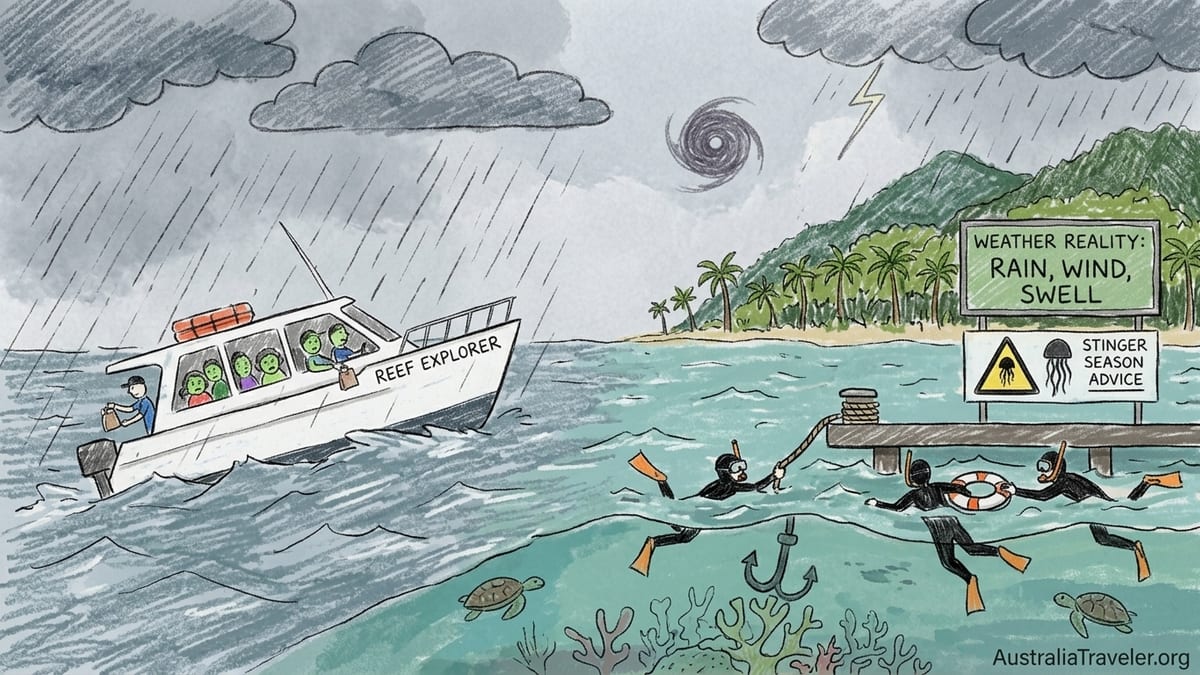
When Summer Dreams Meet Wet Season Reality
My decision to visit Cairns in January was driven by a postcard fantasy. I pictured flat, glassy water, blazing sunshine and bath warm seas. What I actually met at the Cairns Marlin Marina was a stiff onshore wind, lead grey skies and crew members warning us that visibility would be “variable” due to recent heavy rain and swell. Several passengers were already pale from the short walk along the exposed pier.
On board, the first hour out to the outer reef felt more like a North Sea ferry than a tropical cruise. The catamaran pitched and rolled in a confused chop, drink cups slid sideways on tables despite non slip mats, and crew moved quietly down the aisles passing out extra sick bags. A German couple across from me, who had also booked January dates to “avoid the southern winter crowds,” spent most of the trip with eyes closed and knuckles white on the armrests.
By the time we reached the first mooring, a staff member announced that recent downpours had flushed sediment from the mainland and outer reefs were still stirred up from several windy days. Instead of vivid blue, the water above the coral looked a murky turquoise. Wind chopped the surface into constant ripples, making it hard to see much from the deck. I still swam with turtles and neon fish, but the visibility felt more like peering through frosted glass than into a BBC documentary.
Later that afternoon the captain told me, almost apologetically, that this run of unsettled weather was common in the heart of the wet season. “People see ‘tropical summer’ and think calm and clear,” he said. “But up here, January is all about humidity, rain and wind. The cooler, drier months are much more reliable if the reef is your main reason for coming.” It was the first of several conversations that made me question the timing of my trip.
What the Bureau of Meteorology Actually Says About Cairns Summers
If I had paid closer attention to Bureau of Meteorology data instead of Instagram, I might have chosen different dates. Cairns sits in a wet tropical climate with a distinct monsoonal pattern. Bureau records show that most of its nearly 2,000 millimetres of annual rainfall arrives between about December and April, with January and February typically the wettest months by a large margin. In some years, January alone has recorded more than a metre of rain.
Those statistics describe seasonal risk rather than a guaranteed daily deluge. Locals will tell you that some wet seasons are late or mild and that even in a typical year you can still score bright blue days between storms. But the probability shifts dramatically compared with the dry season. From roughly May to October, Cairns sits under the influence of the subtropical ridge and the south east trade winds. Rain is far less frequent, humidity is lower and daytime temperatures are warm instead of draining.
Overlay this with cyclone climatology and the picture becomes even more complex. Officially, the tropical cyclone season in northern Queensland runs from 1 November to 30 April, with the highest likelihood of coastal systems between about December and March. The Bureau of Meteorology stresses that not every season brings a landfalling cyclone near Cairns, but as Cyclone Jasper showed in December 2023, a single system can bring widespread flooding, port closures and multiple days of cancelled tours.
None of this means that visiting in summer is automatically a mistake. It does mean that if you have only three or four nights in Cairns or Port Douglas and the reef is the main reason for your trip, you are stacking the odds against yourself by booking in the heart of the wet and cyclone season without a backup plan. I learned that the hard way when our captain casually mentioned that the outer reef trip two days earlier had been abandoned halfway due to deteriorating seas.
Rain, Wind, Swell and Why “Bad Weather” Is Not All Equal
Before my January visit, I worried most about rain. I pictured dark clouds ruining photos and showers making the boat deck slippery. Once I was actually at sea, it became clear that rain itself mattered much less than wind and sea state. Several crew members repeated a version of the same line. “We do not cancel for showers, we cancel for strong wind and swell.” They were blunt that a calm, overcast day could deliver far better snorkeling than a blazing hot day with 25 knot winds.
That nuance plays out underwater. Heavy rain over several days can reduce visibility by sending plumes of sediment and tannin rich river water out onto nearshore reefs and islands. But on the outer reef, visibility is often governed more by recent swell and local chop than by rainfall totals alone. Divers on my boat told me they had seen twenty plus metres of visibility on overcast wet season days when seas were gentle, and struggled to see more than five metres on bright dry season days that followed a run of strong trade winds.
Operators adapt to these variables in real time. On my January trip, the skipper chose reef sites that sat slightly closer to the shelter of the continental shelf, trading the most dramatic wall dives for more comfortable conditions. Another company in Port Douglas explained that in rougher weather they often switch from an exposed outer reef mooring to a semi protected lagoon site inside the main reef structure. That flexibility keeps trips running but it can change the character of your day underwater.
For passengers prone to motion sickness, the combination of wind against tide and a long run out to the reef can turn a dream outing into an ordeal. On a second day trip in March some years earlier, also during the wet season, I watched half a boatload of snorkelers spend the outbound journey clutching sick bags while crew quietly mopped. When those same passengers finally slid into choppy water with limited visibility, several gave up after ten minutes and retreated to the shelter of the pontoon. None of these factors appear in glossy brochures that sell “summer sun and warm seas.”
Marine Stingers: Box Jellyfish, Irukandji and Sensible Precautions
The other major wet season reality is less visible but more serious. Tropical Queensland’s warmer months bring a higher risk from potentially dangerous marine stingers, particularly box jellyfish and Irukandji. Queensland government safety information notes that these jellyfish may be present year round in tropical waters, but that the risk from the most harmful species is higher during the so called marine stinger season, commonly described as running from about November to May in northern Queensland.
Box jellyfish are large, cube shaped animals with long, almost transparent tentacles and potent venom that can be life threatening in shallow coastal waters. Irukandji are tiny, sometimes only a couple of centimetres across, and almost impossible for swimmers to spot. Health authorities and workplace safety regulators emphasise that stings are rare relative to the millions of hours people spend in the water each year on the Great Barrier Reef, but they also stress the need for basic precautions particularly in enclosed coastal areas during the warmer months.
Reef operators take this seriously. On my January trip from Cairns, every swimmer and snorkeler was given a full length lycra suit at no extra charge and staff offered a short briefing on marine stingers before we reached the first mooring. They explained that suits are designed to provide a physical barrier between tentacles and skin, significantly reducing the likelihood of a serious sting on the covered areas. They also clarified that suits are not a guarantee and that basic measures like entering the water slowly, following crew instructions and immediately alerting staff if you feel an unusual sting or pain remain important.
None of this needs to be sensationalised. Government and medical guidance consistently frames stinger risk as something to manage rather than a reason to avoid the Great Barrier Reef entirely. Protective suits, clear signage during stinger season, trained lifeguards on patrolled beaches and vinegar and first aid kits on commercial vessels all form part of a layered safety approach. For me, the confronting part was realising that I had chosen months when that risk profile was objectively higher without really understanding what that meant in practice. Packing a lycra suit feels very different when you know you are travelling in a period when authorities actually label conditions “stinger season.”
Short Itineraries, Canceled Tours and the Value of a Backup Day
The most practical consequence of travelling in the heart of the wet and cyclone season is not that every day is ruined, but that the chance of losing your only reef day to weather climbs sharply. Reef trips from Cairns and Port Douglas are not cheap. A recent scan of 2026 pricing showed full day outer reef tours from Cairns starting at around A$250 per adult, with pontoon based days in the A$280 to A$300 range and premium small group catamaran trips higher again. For a family of four, a single day on the reef can easily represent A$800 to A$1,200 in fares before food and incidentals.
When seas were marginal during my January stay, I met several travellers in the marina cafes who had only three nights in Cairns. One American family had booked a single reef day on their middle date. A strong onshore wind warning led their operator to cancel at 7 a.m. With flights out the next morning and day tours largely booked out, they had no practical option to rebook. Their entire reef experience became a rain soaked photo in front of the marina as crew apologised and processed refunds.
Adding one extra flexible day at the start or end of a stay is not free, but it can be cheaper than losing your only reef day. In early 2026, last minute accommodation in Cairns in the wet season often started around A$160 to A$220 per night for a mid range hotel room or serviced apartment, with Port Douglas commonly a bit higher. Compared with the sunk cost of a forfeited reef experience plus the emotional sting of missing your main reason for visiting, that extra night begins to look like an insurance policy instead of a luxury.
The key is flexibility. A rigid non refundable package that locks your reef trip into a single date gives you little room to adapt to forecasts. By contrast, a cancellable hotel booking, a reef tour with no fee or low fee date changes and a spare “float” day mean you can shuffle plans if the Bureau of Meteorology issues a strong wind warning or a tropical low appears off the coast. In my case, I could have used a spare day to pivot from rough seas to rainforest walks in the Atherton Tablelands or the more sheltered calm of a lagoon style reef site.
Summer Versus Dry Season: Visibility, Comfort and Trade offs
It is tempting to treat this as a simple equation where December to March is bad and May to October is good. The reality is messier. My wet season trips delivered bathtub warm water and lush green hillsides but also clammy nights, higher stinger risk and a baseline of uncertainty about whether boats would even depart. Skies often cleared in dramatic fashion after short, heavy downpours, but I never shook the feeling that the next tropical low could derail plans.
In the dry season, from roughly May to October, most travellers find the overall reliability of weather dramatically better. Days are warm but less humid, rain is infrequent and cyclone risk is very low. Many dive operators and long term locals point to May, June and September as particularly attractive sweet spots, combining clear water with more settled conditions than mid summer. Several divers I spoke to in August raved about twenty metre visibility and cool, crisp mornings followed by bright, windy afternoons.
Yet the dry season is not carefree. Those same trade winds that keep skies clear can whip up short period wind waves that make boat rides bumpy and surface conditions choppy. I have had a supposedly ideal August day in Far North Queensland where a strong south east trade set in, turning snorkels into a battle against surface chop and leaving several less confident swimmers clinging to mooring lines. One dive instructor remarked that he sees more people skip second and third snorkel sessions on very windy winter days than on still, overcast summer days with decent visibility.
The choice becomes one of risk tolerance and priorities. If warm water and lush landscapes matter more than crisp visibility, and you can build in plenty of contingency days, then parts of the summer wet season can still deliver remarkable experiences. If your time is short and the reef is non negotiable, the drier months list far fewer variables that can ruin your plans. What my January experience taught me is that it is not enough to know that “it might rain.” You need to understand how rain, wind, swell and stinger season intersect with the specific activities you care about.
Costs, Booking Protections and How to Stack the Odds in Your Favour
From a budgeting standpoint, the difference between travelling carelessly in summer and planning carefully can be measured in hundreds of dollars and in lost experiences. A non refundable reef tour, booked through a third party reseller, might save you A$10 on a headline fare but leave you with no recourse if conditions are marginal and the operator cancels or if your flight is delayed. Choosing an operator that offers no penalty date changes up to a set deadline, even at a slightly higher fare, is often the smarter call in the volatile November to April period.
Accommodation flexibility also matters. Many hotels in Cairns and Port Douglas now offer a mix of cheaper advance purchase rates with strict cancellation rules and slightly higher flexible rates that can be cancelled or changed until a day or two before arrival. On my next trip, I chose the flexible option for the first and last nights and used the middle days for pre booked tours. When a trough brought several days of heavy rain and strong winds, I was able to slide my reef day to the clearest forecast window and push a planned rainforest trip into the wetter period where canopy cover made showers less intrusive.
Travel insurance sits behind all of this as a last line of defence. Policies vary, but some will reimburse non refundable tour costs if your trip is disrupted by a significant weather event such as a declared cyclone, while others exclude poor conditions entirely. Reading the product disclosure statement before purchase is not thrilling, but in a region where cyclone watches and warnings do still appear between November and April, it is prudent. Insurance will not bring back a lost sunny day, but it can soften the financial blow if a storm shuts down operations for several days.
None of these protections eliminate weather risk. They simply allow you to respond. The lesson from my January experience, and from many conversations with operators and repeat visitors, is that the people who leave the most satisfied in summer are not those who assume every day will be perfect. They are the ones who build in a buffer day, choose flexible fares and accept that on some trips, the reef may share the itinerary with waterfalls, museums and cafes when conditions at sea are hostile.
The Takeaway: When I Would Go Back and When Summer Still Works
Looking back on that sticky January morning in Cairns, seasick passengers around me and rain running off the bow, I do not regret going to the Great Barrier Reef. Even in stirred up water under a grey sky, watching a green turtle graze on coral still felt miraculous. But if I were planning the same trip again with the reef as the clear focus, I would choose different months and build a more realistic plan around the climate rather than forcing my expectations onto it.
Personally, I would now target late May, June or September for a first time reef focused visit to Cairns or Port Douglas. Those months sit firmly in the drier part of the year, outside the core cyclone window, with lower stinger risk and a strong track record of settled weather. I would still watch wind forecasts closely and accept that a run of strong trade winds can roughen seas in any month, but the underlying odds of a clear, calm reef day are simply better.
If I had to travel between about November and March again, either for school holiday reasons or to combine the reef with tropical rainforests at their lushest, I would treat the wet season as something to work with rather than ignore. That would mean adding at least one flexible backup day in Cairns or Port Douglas, prioritising reef operators that include full length stinger suits and allow date changes, and mentally preparing for the possibility that my first choice reef site or even the entire day at sea might be swapped for an inland waterfall circuit if conditions deteriorated.
For informed travellers, summer can still work. Warm seas are kinder to those who feel the cold, afternoon storms can be brief and spectacular rather than trip ending, and smaller visitor numbers outside local school holidays change the character of busy resort towns. The crucial shift is to stop assuming that “tropical summer” means postcard weather. Instead, respect the Bureau of Meteorology’s data, take marine stinger advice seriously without panicking, and give yourself the space to adapt. Do that and you will be far less likely to find yourself, as I did, gripping a handrail on a lurching deck in early January and wondering whether you chose the wrong season entirely.
FAQ
Q1. Is it a bad idea to visit the Great Barrier Reef in January or February?
It is not automatically a bad idea, but January and February fall in the wet and cyclone season for Far North Queensland, with higher odds of heavy rain, humidity, wind and short notice tour cancellations. If you choose these months, build in spare days and flexible bookings so you can move your reef trip to the best available weather window.
Q2. How big is the risk from box jellyfish and Irukandji on reef trips?
Government and health information describe the risk from dangerous jellyfish as higher between about November and May in tropical Queensland, especially in shallow coastal waters. Serious stings on offshore reef tours are uncommon, but operators still use protective suits, briefings and onboard first aid to reduce risk further. It is a real but managed hazard rather than a constant emergency.
Q3. Does rain ruin visibility on the Great Barrier Reef?
Short showers do not usually ruin a reef day. Extended heavy rain can push murky runoff onto nearshore reefs and islands, reducing clarity, but on the outer reef visibility is often affected more by recent swell and local wind chop than by rainfall alone. A calm, overcast day after rain can be better for snorkeling than a bright, windy day with strong surface waves.
Q4. Is the dry season from May to October always calm and perfect?
No season is guaranteed. The May to October period in Cairns and Port Douglas is generally drier and less humid, with lower cyclone and stinger risk, but the south east trade winds can be strong. That can mean choppy boat rides and surface chop even on sunny days. It is still the most reliable time overall for reef trips, but you should check forecasts and allow for some variability.
Q5. How many days should I allow in Cairns or Port Douglas if the reef is my main goal?
If the reef is central to your trip, plan at least three full days in Cairns or Port Douglas, with one dedicated reef day and at least one flexible backup day. This gives you a realistic chance to reschedule if your first date is cancelled or if conditions look significantly better on another day.
Q6. Are stinger suits really necessary on reef tours?
During the higher risk months, most reputable operators north of about Bundaberg either include or strongly recommend full length lycra suits for swimmers and snorkelers. They provide an important barrier against jellyfish tentacles, offer some sun protection and add only minor inconvenience. Wearing one is a simple, practical way to reduce risk further.
Q7. What can I do if my only planned reef day is cancelled for weather?
If your only reef day is cancelled at short notice and you do not have a backup day, options are limited beyond a refund. You can sometimes switch to a more sheltered inner reef or island trip if space exists, or pivot to land based activities such as rainforest walks or waterfalls. The best protection is to avoid this situation altogether by scheduling at least one extra flexible day.
Q8. How rough are boat rides to the outer reef in summer compared with winter?
In the wet season, short period wind chop and swell driven by monsoonal systems and occasional tropical lows can make boat rides feel lurching and uncomfortable, particularly in January to March. In winter, strong trade winds can also create rough conditions, but prolonged calm spells are more common. Comfort varies far more with daily wind and swell forecasts than with temperature alone.
Q9. Is Port Douglas better than Cairns for reef trips in the wet season?
Both ports access excellent outer reef sites and both are affected by regional weather patterns. Port Douglas offers slightly shorter runs to some northern reefs and can feel more resort focused, while Cairns has more operator choice and often more competitive pricing. In the wet season, the main advantage comes from choosing operators from either port who are flexible with sites and dates rather than from the town itself.
Q10. If I can only travel in Australian summer, what is the smartest way to plan?
If summer is your only option, aim for early December or late March rather than the heart of January and February, build at least one backup day into your stay, choose operators and accommodation with flexible change policies, and be prepared to wear stinger suits and reshuffle plans around forecast wind and sea conditions. Treat the climate as a partner to work with, not a backdrop you can ignore.