


I booked my first scuba dive on the Great Barrier Reef with the same mix of excitement and dread that comes with stepping onto a rollercoaster you are not quite sure you want to ride. I had snorkeled before and honestly loved the idea of staying on the surface where I could float, breathe normally and bail out at any time. But something about flying all the way to Cairns, staring at the maps of the outer reef and then imagining myself staying at arm’s length from it felt like a waste. That is how I found myself signing up, not for a full certification, but for an introductory scuba dive under close supervision on Australia’s most famous reef.
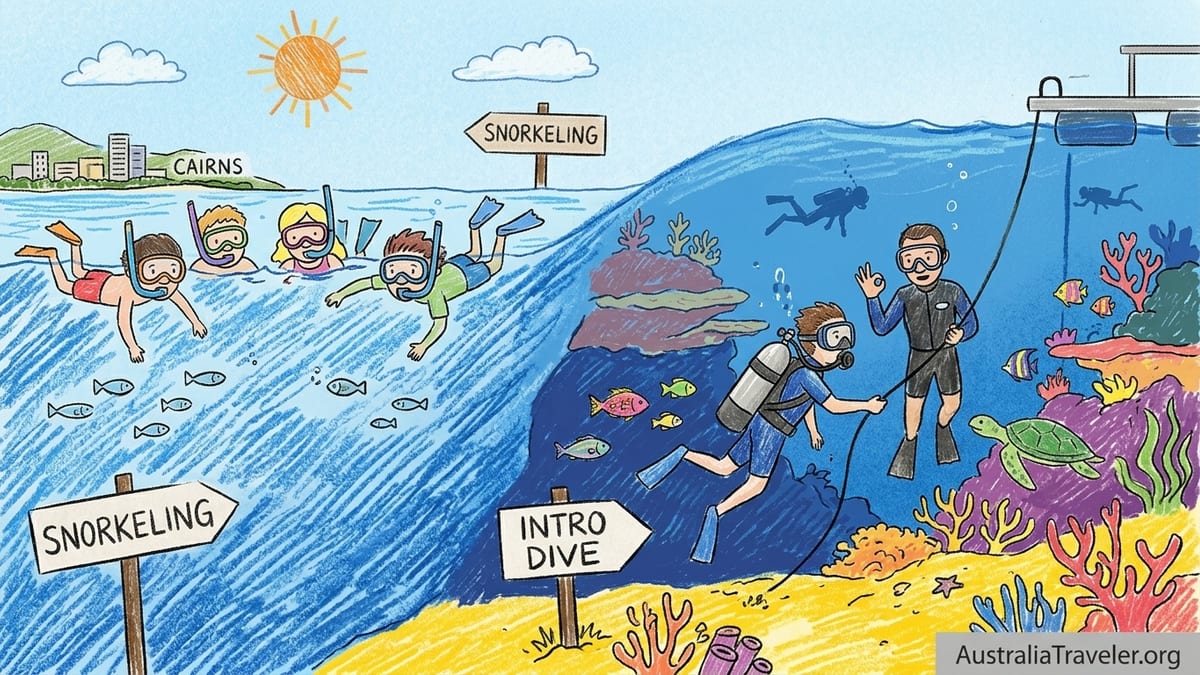
Why I Chose an Introductory Dive Instead of “Just” Snorkeling
I based myself in Cairns, the classic jumping-off point for the outer Great Barrier Reef. Every brochure at the Reef Fleet Terminal showed happy snorkelers grinning over fluorescent coral gardens, and I was almost ready to stick with that. I can swim, but I would not call myself a water person, and the thought of breathing out of a tank felt intimidating. What tipped me into diving was the sense that snorkelers were still only skimming the top, while divers were moving through the reef itself, down where the bigger fish, turtles and overhangs are.
I did not want to commit to a full multi-day course without knowing if I would even like the feeling of being underwater. Operators in Cairns talk a lot about “intro dives” or “resort dives,” which are closely supervised experiences designed for people with no certification. These follow the PADI Discover Scuba Diving style of program, where you learn a few essential skills and then descend with an instructor holding on to you or staying within arm’s reach at all times. It sounded like a manageable middle ground between floating on the surface and going all-in on a certification.
Price was the other factor. A standard outer reef snorkel trip from Cairns typically runs in the low 200 Australian dollar range per adult, while adding an introductory scuba dive often adds another 120 to 160 Australian dollars for one dive. A full PADI Open Water course from Cairns operators usually costs several hundreds more and takes at least three days. I decided I could justify paying extra for one “deep” experience, but not yet for a full course.
Safety was my final consideration. Australian dive regulations are known for being strict, with mandatory medical questionnaires and age rules. That reassured me. I liked the idea that if I signed up for an intro dive and the crew decided I should not do it for medical or anxiety reasons, they would simply stop the process and keep me snorkeling. That safety net was what let me fill in the booking form instead of backing away.
Choosing the Operator and Getting Out to the Reef
I compared three big names operating out of Cairns: Divers Den, Sunlover Reef Cruises and Reef Magic Cruises. All three offer introductory dives on the outer reef and all require you to join a full-day reef trip first. Their brochures and current price lists showed adult day fares generally in the range of about 260 to 320 Australian dollars depending on the season and package, with introductory dives as bookable extras.
In the end I picked Reef Magic, partly because I liked the idea of a stable pontoon on the outer reef as a base. They operate a day cruise out to their Marine World pontoon that departs from Cairns’ Marlin Jetty in the morning and returns mid-afternoon, with around five hours on the reef. The base fare I paid was just over 300 Australian dollars including snorkel gear, a buffet lunch, semi-submersible and glass-bottom boat tours. I then pre-booked one introductory dive, which added roughly 150 Australian dollars, and I budgeted extra for professional photos.
Check-in at the Reef Fleet Terminal felt more like boarding a small ferry than joining an extreme sport. At the counter they confirmed my introductory dive booking and handed me both a boarding pass and the all-important dive medical questionnaire to complete on the boat. The vessel itself was a modern catamaran with indoor seating, open decks and a small bar. On the way out to the reef they served tea and coffee while the crew ran through safety demonstrations and outlined the day’s schedule.
The journey to the outer reef took just under 90 minutes. As Cairns’ waterfront buildings shrank behind us, the sea shifted from murky green to a clear, almost electric blue. I used the time to nibble some ginger tablets and stare at the dive medical form. It asked about asthma, heart and lung conditions, medications, recent surgeries and a handful of other issues that could make diving unsafe. Australian operators are strict about this, and I knew that answering “yes” to some questions would trigger the need for a doctor’s assessment. In my case I could truthfully tick “no” to everything, sign at the bottom and hand it over with a mix of relief and nervous anticipation.
Briefing, Gear Fitting and Learning to Breathe Like a Diver
Once we tied up at the Marine World pontoon, the snorkeling crowd surged for the gear racks, while those of us booked on introductory dives were asked to stay back for our briefing. Our small group included a couple from Europe, a solo traveler from Brisbane and me. The instructor explained that introductory diving here followed a Discover Scuba style outline: shallow water skills on a submerged platform, a short guided dive along the reef slope to a maximum of around 10 to 12 metres and total underwater time of roughly 20 minutes, depending on how we handled air consumption and nerves.
The briefing began dry, seated at tables. The instructor went over the basic physics of pressure, why ears need equalizing, and the critical rule of never holding your breath underwater while breathing compressed air. He also demonstrated the main hand signals we would use: thumbs up for “up,” OK signs, flat hands for “problem” and pointing to ears, mask or chest to indicate where that problem was. It was not a full classroom session like you would get on an Open Water course, but it was enough to make the whole thing feel more logical and less like magic.
Then came gear fitting. On the pontoon’s lower deck, staff sized us for wetsuits, buoyancy control devices, regulators and weights. The weight of the gear genuinely surprised me. Out of the water the tank and BCD felt like someone had dropped a heavy backpack onto my shoulders, and walking to the entry platform in full kit felt clumsy and awkward. I understood instantly why divers talk about careful footwork on wet decks.
Our first practical step was learning to breathe through the regulator at the surface. Kneeling on the submerged platform with only our heads underwater, we were told to put the regulators in our mouths, press the purge button to clear them and begin to inhale slowly through our mouths, exhaling bubbles out into the water. The initial sensation was deeply unnatural. Every instinct said that putting your face underwater and inhaling would lead to choking. The regulator’s gentle hiss and resistance reminded me more of breathing in cold winter air than of normal breathing. After a couple of minutes, though, something clicked. My brain stopped yelling and I realized I could take slow, deliberate breaths without a problem.
Equalizing, Mask Skills and That First Real Descent
Once we were comfortable breathing, the instructor moved us through the two main safety skills: clearing a regulator and clearing a mask. For the regulator, the drill was simple. Take it out, pretend to lose it, then sweep your arm along your thigh and up to recover it, put it back in, blow bubbles and press the purge button. Doing this in chest-deep water felt manageable, though my heart rate spiked the first time I deliberately spat out my lifeline.
Mask clearing proved trickier. The instructor had us let a little water into the bottom of our masks by pulling the top gently away from our foreheads, then asked us to press the top frame and blow out firmly through our noses to push the water out the bottom. On the first attempt I snorted a small flood up my nose, surfaced spluttering and instinctively ripped my mask off. The instructor calmly talked me through trying again at shallower depth. On the second attempt, focusing on tilting my head slightly back and really exhaling through my nose, the water whooshed out. It was not elegant, but it worked, and knowing I could clear a leaky mask took away one of my biggest fears.
Equalizing ear pressure was the final piece before the real descent. Following the briefing, we pinched our noses, closed our mouths and gently tried to blow, forcing air into our middle ears. On the surface I heard faint pops and crackles. The instructor emphasized that we should equalize early and often on the way down, not wait for sharp pain. I had mild trouble in one ear that lagged behind the other; a couple of extra gentle equalizations and swallowing worked, but it made me determined to descend very slowly.
Then it was time. One by one, holding a metal descent line next to the pontoon, we deflated our BCDs and let the water close over our heads while the instructor stayed directly in front, eyes locked on each face. The first metre felt like a controlled panic. The surface disappeared above, the water grew cooler and sound narrowed to the hiss of my breathing and the faint crackle of reef life. My brain flared with alarm until I forced myself to look at the instructor’s calm OK sign and return it.
We paused every half metre for equalizing. At around 3 to 4 metres my right ear complained with a dull ache. I signaled “problem,” pointed to my ear and the instructor brought me slightly up until the discomfort eased. After another round of gentle equalizing, the pain faded and we continued down the shot line to what the instructor later said was about 8 to 10 metres, well within the typical limit for introductory divers on the Great Barrier Reef.
What I Actually Saw Underwater Compared With Snorkeling
The moment we left the descent line and began moving along the reef slope is when I finally understood why people put up with all the gear and training. Visibility that day was around 15 to 20 metres. From our depth I could look up and still see snorkelers as wavy silhouettes on the surface, while below us the reef fell away into a more shadowed blue. Soft corals and plate corals rose up in layers rather than looking like a flat garden; from the side they formed ledges and overhangs that snorkelers could never really see into from above.
Our instructor kept us in a tight chain, each of us lightly holding onto a metal ring on the person in front, with him leading and occasionally turning back to give an OK sign. Fish life was busier and less skittish than what I had seen snorkeling: anemonefish sheltering in swaying anemones at almost eye level, a giant clam pulsing as it reacted to our shadows, and schools of small fusiliers flashing silver and blue around us. The highlight was a green sea turtle that glided past just a few metres away, unhurried and apparently unconcerned by our presence. From the surface, snorkelers yelled and pointed down, but from our depth the turtle and reef felt like a shared space rather than a distant show.
We followed the reef for what felt like ages but was probably no more than 20 to 25 minutes underwater, judged by my later glance at the dive computer the instructor wore. Time compressed into a rhythm of fin kicks, slow breaths and glances at the coral formations drifting past. I noticed the play of light on the sand at this depth, with sunbeams creating streaks and patches that shifted every second. Colors were slightly muted compared to shallow snorkeling, with reds and oranges darker, but blues and greens rich and enveloping.
Having already snorkeled the same site earlier that day, I could compare the two experiences directly. From the surface I had seen bright patches of branching coral and plenty of small fish, but everything felt distant and flattened, like watching a nature documentary through a screen. Diving put me in the middle of it. I could peer under ledges, hover next to bommies and watch individual fish go about their business. The trade-off was that I saw a smaller overall area than while snorkeling but experienced it more intensely and intimately.
Nerves, Comfort and How Much the Instructor Really Helped
Honesty time: at no point during that first dive did I feel completely relaxed. My breathing never quite settled into the effortlessly slow pattern you see in experienced divers on videos. Instead, I hovered between focused determination and background anxiety. Every few minutes a thought would flash up about the weight on my back, the depth overhead or the idea that I was entirely dependent on hoses and valves I barely understood.
What kept that anxiety from taking over was the level of support from the instructor. He never more than an arm’s length away, and often closer. When my kicking got frantic or my fin tips brushed the coral, he would gently reposition my legs or adjust my buoyancy with small taps on my BCD inflator. When I signaled that my ear felt odd, he stopped the group, eased me slightly shallower and waited until I gave an OK. I never once felt judged for being nervous; if anything, the sense that he had seen every form of underwater wobble before helped me breathe slower.
The equipment weight, which had felt awkward on the pontoon, more or less disappeared once I was neutrally buoyant underwater. I still noticed the strap of the mask on the back of my head and the mouthpiece between my teeth, but I stopped feeling like I was carrying a backpack of bricks. The only real physical discomfort beyond the ear equalizing was a mild jaw ache from clenching the regulator a bit too tightly, a classic beginner mistake.
After surfacing, the emotional swing was remarkable. I went from tense concentration to an almost giddy relief. Standing back on the pontoon, the gear felt crushingly heavy again, but this time I did not care. I had done the thing that had scared me most about the trip. Over lunch, the instructor dropped by our table to debrief, confirming our maximum depth as around 10 metres and underwater time just over 20 minutes. Hearing those numbers made the experience feel concrete and trackable, not just like a blur of bubbles and fish.
The Money Question: Was the Extra Cost Worth It?
By the end of the day my tally looked like this. The base day trip to the Reef Magic pontoon had cost me a bit over 300 Australian dollars, which included snorkel gear, a large buffet lunch and several hours of free snorkeling plus semi-submersible and glass-bottom boat rides. Adding the introductory scuba dive was roughly 150 Australian dollars on top of that. I also spent around 50 Australian dollars on professional underwater photos from the dive and snorkel photographer, who had captured a handful of shots of me awkwardly but proudly finning along behind the instructor. All up, my reef day came in at about the mid 500s in Australian dollars.
Would I have enjoyed the day with only snorkeling? Absolutely. The shallow coral gardens accessible from the pontoon’s snorkel platforms were vibrant and full of fish, and the semi-submersible tour gave a comfortable, dry close-up of the reef slope for anyone not wanting to get their face wet. For many visitors with tighter budgets, staying on the surface will still deliver a very satisfying Great Barrier Reef experience. There is real value in hours of relaxed snorkeling versus 20 focused minutes of scuba.
However, for me, having flown to Cairns specifically with the Great Barrier Reef in mind, the introductory dive felt worth the extra cost. It gave me access to a different layer of the reef, both literally and emotionally. The dive turned the reef from something I looked at into a place I briefly inhabited. That shift is hard to put a dollar value on, but when I look back on the trip, most of my standout memories are from those minutes underwater rather than from the surface snorkeling.
If your budget can stretch to it and you are medically cleared and reasonably comfortable in the water, I would say an introductory dive on the Great Barrier Reef justifies its price as a one-time, possibly life-shaping experience. If you are already sure you love the idea of diving and expect to do it again elsewhere, then putting that same money instead toward a full Open Water course might be smarter, but as a test drive, the intro dive gave me exactly what I needed.
Intro Dive vs PADI Open Water: Training, Freedom and Future Options
One thing my introductory dive made very clear is how different it is from becoming a certified diver. An introductory or Discover Scuba type dive is a supervised experience. You learn just enough theory and skills to be safe under the direct control of a professional. You are not certified at the end and you cannot rent tanks or go diving independently. It is closer to a tandem skydive than to holding a pilot’s license.
By contrast, a PADI Open Water Diver course, or its equivalents from agencies like SSI or NAUI, typically takes several days and includes multiple confined water sessions and at least four open water training dives. Successful completion qualifies you to dive with a buddy, without an instructor, to depths of around 18 metres. The minimum age is commonly 10 years for junior versions of these courses, with full adult certifications from the mid-teens. That certification is recognized worldwide and allows you to book boat dives and hire gear on future trips without being limited to supervised intro experiences.
For a traveler like me who was not sure if diving would click, an introductory dive made sense as a low-commitment test. But I also saw its limitations. There was no written exam, limited practice of skills and no real repetition to ingrain habits. The instructor handled navigation and all equipment adjustments. If I want to see more of the underwater world beyond supervised dives, an Open Water course is the necessary next step.
One bonus the instructor mentioned is that some operators can credit parts of an introductory program toward a later certification if you sign up within a certain timeframe. They might repeat fewer skills or count that first dive as one of your required training dives. That is worth asking about if you suspect you will sign up for a course soon after your intro dive.
Age Limits, Medical Rules and Flying After Diving
Before my trip I worried about whether I was even allowed to try an introductory dive. In Cairns, the major outer reef operators I looked at set their minimum age for introductory diving around 12 years old, in line with training guidelines that place full junior certification at around 10 years. There was no upper age limit, but they placed strong emphasis on the medical questionnaire and, where necessary, medical clearance from a doctor familiar with diving medicine.
The medical form I completed on the boat was detailed rather than a token waiver. It asked about asthma, cardiac issues, lung problems, pregnancy, recent surgeries and specific medications. Crew members were clear that a “yes” to some questions without a doctor’s clearance could mean no diving that day, even if you had already paid. While that might feel strict, the rationale is simple: underwater, even a minor condition can potentially become serious, and operators in Australia answer to both industry bodies and national safety regulators.
Flying after diving is another rule that operators on the Great Barrier Reef take seriously. On our return journey the crew reminded all certified and introductory divers about waiting times before boarding a flight. The general guidance recreational agencies promote is waiting at least 12 hours after a single no-decompression dive, and up to 18 to 24 hours after multiple dives or multiple diving days, before flying. My one short introductory dive meant that my plan to fly out of Cairns the following afternoon, more than 24 hours later, comfortably met that guidance.
If you are planning your own trip, it is important to schedule flights so there is a buffer after your reef day. The safest approach is to dive early in your visit and keep your departure flight for at least the next day. Since introductory dives often reach depths around 10 to 12 metres and stay well within no-decompression limits, they are on the conservative end of risk, but airlines and operators still recommend observing the full waiting period.
The Takeaway
Looking back, my first introductory dive on the Great Barrier Reef was both less terrifying and more intense than I expected. Many of my pre-trip fears turned out to be manageable with good instruction. Breathing through a regulator felt alien for the first couple of minutes, but quickly became something my body could accept. Ear pressure was a real issue for me, but equalizing slowly and communicating clearly with the instructor kept discomfort from turning into pain. The nightmare scenario of suddenly running out of air or panicking did not materialize, largely because the dive stayed shallow, short and conservative.
Other fears were exaggerated. I had imagined heavy equipment dragging me down or making me feel trapped, but once underwater the weight effectively vanished. I also worried about feeling claustrophobic, yet the wide visibility and sense of open blue water actually felt expansive. My biggest surprise was how focused and meditative the dive became. With every breath audible and every kick deliberate, my attention narrowed in a way that felt almost like a moving meditation, broken only by bursts of delight when a turtle or giant clam appeared.
If I were planning a return trip, I would make a different choice. Now that I know I enjoy being underwater and can handle the basics, I would put my money toward a full Open Water course instead of another one-off introductory dive. That would give me the freedom to join regular dive trips elsewhere, from the Whitsundays to Southeast Asia, without always needing to be on a supervised intro program. For someone who still feels very unsure, though, I would still recommend starting exactly where I did: one carefully supervised introductory dive on a reputable Great Barrier Reef operator, with plenty of time left in the day for relaxed snorkeling.
At the end of that day on the reef, as Cairns came back into view and the boat’s deck dried out, I realized that the question “Was it worth the money?” had become secondary. The real value was knowing, from lived experience, what it feels like to breathe underwater amid coral and fish, and to have that memory anchored to one of the world’s great natural wonders. For me, that alone justified the extra line on my credit card statement.
FAQ
Q1. Do I need any prior experience to do an introductory scuba dive on the Great Barrier Reef?
For the standard introductory dives offered by major operators out of Cairns, you do not need previous scuba experience, but you should be comfortable in the water, able to swim and able to complete a medical questionnaire without disqualifying conditions.
Q2. How deep will I go on an introductory dive and how long will I be underwater?
Introductory dives on the outer Great Barrier Reef are usually limited to around 8 to 12 metres, with actual underwater time often in the range of 15 to 25 minutes, depending on how quickly the group completes skills and how much air each diver uses.
Q3. How much does it cost to add an introductory dive to a Cairns reef trip?
As of the most recent price lists I checked, full-day outer reef trips from Cairns generally cost around the low 300 Australian dollars per adult including snorkeling, and adding one introductory dive typically adds roughly 120 to 160 Australian dollars on top, with optional photos or extra dives costing more.
Q4. What is the minimum age for an introductory dive on the Great Barrier Reef?
Most Cairns outer reef operators set the minimum age for introductory diving at about 12 years, in line with training agency guidance for entry-level experiences, although policies can vary slightly between companies and are always subject to medical clearance.
Q5. How is an introductory dive different from a PADI Open Water course?
An introductory dive is a single supervised experience where you learn a few key skills and dive under close control of an instructor, but you do not earn a certification. A PADI Open Water course spans several days, includes multiple confined and open water dives, knowledge development and assessments, and results in a certification that lets you dive independently with a buddy to around 18 metres.
Q6. Can I use an introductory dive as credit toward a future certification?
Some operators and training agencies may be able to count parts of your introductory program, such as confined-water style skills or an open water dive, toward a later course if you sign up within a certain period. This is not automatic, so you should ask the dive shop in advance if credit is possible.
Q7. What medical conditions might stop me from doing an introductory dive?
Conditions such as uncontrolled asthma, serious heart or lung disease, recent major surgery, some neurological issues and certain medications can prevent you from diving without a doctor’s written clearance, and Australian operators are strict about following these rules for safety.
Q8. How long do I need to wait before flying after an introductory dive?
General recreational diving guidance recommends waiting at least 12 hours after a single no-decompression dive and longer after multiple dives, so planning a gap of 18 to 24 hours before flying after your reef day is a conservative and commonly recommended approach.
Q9. Is an introductory dive worth the extra cost if I am happy just snorkeling?
If you are content staying on the surface and your budget is tight, snorkeling alone can still provide an excellent Great Barrier Reef experience. The extra cost of an introductory dive is most worthwhile if you are curious about diving, want a more immersive view of the reef or are considering a future certification.
Q10. After doing an introductory dive, what beginner package would you personally choose next?
Having completed an introductory dive and enjoyed it, my next step would be to invest in a full Open Water course with a reputable operator, rather than repeating another one-off intro, to gain the skills and certification needed to dive more independently on future trips.