


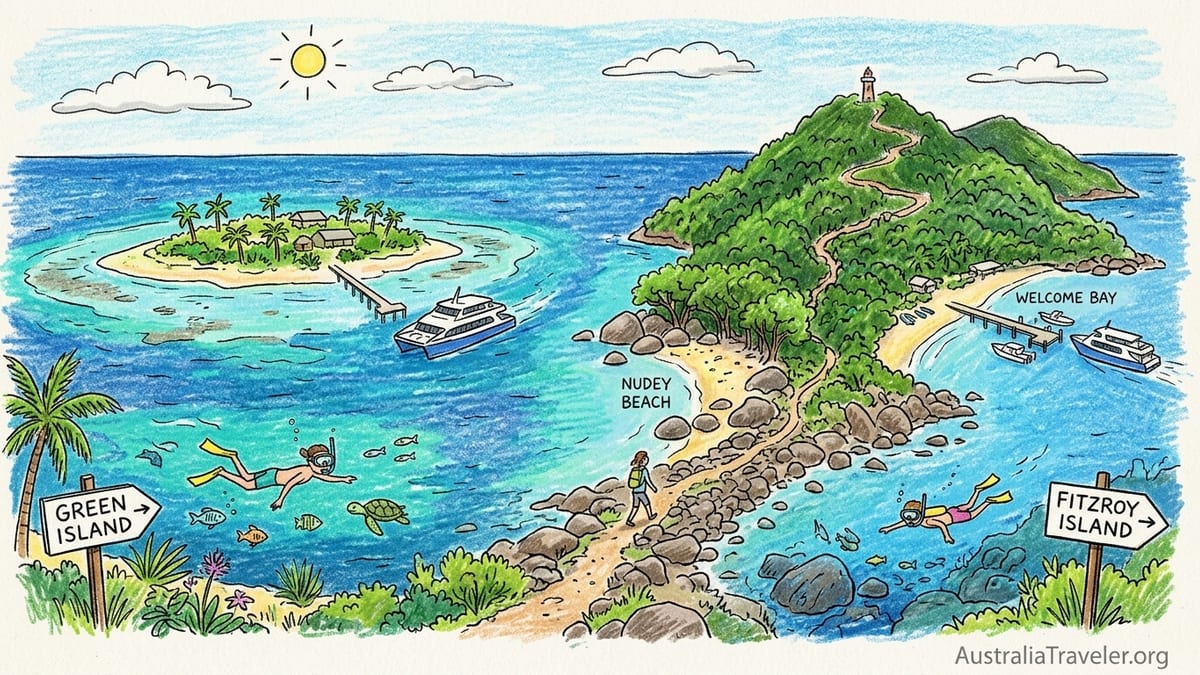
The first time I saw Green Island from the ferry, it looked almost unreal: a flat ring of white sand and dark green rainforest, floating in the middle of an ink-blue Coral Sea. A few days later I watched Fitzroy Island grow out of the horizon in a completely different way, a dark mountain rising straight out of the water, with a thin bright strip of beach at its feet. I had come to Cairns torn between these two easy island day trips and, in the end, I booked both. I wanted to know, from my own experience, which island is better for snorkelling, beaches, walking, kids and simple value for money. This is how the two stacked up for me.
Why I Decided To Visit Both Islands
Before this trip I had read all the usual online arguments: Green Island is too busy, Fitzroy is too rocky, Green is better for kids, Fitzroy has better snorkelling. The problem was that almost everyone seemed to have only done one island and was fiercely loyal to it. With ferry prices from Cairns high enough that you do not want to guess wrong, I decided the only honest way to write about them was to visit both within the same week, in similar weather and tides.
I booked Green Island first because its compact coral cay layout looked gentle and manageable. The aerial photos showed a classic postcard: a small, low island, circled by reef, with a neat pier poking out. Official information puts it about 27 kilometres offshore, taking roughly 45 minutes by fast catamaran from Cairns Reef Fleet Terminal. That sounded like a good warm-up for my sea stomach and a low-stress day to find my snorkelling legs.
Fitzroy Island came second. On maps it sits slightly closer to the mainland but is much larger and mountainous, with walking trails and two main beaches, Welcome Bay by the jetty and Nudey Beach around the headland. I wanted to compare what it felt like to snorkel right off a coral cay like Green Island versus a steep, forested island where the reef hugs deeper shores. I also wanted to see if the extra walking and rockier entries at Fitzroy would be a problem for less confident swimmers or older travellers.
To keep things fair I travelled solo on Green Island and then repeated similar choices on Fitzroy: basic ferry transfers, add-on snorkel gear, casual food on the island, plenty of time in the water and a good wander inland. What follows is not a marketing brochure but how it genuinely felt to be there, and what it cost me in Australian dollars as of late 2026.
Ferry Trips From Cairns: Times, Motion And First Impressions
Both days started the same way: walking down to the Cairns Reef Fleet Terminal just after 8 am, past the esplanade lagoon and rows of reef-cruise check-in desks. For Green Island I checked in with Great Adventures, one of the main operators, which currently lists departures at 8.30 am and 10.30 am, with returns in the mid-afternoon and late afternoon. The staff recommended arriving about an hour early to collect my boarding pass and, based on how busy the terminal was, that turned out to be very good advice.
The Green Island vessel I boarded was a large, enclosed catamaran with two decks and plenty of indoor seating. The crossing took about 45 minutes in mild seas. I am not usually prone to seasickness but I still felt that gentle queasiness you get when the boat meets a short, choppy swell. Sitting downstairs in the middle of the cabin helped; several people who chose the front outdoor seats moved inside halfway through. If you know you get seasick and you are planning to do Green Island, I would board early to grab a central seat and avoid reading during the trip.
My Fitzroy Island day started with a similar check-in at the terminal, this time for a Fitzroy Flyer style service that many visitors now use. Schedules can vary by operator, but common patterns are morning departures around 8.00 am to 8.30 am, a late morning option and mid-afternoon returns that give about four to five hours on the island. The boat was slightly smaller than the Green Island catamaran, with a mix of indoor and outdoor seating. The 45-minute crossing felt livelier because the wind had picked up and we were moving across slightly larger chop. A couple of passengers used sick bags and, again, those sitting toward the middle and rear seemed to fare better than those at the bow.
What struck me on arrival was how the shapes of the islands set the tone for the day. Approaching Green Island, the sea changes from dark blue to a vivid turquoise, and you can see the shallow reef flats radiating out like a halo. The jetty leads straight to a compact hub of buildings and shaded paths. Fitzroy, on the other hand, looms up as a steep green hill, with the resort and jetty tucked into Welcome Bay at its base. You are immediately aware that this is a bigger, wilder island. That first view turned out to be a pretty good summary of the experience on each one.
Layout And Atmosphere: Coral Cay Versus Mountain Island
Green Island is small enough that you can walk all the way around the shoreline in well under an hour, tide allowing. It is a true coral cay, only about 12 hectares of land, flat and low, ringed by shallow reef and beach. The development cluster around the jetty feels like a mini-resort village: a shaded plaza with a café and bar, shops renting snorkel gear and beach equipment, and pathways that quickly give way to rainforest and beach access tracks. There is a 1.3 kilometre boardwalk loop that winds through thick coastal rainforest. Once I stepped onto it, the noise of the day trippers fell away and I could hear only birds and the distant thrum of boat engines.
Fitzroy Island feels very different the moment you step off the gangway. The main resort complex spreads along Welcome Bay, backed by steep forested slopes. Instead of a ring-shaped island, you have a long, irregular coastline with rocky outcrops and pockets of beach. There are proper walking trails climbing into the national park, including a track to the lighthouse and summit that most visitors describe as steep but rewarding, and a shorter trail through forest to Nudey Beach on the western side of the island. Everything feels less manicured than Green Island, which is part of the appeal but also means more uneven ground and stairs.
Atmosphere-wise, Green Island felt busy but organised. It is one of the most visited island national parks in the Great Barrier Reef area, and that shows: there are lifeguards on duty at the main swimming beach, multiple bars and food outlets, and regular announcements about departure times. I saw plenty of young families with prams, older couples and tour groups. The compact layout makes it simple to move between beach, boardwalk and facilities without walking very far.
Fitzroy’s atmosphere was more laid-back and slightly younger on the day I visited. Day trippers mingled with overnight resort guests who clearly knew the island’s rhythms: snorkelling early, lingering over lunch after the first boats arrived, then heading back to the water once the midday rush dipped. The resort bar and café open directly onto the beachfront, and there is a small sports hire hub near the reception. Compared with Green Island it felt less like a packaged attraction and more like a small island village that just happens to welcome day visitors.
Beaches, Shade And Getting Around On Each Island
On Green Island, the main swimming and snorkelling beach stretches along the side closest to the jetty, with a broad fringe of sand at mid-tide and patches of seagrass and coral rubble closer to the waterline. The sand here is soft enough underfoot, but once you step into the shallows you quickly feel broken coral and bits of shell. I wore reef shoes when wading and then switched to fins once I was deep enough. Natural shade is pretty good, with casuarina and pandanus trees backing parts of the beach, although many people still cluster under the fixed shade structures and hire lounges near the lifeguard flags.
Circling Green Island on foot is straightforward. The coastal track mixes open sand with shaded sections under trees. Most of it is flat, which makes it manageable for toddlers who like to walk and older visitors who prefer to avoid hills. The only mobility pinch points I noticed were soft sand near the high tide line and the steps down from the jetty.
Fitzroy’s Welcome Bay beach looks very different. The upper beach is a mix of coarse sand and large coral rubble. Underfoot it is noticeably harder and lumpier than Green Island’s main beach, and many people wear reef shoes all the time rather than just for entry. Shade is more limited near the waterline, so most day trippers claim spots closer to the resort lawn or under scattered trees. For a classic white-sand cove you need to walk 15 to 20 minutes to Nudey Beach, along a rock-and-root-strewn track that rolls over small headlands and through rainforest. This is not pram-friendly and it is not ideal if you have serious knee or balance issues, but plenty of moderate walkers, including older travellers taking their time, manage it with sturdy shoes.
Once you reach Nudey Beach, the reward is a beautiful, relatively short stretch of bright sand edged with boulders and coral chunks. There is no jetty and no built-up strip here, just a basic composting toilet back from the tree line. Shade comes from overhanging trees and shifts through the day, so arriving in the late morning I found good cover at the southern end and moved north as the sun arced west. Getting into the water at Nudey involves stepping over some loose coral and stone, and I was glad for my reef shoes on the first few metres.
Snorkelling Conditions: Tides, Weather And What I Actually Saw
Snorkelling experiences on both islands change significantly with tide, wind and exactly where you get in. I booked Green Island on a day with light winds and a midday high tide. From the flagged swimming area near the jetty I swam out over a shallow sandy patch and then turned slightly away from the densest cluster of people. Within a few minutes the visibility improved and I started to see healthy patches of hard coral interspersed with seagrass and sand channels. The water depth here at high tide was comfortably over my head but still shallow enough that sunlight lit up the reef.
On that first Green Island snorkel I saw a hawksbill turtle grazing on the edge of a bommie, several clams, and schools of damselfish flicking through branching coral. The water clarity was good by nearshore standards, perhaps eight to ten metres horizontally when I stayed away from sand kickers. Later in the day, as the tide dropped and more people waded in, the visibility near the beach declined. Sand and silt made the first 30 metres quite cloudy, but beyond that I could still find clearer pockets, especially if I headed slightly away from the jetty and followed the edge of the reef flat.
On Fitzroy I split my snorkelling between Welcome Bay and Nudey Beach. Morning conditions at Welcome Bay were calm, with only a light surface ripple. Entry is straight off the coral rubble beach and the bottom drops off more quickly than at Green Island. After only a short swim I was floating above a fringing reef slope that looked more dramatic than the mostly flat Green Island reef, with large boulders and chunky coral heads stepping down into deeper blue water. I saw several turtles here and one big bumphead parrotfish crunching noisily on coral. Visibility felt similar to my Green Island morning, perhaps eight metres or so, but with stronger shafts of light filtering between reef and rock.
By the time I reached Nudey Beach around late morning, a light northeasterly wind had picked up and there was more movement in the water. Entry was a little trickier across rolling stones. Once I cleared the shallows and slipped on fins, I followed the rocky point and found some of the most varied close-in coral I saw that week. There were plate corals stacked like crockery, soft corals swaying in the surge and plenty of fish life. The trade-off was slightly reduced water clarity compared with my early Welcome Bay swim and more surge pushing me sideways along the slope. Less confident swimmers were sticking close to shore or wearing flotation vests hired from the sports hub.
If I had to generalise, I would say Green Island’s snorkelling felt more forgiving and “pool-like” for beginners, especially around high tide and near the patrolled area. Fitzroy offered more dramatic reef structure and a stronger sense of open ocean, but it also asked more of your legs and confidence, especially at lower tides or on windier days. Neither island delivered outer-reef level visibility on my visits, but both gave enjoyable, easy-access snorkelling straight off the sand.
Facilities, Food, Crowds And Costs: What I Actually Paid
Green Island’s facilities are extensive for such a small island. Near the jetty there are toilets, freshwater showers, change rooms and a large shaded seating area. I used a locker near the resort reception for my valuables and found it easy to duck back between swims. Food options range from a casual café with pies and sandwiches to a sit-down restaurant if you want a proper lunch. Prices reflect island logistics: expect to pay around 18 to 25 Australian dollars for a burger or fish and chips, and 5 to 7 dollars for basic snacks or coffee. It is not outrageous, but it is noticeably more than mainland Cairns.
On the ticket side, I chose a basic “ferry only” style day trip for Green Island, which at the time of travel priced around 100 to 120 Australian dollars for an adult, depending on the operator and day. Package options increased the price to the 130 to 160 dollar range but bundled in things like snorkel hire, a glass bottom boat tour or a simple buffet or picnic lunch. Since I had my own mask and snorkel, I only hired fins on the island and paid about 15 to 20 dollars for the day. A full set of snorkel gear on Green Island typically comes in above 30 dollars if you hire on site.
On Fitzroy Island, the core return ferry transfer was similar in price, sitting roughly around 95 to 120 dollars for an adult, with some variability by operator and season. I again chose a transfer-only option and then added activities separately. At the Fitzroy Island sports hub, advertised prices for snorkel, mask and fins hire sit around 30 dollars per set per day, and additional items like stinger suits or life jackets are about 15 to 20 dollars each. Some Cairns-based booking sites offer combined ferry and snorkel-hire packages that start from around 120 to 130 dollars per adult and can climb higher if you add extras like a glass-bottom boat tour or packed lunch.
Food on Fitzroy felt marginally better value, perhaps because I gravitated to the resort bar for simple meals. My lunch of fish and chips and a soft drink came to just under 30 dollars, comparable to Green Island but with a slightly larger portion and a more relaxed setting on the lawn overlooking Welcome Bay. There is also a small general store selling basics and cold drinks at typical island markups. Toilets, change rooms and outdoor showers cluster near the jetty and resort, and while they were busier in the middle of the day, I never had to wait long.
For a family of four, both islands add up quickly. A realistic full-day cost in late 2026 for two adults and two primary-school-age children on a basic ferry-only ticket sits in the 350 to 450 dollar range by the time you add ferry fares, at least one or two snorkel sets and casual lunch. Choosing packages that bundle snorkel gear or glass-bottom boat tours can add another 80 to 150 dollars to that total, but may be worthwhile if everyone in the family wants the activities included and you prefer to prepay.
Accessibility, Comfort And Who Each Island Suits
One of my biggest questions going in was which island would be kinder to people with toddlers, older knees or limited mobility. Green Island’s flatness was a clear advantage here. Once you step off the boat and negotiate the initial jetty ramp, the core of the island is relatively level, with paved paths, boardwalks and only gentle slopes. Prams and small-wheeled travel strollers were everywhere. I saw grandparents comfortably ambling from café to beach, and several visitors using walking sticks along the rainforest boardwalk. The main challenges were soft sand if you wanted to be right on the waterline and the broken coral in the shallows.
For non-swimmers or anxious swimmers, Green Island also felt friendlier. The lifeguarded swimming area gives psychological comfort, and you can wade out a long way in waist-deep water at mid to high tide before committing to deeper snorkelling. Glass-bottom boat tours run directly from the jetty, so you can still see coral and fish without getting wet. Several package products specifically appeal to this audience by combining ferry, glass-bottom boat and a modest buffet or picnic lunch, letting you structure your day without having to queue repeatedly for extras.
Fitzroy Island poses more of a challenge for anyone with limited mobility. The jetty and immediate resort area are fairly level, but the beaches are much lumpier, especially in Welcome Bay where coral rubble sits above the tide line. Walking the Nudey Beach track involves stone steps, roots and sections of rock. It is not technical hiking, but it would be tiring or risky if you are unsteady on your feet. I saw a few determined families carrying toddlers in backpacks or on hips, but this would be tough with a stroller. Once on the beach, entry into the water again involves threading across uneven stones and coral heads.
That said, for reasonably fit visitors who enjoy walking and do not mind some uneven ground, Fitzroy offers more variety. You can snorkel in the morning, hike to the summit or lighthouse in the cooler hours, then laze at Nudey Beach in the afternoon. Non-swimmers still have options in the form of glass-bottom boat tours that circle the island from Welcome Bay. However, the lack of extensive shade and the trickier footing mean you need to think more carefully about footwear, sun protection and rest breaks, especially with very young children or older relatives.
Staying Overnight Versus Day Tripping
I visited both islands as day trips, but I spoke with several people staying overnight, especially on Fitzroy. Their stories changed how I think about the value of a simple day visit. On Green Island there is a small resort with guestrooms hidden back in the rainforest. Overnight guests have access to the island before the first and after the last ferries, which means quiet early-morning walks on the beach and sunset light on the reef with far fewer people around. However, because the island is so compact, several guests commented that one or two nights felt like enough, and that food and drinks across those days added up quickly compared with staying in Cairns and just day tripping once.
Fitzroy Island, by contrast, seems to reward longer stays more obviously. The resort offers a spread of accommodation options, from standard hotel rooms to apartments and some more basic cabins and camping. People I met who were there for three or four nights talked about timing their snorkelling around the tides, returning to favourite coral bommies at different depths, and enjoying quiet dawn sessions at Welcome Bay before the day boats arrived. They also spoke highly of watching the light change from the summit and having Nudey Beach almost to themselves after the last ferries left.
If your main goal is to get a simple taste of island snorkelling and sand on a tight schedule, a single day on either island works. If you want to slow down, work around weather and tides, and dodge crowds, Fitzroy Island offers more scope, especially outside school holidays. From a budget perspective, once you add several nights of island accommodation and resort-priced food, it may start to rival or exceed the cost of doing a dedicated outer reef liveaboard or a sequence of day boats from Cairns. The trade-off is that on the islands you keep the comfort of sleeping on land and you still have forest walks and viewpoints when you are out of the water.
My Personal Winners: Snorkelling, Beaches, Scenery, Convenience And Value
Whenever I compare destinations like this I try to imagine who I would send to each place, based on what they care about most. After doing both Green Island and Fitzroy from Cairns in the same week, this is where I landed.
For snorkelling, Fitzroy Island edges ahead for me. The fringing reef at Welcome Bay and around the Nudey Beach headland felt more varied in structure, with steeper drop-offs, larger coral heads and more encounters with turtles and big parrotfish. The trade-off is that entry is trickier and the water can feel more exposed, so I would still steer absolute beginners or non-swimmers toward Green Island first. But for confident snorkellers comfortable with some surge and uneven entries, Fitzroy delivered more memorable underwater scenes.
For beaches, I would actually split the decision. If you want an easy, soft place for kids to dig and paddle, with lifeguards in sight and facilities only a short shuffle away, Green Island’s main beach is hard to beat. Its sand might hide some coral bits, but overall it is friendlier to bare feet and beach towels. If you want that wild, framed-by-boulders cove that looks like a screensaver, Nudey Beach on Fitzroy wins. It simply feels more remote once you round the headland, even though you are sharing it with plenty of other day trippers in the middle of the day.
For scenery, Fitzroy Island is my clear favourite. The combination of steep forested slopes, rocky headlands and long views back to the mainland and surrounding reefs gives it a three-dimensional drama that a low coral cay just cannot match. Green Island is beautiful in a classic reef-postcard way, especially when viewed from the ferry or the air, but once you are on the island you are mostly in flat rainforest or at water level.
In terms of convenience, Green Island is the winner. Its compact layout, flat walking surfaces, dense facilities and lifeguarded beach make it easier to manage a mixed group with different energy levels and water confidence. With toddlers, older relatives or anyone who tires easily, I would choose Green Island first. Fitzroy demands more walking, more care on rocky beaches and a little more planning around shade.
On overall value, weighing ferry prices, equipment hire, food and what I felt I “got” from each day, Fitzroy Island just nudges ahead for me as an active traveller who likes to snorkel, hike and sit in beautiful bays. Green Island still offers good value if you want maximum simplicity and comfort, and it remains an excellent first taste of the Great Barrier Reef for families and cautious swimmers. If your time and budget allow only one island from Cairns, I would ask two questions: do you want flat, easy and organised (pick Green), or wilder, rockier and more adventurous (pick Fitzroy)? Having done both back-to-back, I am glad I did not have to choose.
FAQ
Q1. Which island has better snorkelling, Green Island or Fitzroy Island?
For confident swimmers, I found Fitzroy Island slightly better overall, especially around Welcome Bay and Nudey Beach where the fringing reef has more dramatic drop-offs and larger coral structures. Green Island still offers enjoyable snorkelling with easier, more sheltered entry, which I would recommend for beginners or nervous swimmers.
Q2. How long does the ferry from Cairns take to each island?
Both islands are reached by fast catamaran in roughly 45 minutes from the Cairns Reef Fleet Terminal, though actual times can vary slightly by operator and sea conditions. Green Island lies about 27 kilometres offshore as a low coral cay, while Fitzroy Island sits a similar distance out as a larger mountainous island.
Q3. Is Green Island or Fitzroy Island better for families with young children?
For families with toddlers or very young children, I found Green Island easier. The island is flat, walking distances are short, prams are workable on the main paths, and there is a lifeguarded swimming area close to toilets, shade and food. Fitzroy can still work for families, but the rockier beaches and rougher walking track to Nudey Beach require more effort and attention.
Q4. Are there good facilities like toilets and change rooms on both islands?
Yes. Green Island has extensive facilities concentrated near the jetty and resort area, including toilets, freshwater showers, change rooms, lockers and multiple food outlets. Fitzroy Island offers toilets, change rooms and outdoor showers around the jetty and resort, plus a small general store and bar, though facilities are more limited once you leave Welcome Bay for places like Nudey Beach.
Q5. How much should I budget for a day trip to each island from Cairns?
For a solo adult on a basic ferry-only ticket, plus snorkel gear hire and a casual lunch, a realistic budget in late 2026 is around 160 to 200 Australian dollars for either island. For a family of two adults and two children, total costs can easily reach 350 to 450 dollars for the day once you factor in all ferry tickets, some snorkel equipment and food.
Q6. Can non-swimmers still enjoy Green Island or Fitzroy Island?
Yes. Non-swimmers on Green Island can stay in the shallow, patrolled areas, relax on the beach and join glass-bottom boat tours to see coral and fish without entering the water. On Fitzroy, non-swimmers can enjoy Welcome Bay’s beach, short walks and glass-bottom boat trips that circle the island. In both cases, life jackets and flotation aids are available for hire.
Q7. Which island is more suitable for older travellers or people with limited mobility?
From what I experienced, Green Island is more suitable. Its compact, mostly level paths and easy access to beaches and facilities mean less walking and fewer stairs. Fitzroy Island involves more uneven surfaces, coral rubble beaches and steeper walking tracks, which can be challenging for those with knee, hip or balance issues.
Q8. Do I need to stay overnight to get the best experience?
You can have a very good experience on both islands as a day trip, but staying overnight changes the feel. Green Island overnights offer quieter mornings and evenings on a compact island, while Fitzroy Island rewards longer stays with time to explore walking tracks, adjust snorkelling around tides and enjoy Welcome Bay or Nudey Beach after the day boats leave.
Q9. Is there much shade on the beaches?
On Green Island there is reasonable natural shade along parts of the main beach from trees, supplemented by built shade structures and hire loungers near the flagged swimming area. At Fitzroy’s Welcome Bay, shade is more limited closer to the waterline and better back near the resort lawns, while at Nudey Beach shade shifts through the day under coastal trees and boulders.
Q10. If I have time and money for only one island, which should I choose?
If you prefer flat walking, strong facilities and a gentle introduction to reef snorkelling, I would choose Green Island. If you are reasonably fit, comfortable in the water and keen on more dramatic scenery and reef structure, Fitzroy Island is my pick. Both are worthwhile, but your ideal choice depends on whether you value convenience or a slightly wilder adventure more.