


The Great Barrier Reef rewards visitors in every month of the year, but it never behaves like a resort swimming pool. Conditions change with the seasons, the wind, recent rain and even the moon. There is no single “perfect” month that guarantees flat seas, blue skies, crystal‑clear visibility and every marquee wildlife encounter. What you can do is match each season’s trade‑offs to your priorities so you know what you are saying yes to, and what you are accepting as the price of that choice.
How Northern Queensland’s Seasons Shape Reef Conditions
The reef that most visitors see sits off the coast of northern Queensland, from Cairns and Port Douglas in the tropical north to the Whitsundays and southern islands such as Lady Elliot Island and Heron Island. This entire region has a tropical climate with a warm, humid wet season and a milder, drier winter. Bureau of Meteorology climate data for places like Cairns and Townsville shows that most of the annual rain falls between about December and April, with January and February often recording the heaviest totals. Coastal sea temperatures near Cairns average close to 29 degrees Celsius in mid‑summer and around 24 degrees in mid‑winter, so the water is warm year‑round.
In practice, this means two broad travel patterns. From about November to April you can expect hotter air, warmer water, higher humidity, more frequent rain and a greater chance of thunderstorms or short‑lived low‑pressure systems. From May to October, temperatures and humidity ease off, rainfall usually drops, and the southeast trade winds often pick up, bringing more consistent breezes that can create choppier boat rides. Port Douglas sits slightly north of Cairns with a very similar pattern, while the Whitsundays, around Airlie Beach, are a little further south and a touch less humid in peak summer but still warm and tropical.
These seasonal rhythms do not mean constant rain in summer or guaranteed sunshine in winter. Even in the wet season there can be strings of clear, calm days. In July or August, which are considered part of the dry season, you can still see showers, overcast spells or a gusty southeasterly that makes the outer‑reef ride feel bumpy. Understanding that variability is crucial, especially if you have only one or two days on the water.
On top of this background climate, a formal tropical cyclone season runs from November to April in the Coral Sea and along the Queensland coast. Only a small number of systems affect the reef in any given year, and many stay well offshore, but operators in places like Cairns, Port Douglas and Airlie Beach monitor forecasts closely. Most tours simply do not operate if conditions are unsafe, and when a system passes it can leave several days of residual swell, cloud or reduced underwater visibility.
Month‑by‑Month: Cairns vs the Whitsundays
The following overview uses Bureau of Meteorology climate averages and regional tourism information to give a realistic month‑by‑month comparison between Cairns and the Whitsundays. Conditions can vary from year to year and even week to week, but the broad patterns are reliable enough for planning.
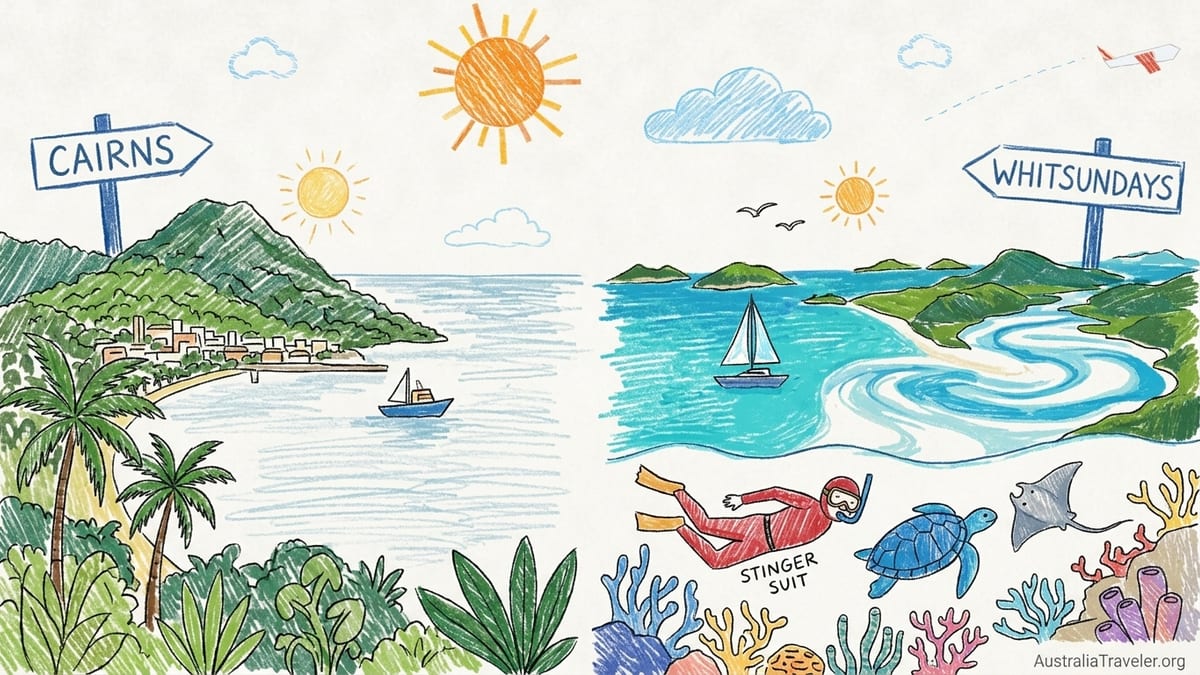
January and February bring some of the hottest, wettest weather for both Cairns and the Whitsundays. Daytime temperatures often sit around 30 to 32 degrees Celsius with high humidity. In Cairns this is the heart of the wet season, when monthly rainfall can exceed several hundred millimetres and heavy afternoon downpours are common. Seas can be calm one day and lumpy the next if a monsoon trough or cyclone forms. Water temperatures around outer reefs are usually in the high twenties. It is peak marine stinger season, so operators from Cairns, Port Douglas and Airlie Beach provide full‑body protective suits for snorkelers and divers and strongly encourage their use. Visitor demand from international travelers is moderate, but heavy rain can deter some domestic tourists, keeping prices more flexible outside school holidays.
By March and April, rainfall in Cairns is still relatively high compared with winter, but the wet season is beginning to ease. The Whitsundays often see slightly less extreme rain totals, although showers and storms remain possible. Sea temperatures are still warm, which keeps snorkelling comfortable, and on clear days underwater visibility can be excellent. Easter school holidays often fall in this period, which means popular reef trips from both Cairns and Airlie Beach can book out several days ahead. March is still squarely in cyclone and marine stinger season. April is more transitional; some operators begin to reduce the emphasis on stinger messaging later in the month, but many continue to recommend suits whenever water is warm.
May and June mark the start of the drier half of the year. In Cairns the air turns a little cooler and much less humid, while the Whitsundays enjoy mild, sunny days that many Australian families favour. Rainfall drops away and long runs of fine weather become more common, though the southeast trade winds can freshen and make some days breezy on the outer reef. Water temperatures slip into the mid‑twenties Celsius but are still warm enough for comfortable snorkelling in a light wetsuit or stinger suit. Marine stinger risk is considered lower by Surf Life Saving Queensland outside the November to May window, but advisory agencies repeatedly note that some stingers can be present year‑round, so professional crews may still suggest protective suits, especially earlier in May.
July and August are among the most popular months for both Cairns and the Whitsundays. Days are generally warm but not hot, humidity is low, and rainfall is at or near its annual minimum in many coastal locations. In Cairns, for example, some operators commonly describe August as a “blue‑sky month” with comfortable air temperatures around the mid‑twenties Celsius. The trade winds are usually well established, which means you must be prepared for windy days and bumpy crossings. If you are prone to seasickness, this period can actually feel less ideal despite the fine weather ashore. Sea temperatures are at their coolest, roughly the mid‑twenties near the reef, so operators often provide short wetsuits for comfort. These months sit outside the main stinger season.
September and October are classic shoulder‑season months. Around Cairns, average air temperatures climb back toward 30 degrees Celsius by October, but humidity is still relatively modest and rainfall tends to be low compared with summer. The Whitsundays can feel like a sweet spot with warm water, mostly dry weather and slightly gentler winds than mid‑winter. However, wind patterns in the Coral Sea are complex. Some years see calm, glassy late‑spring conditions; others bring prolonged breezes. Sea temperatures are rising, which many snorkelers find ideal. This is a busy period for domestic tourism, particularly around the September school holidays, and reef trips from both Cairns and Airlie Beach can sell out well in advance.
November and December take you back into hotter, stickier conditions. In Cairns and Port Douglas, afternoon thunderstorms become more common as the wet season builds, but entire weeks can still be mostly sunny and calm. The Whitsundays also heat up, with increasing humidity and a return of marine stinger warnings. November is usually the start of the higher‑risk jellyfish period along the tropical Queensland coast, and local councils often install stinger nets at mainland beaches. At the same time, sea temperatures are beautifully warm and visibility on outer reefs can be excellent when wind and river runoff are low. International holiday travel ramps up from late November into December, so accommodation around Christmas and New Year in both regions can be expensive and heavily booked even though weather patterns are less predictable.
Weather, Wind, Runoff and Underwater Visibility
Reef visitors are often surprised to learn that the clearest underwater visibility does not always coincide with the sunniest day on land. What matters underwater is a mix of wind, waves, currents, distance from river mouths and recent rainfall. After a period of heavy rain in the wet season, rivers around Cairns and Townsville can discharge large volumes of sediment into coastal waters. This runoff can temporarily reduce visibility on inshore reefs or islands closer to river mouths. Operators typically steer guests toward outer‑reef sites that sit far offshore in deeper, clearer water, but even there a plume of greenish, less transparent water can drift through for a few days.
Wind can have an equally strong influence. In the drier months from about May to September, the southeast trade winds regularly blow along the Queensland coast. A brisk trade wind can roughen the sea surface between the mainland and the outer reefs, which makes the ride from Cairns or Port Douglas feel bouncy on smaller boats. On multiday sailing trips in the Whitsundays, stronger winds mean more heeling and spray. Even if you do not get seasick, those conditions can be tiring. Underwater, surface chop and surge can make first‑time snorkelers feel less relaxed.
Tour operators adjust daily plans based on the forecast. For example, a Cairns company sending high‑speed catamarans to the outer reef might decide to visit more sheltered reef walls when the wind is up, while a Whitsundays sailing charter could anchor on the leeside of an island like Whitsunday Island itself to give guests a calmer snorkel on fringing coral. Tides also play a role. Very low tides can expose shallow coral around island platforms and sometimes limit where boats can safely bring snorkelers close to the reef top. On some Whitsunday day trips, staff will brief passengers that a particular swim will be “more of a deeper snorkel” if the tide is high, with coral bommies sitting several metres below the surface.
Rain on the day of your trip does not automatically ruin underwater visibility. Light showers often have little effect offshore, especially on the outer reef. The bigger concern is extended periods of heavy rain in the days before you go, which can flood creeks and bring fine sediment and organic material into near‑shore lagoons. When you are booking, it can be worth asking the operator whether their usual sites are closer to river mouths or far out on the shelf, particularly in mid‑wet‑season months like January and February.
Marine Stingers, Protective Suits and Safety Advice
Marine stingers are a fact of life in tropical Queensland waters, especially from around November to May. Information from Surf Life Saving Queensland and state safety agencies explains that dangerous species such as box jellyfish and Irukandji‑type jellyfish are more active and more numerous in these warmer months, although some stingers can be present at any time of year. Government and surf lifesaving bodies consistently describe November to May as the higher‑risk season for tropical waters north of about Bundaberg on the Queensland coast.
On the Great Barrier Reef, practical management revolves around protective clothing and local knowledge. Reef tour operators in Cairns, Port Douglas and the Whitsundays nearly always supply full‑body Lycra or thin neoprene suits in season. These suits cover arms and legs and are worn over normal swimwear. They markedly reduce the area of exposed skin and also provide sun protection, which is useful when you are floating at the surface for long periods. Visitors sometimes worry that suits feel overcautious, but staff in destinations from Fitzroy Island near Cairns to Whitehaven Beach in the Whitsundays regularly explain that a suit is a simple precaution that allows guests to relax and enjoy the water.
Local councils along the mainland coast install stinger‑net enclosures at many patrolled beaches in season, including around Cairns’ northern beaches and at Airlie Beach. Lifesavers’ public messaging emphasises that nets reduce the chance of larger box jellyfish entering but cannot guarantee complete protection, especially from very small species such as Irukandji. Visitors are urged to swim at patrolled beaches, read safety signage and listen carefully to lifeguards. On reef and island trips, crews will usually give a specific safety briefing tailored to current conditions and may decide to limit or suspend water activities on rare high‑risk days such as after certain wind patterns or jellyfish detections.
If you are planning travel in the higher‑risk months, simple preparation helps. Many travellers choose to rent the tour operator’s suit, which is typically included in the trip price or hired for a modest fee, rather than buying one at a resort shop. Families sometimes purchase children’s stinger suits or full‑coverage swimwear in advance so kids are used to the feel. If you are visiting between about June and September, operators along the outer reef might offer short wetsuits primarily for warmth rather than stinger protection, reflecting the lower but not zero jellyfish risk in cooler water.
Wildlife Seasons: Whales, Rays, Turtles and Coral Spawning
One of the reasons there is no single “best” month for the Great Barrier Reef is that different wildlife experiences peak in different seasons, and nature never runs on a guaranteed timetable. Tourism and environment agencies in Queensland publish general wildlife calendars that outline likely seasons, but every year brings slight variations in timing and abundance.
Humpback whales migrate along the Queensland coast in the middle of the year. They move north from Antarctic feeding grounds in the southern autumn and early winter, then return south with calves in late winter and spring. On the Great Barrier Reef, this means that reef boats from Cairns, Port Douglas and particularly the Whitsundays often see whales between about June and October during normal years. Some day boats incorporate seasonal whale‑watching commentary when sightings are common. Regulations require vessels to keep specific distances from whales, and boats avoid close approaches to mothers with calves, so you should think of whale encounters from standard reef trips as a bonus rather than a close‑up guarantee.
Dwarf minke whales have a more concentrated seasonal window. Operators based in Cairns and Port Douglas run limited‑permit expeditions to the Ribbon Reefs in June and July because historical sighting data suggests this is when minkes most often aggregate in that area. Places on these specialist liveaboards are limited and usually booked months in advance by keen divers. Even then, every trip includes the caveat that wild animals decide whether to show up.
Manta rays and reef turtles appear in many parts of the reef across much of the year, but particular hotspots and seasons exist. Southern reef islands such as Lady Elliot Island, which market themselves as “home of the manta ray,” report reliable encounters in the cooler months and around plankton‑rich upwellings, while some northern cleaning stations see more activity when currents bring food. Green and loggerhead turtles nest on certain coral cays in the warmer months and hatchlings emerge weeks later, typically around summer. Tour operators sometimes offer night‑time turtle‑watching experiences on islands where visitor access is carefully managed. Bookings for these periods, especially around school holidays, can fill well ahead of time.
Mass coral spawning is another headline event. Scientific information about the Great Barrier Reef notes that many corals reproduce in synchronised spawning events a few nights after the full moon in late spring or early summer, once the water has warmed. Around Cairns and the central reef, this often happens in November, though in some years significant spawning also occurs in October or December. Dive boats and island resorts occasionally schedule special departures around likely spawning dates, but even with careful planning conditions and timing can shift. On some nights visibility is clouded by gametes, creating an otherworldly but not “clear water” experience. For underwater photographers, this can be a highlight, but visitors seeking postcard‑clear photos might prefer a different week.
Comparing Cairns, Port Douglas, Whitsundays and Southern Islands
Although all of these destinations sit along the same vast reef system, their on‑the‑ground experience differs noticeably through the year. Cairns is the largest gateway city, with an international airport, a broad range of accommodation from hostels to major hotels and a busy reef‑trip marina. Trips from Cairns often involve relatively longer boat rides to reach outer‑reef platforms or pontoon systems, which can mean more exposure to wind and swell on breezy days. Many visitors use Cairns as a base for a mixed holiday that also includes rainforest trips to the Atherton Tablelands or Kuranda.
Port Douglas, about an hour’s drive north of Cairns, has a more resort‑town feel with a compact main street and access to both the reef and the Daintree Rainforest. Reef trips from Port Douglas may reach certain outer reefs slightly faster than from Cairns, and some guests find Four Mile Beach more appealing than Cairns’ mudflat foreshore, which relies on its man‑made lagoon for swimming. The climate patterns around Port Douglas mirror Cairns closely, with hot, humid wet‑season months and very warm, relatively dry winters.
The Whitsundays, accessed via Airlie Beach or Hamilton Island, offer a different style of reef holiday again. Here the focus is on a scatter of continental islands with fringing coral reefs and sheltered anchorages, plus selected outer‑reef pontoons. Day trips might combine time on a famous beach such as Whitehaven, accessible via cruise boat or scenic flight, with snorkelling in bays that are partially protected from ocean swell. Wind direction plays a major part in how comfortable a given anchorage feels on any day. A gusty southeasterly can roughen exposed channels, making longer boat legs livelier, but boats can tuck behind islands for calmer swims. Stinger‑season dynamics apply here too, with local councils and Surf Life Saving Queensland emphasising protective suits during the November to May higher‑risk period.
Further south, islands like Lady Elliot and Heron sit near the southern end of the Great Barrier Reef. These locations are outside the core tropical box jellyfish range for much of the year and often promote cooler‑water diving in winter with manta rays and abundant turtles. Air and water temperatures here are generally a few degrees cooler than Cairns in mid‑winter, and stinger risk messaging reflects that difference. For visitors primarily seeking manta encounters or wanting to avoid the hottest, stickiest months, these southern islands can be attractive alternatives, although access usually involves small scenic flights and multi‑night stays rather than simple day trips.
Crowds, School Holidays, Prices and Backup Plans
Seasonal planning for the Great Barrier Reef is not only about the weather and wildlife. Australian and international school holidays, public holidays and airline schedules all influence crowding and prices. In Cairns, Port Douglas and Airlie Beach, accommodation and reef‑trip prices tend to spike during Australian school holiday periods such as late December and January, the Easter weeks in March or April, and the mid‑year break around June or July. During these windows, family‑friendly reef cruises, island day trips and introductory dive experiences can sell out days or weeks in advance, regardless of the underlying weather pattern.
Conversely, shoulder periods like late February outside school holidays, or early May before the southern winter rush, often see more competitive hotel rates and last‑minute tour availability, particularly in Cairns. The trade‑off can be a greater chance of heavy rain or humidity. In the Whitsundays, yacht charters and multi‑day sailing tours can be in high demand in the cooler, drier middle of the year, with prices reflecting the seasonal popularity of calm winter sailing conditions, even though wind can still be brisk.
Because no month is completely safe from rain, wind or the occasional cancelled service, it is wise to build backup options into your itinerary. In Cairns, travellers often plan their reef day early in a week‑long stay so that if strong wind forces a cancellation, they can switch days and slot in waterfall or rainforest excursions instead. In the Whitsundays, operators sometimes reshuffle itineraries to put island beach visits on windier days and outer‑reef segments on calmer ones. Travel insurance that covers weather‑related disruptions can be worth considering, especially if you have pre‑paid for expensive liveaboard dive trips or private yacht charters.
On a practical level, watch cancellation policies closely. Some mass‑market reef operators from Cairns and Airlie Beach offer flexible rebooking if conditions are marginal, while boutique or small‑group boats may have stricter terms. Checking forecast discussions from the Bureau of Meteorology in the week before your trip, rather than relying solely on long‑range averages, will give you a far clearer picture of likely wind and rainfall on your actual dates.
Recommendations by Traveler Type
Different visitors value different conditions. Families with young children often prioritise gentle seas and simple logistics over absolute peak underwater visibility. For many of these travellers, the early dry season around May or June can work well. In Cairns and Port Douglas, humidity is easing, rain is usually lower than mid‑summer, and southeast trade winds have not always reached their winter peak. In the Whitsundays, these months combine warm water with a good balance of sunshine and manageable breezes. School holiday crowds around Easter and the June break mean higher prices, so families seeking value sometimes look to shoulder weeks just before or after these peaks.
Certified divers who focus on visibility and specific wildlife experiences may prefer the cooler, drier months. For example, experienced divers might target June or July from Cairns and Port Douglas for a chance to join a permitted dwarf minke whale liveaboard and accept that water will be cooler and trade winds stronger. Others might aim for late September or October, when waters are warmer again, rainfall is often modest, and coral spawning preparations bring a sense of anticipation. These travellers usually accept choppier crossings as part of the package and often bring their own seasickness remedies to maximise their chances of making every scheduled dive.
Snorkelers who are less confident in the water and prone to seasickness might choose transitional months with lower typical wind, such as late March, April or early November, while recognising that these still fall within cyclone and stinger seasons. Booking larger, more stable catamarans out of Cairns or Port Douglas, or shorter island‑based trips such as to Green Island or the Low Isles, can reduce time spent in open, choppy water. In the Whitsundays, picking day tours that focus on more sheltered island bays instead of only outer‑reef pontoons may offer a more comfortable compromise.
Wildlife photographers often embrace the idea that there is no perfect month by planning multiple shorter trips in different seasons or by selecting a single strong theme. A photographer concentrating on humpback whales around the Whitsundays might choose July or August and spend several days on whale‑friendly day boats or small‑group charters, accepting cooler water. Another focused on coral spawning near Cairns might select a November window around a full moon and stay flexible, booking with dive operators that run late‑evening departures.
Travellers who prioritise lower prices but still want a decent chance of good conditions could look to late February, early March or early May in Cairns, and to the shoulder periods of late October or early November in the Whitsundays. In these windows, hotel rates are often more forgiving than peak winter school holidays, flights can be cheaper and many reef operators run promotions to keep boats full. The trade‑offs are real: hotter, more humid weather in late summer, potentially unsettled conditions in spring, and the ongoing possibility of stingers during the warmer months. Being mentally prepared for those factors and planning a mix of reef and land‑based activities makes it easier to feel satisfied even if one day on the water is windier or cloudier than hoped.
The Takeaway
There is no single magical month when the Great Barrier Reef promises flat seas, flawless visibility, dry days and every marquee animal on cue. Instead, each season along the Queensland coast delivers its own pattern of rewards and compromises. The hot, wet months from November to April offer bath‑warm water, vibrant tropical skies, the drama of summer thunderstorms and access to events such as coral spawning and turtle nesting, balanced against increased marine stinger risk, higher humidity, occasional heavy rain and the background possibility of a cyclone. The cooler, drier months from May to October bring softer air, more stable sunshine and reliable wildlife like humpback whales, at the cost of cooler water and more frequent trade‑wind chop on boat rides.
The key to a satisfying trip is to start by deciding what matters most to you. If you dream of minke whales and long, clear dives, a mid‑winter trip from Cairns or Port Douglas might be worth the thicker wetsuit and breezy crossings. If your priority is a family holiday that mixes reef time with warm‑weather pool days and rainforest walks, then a shoulder month like May, June, September or October may offer the best overall balance. If budget drives your decisions, looking to quieter shoulder weeks in late summer or late spring can unlock lower prices as long as you are prepared for heat, humidity and more variable forecasts.
Regardless of the month, you can stack the odds in your favour by booking reputable operators, building flexibility into your itinerary, listening to local marine stinger and weather advice and packing realistically for warm sun, possible showers and breezy decks. The Great Barrier Reef is vast, alive and constantly changing. There is no perfect moment when everything aligns, but there are many excellent ones, and with thoughtful planning you can find the version of “best time” that suits you.
FAQ
Q1. Is there a single best month to visit the Great Barrier Reef?
There is no single month that reliably delivers calm seas, perfect visibility, dry weather and every major wildlife encounter. Each month involves trade‑offs between heat, rainfall, wind, marine stinger risk, wildlife seasons and crowd levels, so the best choice depends on whether you prioritise comfort, specific animals, school‑holiday timing or price.
Q2. When is the marine stinger season, and how worried should I be?
Authorities in Queensland describe a higher‑risk marine stinger season from roughly November to May in tropical waters, particularly north of about Bundaberg. Dangerous jellyfish are still relatively rare events compared with the number of people in the water, and most reef operators manage the risk by providing full‑body protective suits, monitoring conditions and adjusting activities when necessary. Following local advice and wearing the recommended suit greatly reduces the risk of a serious sting.
Q3. Are winter months always calmer on the reef?
Winter months from June to August are usually drier on land with lower humidity, which many visitors find comfortable, but they are not always calmer at sea. The southeast trade winds often strengthen in this period, which can make boat rides from Cairns, Port Douglas and the Whitsundays noticeably choppier. Calm days certainly occur in winter, but windier spells are also common, so seasickness‑prone travellers should still come prepared.
Q4. When are humpback and dwarf minke whales most likely to be seen?
Humpback whales generally migrate through Great Barrier Reef waters from around June to October, with good chances of sightings from reef boats in the Whitsundays and, to a lesser extent, around Cairns and Port Douglas in these months. Dwarf minke whale encounters are more tightly focused in June and July on specific northern reefs, accessed mainly by specialist liveaboard dive trips that operate under a permit system and still cannot guarantee sightings on any given departure.
Q5. How does heavy rain affect reef visibility?
Heavy rain, most common between about December and April, can increase river runoff and carry sediment and organic matter into coastal waters, which may reduce visibility on inshore reefs and around some islands for days afterward. Outer‑reef sites farther offshore are less affected but can still see temporary changes when plumes spread. Light showers on the day of your trip usually have much less impact than extended wet periods in the days leading up to it.
Q6. Do I need a stinger suit if I visit in July or August?
July and August sit outside the main higher‑risk marine stinger season, and many visitors snorkel and dive in standard wetsuits provided for warmth. However, safety agencies point out that some jellyfish species can be present year‑round, so some operators still recommend coverage, especially for children or cautious swimmers. Wearing a suit in winter is often more about staying comfortably warm during long snorkels in cooler water than about stinger protection alone.
Q7. Which area is better for calmer water, Cairns or the Whitsundays?
Neither area is consistently calmer because conditions depend heavily on daily wind patterns, but the Whitsundays have the advantage of many sheltered island bays. On windy days, boats there can often anchor on the lee side of islands for more protected snorkelling, even if crossings between islands are bumpy. Trips from Cairns and Port Douglas to the outer reef often involve longer stretches in open water, so large catamarans and careful choice of travel days can make a noticeable difference in comfort.
Q8. How far ahead should I book reef trips in busy months?
During Australian school holidays, including late December to January, Easter and the mid‑year winter break, it is wise to book popular reef trips at least several weeks ahead, especially family‑oriented day cruises, introductory diving and overnight sailing tours in the Whitsundays. Outside peak periods, booking a few days in advance is often sufficient, though specific high‑demand experiences like minke whale liveaboards or turtle nesting packages on southern islands can sell out months in advance.
Q9. What is a good strategy if my only available time is during cyclone season?
If you can travel only between November and April, build flexibility into your plan instead of avoiding the reef altogether. Schedule your reef trip early in your stay so that if strong winds or a developing system force a cancellation, you have other days to rebook. Pair reef days with inland or rainforest activities that are less weather‑sensitive, choose reputable operators with clear cancellation policies and keep an eye on Bureau of Meteorology updates in the week before departure. Remember that only a minority of weeks in cyclone season are affected by severe weather.
Q10. Which months offer the best balance of price and conditions for budget travellers?
Budget‑minded travellers often find good value in late summer and shoulder periods such as late February, early March and early May around Cairns, and in late October or early November in the Whitsundays. These windows usually avoid the most expensive school‑holiday peaks while still offering warm water and a reasonable chance of fine weather. The trade‑off is higher humidity and, in late summer, greater stinger and rainfall risk. Booking flexible accommodation, watching for mid‑week flight deals and staying open to itinerary tweaks helps make the most of these value‑oriented months.