


The Great Barrier Reef is not one single place you “go to” for the day. It is a living system stretching for roughly 2,300 kilometres along the Queensland coast, with very different ways to experience it from Cairns, Port Douglas, the Whitsundays, Townsville and the Southern Great Barrier Reef. Choosing where to base yourself before you book reef tours or hotels will shape everything from how long you spend on boats to what kind of coral, islands and marine life you actually see.
Understanding the Geography of the Great Barrier Reef
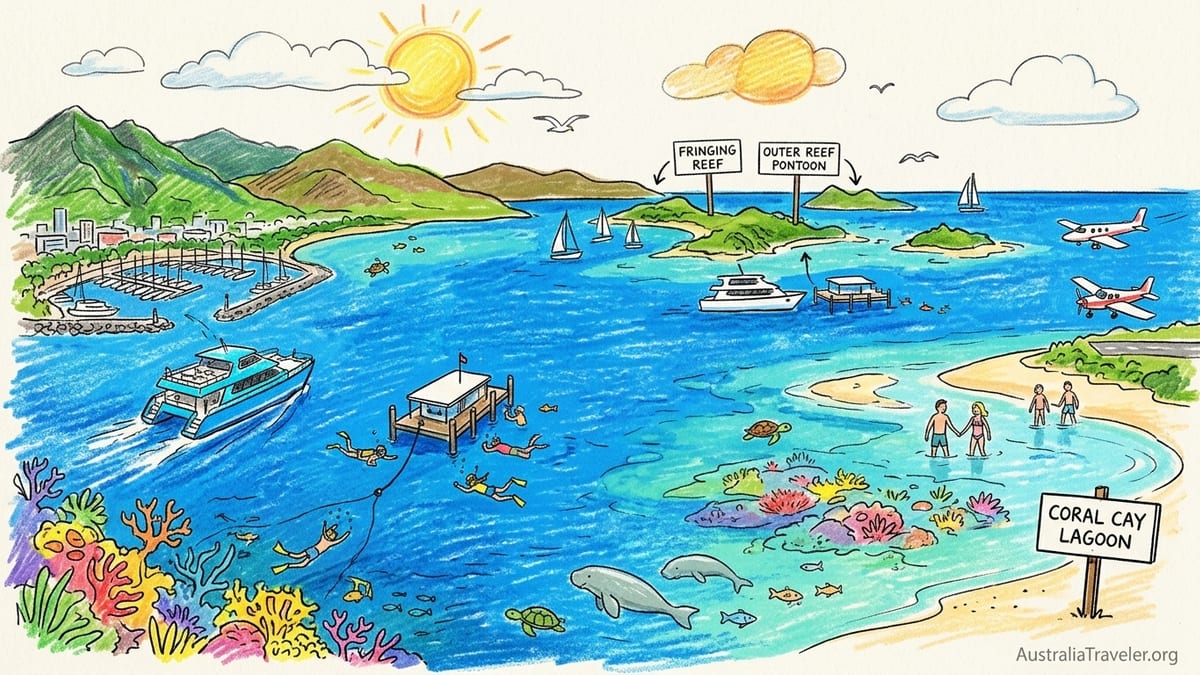
The Great Barrier Reef runs for about 2,300 kilometres from just north of Bundaberg in Southern Queensland all the way to the tip of Cape York. It contains thousands of individual reefs and hundreds of islands spread across a broad shelf, which means the experience of “going to the reef” from Cairns is very different to going from Airlie Beach or Bundaberg. Some departures take you to deep outer reefs, some to calm lagoons around coral cays, and others to floating platforms anchored permanently offshore.
Practically, this matters because it determines travel time, water conditions and what you can do once you arrive. From Cairns and Port Douglas, many boats travel 60 to 90 minutes each way to outer-reef sites. In the Whitsundays, such as Airlie Beach and Hamilton Island, you might spend closer to two hours each way reaching Hardy Reef and its pontoons. From Bundaberg and the Town of 1770, trips to Southern Great Barrier Reef coral cays like Lady Musgrave and Lady Elliot are often full-day adventures with long but rewarding journeys.
Not every Queensland coastal city gives you straightforward day-trip access to high quality reef. Brisbane, for example, is hundreds of kilometres away from the main reef, and even some closer towns have limited or highly specialised services. When you decide where to stay, it is worth thinking first about what kind of reef environment you want to see, then matching that with a gateway town that offers the right kind of tours.
Fringing Reefs, Outer Reefs, Coral Cays and Pontoons Explained
Travel brochures throw around terms like “fringing reef”, “outer reef” and “coral cay”, but they describe very different experiences on the water. A fringing reef grows directly along the coastline or around an island. Magnetic Island off Townsville and some of the Whitsunday islands have fringing reefs that you can reach from the beach or after a very short boat ride. This usually means shorter travel times but slightly less dramatic drop-offs compared with the outer shelf.
Outer reefs sit further offshore on the edge of the continental shelf, in deeper, clearer water. From Cairns and Port Douglas, many operators travel to these outer reefs because visibility is often better, and coral walls can be more spectacular. Companies such as Sunlover and other large-boat operators run full-day trips from Cairns to outer-reef sites like Moore Reef, often with a floating pontoon as a base for snorkelling, glass-bottom boat rides and semi-submersible tours. Quicksilver operates similar large-vessel trips out of Port Douglas to Agincourt Reef, another outer-reef system known for walls and bommies in blue water.
Coral cays are small, low islands formed entirely from coral rubble and sand, often surrounded by a shallow lagoon. Lady Musgrave, Lady Elliot and Heron Island in the Southern Great Barrier Reef are classic coral cays, with reef flats that start very close to shore. Visitors there can often wade into the water and start snorkelling a few fin-kicks from the beach, which is ideal for less confident swimmers. Offshore pontoons, such as those used at Hardy Reef by Cruise Whitsundays and at Moore Reef and Agincourt, are large platforms anchored at a fixed reef site, providing changing rooms, shade, underwater observatories and structured activities.
For non-swimmers and nervous snorkellers, the choice between an island cay and a pontoon can be important. Coral cays usually offer sandy entries and very shallow water near shore, excellent for simply floating with a mask. Pontoons, by contrast, have ladders and snorkel platforms directly into deeper water but compensate with guided snorkel tours, life vests and glass-bottom or semi-submersible options for those who prefer to stay dry.
Cairns: Busy Hub with Flexible Outer-Reef Access
Cairns is the most famous gateway to the Great Barrier Reef, with a busy marina and dozens of boats leaving most days of the year. From here, operators such as Sunlover offer full-day trips to outer-reef locations including Moore Reef, often based around large multi-level pontoons. Recent pricing for a Sunlover Moore Reef full-day trip for the 2026–2027 season starts around the low 300 Australian dollars per adult for a day that typically runs from about 9am to 5pm including up to four hours on the reef, snorkel gear, buffet lunch and activities like glass-bottom boat tours.
Smaller, more dive-focused boats depart from Cairns as well, visiting sites like Saxon and Hastings reefs with fewer passengers and multiple snorkel or dive sites in one day. Many of these trips advertise one and a half to two hours travel time each way, which is worth considering if you are prone to seasickness. On the plus side, Cairns itself has the widest accommodation range of any reef gateway, from hostels and budget hotels near the Esplanade lagoon to high-end hotels with lagoon pools, as well as a lively dining and bar scene for evenings.
The key advantages of Cairns are choice, competitive pricing and ease of access. Cairns Airport receives frequent direct flights from major Australian cities, and transfers to town are short, usually 10 to 15 minutes by taxi or shuttle. The main drawbacks are that the marina area can feel crowded in high season, and some travellers find the city more functional than charming. If you want a resort-style beach right at your door, the nearby Northern Beaches or Port Douglas may be more appealing, though transfers will be longer.
Port Douglas and Agincourt Reef: Quieter Feel, Classic Outer-Reef Walls
Port Douglas sits around an hour’s drive north of Cairns along a scenic coastal road, with a smaller, more resort-oriented atmosphere. It has an attractive village-style centre and long, wide Four Mile Beach, which many visitors prefer for a more relaxed holiday feel. From Port Douglas, Quicksilver runs large catamarans to a dedicated pontoon at Agincourt Reef on the outer edge of the reef system, with a similar model of day trip to the big operators in Cairns: roughly 90 minutes each way by boat, several hours on the pontoon, snorkelling, semi-submersibles and lunch included.
For travellers who want a smaller-group snorkelling focus, Port Douglas is also home to companies such as Wavelength, which offer trips to selected outer-reef sites with full briefings by marine biologists. These tours generally use smaller boats and avoid pontoons, instead visiting multiple reef sites in one day, often prioritising healthy coral gardens and varied marine life. This approach can appeal to confident snorkellers and photographers who would rather spend more time exploring and less time on structured pontoon activities.
The trade-offs with Port Douglas include slightly higher average accommodation prices and the need to either transfer from Cairns Airport by coach or shuttle, or hire a car. Coach transfers typically add around an hour and a half to arrival and departure days. On the positive side, combining an Agincourt or outer-reef snorkel day with a trip to the nearby Daintree Rainforest is straightforward from Port Douglas, which is a major reason many visitors choose it as their base.
Whitsundays, Airlie Beach and Hardy Reef: Islands, Lagoons and Scenic Sailing
Further south, Airlie Beach and the Whitsunday islands provide a very different reef experience, focused on white-sand beaches, island scenery and a mix of reef and coastal cruising. Cruise Whitsundays operates day trips from Airlie Beach and Hamilton Island to Hardy Reef, where a large pontoon and semi-permanent structures offer snorkelling platforms, underwater viewing rooms and the possibility of overnight stays in some packages. Travel times from Airlie Beach to Hardy Reef are typically around two hours each way by high-speed catamaran, with a full day including several hours at the pontoon.
Prices for Hardy Reef pontoon trips vary by season and inclusions, but base adult rates are generally several hundred Australian dollars, similar to premium outer-reef cruises elsewhere on the coast. Many visitors choose Whitsunday reef trips that combine time at iconic locations like Whitehaven Beach with snorkelling on fringing reefs around islands such as Hook or Border islands. These itineraries often have slightly shorter open-water crossings than the outer shelf, which can mean a gentler ride on choppy days.
Airlie Beach itself is an established backpacker and holiday town with marinas, lagoon pools and a strong focus on sailing. Accommodation ranges from hostels and apartment-style resorts on the hillside to family-friendly hotels. Hamilton Island offers a more upmarket resort environment with its own airport, making it convenient for travellers with limited time who want an all-in-one island base. The main considerations here are cost and the proportion of time spent on boats. A typical Hardy Reef pontoon day from Hamilton Island still involves close to four hours of cruising in total, which may be tiring for young children or those prone to seasickness.
Townsville, Magnetic Island and the Central Reef
Townsville is an important regional centre, but it functions differently from Cairns or Airlie Beach as a reef base. The main immediate attraction is Magnetic Island, a short ferry ride across Cleveland Bay, where visitors can hike between bays, spot koalas in the wild and snorkel on fringing reefs off beaches such as Geoffrey Bay and Nelly Bay. This makes Magnetic Island a good choice for travellers who prefer a quieter, low-rise island setting with easy off-the-beach snorkelling rather than long boat rides.
Access to outer reefs from Townsville exists but is less concentrated than in Cairns or the Whitsundays, with some dive-focused operators running full-day or multi-day trips. These are often aimed at certified divers interested in sites like the SS Yongala wreck or specific offshore reefs, rather than casual day-trippers. If your primary goal is to see colourful coral gardens with minimal fuss, Townsville and Magnetic Island can still deliver, but mostly via fringing-reef snorkelling close to shore instead of large-scale pontoon operations.
Accommodation in Townsville ranges from modern seafront hotels along The Strand to business hotels in the CBD, while Magnetic Island offers bungalows, apartments and small resorts scattered across bays. Because Townsville is less of a dedicated reef holiday town, it can be ideal if you want to combine reef time with other interests such as visiting the Museum of Tropical Queensland, exploring local dining or using the city as a stopover on a longer coastal road trip.
Southern Great Barrier Reef: Lady Musgrave, Lady Elliot and Heron Island
At the southern end of the reef, Bundaberg and the Town of 1770 provide access to coral cays that feel quite different from the outer shelf trips further north. Lady Musgrave Island and its lagoon, in particular, are reached on full-day tours from Bundaberg with operators such as Lady Musgrave Experience. Recent fact sheets list day trips from Bundaberg that depart around 7am, cruise for several hours to a lagoon pontoon and island, and return to port late afternoon, with total tour lengths of roughly 10 hours. Base adult prices for these full-day experiences currently sit in the low- to mid-200 Australian dollar range, with premium seating or VIP upgrades available at higher rates.
Lady Musgrave’s appeal lies in its sheltered lagoon, shallow snorkelling over coral gardens and the ability to step ashore on the island for guided walks. Many itineraries include glass-bottom boat tours, reef presentations and the chance to see turtles, reef fish and, in season, manta rays. Similar in concept but different in logistics, Lady Elliot Island is a coral cay that you access only by small aircraft from Bundaberg, Hervey Bay, Brisbane or the Gold Coast, with flight times of roughly 30 to 100 minutes depending on departure point. Flight and day-trip packages are coordinated through the Lady Elliot Island Eco Resort and are priced to reflect both the scenic flight and reef experience.
Heron Island, another southern coral cay, is typically accessed by boat or helicopter from Gladstone and is more focused on overnight stays than day-trips. Collectively, these southern cays are known for clearer water in cooler months, prolific bird and turtle life and slightly cooler water temperatures compared with the tropical north. They are particularly attractive to visitors who want a nature-centric experience where snorkelling starts almost from the beach and evenings are quiet, with dark skies and minimal development.
Weather, Seasons, Marine Life and Non-Swimmer Options
Weather plays a major role in reef trips along the entire Queensland coast. The peak domestic holiday period of December to February is also the wet season in the tropical north around Cairns and Port Douglas, with hotter temperatures, more rain and a higher chance of tropical storms. Sea conditions can be choppier, though warm water and long days appeal to many travellers. From about November to May, tropical waters also see marine stingers, which is why reputable operators supply stinger suits and advise against unprotected swimming from unpatrolled beaches.
In the shoulder and cooler months from around June to September, the northern tropics are drier and less humid, with more stable conditions on the water. These months are popular with divers and snorkellers and correspond with higher manta ray numbers around places like Lady Elliot Island in the south. The Southern Great Barrier Reef, including Lady Musgrave and Heron, often has pleasantly warm days and slightly cooler water in winter but can offer very good visibility, making mask-and-snorkel time rewarding even if you need a short wetsuit.
For non-swimmers or mixed groups, choosing an operator with strong “dry reef” options is essential. Pontoon-based trips from Cairns, Port Douglas and the Whitsundays usually include glass-bottom boat rides and semi-submersible tours, where you sit below the waterline while the vessel moves slowly over coral gardens. Many also have underwater observatories built into the pontoons, allowing you to watch fish and sometimes turtles without getting wet. On coral cays such as Lady Musgrave or Lady Elliot, non-swimmers can still join island walks, birdwatching and simple paddles in waist-deep water wearing life vests.
Practical Comparison: Key Gateways at a Glance
To help compare the main options, it is useful to look at a simple side-by-side snapshot. Details such as exact prices and schedules change regularly, but recent information provides a reliable guide to what travellers can expect in 2026. The table below focuses on typical experiences rather than every possible variation.
| Base | Nearest airport & transfer | Typical reef tour duration | Reef access style | Approx adult day-trip prices (2026) | Accommodation style | Main advantages | Main drawbacks |
| Cairns | Cairns Airport, about 10–15 minutes to CBD by taxi or shuttle | Full-day outer reef, often 8–9 hours total with 3–4 hours on reef | Outer reefs by large catamaran, pontoons and smaller dive boats | Common full-day outer reef trips around low 300 AUD for major pontoon operators, other boats vary above and below this | Hostels to five-star hotels in and around CBD and Esplanade | Huge choice of operators, easy flights, good prices, lively city amenities | Longer boat rides, busy marina, city is more functional than resort-like |
| Port Douglas | Cairns Airport then roughly 1–1.5 hours by coach or car | Full-day outer reef, similar 8–9 hours with 3–4 hours on site | Agincourt Reef pontoon with Quicksilver, smaller snorkel boats such as Wavelength to outer reefs | Outer-reef pontoon trips roughly in line with premium Cairns cruises, smaller boats often priced in a similar or slightly higher range | Resort hotels, apartments and villas near the beach and marina | Quieter resort feel, easy access to Daintree, strong small-group snorkel options | Extra transfer time from the airport, generally higher room rates at peak times |
| Airlie Beach / Whitsundays | Whitsunday Coast Airport with transfers around 30 minutes to Airlie; Hamilton Island has its own airport | Whitehaven and fringing reef trips often 7–8 hours; Hardy Reef pontoon days closer to 9–10 hours with about 4 hours at the pontoon | Fringing reefs around islands, plus Hardy Reef pontoon with Cruise Whitsundays | Hardy Reef pontoon and full-day reef adventures generally priced in the mid-hundreds of dollars per adult, reflecting longer distance | Backpacker hostels, mid-range resorts in Airlie; full-service island resorts on Hamilton Island | Iconic beaches and island scenery, sailing focus, mix of reef and land experiences | Longer open-water crossings, higher costs for island stays, town can feel party-oriented |
| Townsville / Magnetic Island | Townsville Airport, about 10 minutes to city; 20-minute ferry to Magnetic Island | Fringing-reef snorkelling often done independently; specialised outer-reef and wreck dive trips can be full-day or longer | Beach-access fringing reefs on Magnetic Island, plus niche offshore dive trips | Ferry and gear hire relatively modest; specialist dive charters more expensive and targeted at certified divers | City hotels in Townsville, small-scale resorts and apartments on Magnetic Island | Short travel from shore to reef, relaxed island feel, good for independent snorkellers | Fewer mainstream outer-reef day tours, limited options for those wanting big pontoons |
| Bundaberg / Southern Great Barrier Reef | Bundaberg Airport with flights from Brisbane, then about 20–30 minutes by road to port | Lady Musgrave full-day tours around 10 hours door-to-door, with several hours in the lagoon | Coral cay and sheltered lagoon, pontoon base, guided island walks | Recent adult day-tour prices to Lady Musgrave starting in the low- to mid-200 AUD range, with premium options higher | Motels and hotels in Bundaberg, coastal holiday parks, limited overnight options on cays | Sheltered snorkelling, strong turtle and bird life, quieter and less crowded | Longer day on the water, smaller range of restaurants and nightlife compared with Cairns or Airlie |
This comparison underlines that “Great Barrier Reef access” can mean anything from walking off a beach into waist-deep water to committing to lengthy offshore cruises. Matching your tolerance for boat travel, budget and desired atmosphere with the right departure point is the most important decision you will make before pressing “book now” on a reef tour.
The Takeaway
For first-time snorkellers, the choice often comes down to balancing ease of access, water conditions and the support available once you reach the reef. Pontoons run by operators like Quicksilver off Port Douglas, Sunlover and similar companies off Cairns, and Cruise Whitsundays at Hardy Reef all provide structured environments with life vests, snorkel guides, semi-submersibles and calm areas close to the platforms. Southern coral cays such as Lady Musgrave and Lady Elliot add the benefit of beach entries into shallow lagoons, which can feel gentler and more intuitive for nervous swimmers.
Certified divers or confident snorkellers who want to prioritise coral quality and varied sites may gravitate to smaller boats that visit multiple outer-reef locations in a day. Port Douglas options such as Wavelength, as well as various specialist dive boats from Cairns or Townsville, can spend more time in the water and less on fixed pontoons. For these travellers, slightly higher per-person costs are often offset by the richness of the underwater experience and smaller group sizes.
Families with young children may prefer bases where non-swimmer options are strong and transfers are straightforward. Cairns stands out for its combination of short airport transfer, family accommodation choices and abundance of pontoon trips with glass-bottom boats and kids’ snorkel zones. Port Douglas adds a softer resort feel and easy access to the Daintree for non-reef days, while the Whitsundays offer iconic beaches and resort pools alongside reef time. The Southern Great Barrier Reef, especially Lady Musgrave, appeals to families who value nature and do not mind an early start and long boat ride in exchange for a sheltered lagoon experience.
Couples often weigh atmosphere as heavily as reef logistics. Port Douglas and the Whitsundays deliver classic tropical-holiday aesthetics, with palm-fringed beaches, waterfront dining and sunset bars. Coral cays like Lady Elliot and Heron Island, with minimal development and dark night skies, suit couples who want an eco-retreat style stay with early nights and dawn snorkels. Cairns can still work well for couples who prioritise dining variety and nightlife alongside daytime tours.
Travellers with limited time, such as those on a short Australian itinerary, are usually best served by Cairns or Hamilton Island. Cairns allows you to land at the airport, transfer into town in minutes and join a full-day outer-reef trip the next morning. Hamilton Island makes it possible to fly directly onto an island with resort facilities and then take a one-day Cruise Whitsundays trip to Hardy Reef, accepting the long boat segment as part of the package. What is important to understand is that not every Queensland city offers this kind of straightforward reef access. Brisbane, for example, requires additional flights or long drives to reach true Great Barrier Reef departure points, and even along the coast, some towns focus on beaches or islands rather than reef day-trips.
In practice, the “best” base for the Great Barrier Reef is the one whose travel times, budget range and style of reef access align with your own preferences. Decide first whether you picture yourself stepping off a beach into a calm lagoon, climbing down a ladder from a pontoon in blue water or rolling off a small dive boat onto an outer wall. Once that image is clear, choosing between Cairns, Port Douglas, the Whitsundays, Townsville and the Southern Great Barrier Reef becomes much simpler.
FAQ
Q1. Is Cairns or Port Douglas better for a first Great Barrier Reef trip?
Cairns is more convenient for flights and offers the widest range of reef tours at different price points, which suits many first-timers. Port Douglas has a smaller, resort-style feel and direct access to Agincourt Reef with both large pontoon trips and small-group snorkel boats, which some travellers prefer if they are comfortable adding the extra road transfer from Cairns Airport.
Q2. Can I visit the Great Barrier Reef on a day trip from Brisbane?
No straightforward day-trip options exist from Brisbane to the main sections of the Great Barrier Reef. You would need to fly or drive to a reef gateway such as Cairns, the Whitsundays or Bundaberg first. Some Southern Great Barrier Reef experiences, such as Lady Elliot Island flights, can depart from the wider Brisbane region, but they are organised as dedicated packages and involve early starts and scenic flights rather than simple boat departures from the city itself.
Q3. Are pontoon trips or coral cays better for children and non-swimmers?
Pontoons at Moore Reef, Agincourt Reef and Hardy Reef offer structured environments with life vests, snorkel platforms, underwater observatories and glass-bottom boats, which work very well for non-swimmers and children. Coral cays like Lady Musgrave and Lady Elliot add the advantage of shallow lagoons and sandy beach entries, which can feel more relaxed for young children or nervous adults who prefer to stand up between snorkel sessions.
Q4. How much should I budget for a quality Great Barrier Reef day trip in 2026?
Recent pricing indicates that full-day outer-reef and pontoon trips from major hubs such as Cairns, Port Douglas and the Whitsundays generally fall in the low to mid hundreds of Australian dollars per adult, depending on inclusions like hotel transfers, meals and optional activities. Southern Great Barrier Reef day tours to Lady Musgrave from Bundaberg are often priced in the low- to mid-200 dollar range for adults, while flight-based packages to coral cays such as Lady Elliot cost more due to the scenic flight component.
Q5. When is the best time of year to visit the Great Barrier Reef?
The cooler, drier months from roughly June to September offer comfortable air temperatures, lower humidity and generally stable sea conditions in the northern tropics, which many travellers find ideal. Summer from December to February brings warmer water and long days but also higher rainfall, tropical storms and marine stinger season in the far north, which is why operators supply stinger suits. In the Southern Great Barrier Reef, winter can provide excellent underwater visibility, while manta rays and certain wildlife events peak at different times of the year.
Q6. Do I need to be able to swim to enjoy a reef trip?
No, but your experience will be different. Large operators on pontoons provide flotation devices, life vests, snorkel vests and guided tours to support weak swimmers. Glass-bottom boat and semi-submersible rides allow you to see coral and fish without entering the water. On coral cays, you can enjoy guided walks, birdwatching and standing in the shallows with a mask and snorkel while still holding on to a guide rope or staying in waist-deep water.
Q7. How long are the boat rides and will I get seasick?
From Cairns and Port Douglas, expect around 60 to 90 minutes each way to outer-reef sites, depending on the operator and sea conditions. From Airlie Beach or Hamilton Island to Hardy Reef, travel times are often closer to two hours each way. Bundaberg to Lady Musgrave involves several hours on the boat each way. If you are prone to seasickness, consider choosing coral cays with sheltered lagoons, larger stable catamarans, routes that spend more time behind islands, or consult a pharmacist about motion-sickness remedies before you travel.
Q8. Is the coral still healthy enough to justify the trip?
The Great Barrier Reef has experienced bleaching events and other environmental pressures, and conditions vary between locations and even between individual reefs. Many visitors still report vibrant coral gardens and abundant marine life, especially on well-chosen outer-reef sites and certain coral cays. Reputable operators adjust their itineraries to focus on healthier areas and often employ marine biologists who explain both the beauty of what you are seeing and the challenges the reef faces.
Q9. Should I base myself in one reef hub or visit several?
If you have limited time, focusing on one hub such as Cairns, Port Douglas or the Whitsundays is usually more efficient, allowing you to settle into a hotel and plan around the best-weather day for your reef trip. Travellers with longer itineraries sometimes combine, for example, a few days in Cairns or Port Douglas with time in the Southern Great Barrier Reef or the Whitsundays to experience both outer reefs and coral cays. Each move, however, adds travel time and cost.
Q10. How far in advance should I book reef tours and accommodation?
In popular months, especially Australian school holidays and peak winter for northern Queensland, many well-regarded operators and sought-after hotels fill weeks in advance. Booking reef tours and key accommodation at least several weeks ahead is sensible if you are fixed to particular dates or travelling as a family or group. Shoulder seasons can offer more flexibility, but confirming reef trips early still helps you choose the best day based on forecast conditions rather than accepting only what remains.