


Choosing a Great Barrier Reef snorkelling tour from Cairns or Port Douglas in 2026 has never been more confusing. Prices, reef sites and inclusions vary widely between big outer-reef catamarans, specialist snorkel boats, permanent pontoons and island-based packages. This guide compares leading operators including Sunlover Reef Cruises, Reef Magic, Quicksilver, Silversonic, Silverswift, Wavelength and Divers Den, and explains what you really get for your money.
How to Choose Between Cairns and Port Douglas for Reef Snorkelling
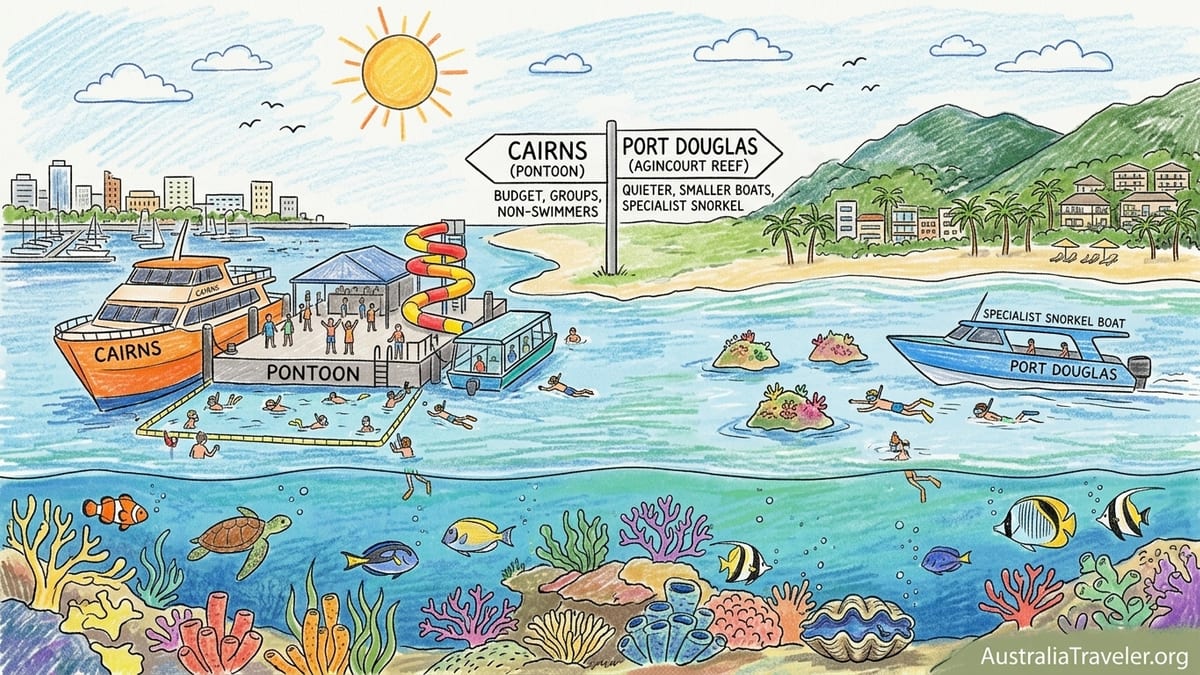
Cairns and Port Douglas both offer full-day Great Barrier Reef tours to outer reefs and islands, but they suit slightly different travellers. Cairns is a larger hub with more budget to mid-range choices and a big focus on permanent pontoons such as Sunlover’s Moore Reef and Reef Magic’s Marine World. Port Douglas feels smaller and more resort-focused, with outer-reef trips that mainly target the Agincourt Ribbon Reefs and a mix of large pontoons and smaller specialist snorkel boats.
Travel time to the reef is similar overall. Sunlover and Reef Magic quote about 90 minutes each way from Cairns to their pontoons on Moore Reef, while Port Douglas boats such as Quicksilver, Silversonic and Wavelength typically take around 70 to 90 minutes to reach Agincourt or other outer-reef sites. The main difference is not time on the boat but what you find when you arrive: a large multi-use platform with semi-submersibles and slides, or a smaller vessel moving between several snorkel sites.
If you are staying mostly in Cairns and want a classic day that works for mixed-ability groups, an outer-reef pontoon is usually the easiest choice. If you are based in Port Douglas and value quieter streets, smaller-group boats and immediate access to the Agincourt Reefs, then booking from there avoids extra coach travel. Many travellers split their stay between both towns and deliberately book one pontoon trip and one specialist snorkel boat to experience two different styles of reef day.
The critical step before you book is to match your swimming confidence, your group’s needs and your expectations around crowd size and structure. In the sections below, prices and inclusions are examples checked in late 2026. Operators change fares and reef sites regularly in response to fuel costs, weather and coral health, so always confirm details at the time of booking.
Comparing Outer-Reef Catamarans, Pontoons and Specialist Boats
Most day trips in this guide use large, stable catamarans that run daily schedules year-round. From Cairns, Sunlover and Reef Magic both operate high-capacity catamarans to their own permanent pontoons. From Port Douglas, Quicksilver sends a similar style catamaran to a big pontoon at Agincourt Reef, while Silversonic and Wavelength operate smaller fast boats that visit multiple moorings without a fixed platform.
Outer-reef catamarans with pontoons are designed for maximum flexibility rather than intimacy. Quicksilver’s Port Douglas outer-reef cruise, valid to 31 March 2027, is priced around 338 Australian dollars for an adult, 179 for a child and 864 for a family of two adults and two children, with a separate coach transfer cost and a fuel surcharge added for 2026. That fare includes the cruise, use of snorkel gear, access to the pontoon, semi-submersible rides and an underwater observatory. Sunlover’s Moore Reef full-day product from Cairns advertises similar inclusions such as snorkel gear, glass-bottom boat, semi-sub tour, underwater viewing room and a large waterslide, with adult day prices generally quoted just above the 200 dollar mark for 2026.
Smaller specialist snorkel boats like Wavelength out of Port Douglas trade amenities for space and flexibility. Wavelength advertises itself as a snorkel-only trip with a capped passenger load and three outer-reef sites in one day. Recent price checks place its full-day fare higher than some mass-market boats but still within the 300 to 400 dollar range per adult, including a guided snorkel with a marine biologist and professional photos delivered digitally. Silversonic and Silverswift, also under the Quicksilver Group, sit somewhere between, focusing on snorkellers and divers with three reef sites and up to five hours in the water.
Reef Magic’s Marine World platform from Cairns is a useful comparison. It mixes a permanent pontoon setup with a stronger marine education focus, including regular talks by marine biologists and visible coral restoration work. Pricing in 2026 is similar to the Quicksilver and Sunlover day trips, typically in the low to mid 300 dollar range per adult once levies and surcharges are included. For travellers who want a balance between comfort, education and accessibility from Cairns city, Reef Magic is often shortlisted alongside Sunlover.
Key Tour Details and Example Comparisons
The table below summarises core features of several representative 2026 products. Details are rounded and simplified for clarity and will change over time, but they illustrate the spread in departures, reef style and pricing.
Sunlover Reef Cruises, departing Cairns Marlin Marina, runs a full-day Moore Reef trip using a large catamaran. Guests typically snorkel at a single outer-reef pontoon site, with a big supervised snorkel area, underwater observatory, semi-submersible, glass-bottom boat, enclosed ocean pool and waterslide. Usable water time is usually around three to four hours, depending on season and conditions. Adult fares in 2026 sit slightly above 200 dollars, with child and family fares undercutting Port Douglas pontoon pricing, and environmental management charges included in the ticket.
Reef Magic’s Marine World, also from Cairns, follows a similar pattern. The boat sails to a proprietary pontoon on the outer reef, with about five hours at the reef advertised in some brochures. Activities include guided snorkels, fish-feeding presentations, glass-bottom boat and semi-submersible tours. Prices for adults are generally in the low to mid 300 dollar bracket once all charges are factored in, similar to Quicksilver’s Port Douglas pontoon, but Reef Magic emphasises its limits on daily passenger numbers and its Indigenous and marine-science partnerships.
Quicksilver’s Agincourt Reef pontoon from Port Douglas departs the Crystalbrook Marina around mid-morning and returns late afternoon, giving about three and a half hours on the pontoon itself. The boat capacity is higher than most smaller snorkel boats, which keeps per-seat costs relatively competitive but creates a busier deck and snorkel area. Coach transfers are extra and, from 1 April 2026, a fuel surcharge applies to adults and children. The upside is a wide choice of activities for non-swimmers, including an underwater observatory, semi-submersible tours and optional helicopter flights.
Silversonic and Wavelength, both from Port Douglas, illustrate the multiple-site snorkel approach. Silversonic usually visits three sites on Agincourt Reef, with up to five hours of combined water time. The advertised adult fare stands around 328 dollars, plus the same fuel surcharge introduced in 2026. Wavelength’s specialist snorkelling cruise, also visiting three outer-reef moorings, positions itself as a snorkellers-only experience with no diving and fewer people in the water at each site. Its adult fare is similar or slightly higher than Silversonic, but includes a guided snorkel with a marine biologist and complimentary photos, helping it appeal to travellers who value education and smaller groups more than slides or semi-subs.
Understanding Reef Sites, Multiple Stops and Water Time
Many travellers assume that visiting more reef sites automatically means better coral or clearer water, but the reality is more nuanced. Multiple sites mainly provide variety of habitat and a hedge against localised conditions. On a multi-stop boat such as Silverswift or Wavelength from Port Douglas, you might snorkel one bommie with shallow hard corals and turtles, a second site with deeper walls and schools of reef fish and a third with soft corals and giant clams. If one site has poor visibility due to wind or tide, the crew can adapt the day and spend more time elsewhere.
Pontoon-based trips like Sunlover, Quicksilver and Reef Magic typically stay at a single mooring all day, but those moorings have been chosen for a balance of coral, depth, shelter and access. Operators invest heavily in pontoons and tend to place them on reef sections that perform consistently across seasons. If visibility is down at that location on a given day, a multi-site boat might indeed find clearer water elsewhere, but it might just as easily encounter cloudier conditions at all three stops if a large weather system is passing through.
Usable water time is another area where expectations can differ from reality. An itinerary that advertises three sites does not necessarily double your snorkelling time compared with a pontoon day. On multi-site boats, you spend extra time moving between moorings, listening to safety briefings for each new site and getting everyone in and out of the water. The net result is often around four to five hours of total water access across the whole day, which is comparable to the three to four hours at a well-run pontoon where entry points stay open continuously.
The best way to read “three reef sites” in a brochure is as a promise of variety, not a guarantee of superior coral. Coral health on the Great Barrier Reef is patchy and dynamic. Operators regularly rotate specific moorings, sometimes at short notice, to avoid stressing recovering areas. Two trips on the same boat, taken just a few months apart, can feature different combinations of reef sections. It is more realistic to book based on style of day and support level than to chase the single “best” reef.
Support, Accessibility and On-Water Experience
Different tour styles cater to very different comfort levels in the water. Pontoon trips such as Sunlover’s Moore Reef, Reef Magic’s Marine World and Quicksilver’s Agincourt platform are set up for beginners, young children, older travellers and non-swimmers who still want to see the reef. They offer wide staircases or hydraulic platforms into the water, roped-off snorkel enclosures, floating rest stations and plenty of staff in high-visibility wetsuits or rash shirts supervising the area.
Non-swimmers and nervous guests on these pontoons can stay completely dry yet still enjoy the reef. Underwater observatories built into the structures allow you to watch fish and coral at eye level. Semi-submersible tours run on set schedules and take guests on 20 to 30 minute loops along the reef wall with a guide explaining what they see. Glass-bottom boats provide a similar experience in shallower water. These features are precisely why families often accept higher per-person prices on pontoon trips: everyone, including grandparents and small children, can participate to some degree.
By contrast, smaller specialist snorkel boats like Silversonic, Silverswift, Wavelength and many Divers Den products are geared to confident swimmers focused on the water. They rarely have underwater observatories or semi-subs. Instead, they put resources into higher guide-to-guest ratios in the water, free guided snorkel tours at one or more sites and smaller group sizes. Flotation aids such as noodles, vests and in-water platforms are still provided, but guests are expected to be comfortable swimming away from the boat and coping with chop and current.
If mobility is limited, a pontoon almost always provides the easiest environment. Wide, stable decks make it simpler to gear up and rest between sessions, and you can choose between shaded seating and sun decks. For guests with vision or hearing impairments, the combination of observatories, talk schedules and frequent staff presence can make the day more manageable. On small fast boats, exits to the water are usually via ladders at the stern, and deck space can feel crowded at peak times, which may be tiring for some travellers.
Prices, Levies, Cancellation Policies and Extras
Across Cairns and Port Douglas, 2026 outer-reef day trips typically cost between about 220 and 360 Australian dollars per adult before optional extras. The lower end of that range includes some Cairns pontoon products such as Sunlover’s Moore Reef full day, while the higher end covers specialist boats like Wavelength and certain premium or seasonal packages. Child fares are usually set at roughly half to two-thirds of the adult price, and family fares for two adults and two children often bring a modest saving over booking separately.
Environmental levies and government charges are almost always included in the advertised fare but occasionally appear as separate line items at checkout. For example, Quicksilver’s pricing sheets describe fares as inclusive of the Environmental Management Charge, but a separate fuel surcharge of around 10 dollars per adult and a smaller amount per child has been introduced from April 2026 on several of its products. Similar levies apply to Silversonic and Poseidon. Reef Magic and Sunlover factor their reef tax and marine park charges into the core price, though both note the possibility of fuel surcharges if costs spike.
Cancellation policies vary by operator and channel. Quicksilver’s published terms specify that cancellations made after midday on the day before travel incur a 50 percent fee, with 100 percent charged for cancellations on the morning of travel. Other operators use windows ranging from 24 to 72 hours before departure for a full refund. Third-party agents and package providers sometimes have stricter rules than booking direct. If your travel dates fall in the busy Australian school holiday periods, it is especially important to check the fine print before confirming non-refundable accommodation or flights around a reef booking.
Optional extras can add significantly to your total spend. Introductory scuba dives for non-certified guests usually cost between 120 and 180 dollars per person for one dive on top of your snorkel fare, with discounts for second dives. Certified dives are often slightly cheaper but still charged as an add-on. Some operators, such as Wavelength, differentiate themselves by not chasing dive revenue at all and instead focusing resources on guided snorkelling. Photography ranges from hired underwater cameras to professional photographers in the water; Wavelength currently includes a set of images as part of its fare, while many other operators sell photo packages separately. Helicopter flights, when available from pontoons, are premium-priced and should be booked ahead in peak season.
Equipment, Food, Transfers and Onboard Comfort
For most mainstream operators, snorkelling equipment is included in the base price. Sunlover, Reef Magic, Quicksilver, Silversonic, Silverswift, Wavelength and Divers Den all supply masks, snorkels and fins, with prescription masks available in limited numbers. Wetsuits or stinger suits are usually included during the tropical “stinger season” from roughly November to May, and either included or available to hire for a small fee at other times of year. If you wear glasses or have particular gear preferences, it is still worth bringing your own mask to ensure the best fit.
Food service is another differentiator. Pontoon operators tend to provide plentiful buffet-style lunches, with tea and coffee available while the vessel is alongside the pontoon. Sunlover’s Moore Reef fact sheets highlight a tropical buffet lunch and access to freshwater showers on the pontoon, while Reef Magic emphasises hot dishes and salads served on its Marine World platform. Quicksilver’s pontoon offers a similar buffet spread. Smaller boats like Wavelength and Silversonic generally include a lighter buffet or plated lunch, complemented by morning and afternoon tea, with more emphasis on efficient service so as not to cut into water time.
Hotel transfers are often assumed to be included but frequently are not. Port Douglas products such as Quicksilver’s outer-reef cruise price the boat trip separately from the coach, with return transfers from local accommodation available at extra cost and higher fees again for transfers from Cairns. In contrast, some Port Douglas smaller boats bundle local transfers into the fare, and several Cairns companies offer city hotel pickups but charge extra from the northern beaches. Divers Den and Reef Magic sometimes market “make your own way” fares without transfers alongside bundled options. Always check whether your quoted price includes transport to the marina, especially if you are staying without a car.
Comfort on the journey can matter as much as what happens at the reef. Large catamarans like those used by Sunlover, Reef Magic and Quicksilver are generally more stable and offer more indoor seating, which is important for guests prone to seasickness. Smaller fast boats reach the reef quickly but can feel more exposed in rough weather. Anti-nausea medication should be taken before boarding if you are concerned, and choosing a seat toward the rear and centre of the vessel usually minimises motion. If conditions are forecast to be particularly choppy and your group includes nervous sailors, a bigger boat to a pontoon is usually the safer pick.
Evidence-Based Recommendations for Different Travellers
For overall value, many travellers find that Cairns-based pontoons like Sunlover’s Moore Reef or Reef Magic’s Marine World offer a strong balance of price and inclusions. Adult fares around the low to mid 200 or 300 dollar mark include snorkel gear, lunch, semi-submersible and glass-bottom tours and access to extensive facilities. When you factor in that non-swimmers can still enjoy observatories and boat tours without paying for separate excursions, these trips often deliver good cost-per-activity, particularly for first-time visitors who may not return.
For marine education, Reef Magic and Wavelength currently stand out. Reef Magic’s partnership with marine biologists and Indigenous rangers at its Marine World pontoon, and its focus on reef restoration, creates a day rich in interpretation and context without sacrificing comfort. Wavelength positions itself as a snorkel-only, low-numbers trip where the core product is time in the water with a marine biologist guide. Guests receive detailed briefings on reef ecology and often leave with a better understanding of coral health and conservation than they would from more entertainment-focused tours.
Families with young children or mixed-ability groups usually do best on a pontoon. From Cairns, Sunlover and Reef Magic both provide enclosed wading or ocean pools, shaded seating, change rooms, showers and supervised snorkel areas that work well for children who are still building confidence. From Port Douglas, Quicksilver’s Agincourt platform offers a similar array of facilities and is well known for accommodating grandparents, nervous swimmers and energetic kids on the same day. The trade-off is crowd size and cost: you pay more per person than some smaller boats and share the experience with a larger number of fellow guests.
Travellers seeking smaller groups and maximum snorkelling time should look closely at specialist boats from Port Douglas such as Wavelength and Silversonic, and comparable products from Divers Den out of Cairns. These vessels visit multiple sites and generally keep guest numbers lower than the big pontoons, resulting in quieter water, more personal guidance and a higher percentage of the day spent actually snorkelling. There is less for non-swimmers to do, so these trips are best reserved for groups where everyone is comfortable in the ocean and willing to forego slides and semi-subs in favour of extra time over the reef.
FAQ
Q1. Is it better to snorkel the Great Barrier Reef from Cairns or Port Douglas?
Cairns offers more choice at a wider range of price points and is convenient if you are already staying in the city. Port Douglas gives you quick access to the Agincourt Ribbon Reefs and a quieter resort feel, but with fewer budget options. For many travellers, the decision comes down to where they plan to base themselves and whether they prefer large pontoons or smaller specialist boats.
Q2. How much does a full-day outer-reef snorkelling trip cost in 2026?
In late 2026, most full-day outer-reef snorkelling trips cost roughly between 220 and 360 Australian dollars per adult, depending on operator, style of boat and inclusions. Cairns pontoon trips like Sunlover’s Moore Reef tend to be at the lower end of this range, while specialist small-group boats such as Wavelength sit toward the upper end. Child and family fares are discounted but still represent a significant spend for larger groups.
Q3. Do multi-site snorkel tours always have better coral?
No. Multi-site tours primarily offer more variety and flexibility rather than guaranteed better coral. Visiting three sites allows crews to adapt to conditions and show you different reef structures, but coral health can vary from month to month and even week to week. A single well-chosen pontoon site can be just as impressive as multiple stops, especially if weather or visibility limits options on the day you travel.
Q4. Which tours are best for non-swimmers and young children?
Pontoon-based tours from Sunlover, Reef Magic and Quicksilver are generally the best choice for non-swimmers and families with young children. They provide underwater observatories, semi-submersible and glass-bottom boat rides, shallow supervised snorkel areas and plenty of shaded seating. Children can ease into the water from wide platforms and retreat to the deck whenever they are tired, while grandparents or nervous swimmers still have things to do without getting wet.
Q5. Are guided snorkel tours worth paying extra for?
Guided snorkel tours can significantly improve your experience if you are new to reef environments or keen to learn more. On specialist boats like Wavelength, a guided snorkel with a marine biologist is already included, making it excellent value for education-focused travellers. On some pontoon trips, guided tours are a paid extra; in that case they are most worthwhile for guests who are moderately confident in the water but unfamiliar with what they are seeing and wanting more context.
Q6. How important are flotation aids and stinger suits?
Flotation aids and stinger suits provide both safety and comfort. Even confident swimmers can tire quickly in choppy seas, so using noodles or vests can extend your time in the water. Stinger suits reduce the risk of jellyfish stings in the warmer months and offer sun protection at any time of year. Most mainstream operators include or cheaply hire both, and for many travellers they make the difference between a short, stressful swim and a relaxed, hour-long snorkel.
Q7. What should I look for in cancellation policies?
Focus on how close to departure you can cancel without penalty. Many reef operators allow free cancellation up to 24 or 48 hours before travel, but some switch to a 50 percent fee the afternoon before your trip and 100 percent on the day. If your itinerary is tight or depends on domestic flights, consider choosing a tour with more flexible terms or booking through a channel that offers additional cancellation protection, especially during cyclone season or school holiday peaks.
Q8. Are underwater photos included in the tour price?
It depends on the operator. Wavelength currently includes professional photos via digital download, which adds value for couples and families who want a record of their day without worrying about cameras. Most other operators sell photos separately or rent underwater cameras for a daily fee. If images are important to you, factor in this extra cost when comparing tours that look similar in base price but differ in included services.
Q9. Should I book introductory dives or just snorkel?
If you are curious about scuba and comfortable in the water, an introductory dive can be a memorable add-on, but it is not essential for seeing the reef. Many of the brightest corals and fish are in shallow water that is easy to reach while snorkelling. Introductory dives add between 120 and 180 dollars per person and may reduce your snorkel time because of safety briefings and surface intervals, so consider your budget and priorities carefully before committing.
Q10. How far in advance should I book a Great Barrier Reef tour?
For travel during Australian school holidays or the peak winter visitor season from June to August, booking several weeks in advance is sensible, particularly for smaller specialist boats that cap numbers. Outside these periods, many travellers secure spots a few days ahead or even on arrival, but popular dates and certain premium options, such as helicopter add-ons, can still sell out. If your schedule is fixed or you have specific operators in mind, reserving early reduces stress and helps you compare options calmly.