


It was only when I reached the payment screen for my Great Barrier Reef snorkelling trip from Cairns that the tour stopped looking like a bargain. The headline price on the brochure was a neat, round figure. At checkout, a fuel surcharge appeared, along with a line for reef taxes I had assumed were included. Guided snorkelling, introductory diving and underwater photos were all pre-ticked as "recommended" add-ons. By the time I removed what I could and accepted what I could not, the real price of my day at Moore Reef was far north of the advertised fare.
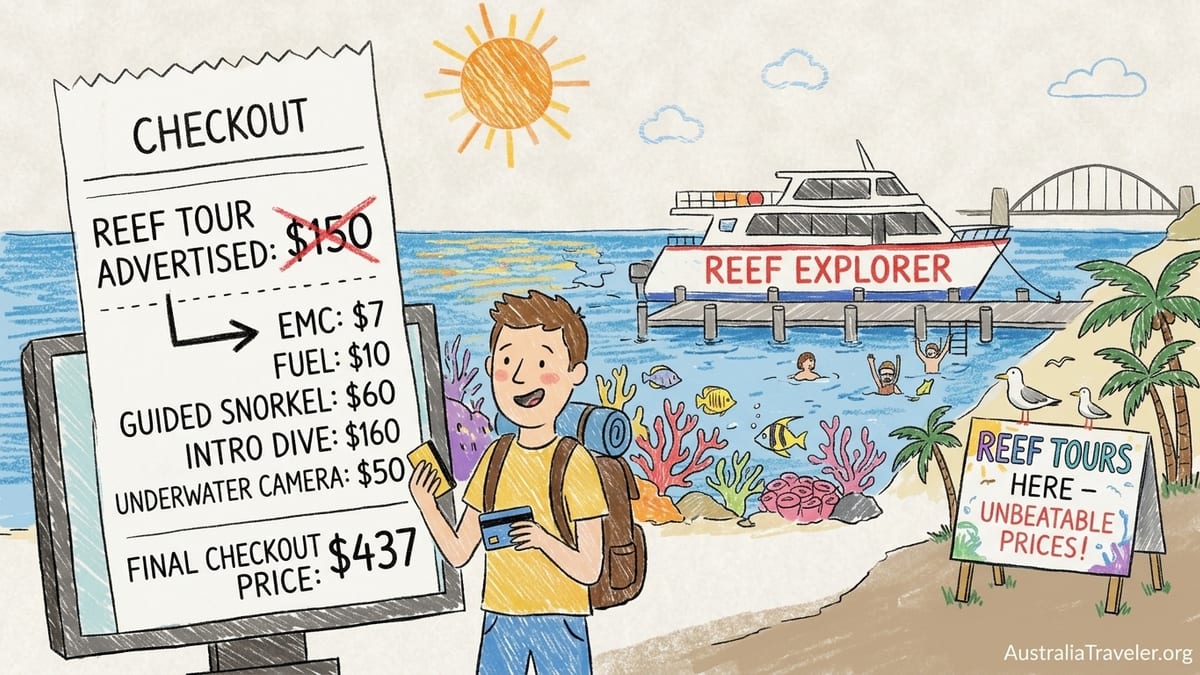
How a Simple Reef Day Trip Gets More Expensive at Checkout
Great Barrier Reef day tours from Cairns are marketed as straightforward: one price for a full day on the reef with snorkelling and lunch. In reality, the number you first see often does not match the figure that leaves your bank account. The difference lies in environmental charges, fuel surcharges and a constellation of extras that can feel optional on paper but heavily promoted in practice.
On my own booking, the base fare for an outer reef trip looked competitive alongside other operators. Only on the final confirmation screen did I notice additional lines for a fuel levy, reef management charge and optional guided snorkel. Some were mandatory, others were not, but the effect was the same: a significant gap between the teaser price and the actual payment.
This experience is not unique. Some Cairns travel agencies warn that certain reef tours still collect reef levies and fuel surcharges at check-in or onboard rather than including them upfront, even though others now build these charges into all advertised fares. The inconsistency makes it difficult for travellers to compare tours on a like-for-like basis and to budget realistically for a day on the water.
It is important to stress that not every operator hides fees. Companies such as Sunlover Reef Cruises now state clearly that their Moore Reef full-day tour price includes both the Environmental Management Charge and a fuel surcharge, and that the fuel component for Moore Reef and Reef & Island in a Day is currently 10 Australian dollars per adult and 5 dollars per child, already counted in the headline fare for travel between 1 April 2026 and 31 March 2027. Other tours, especially those sold through third-party sites, may still separate these costs.
The Environmental Management Charge: What It Is and How It Appears
One of the most misunderstood items on reef tour invoices is the Environmental Management Charge, commonly called the EMC or “reef tax.” This charge is set by the Great Barrier Reef Marine Park Authority and collected from most visitors using commercial tourism operators in the Marine Park. It is not a creation of the boat companies, although they are responsible for collecting and forwarding the money.
The Reef Authority explains that the Environmental Management Charge is calculated on a per person, per day basis for most tourism activities, and that operators must collect it from visitors and remit it under the Great Barrier Reef Marine Park Regulations. The funds support management and conservation of the reef, from compliance patrols to scientific monitoring and education programs. The exact per person amount is reviewed periodically, with operators given advance notice so they can update brochures and price lists.
How this appears to guests varies. Some reef companies now advertise that the EMC is already included in the fare, so there is no separate line for guests to worry about on the day. Sunlover, for example, notes that prices for its Moore Reef full-day tour include the Environmental Management Charge. Others list a base fare and then specify an additional per person levy in the fine print, payable at check-in. A third group passes this task to resellers, who add a generic note such as “additional reef taxes may apply,” without listing the actual amount.
From a transparency perspective, bundling the EMC into the published tour price is the cleanest approach. The guest pays the same total either way, but including the charge avoids the impression that a government conservation fee is an unexpected extra. Problems arise when an advertised fare excludes the EMC, fuel levy and port charges, then promotes itself as cheaper than rivals that fold those costs in.
Fuel Surcharges, Guided Snorkelling and Dive Upgrades
Fuel is another legitimate but sometimes confusing part of the Great Barrier Reef pricing puzzle. Operators burn considerable diesel to reach outer reef sites such as Moore Reef, and fuel prices in Australia have been volatile since the pandemic. To cope with this, several companies introduced separate fuel surcharges that can be adjusted without reprinting every brochure.
Sunlover’s terms and conditions, for instance, state that a fuel surcharge applies to Moore Reef and Reef & Island in a Day tours and is reviewed according to fuel price changes. For the current season it is set at 10 dollars per adult and 5 dollars per child, but Sunlover also notes that on its main price pages this amount is included in the total fare, rather than added at checkout. Other operators and booking agents remain less integrated, listing attractive base fares on comparison sites and flagging fuel levies only in the detailed tour description or in a footnote.
Beyond fuel and reef management charges, the more discretionary extras start to appear. Guided snorkelling is heavily promoted on many boats, often as a way to see more wildlife and gain interpretation from a marine biologist. On outer reef pontoons, prices around 60 to 70 dollars per adult are common for small-group guided sessions at Moore Reef or similar sites. Introductory scuba dives are another big-ticket add-on, with rates that can more than double the price of a day out once a couple or family decides to sign up.
There is nothing inherently wrong with selling guided snorkels or dive upgrades. For nervous swimmers or first-time divers, a small-group tour with a guide can increase safety and confidence. The concern is when these are marketed as almost mandatory to “really experience the reef,” or when booking flows pre-select them as recommended options that guests must actively untick. That framing can push people into spending far more than planned without truly understanding that basic snorkelling in the tour price already offers plenty of reef time and coral viewing.
What Is Included on a Sunlover Moore Reef Day, and What Is Not
To understand the gap between advertised and actual costs, it helps to look at a specific tour in detail. Sunlover’s Moore Reef full-day trip is a widely promoted outer reef option from Cairns, visiting a large pontoon moored at Moore Reef. The current headline price for travel between April 2026 and March 2027 is listed as 317 dollars per adult, 177 dollars per child aged 4 to 15, and 816 dollars for a family of two adults and two children. Sunlover states that these prices include goods and services tax, the Environmental Management Charge and the fuel surcharge.
The inclusions for that fare are broad. Guests receive a return catamaran cruise from the Reef Fleet Terminal in Cairns, around four hours at Moore Reef, snorkelling equipment, use of lycra suits, access to the pontoon, semi-submersible tours or glass-bottom viewing depending on the current program, fish feeding and a buffet-style lunch. For many travellers, those inclusions are sufficient for a full day of snorkelling and reef viewing without extra costs on the water.
Optional extras begin once you look at the activity list. A guided snorkel with a marine biologist is available at an additional fee that recent brochures and booking partners list at around 60 to 70 dollars per adult. Introductory scuba diving carries a separate price again, often in the 140 to 200 dollar range depending on whether a guest chooses one or more dives and whether they book ahead or onboard. Helmet diving and helicopter scenic flights add further layers of optional spending for those with the budget.
Sunlover’s pricing pages are relatively clear about which elements are included and which require an extra payment. Importantly, the Environmental Management Charge and fuel surcharge are described as already in the fare, not payable on the day. Where confusion creeps in is when third-party sellers promote the same tour with only the base inclusions highlighted and place the activity prices deeper in the description. Travellers comparing Moore Reef with competitor pontoons may see similar base fares but very different approaches to bundling, which can lead to surprise when they discover that a “cheaper” trip requires paying extra for snorkel gear or semi-submersible tours that Sunlover includes.
How Other Operators Package Inclusions Differently
Not all Great Barrier Reef tours follow the exact same model as Sunlover’s Moore Reef pontoon. Some operators focus on smaller boats that visit two or three outer reef sites in one day, often appealing to more confident swimmers and certified divers. Others run island-based days at Fitzroy or Green Island with optional glass-bottom boat trips and snorkel hire. The mix of what is bundled and what is sold on top influences how far the checkout price drifts from the headline.
A Cairns-based reef tour specialist notes in its frequently asked questions that reef taxes, meals and snorkelling equipment are included on all of its featured reef tours, while activities such as beginner dives, guided snorkel tours and accommodation pickups are optional. Another booking agency explains that some tours carry a fuel levy or Environmental Management Charge that is not part of the base fare and is paid directly to the operator, highlighting the importance of reading the “extras” section of each listing.
Live-aboard trips and premium small-group charters add further variations. Some overnight boats advertise that reef levies and most dive gear are already included, but charge more for specialty equipment like prescription masks or underwater cameras. A Reddit user describing an overnight reef experience mentioned being initially double-charged for meals and later still billed extra for additional lunches, a reminder that even higher-end packages can carry surprise top-ups if food, drinks or specific dives fall outside the core package.
The key difference is transparency. When operators and agents clearly state that “reef levies are included in the tour price” or that “additional reef taxes may apply, payable on the day,” travellers can decide with full information. When those charges are tucked into fine print or phrased in vague terms like “may apply,” the headline fare ceases to be an honest representation of what the experience actually costs.
Adding the Real-World Costs: Marina Transfers, Meals and Extras
Most visitors to Cairns do not step off a cruise ship directly into a reef catamaran. They start at a hotel or holiday rental somewhere in town or on the northern beaches, and reaching the Reef Fleet Terminal adds another set of costs. Some reef operators offer return hotel transfers into Cairns for an extra fee, which can range from modest shuttle prices for central hotels to noticeably higher charges for Palm Cove, Trinity Beach or Port Douglas pickups.
For a solo traveller staying in central Cairns, walking to the terminal is realistic. For families staying further out, taxi or rideshare fares in both directions quickly inflate the total bill, especially early in the morning when surge pricing can apply. A couple catching a taxi from a northern beaches resort and back may add 80 to 100 dollars to their reef day without noticing it in the tour marketing, because those transport costs sit completely outside the advertised cruise price.
Food is another area where costs creep in. Most outer reef day tours include a substantial onboard lunch, but breakfast and post-cruise meals are up to the traveller. Early departures encourage guests to buy breakfast at the marina or nearby cafes. After returning around 5:30 in the afternoon from Moore Reef or similar tours, many people head straight to dinner while still in town instead of cooking back at their accommodation. For a family of four, buying breakfast and dinner around the marina on reef day can rival the cost of some optional onboard activities.
Then there are minor extras that are easy to overlook in pre-trip budgeting. Renting an underwater camera or GoPro on board may add 50 to 80 dollars for the day, sometimes with an upsell for printed photos or digital packages. Prescription masks can carry a small hire fee for those who need corrective lenses and do not want to invest in a personal mask. Some boats hold refundable deposits on snorkel or dive equipment, which ties up card limits and can cause problems if guests forget to return everything in time at the end of the day.
Sample Price Comparisons: Solo, Couple and Family of Four
To illustrate how the real cost of a reef day can climb, let us work through an example using the current Sunlover Moore Reef pricing and a set of consistent add-ons. These figures are approximate and based on publicly available price information as of the April 2026 to March 2027 season, along with reasonable estimates for ancillary spending in Cairns.
Start with the core Sunlover Moore Reef fare: 317 dollars per adult, 177 dollars per child, 816 dollars for a family of four, with the Environmental Management Charge and fuel surcharge included. Add one guided snorkel per person at a notional 65 dollars per adult and 45 dollars per child, which aligns with recent third-party listings for guided snorkel tours on Moore Reef and similar pontoons. Include an introductory dive for one adult in each booking at an estimated 170 dollars. Add 60 dollars for a shared underwater camera rental per booking. For meals off the boat, assume 25 dollars per person for a basic breakfast and 40 dollars per person for dinner in Cairns. Finally, add 30 dollars total for taxi transfers within central Cairns or modest shuttle fees.
For a solo traveller, the maths looks like this. The core tour price is 317 dollars. One guided snorkel at 65 dollars brings it to 382 dollars. An introductory dive at 170 dollars takes the subtotal to 552 dollars. Add 60 dollars for an underwater camera rental shared perhaps with other solo travellers, 65 dollars for breakfast and dinner combined, and 30 dollars for local transport, and the realistic all-in cost approaches 707 dollars for the day.
For a couple, the base tour fares sum to 634 dollars. Two guided snorkels at 65 dollars each lift this to 764 dollars. One introductory dive for one partner at 170 dollars takes it to 934 dollars, while the other sticks to snorkelling. Add the same 60 dollars for a shared camera rental, 130 dollars for breakfast and dinner for two, and 30 dollars in transport, and the total climbs to around 1,154 dollars for the day.
A family of four using the family fare pays 816 dollars for the core cruise. Two adults and two children adding guided snorkels brings an extra 220 dollars, using 65 dollars per adult and 45 dollars per child, for a subtotal of 1,036 dollars. If one adult opts for an introductory dive at 170 dollars, the total rises to 1,206 dollars. Keep the underwater camera at 60 dollars. Meals off the boat now reach around 260 dollars for breakfast and dinner for four, and transport, even within Cairns, may reach 40 dollars in taxis or shuttle buses. The final approximate figure lands near 1,566 dollars for a single reef day.
Cancellation Rules, Refunds and Who Carries the Risk
Beyond the up-front and onboard costs, the way reef tour operators handle cancellations and changes can significantly affect the real price of a trip, especially for families and those booking months in advance. Most Great Barrier Reef day tours from Cairns provide full refunds if guests cancel a certain time before departure, often 24 hours, although peak seasons may carry longer notice periods. Sunlover, for example, states that full refunds are available for Moore Reef cancellations made at least 24 hours before travel, with a stricter seven-day policy around peak dates.
After that cut-off time, many operators apply a 100 percent charge for guest cancellations or no-shows. Some specify that if a traveller is unable to dive on the day due to failing a medical questionnaire or seasickness, refunds are not available for unused dive options or upgrades. One set of terms for a Cairns reef tour reseller spells this out, noting that refunds are not offered if a passenger has not been cleared to dive on medical grounds but the booking falls within the standard cancellation window.
The situation is different when the operator cancels. If a reef company cancels a tour due to bad weather, mechanical issues or insufficient numbers, guests are usually offered a choice of a full refund or transfer to another date or tour. Travel agencies selling reef experiences highlight that operator cancellations for safety reasons are treated more generously than guest choice cancellations. In those cases, many operators refund the full fare even if the decision is made on the morning of travel.
For travellers, this split matters. A family arriving in Cairns with one or two days available for reef trips might face tough weather forecasts and be unsure whether to commit. If they book and then decide not to travel inside the 24-hour window, they may lose the entire fare. If they wait and the tour sells out or is cancelled by the operator, they may miss the reef altogether. It is one reason why several reef companies and agencies strongly recommend comprehensive travel insurance that covers trip cancellation, especially for multi-day reef packages and live-aboard trips.
When Pricing Crosses the Line from Confusing to Misleading
Many of the hidden-seeming costs on Great Barrier Reef tours have reasonable justifications. The Environmental Management Charge funds reef protection. Fuel levies respond to global energy prices. Guided snorkelling and introductory diving are optional enhancements that require extra staff and equipment. Problems arise when these costs are not explained clearly up front, or when optional extras are presented in ways that feel like obligations rather than choices.
Headline pricing becomes misleading when key compulsory charges are excluded from the main fare and only revealed in small print or at checkout. For example, a tour listed at a discount on a comparison site may look significantly cheaper than a rival, only for a substantial reef levy and fuel surcharge to be added later. Another red flag is when a booking path pre-selects an expensive dive package or premium lunch upgrade and labels it “recommended,” so that travellers who rush through the process unwittingly commit to an experience they did not really want.
Upselling is not unique to the reef industry, but the stakes feel higher when families have saved for a once-in-a-lifetime trip to the Great Barrier Reef. Add-on photos, second dives, premium seating areas and “priority” check-in schemes can easily transform a purchase from a special splurge into something that borders on financial regret. Some of the strongest criticism from past guests focuses not on the core tour but on feeling pressured to buy underwater photo packages or second activity passes onboard, sometimes at prices not advertised before departure.
It is worth emphasising that there are positive examples. Operators that clearly state “our prices are the full price, fuel levy included, so the figure you see is the figure you pay,” and that list optional activities with plain, non-pressured descriptions set a higher standard. Guests on those tours may still spend a little more than planned on extras, but they rarely leave the boat feeling tricked by the initial fare.
The Takeaway
My own Great Barrier Reef day at Moore Reef was memorable for the right reasons once I was actually in the water. The corals, fish life and sheer scale of the outer reef are still extraordinary, and the crew worked hard to keep everyone safe and relaxed. The frustration came from the journey between brochure and boarding gate, where a neat brochure price unravelled into a far more complicated bill.
If I were booking again, I would start with a detailed prebooking checklist. First, I would confirm in writing whether the Environmental Management Charge and any fuel surcharge are already included in the advertised fare. Second, I would ask for a list of all optional extras with current prices, especially guided snorkels, introductory dives, helmet dives, underwater photographs and camera hire. Third, I would calculate realistic costs for hotel transfers, breakfast, dinner and any parking or taxi use on the day.
There are also extras I would refuse next time. I would skip pre-booked underwater photo packages and focus on a simple shared camera rental if needed. I would decline premium meal upgrades and stick with the standard onboard lunch included in the fare. I would resist second dives or extra activity passes sold onboard unless conditions were perfect and I still had both the energy and budget late in the day. Most importantly, I would be comfortable saying no to high-pressure upsells once I had already committed to a substantial base fare.
The Great Barrier Reef is worth the effort and expense, but it should not require detective work to discover the real price of visiting it. Travellers who read the fine print, insist on clarity about compulsory charges and decide in advance which extras genuinely matter to them will enjoy the reef more and resent the bill less.
FAQ
Q1. What exactly is the Environmental Management Charge on Great Barrier Reef tours?
The Environmental Management Charge is a government-set fee collected by reef tour operators on behalf of the Great Barrier Reef Marine Park Authority. It is charged per person per day on most commercial reef trips and helps fund management, monitoring and protection of the Marine Park. Some operators build this charge into their advertised fares, while others list it as a separate levy.
Q2. How can I tell if my reef tour price already includes the Environmental Management Charge and fuel surcharge?
Check the operator’s official price page and terms, not just a booking site summary. Look for wording that states that the Environmental Management Charge and any fuel surcharge are included in the fare. If the information is unclear or a reseller only says that “additional levies may apply,” contact the operator or agent directly and ask for a full breakdown before you pay.
Q3. Are guided snorkelling tours on the reef worth paying extra for?
Guided snorkel tours can be valuable if you are a nervous swimmer, visiting with children or particularly interested in learning about reef ecology from a marine biologist. On outer reef pontoons they often cost in the range of several dozen dollars per person. Confident snorkellers who are happy to explore defined areas on their own may find that the included, unguided snorkelling is enough and can choose to skip the extra fee.
Q4. How expensive are introductory scuba dives on Great Barrier Reef day tours?
Introductory scuba dives on day tours from Cairns and Port Douglas commonly cost well over one hundred dollars per person, on top of the base tour fare. Prices vary by operator and by whether you book in advance or onboard, and some packages offer a second discounted dive. Because the cost is significant, it is wise to decide in advance whether you truly want to try diving or whether snorkelling will meet your expectations.
Q5. What hidden costs should families look for when budgeting for a reef day?
Families should pay close attention to whether child snorkel gear, lycra suits and semi-submersible tours are included or sold as extras. They should factor in hotel transfers or taxi fares to and from the marina, plus breakfast and dinner around the tour, which can be substantial for four people. Finally, they should look at the prices of optional activities like guided snorkels, introductory dives and underwater photo packages, as these can dramatically increase the total cost of a reef day.
Q6. What happens if the operator cancels my reef tour due to bad weather?
If the operator cancels a tour for safety reasons such as high winds or rough seas, guests are usually offered a full refund or the option to move to another date or, sometimes, a different tour. The exact policy varies by company, so it is important to read the terms and conditions when booking. Operator cancellations are generally treated more generously than customer-initiated cancellations.
Q7. Do I get a refund if I decide not to travel within 24 hours of departure?
Most reef tour operators in Cairns apply a strict cancellation window, often 24 hours before departure for standard dates and longer for peak periods. If you cancel inside that window for personal reasons, you are likely to forfeit all or most of the fare. Some operators also state that unused dive options or upgrades are non-refundable if you change your mind on the day or do not pass a medical screening.
Q8. Are underwater photo packages and camera rentals worth it?
Underwater photo packages can be a fun souvenir, but they are often sold at a premium and can feel like an unnecessary extra if you are watching your budget. Renting a shared underwater camera for a group or family can be a more economical choice. If you already own a waterproof phone case or camera, bringing your own equipment avoids these charges entirely.
Q9. How can I avoid feeling pressured into buying extras on a reef tour?
The best strategy is to decide in advance which extras you are willing to pay for and to set a clear budget. When booking, untick pre-selected add-ons you do not want. Onboard, remember that guided tours, extra dives and photo packages are optional, even if they are marketed enthusiastically. Politely declining and focusing on the inclusions you already paid for can make the day feel more relaxed.
Q10. What questions should I ask before booking any Great Barrier Reef tour?
Before you book, ask whether the advertised price includes the Environmental Management Charge, fuel surcharge and snorkelling equipment. Request current prices for optional activities like guided snorkels and introductory dives. Clarify the cancellation policy, including what happens if you are unable to dive on the day for medical reasons. Finally, ask about hotel transfers, departure and return times, and what food and drinks are included so you can plan the rest of your day and budget accurately.