


From the moment the tiny propeller plane banked over the southern Great Barrier Reef and Lady Elliot Island appeared below as a pale ring in a vast cobalt sea, I knew this trip would feel very different from the big mainland resorts I had visited before. Remote, wind-brushed and almost completely encircled by reef, the island looked more like a shipwrecked sailor’s dream than a packaged holiday. What followed over three days in late June 2025 was a very personal immersion in manta country and turtle habitat, framed by strict luggage limits, basic rooms, serious conservation work and some of the most accessible snorkeling I have ever experienced.
Arriving by Small Plane at the Southern Tip of the Reef
I began my Lady Elliot Island trip in Bundaberg, a modest regional airport about 15 minutes’ drive from town. After an early commercial flight from Brisbane, I checked in with the Lady Elliot Island desk for the onward transfer. Check in opened roughly 50 minutes before departure and felt more like joining a small expedition than catching a regular airline service. Staff weighed not just my soft duffel bag but me as well, explaining that the aircraft’s weight and balance calculations are critical when you are flying low over the ocean in a 10 to 19 seat plane.
The luggage allowance was a firm 15 kilograms per person, including carry-on, with the option to pay for limited excess weight at a relatively steep per-kilogram rate. Because I was returning to Bundaberg, the office offered secure storage for anything I did not need on the island, which turned out to be almost half my original suitcase contents. Swapping roller bags for a soft-sided duffel and a small daypack instantly made the trip feel more like an expedition than a holiday.
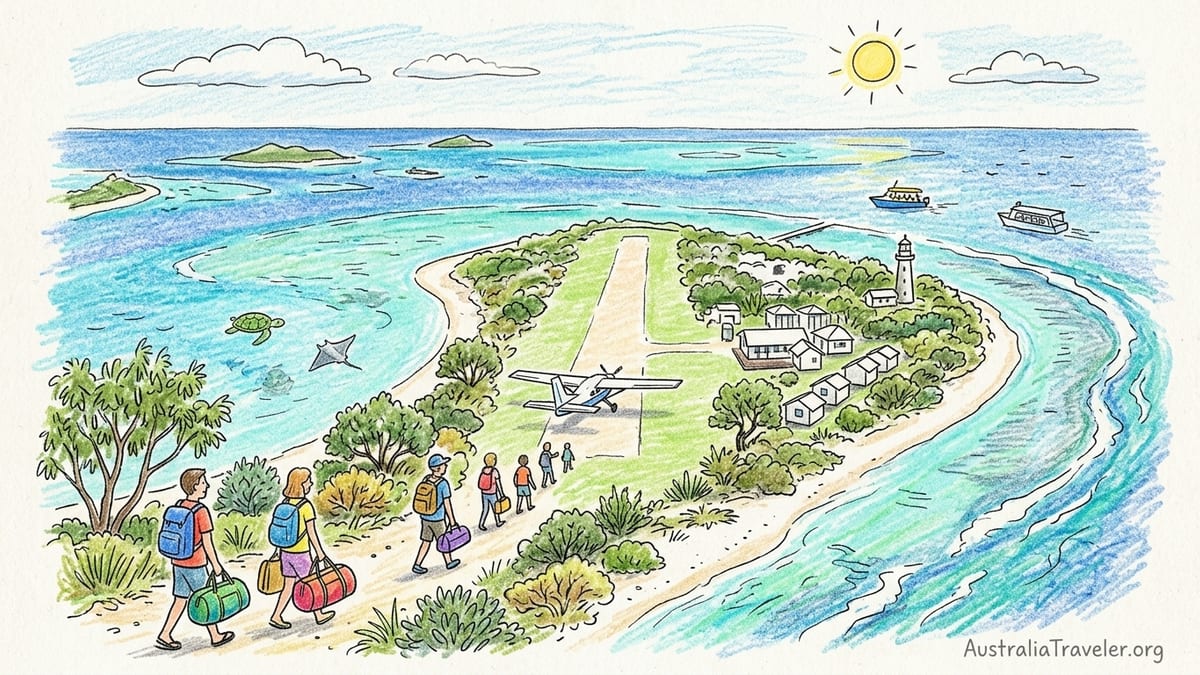
The flight from Bundaberg to Lady Elliot Island took around 30 minutes in clear winter weather. We flew low enough that individual coral bommies and sand patches were clearly visible through the aircraft windows. As the mainland coastline slipped behind us, the deep blue turned turquoise, then almost milky over the shallows. When the pilot pointed out the Capricorn and Bunker Group spread beneath us, the scale of the southern Great Barrier Reef finally clicked. Lady Elliot itself appeared as a flat oval of blinding white coral rubble ringed by a turquoise lagoon and darker outer reef, with a slender airstrip cutting straight through the middle.
The landing is not something you forget. There is no separate runway in the mainland sense, only the narrow grass and compacted coral airstrip that occupies the center of the island. On approach we skimmed in parallel to the reef edge, white surf exploding on the outer wall, then bumped onto the strip with a series of firm jolts. Stepping out of the cabin, I was hit by a mix of warm salt air, seabird calls and the low hiss of waves breaking on the far reef. No jet bridges, no buses, just a short sandy path leading past the tiny reception area and shaded seating to the heart of the eco resort.
First Impressions of a Coral Cay, Not a Mainland Resort
Lady Elliot is a true coral cay on the very southern edge of the Great Barrier Reef, about 80 kilometers northeast of Bundaberg. You notice this as soon as you start walking. There is almost no soil, only loose coral rubble and patches of sand held together by hardy coastal vegetation and rehabilitated forest. Instead of manicured lawns and paved promenades, the “streets” between the accommodation and dining areas are sandy paths edged with pisonia trees, pandanus and shrubs that have been painstakingly replanted after decades of historical guano mining stripped the island bare.
Coming from large mainland gateways such as Cairns or Airlie Beach, the contrast is stark. There are no multi-story hotels, no shopping arcades, no traffic. The main resort complex consists of a low, weathered building that houses reception, the dining room and bar, and a handful of small wings and cottages strung out along the eastern and western sides of the island. Power lines are kept minimal, Wi-Fi is patchy and mobile coverage is non-existent, something staff are upfront about. After the initial twitch of separation anxiety, the lack of connectivity felt like a feature rather than a flaw.
What you do have in abundance is water. From almost anywhere on the island, you can see the lagoon on the sheltered eastern side or the rougher reef edge to the west. At low tide, the lagoon retreats to reveal tide pools and coral formations that can be explored with reef shoes on guided walks. At higher tides, that same lagoon becomes a beginner-friendly snorkeling area. Everything revolves around the reef, the tides and the wildlife, not scheduled entertainment or nightlife.
Arriving in late June placed my visit squarely in what the resort and marine scientists describe as peak manta ray season, when these giants gather in larger numbers at cleaning stations around sites like Lighthouse Bommies just off the island. It is also outside turtle nesting and hatching season, which runs roughly from November through April, so my expectations were tuned to manta encounters and general reef life rather than beach-based turtle activity.
Snorkeling With Turtles and Chasing Manta Shadows
Across three days I snorkeled both from shore and on guided boat-based “snorkel safaris,” as well as joining a glass-bottom boat tour. I visited in clear, cool winter conditions, with daytime highs around 22 to 24 degrees Celsius and water temperatures sitting at roughly 21 to 22 degrees. I wore a 5 mm wetsuit that the resort provided as part of the activity cost, and I was glad of the extra warmth during longer sessions.
My most memorable turtle encounters came not on the outer reef but in the lagoon. On the afternoon of my first day, around mid-tide, I entered near the Coral Gardens beach hut on the eastern side under the guidance of one of the resort’s marine biologists. Visibility was a bit reduced due to wind chop, but within minutes we were drifting over scattered coral heads teeming with damselfish and parrotfish. A green turtle appeared beneath us, grazing calmly on algae and occasionally surfacing for air. Over the next hour we saw three individual turtles, including what the guide identified as a sub-adult hawksbill by its sharply hooked beak.
The next morning, with calmer conditions and a slightly higher tide, I joined a snorkel safari that launched from the boat ramp on the more exposed western side, heading toward sites known locally as Lighthouse Bommies and Coral Gardens. This was specifically sold as a chance to look for manta rays and larger marine life, with very clear messaging that nothing was guaranteed. The crew described how mantas are often seen circling cleaning stations here from roughly May to September, but also noted that plankton levels, currents and weather all influence what shows up on any given day.
On that particular June morning, the mantas never materialised. What we did have was 20-plus meters of visibility and a slow drift over large coral bommies covered in soft corals, anemones and schooling fusiliers. We spotted half a dozen green turtles, one large loggerhead cruising at depth and a fleeting glimpse of a reef shark that vanished into the blue almost as soon as someone pointed. It was thrilling, but it was also a useful reminder that even in one of the Great Barrier Reef’s manta hotspots, wildlife remains unpredictable. Later that afternoon a different group reported seeing two mantas circling a bommie in the same general area, reinforcing the point that timing and luck play a huge role.
Shore Snorkels, Guided Safaris and Glass-Bottom Boats
One of Lady Elliot’s real strengths is the variety of ways you can experience the reef. Shore snorkeling from the beach is free once you have hired or brought your own mask, snorkel, fins and optional wetsuit. Staff at the dive shop recommend specific entry and exit points each day based on wind, tide and swell. During my stay, the eastern lagoon entries were usually advised for less confident swimmers, especially around mid to high tide when there was enough depth over the coral heads to avoid contact. The western side entries near the Lighthouse and Coral Gardens huts were reserved for stronger swimmers comfortable with swell and currents.
Guided snorkel safaris, which are run by boat to outer reef sites, incur an additional cost per session but include gear, in-water guides and briefings. They are especially valuable if you want to explore areas where manta rays often gather or where the reef structure is more complex, such as drop-offs and cleaning stations. On my trip I joined two boat snorkels: the manta-focused morning at Lighthouse Bommies that yielded turtles and reef sharks instead, and a calmer afternoon drift over Coral Gardens that delivered clouds of anthias, larger schools of surgeonfish and a spectacular maze of branching coral heads.
The glass-bottom boat tours offer yet another angle, particularly for anyone in the group who is less confident in the water or visiting during rougher conditions. My midday glass-bottom trip skirted the outer edge of the lagoon and the beginning of the drop-off. Watching a green turtle glide past the window, followed by a ray lifting off the sand, gave my non-snorkeling fellow passengers a real sense of participating in the marine world without having to brave masks and fins. The guide layered in explanation about coral species, fish behavior and the island’s long-term monitoring projects.
Complementing all this are daily marine biology talks and reef walks. During low tide one morning I joined a guided reef walk in the lagoon, wearing sturdy reef shoes provided by the resort. We picked our way over coral rubble and living coral outcrops as the guide pointed out giant clams, sea cucumbers and grazing sea hares. The emphasis throughout was on not touching live coral, never standing on bommies and keeping a safe distance from wildlife, themes repeated in every briefing I attended.
Tides, Coral Beaches and Staying Safe on the Reef
Because Lady Elliot is a true coral cay, beach and water access are controlled more by tides and swell than by sandy shoreline. There are patches of soft sand for lounging, especially near the main resort area, but much of the foreshore is coral rubble. Sturdy footwear is essential when walking around the island or entering the water, and the resort provides very direct briefings about where you can and cannot walk, particularly during turtle nesting months when certain parts of the beach are off-limits at night.
Tide charts are posted in prominent places around the resort, and the daily activities board lists recommended lagoon or western side snorkel times. At very low tide the lagoon becomes too shallow for safe snorkeling without risking contact with living coral, so the focus shifts to reef walks or, if weather permits, boat trips to deeper sites. Conversely, during higher tides and calm conditions the lagoon turns into a gentle nursery where even beginners can float over coral gardens with relatively little concern about currents.
The water itself demands respect. Even in the more sheltered lagoon, currents can pick up and visibility can change quickly with passing cloud or wind shifts. On one afternoon snorkel the water went from crystal clear to noticeably milky as the tide turned and fine sediment lifted. The resort’s advice to always snorkel with a buddy and not venture beyond marked zones felt appropriate rather than heavy-handed. On the more exposed western side, entry and exit points align with channels in the reef where swell is manageable, and guides emphasise the need to keep an eye on both your position and your energy levels.
Sunscreen choice is another repeated safety consideration. The resort prominently promotes reef-safe formulas and asks guests to avoid aerosol sprays and oxybenzone-based sunscreens. Between snorkeling, reef walks and general island wandering, sun exposure is intense even in winter. Light long-sleeve swim shirts, broad-brimmed hats and frequent shade breaks made the difference between comfortable exploration and fried shoulders.
Rooms, Meals and the After-Hours Atmosphere
Accommodation on Lady Elliot Island is best described as comfortable but basic. I stayed in an Eco Cabin on the eastern side, a simple duplex-style room with a small front deck, double bed, bunk beds, ceiling fan and shared bathroom block a short walk away. The walls were thin enough that I could hear my neighbors chatting at night and the wind when it picked up. There was no television, no air-conditioning and no polished resort styling, just clean bedding, mosquito screens and a small desk. Higher-category Reef Units and Sunset Suites offer private bathrooms and a bit more space, but even these retain a simple, weathered feel.
Meals are served buffet-style in a central dining room that doubles as the island’s social hub. My package included breakfast and dinner, with lunch available at additional cost or bundled into day-trip packages. In June 2025, main buffet dinners leaned toward hearty, crowd-pleasing food: roast meats, curries, salads and simple desserts, with at least one vegetarian option each night. Breakfast featured the usual cereals, fruit, eggs and toast, along with a coffee machine that quickly became a morning focal point.
Service was friendly and relaxed rather than polished. Staff remembered names by the second day, were happy to chat about the day’s wildlife sightings and were candid about weather-related limitations. When a patch of strong winds forced the cancellation of an afternoon snorkel safari, the team immediately suggested alternative talks and a behind-the-scenes sustainability tour, rather than leaving guests at a loose end. There is a small bar with outdoor seating facing the western side, and sunset drinks became an informal ritual as day guests checked out and overnight visitors lingered.
The real magic of staying overnight reveals itself once the last day-trippers depart on the late afternoon flights. By 5 pm the airstrip falls silent, the pathways empty and the island shrinks back to a low murmur of resident guests, staff and thousands of seabirds. I wandered the perimeter track at dusk, with noddy terns and shearwaters circling overhead, and felt an isolation that is impossible to recreate on larger, more developed islands. The night sky, too, came alive. With no mainland light pollution and limited on-island lighting due to both conservation and practicality, the Milky Way arched clearly over the lighthouse, and the sound of the surf on the distant reef provided a constant backdrop.
Putting the Eco Claims to the Test
Lady Elliot Island Eco Resort makes strong conservation claims, from renewable energy to habitat restoration. During my June 2025 stay I joined a behind-the-scenes sustainability tour that dug into the details and also cross-checked several points against external sources. Historically, Lady Elliot was heavily degraded by 19th-century guano mining, which stripped vegetation and destroyed seabird habitat. Since taking over in the 1980s, the current leaseholders have worked with the Great Barrier Reef Marine Park Authority and the Great Barrier Reef Foundation on large-scale replanting, invasive-species control and seabird habitat recovery. Independent reporting in Australian media in October 2026 confirmed that the island has shifted from a near-barren “wasteland” to a densely vegetated seabird haven, with aerial photographs showing a ribbon of forest now framing the airstrip.
Energy use is another key pillar. According to both the resort and external partners such as the Great Barrier Reef Foundation, the island now runs predominantly on solar power backed by battery storage, with diesel generators retained for backup. Figures shared publicly mention hundreds of solar panels and more than two hundred batteries installed as part of a long-term transition toward 100 percent renewable energy. While I could not independently verify the exact percentage of renewable supply during my stay, the physical infrastructure was impossible to miss: solar arrays tucked behind the accommodation zone, battery banks housed in purpose-built structures and a clear preference for energy-efficient lighting and appliances.
Water and waste management also operate under tight constraints. All freshwater on the island is produced by desalination, which encourages a culture of conservation among both staff and guests. Showers are functional rather than luxurious, with signage reminding visitors to keep them short. Waste is separated for recycling where possible, and glass bottles are minimized. The resort does charge premium rates compared with many mainland properties, but it is equally clear that a significant portion of that cost goes into maintaining the logistics and infrastructure required to run a self-contained operation on a tiny coral cay while meeting strict environmental regulations.
None of this makes Lady Elliot “perfect.” Air travel to reach the island carries its own emissions, and importing almost all food and materials adds to the footprint. There are also the usual tensions between offering enough comfort to attract paying guests and limiting development to protect the very environment those guests come to see. What impressed me, though, was the openness of staff about these trade-offs, the visible partnership with external scientific bodies, and the tangible, island-wide results of decades of restoration work.
Counting the Cost: Day Trip Versus Staying Several Nights
The single biggest shock for many potential visitors is the cost. Access to Lady Elliot is only by small aircraft from departure points such as Bundaberg, Hervey Bay, the Gold Coast and Redcliffe near Brisbane. Scenic flights bundled with resort packages are priced per person and can easily rival or exceed the nightly accommodation cost, especially from the more distant departure points. By the time you factor in return flights, accommodation, meals and snorkeling activities, a multi-night stay quickly becomes a significant investment for most travelers.
To decide whether to visit as a day trip or to stay two or three nights, it helps to look at how much time you actually get in the water and with the wildlife. A typical day trip from Bundaberg or Hervey Bay might depart mid-morning and return in the late afternoon, giving around five to six usable hours on the island once check-in, transfers, briefings and lunch are accounted for. Within that window you might manage one lagoon snorkel and one guided activity such as a glass-bottom boat tour or snorkel safari, plus a short reef walk if tides align. Weather hiccups or airline delays can easily compress that even further.
By contrast, my three-day, two-night stay translated into six separate snorkeling or in-water sessions, two glass-bottom and boat-based activities, a reef walk and multiple unstructured walks and birdwatching loops around the island. Because I was there across different tides and times of day, I saw the lagoon transform from a shallow maze of coral heads at low tide to a calm turquoise pool at mid-tide and then to a deeper snorkeling area at high tide. I also had more chances to time my snorkel safaris with favorable conditions and plankton levels. While manta rays eluded me personally despite being in season, other guests staying longer did report encounters during overlapping dates, underlining how extra days increase your odds.
Financially, the flights are a fixed cost whether you stay one day or several, so the per-hour value of your time with the reef improves with each additional night. Accommodation and meal packages are certainly not cheap, and the rooms are more akin to well-kept cabins than high-end resort suites. Yet when I compared the total cost of my three-day stay to what I might have spent on a series of full-day boat trips from a mainland base, including transfers and meals, the difference was less dramatic than it first appeared. Where Lady Elliot diverges is in charging you that sum to be based right on the reef itself, with sunrise and sunset access and no need to board a large vessel every morning.
The Takeaway
Lady Elliot Island is not an easy, casual add-on to a Queensland itinerary. Flights are expensive, luggage restrictions are strict and the rooms would disappoint anyone expecting five-star mainland luxury. Coral rubble beaches can be hard on bare feet, weather can disrupt boat-based activities, and the most iconic wildlife experiences such as manta rays or close turtle encounters are never guaranteed, even in peak season. For some travelers that combination of cost, basic comfort and uncertainty will feel like too big a gamble.
For others, including me, the payoff is enormous. The experience of stepping off a small aircraft directly onto a coral cay, of walking from your cabin to the water’s edge in under a minute, and of snorkeling with turtles over healthy coral gardens with no other islands in sight is very hard to replicate elsewhere. The visible results of long-term habitat restoration, the genuine emphasis on renewable energy and conservation, and the enforced digital detox all contribute to a sense that you are visiting a functioning research-friendly nature sanctuary rather than a theme park.
Who will benefit most from staying overnight rather than visiting on a day trip? Confident swimmers and snorkelers who value multiple chances at in-water encounters, photographers chasing different light and tide conditions, families keen on a fully immersive wildlife education experience, and conservation-minded travelers who appreciate seeing restoration in action will all gain from at least two or three nights. Very nervous flyers, those with extremely tight budgets or travelers who prefer polished luxury may be better served by a mainland base with day tours to outer reefs.
Looking back at my late June 2025 visit, I left without the manta ballet I had quietly hoped for, but with memories of turtles in shifting light, seabird-filled sunsets and quiet walks across an island that has clawed its way back from near ecological ruin. For me, that made the journey not just worthwhile but important, a reminder that when done carefully, tourism can help protect the very places that first drew us there.
FAQ
Q1. How do you get to Lady Elliot Island, and from where do the flights depart?
Flights to Lady Elliot Island are operated on small aircraft from several Queensland departure points, most commonly Bundaberg and Hervey Bay, with additional services from the Gold Coast and Redcliffe near Brisbane. All access is by air, and flights are arranged through the island’s booking system rather than regular commercial airlines.
Q2. What is the luggage allowance on the small planes to Lady Elliot Island?
The standard luggage allowance on the small aircraft is around 15 kilograms per person, including checked and carry-on, with a preference for soft bags. Limited excess weight can be purchased at a per-kilogram surcharge, and some departure offices offer luggage storage for items you do not take to the island.
Q3. When is the best time of year to see manta rays around Lady Elliot Island?
Manta rays can be seen at Lady Elliot throughout the year, but larger numbers usually gather between roughly May and September, especially around cleaning stations such as Lighthouse Bommies. Even in this peak period, sightings remain dependent on conditions and are never guaranteed.
Q4. What about turtle nesting and hatchling season on Lady Elliot Island?
Green and loggerhead turtles typically nest on Lady Elliot Island’s beaches between about November and March, with hatchlings emerging and heading to the sea roughly from February through April. During these months, some beach areas may be restricted at night to minimise disturbance, and guided turtle walks may be offered.
Q5. Is the snorkeling suitable for beginners, or do you need to be an experienced swimmer?
The sheltered lagoon on the eastern side provides relatively calm, shallow conditions that are well suited to beginners and families, particularly around mid to high tide. Stronger swimmers can join guided snorkel safaris by boat to deeper outer reef sites, but all visitors should be comfortable in open water and follow staff advice on tides, entries and currents.
Q6. How basic are the rooms, and is the island suitable for travelers who like luxury?
Rooms on Lady Elliot range from simple eco cabins with shared bathrooms to more spacious units with private facilities, but all are modest compared with mainland resorts. There is no air-conditioning in most categories, no televisions and very limited connectivity, so travelers seeking high-end luxury may prefer other Great Barrier Reef options.
Q7. How much does a stay on Lady Elliot Island cost compared to a mainland reef trip?
Once you factor in return scenic flights, accommodation and meals, a multi-night stay on Lady Elliot generally costs more than staying on the mainland and booking a single day trip. However, because the flight cost is fixed, staying two or three nights often provides much better value per hour of reef time than a short visit.
Q8. What conservation measures are actually in place on the island?
Lady Elliot Island has extensive solar power and battery systems to reduce diesel use, strict water and waste management, and long-running habitat restoration programs in partnership with scientific and conservation bodies. Large areas of the island have been revegetated after historical mining, and visitor activities are closely managed to protect both reef and wildlife.
Q9. Is Lady Elliot Island suitable for children and families?
Families who enjoy nature and do not mind simple accommodation often find Lady Elliot rewarding. The lagoon offers relatively gentle snorkeling, and daily reef walks, marine biology talks and glass-bottom boat trips provide structured learning. Parents should be prepared for strong sun, coral rubble underfoot and the absence of typical resort-style kids’ clubs.
Q10. Who should consider a day trip instead of an overnight stay?
Travelers with tight budgets, very limited time or severe anxiety about flying in small aircraft may prefer a day trip from Bundaberg or Hervey Bay. A day visit can still include a lagoon snorkel and a guided reef activity, though it allows far fewer chances for wildlife encounters than a multi-night stay.