


I still remember standing in an Airlie Beach tour office, credit card in hand, hovering over the decision to drop several hundred dollars on a one hour Heart Reef scenic flight. The glossy poster showed the classic image you have already seen on postcards and airline ads: a perfect turquoise heart set in electric blue water, a tiny plane gliding overhead. The reality I was being asked to pay for was rather different: almost A$600 for two adults in a light aircraft, roughly 60 minutes in the air, a few seconds over the heart-shaped coral itself, and no chance to actually snorkel there. I walked out without booking that day and only flew the route later, on a different trip, once I had done a lot more homework. That delay turned out to be the best decision I could have made, because it completely changed the way I see the value of Heart Reef flights.
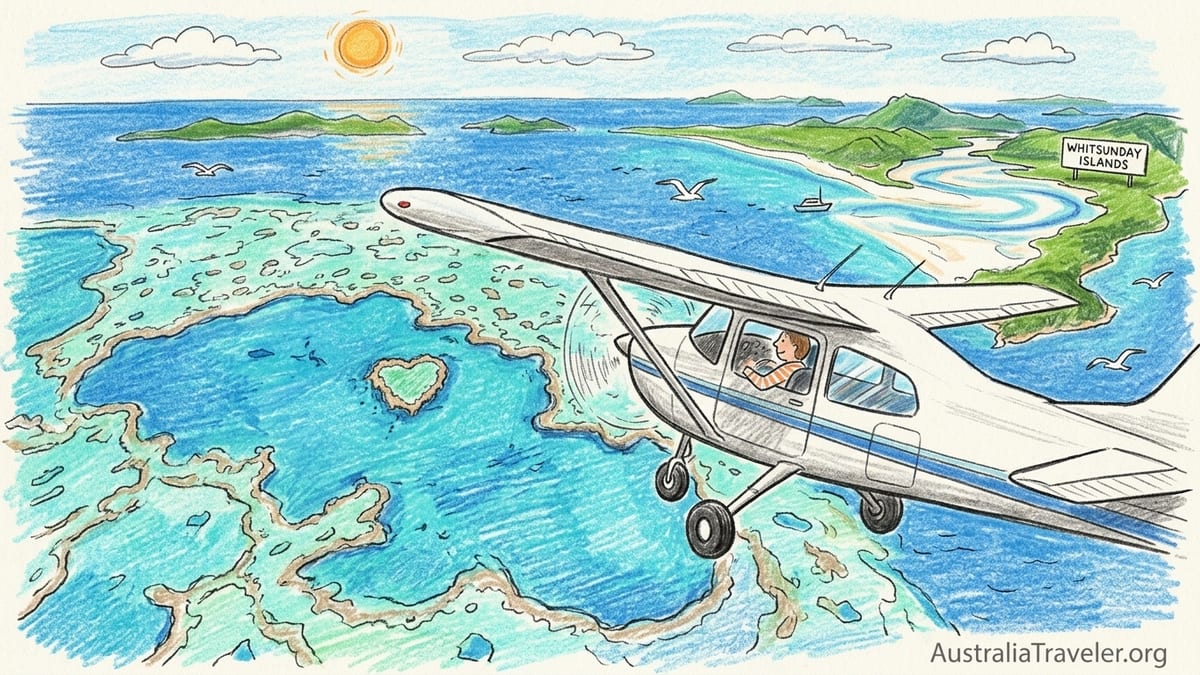
What You Really See On A Heart Reef Scenic Flight
Heart Reef is a naturally heart-shaped coral bommie tucked inside Hardy Reef, part of the outer Great Barrier Reef off the Whitsunday coast. From the air it is genuinely beautiful, but it is also surprisingly small. On my flight from Airlie Beach, we spent most of the time crossing Conway National Park, the Whitsunday islands, Whitehaven Beach and Hill Inlet before finally reaching the outer reef. Only a couple of minutes of that hour was spent near Heart Reef itself, and the famous postcard view lasted for a matter of seconds on each pass.
Most fixed-wing Heart Reef flights from Airlie Beach or Proserpine follow a similar pattern. Operators like Air Whitsunday, Reef Wings and Whitsunday Air Tours sell 60 to 70 minute “reef and island” scenic flights that include Conway Ranges, the Whitsunday group, Whitehaven Beach, Hill Inlet and then several reef formations out at Hardy Reef, with at least one loop over Heart Reef. Recent pricing sits roughly in the A$289 to A$335 range for these aeroplane flights, with guaranteed window seats and hotel transfers from Airlie Beach included in many cases.
Helicopter products are usually shorter in total distance but more focused. From Hamilton Island, for example, Hamilton Island Air lists a one hour Heart Reef and Whitehaven Beach scenic helicopter flight at about A$800 per person, flying over Whitehaven, Hill Inlet, Whitsunday Island and the Great Barrier Reef before circling Heart Reef and returning via Hook Passage and Cid Harbour. From Airlie Beach, family-run helicopter outfits quote around A$895 per person for a 60 minute “Reef and Whitehaven” itinerary that adds Heart Reef and nearby outer reef systems.
In practice this means that on any Heart Reef specific product you will certainly see the Whitsunday islands from the air, glide over the bright white curve of Whitehaven Beach and the swirling sands of Hill Inlet, then continue out to the reef where Heart Reef is one tiny focal point in a much wider patchwork of coral lagoons. It is a wonderful overview of the region, but the heart-shaped coral is the punctuation mark, not the main chapter.
The Gap Between Postcard Photos And The View From Your Seat
Before I paid for a scenic flight, most of my impressions of Heart Reef came from promotional photos. These are almost always taken from a helicopter with the doors removed, a photographer sitting alone beside the open frame, shooting with a long lens in bright, clear conditions. That is not what most passengers experience. On my flight, I was in a high-wing light aircraft with eight seats, fixed windows and a wing strut that neatly bisected the view every time I tried to frame a photo.
Inside a light aircraft, reflections from the perspex can be significant, especially in the middle of the day when the sun is high. I could clearly see my own shirt and the light coloured interior of the plane ghosted over the reef in many of my images. Tilting the camera and pressing it right against the window helped, but it is still nothing like the crystal-clear angles in marketing material. If another passenger is in the front seat, they may get the cleanest view; those in the back will have to work around the wing, struts and other heads.
Helicopters improve some of these issues. When I later flew a heli sector, the view through the bubble canopy was much more open and the pilot could bank the aircraft so that both sides saw the reef. When doors-off flights are available, reflections are reduced dramatically. The catch is that these helicopter experiences are sold at a heavy premium, and they still move quickly. Over Heart Reef itself we had time for a couple of loops, perhaps a minute of clear viewing each way, while the pilot lined up the classic angle and narrated over the headsets. Blink, check your camera settings or adjust your headset and the moment is gone.
Weather is another factor most brochures glide past. Operators will not fly in unsafe conditions, but they do operate on hazy or partly cloudy days. High cloud can soften the colours and reduce the contrast between sand, coral and lagoon. Wind can create chop on the water, breaking up the glassy surface that makes for those perfect turquoise gradients. On one of my flights the light was slightly dull, which made the reef look less luminous than the brochures suggested. Heart Reef was still recognisably heart-shaped, but the cinematic pop simply was not there.
No, You Cannot Snorkel Inside Heart Reef
One of the biggest misconceptions I encounter when talking to other travellers in the Whitsundays is the belief that Heart Reef flights include time to snorkel inside the heart-shaped formation. You cannot. Heart Reef sits within a protected section of Hardy Reef and is off limits to swimmers and snorkellers. Authorities and operators are very clear that viewing is from the air only, specifically to protect the fragile coral structure.
Where a package includes swimming or snorkelling, the in-water component happens at a different part of Hardy Reef or a nearby lagoon, often from a purpose-built pontoon. Cruise Whitsundays, for example, runs day trips to its Hardy Reef pontoon, about 39 nautical miles offshore, where guests can snorkel along the reef wall, use semi-submersibles and glass-bottom boats, and even stay overnight in reef beds. Scenic flight add-ons, when offered, simply route the aircraft over Heart Reef while you travel between the islands and the pontoon; you still never enter the heart lagoon itself.
High-end helicopter products occasionally market a “Heart Reef and Reef Landing” experience. In these you might land on a nearby private pontoon, sand cay or helipad platform in the Hardy Reef area, swim or snorkel in a designated lagoon and then fly a loop around Heart Reef before or after. Even in these premium products, which can cost several thousand dollars per couple, the actual heart-shaped coral is only ever seen from the air and never entered physically.
Understanding this distinction matters for your budget. If you are dreaming of hovering quietly above the heart, then dropping into the water to snorkel around its perimeter, no amount of money will buy that experience under current protections. What you can pay for is a scenic lap overhead and a separate snorkelling session in nearby but different sections of the reef system.
The Cost Question: Fixed‑Wing, Helicopter and Seaplane Compared
Looking at current prices in late 2026, the more affordable way to see Heart Reef from the air is still a fixed-wing aircraft from Airlie Beach or Proserpine. Operators advertise 60 to 70 minute reef and island flights in the A$289 to A$335 per person range, including a guaranteed window seat in many cases. That means a couple is realistically spending somewhere between A$580 and A$670 for that hour in the sky, before any credit card surcharges or optional extras.
Reef Wings, for example, promotes a 70 minute Whitsunday scenic flight with Whitehaven Beach, Hill Inlet, Heart Reef and the Great Barrier Reef included, priced around A$319 per person. Air Whitsunday’s reef and island product sits at a similar level with roughly 60 to 70 minutes of airtime and transfers between the passenger lounge in Airlie Beach and the airport. Some budget-friendly fixed-wing operators also offer shorter island-only flights, like a 25 minute lap over Whitehaven Beach and Hill Inlet without the outer reef, priced under A$100, but those do not reach Heart Reef.
Helicopter scenic flights are significantly more expensive. From Hamilton Island, a one hour Heart Reef and Whitehaven Beach helicopter flight is currently around A$800 per person, with a minimum of two passengers. That means a couple is looking at approximately A$1,600 for 60 minutes of flying. Airlie Beach helicopter companies quote similar rates for 60 minute “Reef and Whitehaven Spectacular” flights that include Heart Reef, Hardy Reef, Hook Reef and Bait Reef along with Whitehaven and Hill Inlet. Shorter heli options that stay around Whitehaven and the inner islands may be around A$300 to A$350 per person for 20 minutes, but again, those do not include Heart Reef.
Seaplane products sit somewhere between the two, often pairing a scenic overflight with a landing on the reef. Classic itineraries involve taking off from Airlie Beach or the Whitsunday Coast, flying over the islands, Whitehaven and Hill Inlet, then touching down near a pontoon or lagoon at Hardy Reef for snorkelling and glass-bottom boat time. These can run into the four figures for two adults once you combine the flight and reef time, but they offer a more diverse day out than a helicopter-only loop.
What You Get For The Same Money On The Water Or The Islands
Once I started lining up numbers side by side, the value equation became harder to ignore. A couple paying about A$640 for a 60 to 70 minute fixed-wing Heart Reef flight could, for not much more, book a full day at the Hardy Reef pontoon instead. Cruise Whitsundays’ current reef day trips typically sit in the A$300 to A$400 per adult range, including a long boat ride through the islands, snorkelling on the reef, equipment hire, lunch and use of semi-submersible tours. Two adults are therefore often in the A$600 to A$800 band for a whole day of reef time, with many hours actually in the water.
Compare that again with the helicopter products. A one hour Heart Reef heli loop at around A$800 per person totals roughly A$1,600 for two. In the Whitsundays that kind of money can also buy a quality small group sailing day to Whitehaven Beach and multiple snorkel sites on a modern catamaran, plus a separate fixed-wing scenic flight over the islands and outer reef on another day, if you shop around in shoulder season and use advance deals. In other words, one short helicopter flight can cost as much as two substantial on-water or underwater days.
Even within the islands, trade-offs are obvious. Many full-day sailing trips to Whitehaven Beach and nearby snorkelling spots cluster in the A$250 to A$300 per adult range, including lunch and snorkel gear. A couple can often enjoy a full day of beaches, lookouts and coral gardens for around A$500 to A$600. Half-day Whitehaven excursions out of Airlie Beach or Hamilton Island skew cheaper again. That is still less than a 60 minute helicopter flight and only a little less than a one hour fixed-wing Heart Reef flight, but the experience feels richer and less rushed.
When I did finally book my own Heart Reef flight, I did so after already spending time underwater at the Hardy Reef pontoon and sailing to Whitehaven Beach. Seen in that context, the flight felt like a spectacular, expensive overview rather than a core reef experience. Had I done it first, I suspect the lack of physical connection with the reef would have felt like a bigger gap.
Aircraft Types, Window Seats And Weight Restrictions
The aircraft you choose affects both price and experience. Fixed-wing scenic flights in the Whitsundays commonly use high-wing planes like the GA8 Airvan or similar models, with each passenger given a window seat. Operators explicitly advertise “guaranteed window seats” to reassure buyers that no one will be stuck in a middle seat paying full price. In practice, though, some seats still offer better angles than others, particularly those further forward or not directly over the wing strut.
Helicopters feel more intimate, with three or four passengers plus the pilot under a large wraparound canopy. Sightlines are generally better, and pilots can bank the aircraft to offer both sides a view over Heart Reef and Whitehaven Beach. The trade-off is cost and capacity. You are paying one of the highest per-hour tourism rates in the region for a very small group aircraft, and if the heli is not full you may be asked to pay a higher “private” rate or wait for another departure.
Seaplanes split the difference, combining a high-wing layout with the novelty of taking off and landing on water. Window seats are usually guaranteed, and the larger door and step arrangement makes boarding straightforward for most people. They are a good compromise if you want both a dramatic approach to the reef and time floating on the water there, but they still suffer from window reflections and weather just like any other aircraft.
Weight restrictions are an easily overlooked but crucial part of the fine print. Many scenic flight operators in the Whitsundays list a maximum individual passenger weight in the range of about 120 to 125 kilograms. They also reserve the right to weigh passengers at check-in and to redistribute seating or charge additional fees if total weight exceeds aircraft limits. This is not vanity; it is a safety issue. However it can be awkward or distressing if you are not expecting it. If weight is a concern for anyone in your party, you should discuss it in detail with the operator before booking.
Weather, Cancellations And Refund Realities
Weather shapes the value of a Heart Reef flight in ways that do not come through in brochures. Most operators in the Whitsundays will cancel or reschedule flights when conditions are unsafe, such as strong winds, low cloud or storms. When this happens, you are usually offered a free change to another day or a full refund. The exact rules vary by company, but “cancellation by operator due to weather” is generally well covered.
Where travellers can be caught out is in the grey zone of marginal conditions or last-minute change of mind. Light cloud, summer haze or a moderate breeze may not be enough for the company to cancel, even though it will reduce colour and clarity over the reef. If you decide you do not like the look of the sky on the morning of your flight and back out inside the stated cut-off time, standard cancellation penalties apply. Many Whitsundays operators use a 24 to 48 hour window, charging 50 to 100 percent of the fare if you cancel inside that period.
Combined boat and flight packages have even more moving parts. If your reef boat runs late and you miss the connecting scenic flight, the operator will usually shuffle timings or apply a partial refund, but the exact outcome depends on whose product you bought and what failed first. Reading the cancellation and refund sections carefully before you pay is not optional at these price points; it is essential.
My own experience has been that morning flights on clear days deliver the best colours and the smoothest air, while flights in the middle of the day can suffer from glare. If you have several days in the Whitsundays, it is worth booking your scenic flight early in your stay so that you have flexibility to move it if the weather turns.
Who Should Pay For The Aerial Perspective?
After flying over Heart Reef, sailing to Whitehaven Beach, and spending long hours snorkelling off the pontoon at Hardy Reef, my conclusion is simple: the Heart Reef flight is a premium, almost luxury product that suits a narrower band of travellers than its marketing suggests. It shines for those who love aerial photography, have already invested in underwater and on-island experiences, and have the budget to treat the flight as an add-on, not the main event.
If you are that traveller, especially if you are the sort of person who gets genuine joy from map-like perspectives and patterns in landscapes, then a fixed-wing Heart Reef flight around the A$300 per person mark can feel like good value. You get the white arcs of Whitehaven, the green of the islands, and the turquoise patchwork of the reef in a single sweeping circuit. A helicopter upgrade makes sense if you are less price sensitive and care deeply about getting the cleanest possible view and best photos.
By contrast, if your budget is tight and you have not yet snorkelled on the reef or walked the headland above Hill Inlet, I would almost always recommend spending your money underwater or on the islands first. A full day at the Hardy Reef pontoon or a small-group Whitehaven sailing trip delivers far richer contact with the Great Barrier Reef ecosystem for the same or less money than a one hour flight. Once you fall in love with the place at sea level, the aerial perspective becomes an indulgent extra rather than an expensive compromise.
For families, value is even more skewed. Multiplying those A$300 to A$800 scenic flight prices by three, four or five quickly pushes the total into territory where you could instead book multi-day sailing, island resort stays or a combination of reef and rainforest experiences elsewhere in Queensland. In that sense, the Heart Reef flight is at its best as a treat for one or two adults, not a default family outing.
The Takeaway
Heart Reef is every bit as charming in person as it looks in the brochures, but the experience of seeing it is far more compressed and costly than those images suggest. You will spend most of your scenic flight time crossing the Whitsunday islands, Whitehaven Beach, Hill Inlet and the outer reef, with Heart Reef itself appearing as a tiny, perfect punctuation mark in a much larger story. That wide overview is absolutely beautiful, yet it remains a brief, aerial encounter with a landscape that reveals its real magic in the water and on the sand.
From a value perspective, I believe some Great Barrier Reef scenic flights, particularly the highest priced Heart Reef helicopter loops, are overpriced for what they deliver. When one hour for two adults can easily reach or exceed the cost of a full day snorkelling at Hardy Reef or sailing to Whitehaven Beach, you have to be certain that the aerial view is what you truly want. For many travellers it will be more memorable to feel coral sand underfoot, watch turtles surface from the deck of a boat, or float face down over a reef wall than to glimpse a heart-shaped coral formation for a few seconds through an aircraft window.
If you are drawn powerfully to that iconic heart-from-the-sky image, can afford the premium without sacrificing time underwater or on the islands, and understand that the view is fleeting and weather dependent, then a Heart Reef flight can be a spectacular highlight of your Whitsundays trip. If you are choosing between that and your first real day on the Great Barrier Reef, I would put my money into fins and a mask every time, and leave the postcard heart for a later visit.
FAQ
Q1. Can I snorkel or dive inside Heart Reef itself?
Swimming and snorkelling are not permitted inside Heart Reef. The formation is protected, so all viewing is done from the air. Any tour that includes in-water time will take you to nearby lagoons or pontoons in the Hardy Reef area, not into the heart-shaped coral.
Q2. How much does a Heart Reef scenic flight cost in 2026?
Recent prices for fixed-wing Heart Reef flights from Airlie Beach sit around A$289 to A$335 per person for about 60 to 70 minutes. Helicopter products from Hamilton Island and Airlie Beach are typically around A$800 per person for one hour that includes Heart Reef, with shorter, cheaper heli flights staying closer to Whitehaven Beach and the inner islands and not reaching the heart.
Q3. Is it worth paying extra for a helicopter instead of a plane?
Helicopters offer better sightlines and more flexible manoeuvring over Heart Reef and Whitehaven Beach, which can mean better photos and a more immersive feeling. However, they cost more than double a typical fixed-wing flight. Unless you are very focused on photography or have a strong preference for helicopters, a window-seat plane flight often delivers a similar visual experience for far less money.
Q4. How long do you actually see Heart Reef during the flight?
Even on a Heart Reef specific itinerary, only a small portion of your air time is spent over the formation. Most flights make one or two loops over Heart Reef, giving you perhaps one or two minutes of clear viewing on each side of the aircraft. The rest of the hour is devoted to islands, beaches and other reef sections.
Q5. Do all passengers get a window seat?
Most Whitsundays fixed-wing scenic flight operators advertise guaranteed window seats, using high-wing aircraft with one seat per side of the aisle. Helicopters generally seat three or four passengers under a bubble canopy, and everyone has a side-facing view. That said, some positions have cleaner angles than others, and aircraft structures or reflections can still affect your photos.
Q6. What are the main alternatives to a Heart Reef flight?
The main alternatives are spending a full day at a Hardy Reef pontoon for snorkelling and reef viewing, booking a sailing or fast-boat trip to Whitehaven Beach and Hill Inlet, or taking a shorter scenic flight that covers only the islands and Whitehaven without going all the way to Heart Reef. These options usually provide more time on the water or sand for the same or less money than a dedicated Heart Reef flight.
Q7. How do weather and time of day affect the experience?
Clear, sunny conditions with light winds bring out the strongest colours in the reef and reduce chop on the water. Morning flights often provide smoother air, while midday flights can suffer from glare and reflections. Operators cancel in genuinely bad weather, but flights can still run on hazy or partly cloudy days when the view is less dramatic than the brochures suggest.
Q8. Are there strict weight limits for passengers?
Yes. Scenic flight operators in the Whitsundays set maximum individual passenger weights, often in the 120 to 125 kilogram range, and also work within total aircraft weight limits. Passengers may be weighed at check-in, and seating can be adjusted or extra charges applied if limits are exceeded. It is important to disclose accurate weights when booking.
Q9. What happens if my Heart Reef flight is cancelled?
If a flight is cancelled by the operator due to bad weather or operational issues, you are usually offered a choice of rescheduling to another time or receiving a full refund. If you cancel inside the stated cut-off period for personal reasons or mild weather concerns, standard cancellation fees, which can be 50 to 100 percent of the fare, are likely to apply.
Q10. Who is a Heart Reef flight best suited for?
A Heart Reef flight suits travellers who already plan to spend time snorkelling or sailing in the Whitsundays and want a premium aerial overview on top of that, especially keen photographers and couples celebrating special occasions. For budget-conscious visitors or first-time reef travellers, it usually makes more sense to prioritise full days underwater or on the islands before considering the extra expense of flying over the heart.