


Choosing where to stay in Sydney is one of the most important decisions you will make when planning your trip. Distances are larger than they look on the map, harbour views come with a premium price tag, and travel times from the beaches into the city can surprise first-time visitors. This guide focuses on the main central and beach neighbourhoods so you can pick the right base before you start comparing individual hotels.
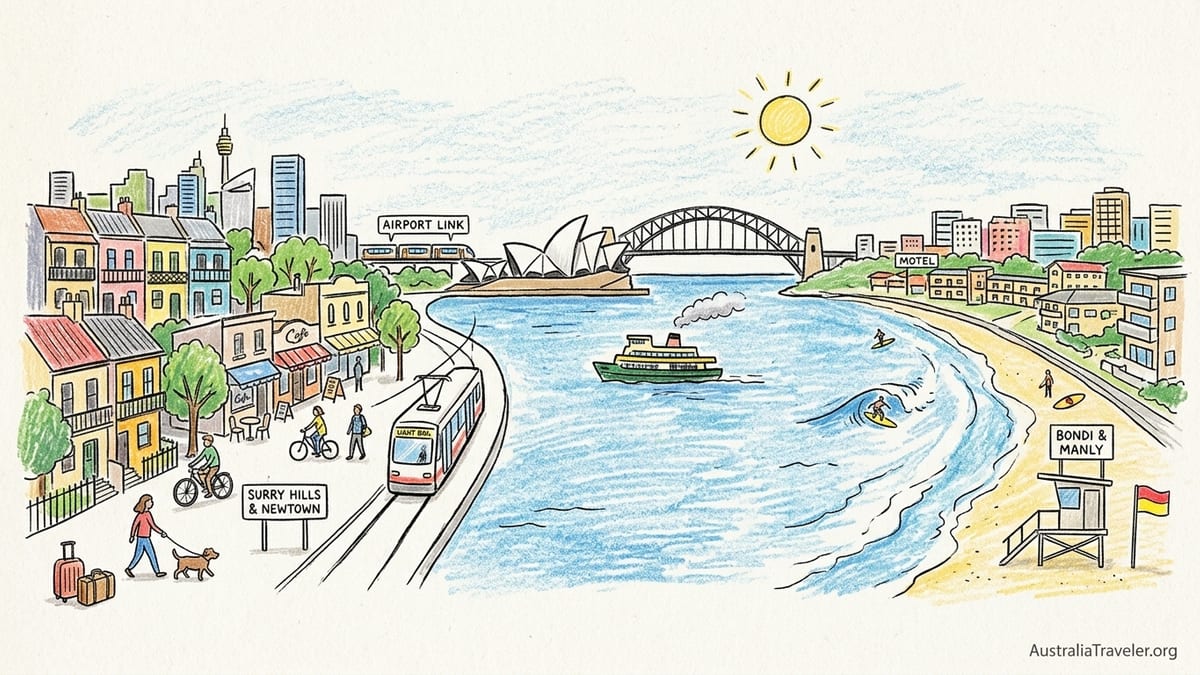
How Sydney’s Neighbourhoods Shape Your Trip
Central Sydney fans out around Circular Quay and the harbour, with the CBD stretching south towards Central Station and a string of inner-city villages such as Surry Hills, Darlinghurst, Potts Point and Newtown spreading around the edges. On the coast, Bondi, Coogee and Manly offer classic beach holidays but sit far enough from the CBD that daily sightseeing requires extra travel time. Understanding these trade-offs is essential if you want to balance budget, convenience and Sydney’s outdoorsy lifestyle.
In price terms, harbourfront hotels in Circular Quay, The Rocks and parts of Darling Harbour are at the top of the scale. Recent market data for 2026 shows CBD averages around 220 to 250 Australian dollars per night in October, while flagship five-star properties such as Four Seasons Hotel Sydney and Sofitel Sydney Darling Harbour often sit in the 400 to 500 dollar range on normal midweek dates, and considerably higher around New Year’s Eve and other major events. More modest hotels and hostels near Central Station or in Surry Hills and Newtown can be substantially cheaper, often under 200 dollars per night for standard rooms, with hostel beds well below that.
Transport is a second key factor. The city centre is compact and walkable, and the integrated Opal ticketing system covers suburban trains, metro, ferries, buses and the light rail. From most CBD and inner-city neighbourhoods it is realistic to reach Circular Quay or Town Hall within 10 to 20 minutes using public transport. From the beach suburbs, you should allow 30 to 45 minutes each way to reach the CBD, which can add up if your itinerary is packed with museums, galleries and harbour cruises.
Finally, travel dates matter. Ordinary weekdays in the shoulder seasons of March to early June and September to early December usually bring the best balance of price and availability. Weekends, Australian school holidays and big events such as Vivid Sydney in late May and early June or New Year’s Eve can see central hotels double or even triple their standard rates, especially those with harbour views or rooftop terraces. Booking early for those busy periods and being flexible about neighbourhood can make a large difference to your total budget.
Circular Quay & The Rocks: Harbour Views and Top-End Hotels
Circular Quay is the postcard centre of Sydney, framed by the Opera House on one side and the Harbour Bridge and historic Rocks district on the other. The atmosphere is lively and tourist focused, with constant ferry movements, buskers and busy waterfront restaurants. This is the most convenient base for classic harbour sightseeing, because ferries to Manly, Taronga Zoo, Barangaroo and Parramatta all depart from the same wharves, and it is easy to walk to the Opera House, Royal Botanic Garden and Museum of Contemporary Art.
The convenience comes at a price. Luxury hotels such as Four Seasons Hotel Sydney, which sits just above Circular Quay, and newer ultra-luxury properties like Capella Sydney a short walk away, frequently charge upwards of 450 to 700 Australian dollars per night in peak periods. Harbour views are not standard in these hotels. At Four Seasons, entry-level rooms are usually city view categories, while full harbour view rooms and suites form a separate, more expensive group. The same pattern applies across the area: if a brochure mentions a direct Opera House or Harbour Bridge view, it almost always refers to a premium room type. Travellers who book the cheapest category should expect an urban or partial view instead.
For budget-conscious visitors who still want this location, Sydney Harbour YHA in The Rocks is a stand-out option. This hostel offers a mix of private ensuite rooms and co-living dorms, many with panoramic harbour and Opera House views from large rooftop terraces rather than every bedroom. Recent information from YHA confirms continental breakfast is available, and there is no on-site car park, although several Wilson Parking garages sit within a short walk. Cancellation rules depend on the chosen rate, and special periods such as New Year’s Eve or the Vivid Sydney festival often use stricter conditions and longer minimum stays.
Transport from Sydney Airport to Circular Quay is straightforward. The airport train reaches Circular Quay in about 20 to 25 minutes with one change at Central or Wynyard, while a taxi or rideshare normally takes 25 to 35 minutes outside the heaviest traffic. Almost everything in this district is walkable, but footpaths can be steep and paved with old cobblestones in parts of The Rocks. Restaurants range from high-end waterfront dining to casual pubs and food courts in nearby George Street and the quay concourse, so you can eat reasonably if you avoid the most obvious tourist terraces.
CBD, Darling Harbour & Barangaroo: Central and Often Better Value
Staying in the broader CBD around Town Hall, Wynyard, Darling Harbour and Barangaroo usually gives you a more local-feeling city break and, on many dates, slightly better value than Circular Quay itself. The atmosphere varies street by street. Around Town Hall and Pitt Street Mall you will find busy shopping streets and large chain hotels. Darling Harbour feels more resort-like, with pedestrian promenades, family attractions such as SEA LIFE Sydney Aquarium and the Australian National Maritime Museum, and plenty of casual dining. Barangaroo, at the northern end, is a newer waterfront precinct with offices, upscale apartments, parks and a growing number of bars and restaurants.
Hotels here cover every budget. On recent searches for midweek dates, three-star CBD properties and older business hotels near World Square or Central Station often appeared in the 140 to 220 Australian dollar range, while well regarded four-star and five-star properties such as Sofitel Sydney Darling Harbour, Hyatt Regency Sydney and various international chains typically priced from the low 300s upwards. Sofitel Sydney Darling Harbour markets a range of city and harbour view rooms, with corner rooms and luxury harbour view categories commanding the highest rates. Breakfast at the hotel’s main restaurant is usually an additional charge unless included in a package, and on-site valet parking is available at a substantial daily fee, with self-parking possible at nearby commercial car parks.
Barangaroo offers easy access to ferries and the Wynyard underground station, which keeps airport and suburban journeys manageable. From this part of the CBD, the train ride to the domestic or international airport terminals generally takes about 20 minutes, or roughly 30 to 40 minutes by taxi at off-peak times. Walkability is strong, with level waterfront promenades and multiple footbridges linking Darling Harbour, the CBD shopping district and The Rocks. Families appreciate the playgrounds around Darling Quarter and Tumbalong Park, while business travellers value how close most hotels are to the convention and exhibition centres.
One significant consideration here is event pricing. Large conventions at the International Convention Centre, major concerts or New Year’s Eve fireworks can drive Darling Harbour and Barangaroo rates sharply higher than standard CBD hotels a few blocks inland. For example, recent rate snapshots for October and early November 2026 showed Sofitel Sydney Darling Harbour and other waterfront five-star hotels pricing around 440 to 500 Australian dollars per night, compared with CBD business hotels nearer Central Station closer to 220 to 260. If you are mainly sleeping and spending your days elsewhere, shifting a short distance away from the water can yield meaningful savings without sacrificing convenience.
Surry Hills, Darlinghurst, Potts Point & Newtown: Inner-City Character
Surry Hills, Darlinghurst, Potts Point and Newtown sit just outside the commercial core and offer a more local atmosphere, with terrace houses, independent boutiques and a strong food scene. These neighbourhoods appeal to repeat visitors, younger couples and travellers who value nightlife and cafes over direct harbour views. Streets can be hilly and sometimes noisy on weekend nights, but they give a clearer sense of everyday Sydney life than the office-lined CBD.
Surry Hills, immediately southeast of Central Station, has become one of Sydney’s trendiest dining neighbourhoods, with small wine bars and restaurants spread along Crown Street and beyond. Here you will find a mix of midrange design hotels, pub-style rooms above historic hotels and a few serviced apartments. Prices are usually lower than in Circular Quay and Barangaroo on the same dates, and Central Station’s transport connections make sightseeing straightforward. From Central you can reach Circular Quay in around 10 minutes by train, and the airport in about 15 minutes on the direct Airport Link.
Darlinghurst and nearby Potts Point extend east of the CBD along a ridge that looks back towards the harbour. These areas once focused on nightlife and backpackers but now mix boutique hotels, renovated guesthouses and a few remaining budget options. Walking to the CBD from Potts Point takes about 20 to 25 minutes, or you can use the train from Kings Cross station to reach Town Hall and Wynyard in roughly 5 minutes. Restaurant choice is excellent, from casual eateries around Kings Cross and Victoria Street to more polished venues in Potts Point itself. The downside is that some streets are steep and parking is limited, so travellers without a car will generally have an easier time than those driving.
Newtown, southwest of the CBD on the T4 rail line, offers a completely different mood again, with street art, live music venues and a long strip of budget-friendly restaurants along King Street. Accommodation here leans towards small motels, pub rooms and serviced apartments rather than big chain hotels. While you lose immediate access to the harbour, trains from Newtown to Central Station run frequently and take around 10 minutes, so reaching city museums or ferries at Circular Quay is still realistic within 25 to 30 minutes. For long stays on a tighter budget, especially for travellers who plan to explore Sydney’s inner west rather than the beaches every day, Newtown can provide strong value.
Bondi, Coogee & Manly: Comparing Sydney’s Beach Bases
Bondi, Coogee and Manly are Sydney’s headline beach suburbs and natural choices for visitors who prioritise ocean swimming and coastal walks. All three offer impressive stretches of sand, surf schools and relaxed dining, but each has a different feel and relationship to the city centre. The main decision is how often you plan to travel into the CBD, and whether the extra journey time is worth waking up beside the water.
Bondi, on the eastern coast, is the most internationally famous. The atmosphere is busy and youthful, with a constant mix of locals and visitors along Campbell Parade and the Bondi to Coogee coastal walk. Accommodation runs from budget hostels and simple motels to boutique hotels and a handful of apartment-style properties suited to families. There is no train line to Bondi Beach itself. Instead, you travel by train to Bondi Junction and then transfer to a bus, or take a direct bus from the city. From the CBD, total journey times typically range from 30 to 40 minutes each way. From the airport, a taxi can take a similar time depending on traffic. Daily commuting into the city for sightseeing is entirely possible, but if your schedule is heavy on museums and harbour cruises you may find the back-and-forth tiring.
Coogee sits slightly further south and has a softer, more residential feel, with a deep bay, sea baths and pubs clustered near the beachfront. Like Bondi, Coogee relies on buses rather than trains, and travel time to Central or Circular Quay is usually 35 to 45 minutes. Nightlife is lively on weekends but generally a little calmer than Bondi’s, and the mix of hotels, serviced apartments and holiday rentals works well for families. Because Coogee is less iconic than Bondi, prices can be modestly lower on some dates, although school holiday periods still push them up.
Manly, on the northern side of the harbour, feels like a self-contained seaside town, with the main ocean beach on one side and a sheltered harbour beach and ferry wharf on the other. The famous Manly ferry from Circular Quay remains one of Sydney’s great everyday experiences, taking around 20 to 30 minutes each way and passing close to the Heads. Accommodation here includes a mix of midrange hotels, older motels and apartments, many oriented towards domestic holidaymakers. Travel to and from the airport requires either a combination of ferry and train or a road transfer across the harbour, so total journey times are typically 45 to 60 minutes.
If your main goal is a beach holiday with occasional forays into the city, Manly is often the most practical choice. The ferry ride is part of the fun, and the town has enough shops, cafes and walks to keep you occupied on days when you do not go into the CBD. Bondi and Coogee are better if you want to combine frequent city sightseeing with early-morning swims, but you should factor in the cumulative cost of bus fares and the time lost to transfers when comparing them with a central hotel.
Prices, Seasons and When to Pay for a Harbour View
Sydney hotel pricing is highly seasonal and sensitive to weekday versus weekend demand. Industry data for 2026 shows average four-star and five-star CBD rates in the low to mid 200 Australian dollar range on ordinary midweek nights outside school holidays. On Fridays and Saturdays, and during Australian school holidays, those averages climb significantly, and premium properties around the harbour often move into the 400 to 600 dollar bracket or higher, especially if they have direct Opera House or bridge views.
New Year’s Eve is an extreme case. Local booking searches and traveller reports for 2026 indicate that central harbourfront hotels typically require multi-night stays around 30 December to 1 January, with many properties near Circular Quay and The Rocks charging well over 1,000 Australian dollars per night for rooms with confirmed fireworks views. Circular Quay’s convenience and the ability to walk to public viewing areas without relying on late-night public transport underpin this premium. By comparison, staying in the CBD near Central Station or in suburbs such as Surry Hills or Potts Point on the same dates can be hundreds of dollars cheaper, but you will need to plan your movements carefully and accept crowded late-night trains or long walks.
Whether a harbour view is worth the extra cost depends on your travel style. For a once-in-a-lifetime trip where you plan to spend evenings in the room, enjoying the skyline, upgrading to a full harbour view category at hotels like Four Seasons or booking a room that faces Darling Harbour at Sofitel Sydney Darling Harbour can feel justifiable. In many cases, standard city view rooms in the same hotels offer similar service and facilities at notably lower prices, and you can still enjoy the panoramic scenery from public areas, nearby parks and waterfront walks. If your budget is tight, consider staying in an inner-city neighbourhood and using the money saved for harbour cruises, guided tours or special dinners by the water instead.
Cancellation policies and inclusions have also become more varied. Many large hotels now offer a choice between cheaper non-refundable rates and flexible options that allow cancellation or date changes until one or two days before arrival. Breakfast is frequently sold as an add-on, and parking is almost always charged separately in central Sydney, with daily rates that can materially increase the cost of a rental car. Before you compare nightly prices between neighbourhoods, check whether breakfast is included, whether you really need a car, and what time limits apply to free cancellation, especially over high-demand periods like Vivid Sydney or New Year’s Eve when stricter rules are common.
Who Should Stay Where: Recommendations by Travel Style
Couples on a short first visit who want iconic views and minimal transit time to major sights usually find Circular Quay and The Rocks the most satisfying base if the budget allows. From hotels like Capella Sydney near the historic Sandstone Precinct or Four Seasons on George Street, you can walk to the Opera House, hop on ferries around the harbour and reach most inner-city restaurants on foot. For couples who prefer a more relaxed ambience and nightlife, Darling Harbour, Barangaroo or Surry Hills offer better access to small bars and dining at lower prices, with simple transport links to Circular Quay for day trips.
Families often prioritise space and kitchen facilities. Apartment-style hotels and serviced apartments are more common around Darling Harbour, Barangaroo, the CBD south of Town Hall and in beach suburbs like Coogee and Manly. Darling Harbour works particularly well for school-age children, thanks to attractions such as the aquarium, wildlife centre and playgrounds within a few minutes’ walk. Budget-conscious families willing to ride trains or buses for 15 to 30 minutes may find better-value two-bedroom apartments in suburbs like Newtown or along the train lines near Central, where supermarkets and casual eateries are plentiful.
Backpackers and budget travellers without cars have the widest range of choice. Sydney Harbour YHA in The Rocks appeals to those who want rooftop Opera House views and are ready to pay slightly higher hostel prices for the privilege. Around Central Station, multiple hostels and budget hotels offer cheaper beds and private rooms with quick airport access on the train and straightforward transfers to Bondi, Newtown and the Blue Mountains. For a more alternative, nightlife-focused stay, smaller hostels in Newtown and Surry Hills place you within walking distance of live music venues and local bars.
Travellers without cars are generally better off in the CBD, inner-city neighbourhoods or Manly, which all have strong public transport. Driving and parking in central Sydney can be stressful and expensive, with many hotels relying on public garages and valet services at daily rates that can rival a small hotel bill. Visitors intent on renting a car for day trips may prefer to pick it up only on the days they leave the city, collecting from depots near Central or the airport rather than paying to store it outside a central hotel overnight.
When Cheaper Outer Areas Really Save Money
Shifting from Circular Quay or The Rocks to areas around Central Station or inner suburbs like Surry Hills and Potts Point can produce meaningful savings, especially for stays of five nights or more. For example, if a harbourfront hotel near Circular Quay is charging around 500 Australian dollars per night for a standard room on your dates, and a solid four-star hotel near Central is pricing around 260 dollars, a five-night stay would save approximately 1,200 dollars before considering extras. Even if you spend an extra 10 to 15 dollars per person per day on public transport and occasional taxis, the overall difference remains significant.
The calculation becomes more complex for beach suburbs and very outer areas. A modestly priced hotel in Bondi or Manly can look attractive compared with a central property, but if you plan to travel into the CBD every day, the extra fares and time costs add up. While Sydney’s daily caps on public transport make multiple trips affordable, the real question is how much you value the hours spent commuting rather than exploring. Over a short four-day visit focused on first-time sightseeing, many travellers find that staying in or near the CBD, even at a slightly higher nightly rate, gives them more usable time and less fatigue.
There are also situations where moving too far out erases any savings. Cheap motels on distant arterial roads or in industrial suburbs may undercut CBD prices, but if you are then paying for regular rideshares into the city or struggling with infrequent buses, the combined cost and inconvenience can leave you worse off. In practice, a sweet spot for value lies in the city fringe neighbourhoods such as Surry Hills, Darlinghurst, Potts Point, Newtown and parts of Pyrmont, which balance lower room rates with strong transport links and enjoyable local streetscapes.
For special events like New Year’s Eve, the trade-offs sharpen. If your main goal is to experience harbour fireworks and you can secure tickets to a central ticketed viewing area, staying slightly away from Circular Quay and walking or taking early public transport in the afternoon can save thousands of dollars on accommodation. On the other hand, if standing on your balcony watching the fireworks is central to your dream trip, then paying the premium for a verified harbour-view room at a Circular Quay or The Rocks hotel and trimming costs elsewhere in your itinerary may be the right choice.
The Takeaway
The best place to stay in Sydney depends less on a single “must stay” district and more on what you want from each day of your trip. Circular Quay and The Rocks offer unmatched convenience for ferries and harbour icons but come with Sydney’s steepest accommodation prices, especially for full harbour views. Wider CBD areas, Darling Harbour and Barangaroo soften the price while remaining extremely central, particularly suited to first-time visitors, business trips and families who value easy transport and nearby attractions.
Inner-city neighbourhoods like Surry Hills, Darlinghurst, Potts Point and Newtown provide character, nightlife and good food at generally lower prices, ideal for repeat visitors and travellers who do not need the Opera House outside their window. Beach suburbs such as Bondi, Coogee and Manly excel for longer stays and summer holidays where ocean swims and coastal walks matter more than quick access to every museum in town, but they demand extra time and planning for city sightseeing.
Ultimately, saving on a cheaper outer-area hotel is genuinely worthwhile when you are staying several nights, are comfortable using public transport and are more interested in neighbourhood life than constant harbour views. The saving becomes less compelling if you are visiting for only a few days devoted to central attractions, or if you end up relying heavily on taxis and rideshares that chip away at your budget. Decide first how you want to spend your days and evenings in Sydney, then choose the neighbourhood that keeps those experiences within easy reach.
FAQ
Q1. Is Circular Quay really worth the higher hotel prices for first-time visitors?
Circular Quay is the most convenient base for classic harbour sightseeing, with ferries, the Opera House and The Rocks all within a short walk. For a short first trip where budget allows, many travellers find the time saved on transport and the constant views justify the higher rates, especially if you value early-morning and late-evening strolls along the water.
Q2. How much extra time should I allow if I stay at Bondi or Coogee instead of the CBD?
From Bondi or Coogee, typical journeys into the CBD take around 30 to 45 minutes each way using buses and, for Bondi, the train from Bondi Junction. If you plan to visit central museums, galleries and harbour attractions on several consecutive days, this can add two to three hours of travel across a short stay.
Q3. What is the most convenient area for families with young children?
Darling Harbour is often the easiest choice for families because of its flat promenades, playgrounds, aquarium and wildlife attractions in one compact area. Many hotels and serviced apartments here offer family rooms, kitchenettes or laundry facilities, and it is still only a short walk or light-rail ride to the CBD and Circular Quay.
Q4. Are harbour-view rooms in Sydney worth the premium price?
Harbour-view rooms cost noticeably more, but for a special trip they can feel memorable, especially if you plan to spend time relaxing in the room. If you will be out from morning to night and are watching your budget, a city-view room in a well-located hotel plus time on public viewpoints such as the Opera House forecourt or harbour promenades often provides better overall value.
Q5. Which neighbourhood is best for nightlife and restaurants?
Surry Hills, Darlinghurst and nearby Potts Point have the highest density of small bars, wine bars and midrange restaurants, while Newtown in the inner west offers a long strip of casual eateries, pubs and live music venues. Staying in or near these areas keeps evenings simple, with most options a short walk away.
Q6. How long does it take to reach Sydney’s airport from central hotels?
From CBD stations such as Circular Quay, Wynyard or Central, the Airport Link train typically takes 15 to 25 minutes to reach the domestic and international terminals. By taxi or rideshare from central areas, journey times outside peak traffic are usually 25 to 40 minutes, with longer delays likely during weekday rush hours and after major events.
Q7. Is it worth renting a car for a city-based stay in Sydney?
For most visitors staying in the CBD, inner suburbs or Manly, a car is more of a liability than an asset. Public transport covers the main sights, and hotel or public car parks in central Sydney charge high daily fees. Renting a car only for day trips outside the city, and collecting it from a depot near Central or the airport, usually makes more financial sense.
Q8. Where should backpackers and solo travellers stay?
Backpackers often choose hostels around Central Station for affordability and excellent transport, or Sydney Harbour YHA in The Rocks for the spectacle of rooftop harbour views. Solo travellers who prefer a neighbourhood feel may favour smaller hostels and guesthouses in Surry Hills, Newtown or Potts Point, which combine social common areas with easy access to bars and cafes.
Q9. How far in advance should I book for New Year’s Eve in Sydney?
For New Year’s Eve stays in central Sydney, particularly if you want a harbour-view room or a hotel close to major viewing areas, it is wise to book many months in advance. Popular hotels near Circular Quay and The Rocks often sell out their best-view rooms first and impose minimum-stay and stricter cancellation conditions during this period.
Q10. If I am on a tight budget, which areas should I prioritise?
Travellers on a tight budget should first look at areas around Central Station, Surry Hills, parts of Darlinghurst and Newtown, where a mix of hostels, budget hotels and simpler apartments offer lower nightly rates. These neighbourhoods maintain good train or bus links to the CBD and beaches, allowing you to trade immediate harbour views for substantial savings without losing too much time to commuting.