


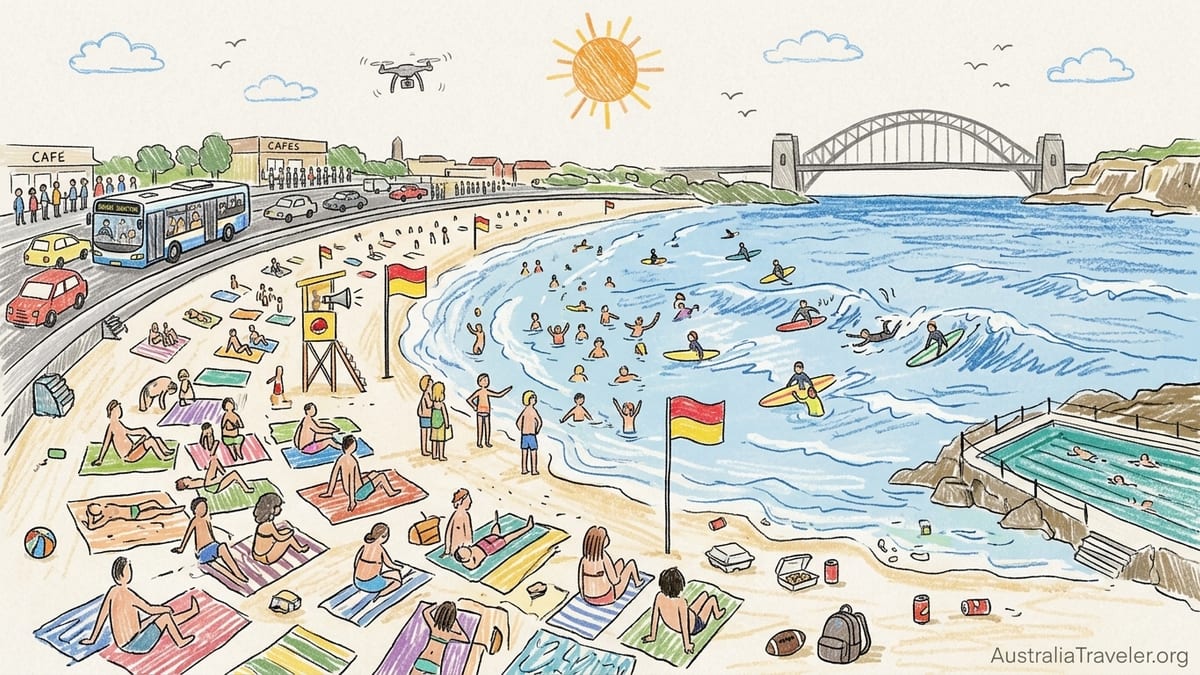
I realised Bondi Beach and I were not going to be friends the moment a stranger’s sandy elbow rested on my thigh. It was a hot January afternoon, peak Sydney summer, and I was lying on a rented towel that cost more than my lunch, wedged between two groups blasting competing playlists. This was the famous Australian beach I had seen in tourism videos: acres of golden sand, sparkling Pacific water, bronzed surfers and relaxed coastal charm. Instead, I found myself in something closer to an outdoor transit hub, with barely a square metre of personal space and a constant soundtrack of traffic, shouting and whistles from lifeguards trying to regain a sense of order.
The Bondi Myth Versus the Reality on the Sand
Before I ever set foot in Sydney, Bondi lived in my head as a sort of coastal fantasy. Tourism boards, glossy magazines and social media feeds promised a sweeping curve of soft sand, light crowds, easy surf and bohemian cafes where you might linger for hours. The implication was that Bondi was both authentically local and effortlessly world class. Like many international visitors, I built my itinerary around spending an entire day there.
On arrival, that fantasy evaporated almost instantly. In peak summer season, especially on weekends and public holidays, the beach fills quickly from mid morning. Towels are laid edge to edge, children weave erratically through the gaps and any hope of a quiet corner near the waterline becomes unrealistic. By midday, lifeguards repeatedly call over loudspeakers for people to move back, stay between the flags and make room for surf rescues. It feels efficient and professional, but it does not feel relaxed.
The noise is constant. There is the roar of the surf, but it competes with amplified music from beachside venues, skateboards rattling along the promenade, the whine of buses braking on Campbell Parade and drones buzzing overhead. If you imagined the soft hush of waves and gulls for your Australian beach day, Bondi in high season will very likely disappoint. What struck me was not the lack of beauty, but the lack of breathing room to enjoy it.
Even simple moments, like reading a book on the sand or quietly watching the sets roll in, are difficult to sustain. People step over your towel without apology, stray footballs land on bags, and the sense that you are in a busy urban park rather than at a seaside escape is hard to ignore. For a beach that sells itself as a bucket list experience, the everyday reality often feels far more hectic than the marketing suggests.
Getting to Bondi: Time, Transfers and Traffic
Reaching Bondi from central Sydney looks straightforward on a map, but the journey is rarely as simple as visitors expect. There is no direct train to the beach. The suburban rail network runs to Bondi Junction, which sits inland on a hill, and from there you transfer to a bus that winds its way down to the coast. The train ride from Central Station to Bondi Junction can be under 15 minutes when services run smoothly, but the overall trip time increases once you factor in waiting for a bus and navigating crowded platforms in summer.
The bus transfer is where the romance of the journey usually fades. Popular routes between Bondi Junction and the beach can become extremely crowded on hot days, with passengers standing tightly packed, surfboards wedged awkwardly in aisles and prams competing for space. Air conditioning does not always keep up with the body heat, and the ride involves frequent stops as more beachgoers pile on. What seems like a short hop on paper can easily feel like a congested commute rather than the beginning of an idyllic day by the ocean.
If you decide to drive, be prepared for slow traffic and stressful parking. The roads leading into Bondi, particularly on summer weekends, often crawl with cars hunting for spaces. On street parking near the beach is metered and time limited, and car parks fill early in the day. Drivers circle blocks in the steep residential streets above the beach, sometimes giving up and parking far from the shoreline. The combination of narrow roads, impatient drivers and pedestrians weaving between cars removes much of the spontaneity from an impromptu trip to the water.
All of this matters because it does not align with the global image of Bondi as a carefree coastal playground. Visitors who only see the drone shots may not factor in the practical friction associated with getting there and back. By the time many people finally step onto the sand, they have already burned a significant portion of the day on transport logistics, which raises the bar for what the beach itself would need to deliver to feel worthwhile.
The Price of the Bondi Dream: Cafes, Surf Lessons and Stays
Bondi does not only trade on its sand and surf. It also positions itself as a lifestyle destination, with a well publicised cafe scene, surf schools and boutique accommodation. In practice, this comes with a price tag that can shock travellers used to less famous stretches of the New South Wales coast. A simple sit down breakfast of eggs, toast and coffee at a beachfront cafe can easily reach a figure that would feel high even in central Sydney, especially once you add a juice or second drink. That might be acceptable if the setting felt calm and special, but when you are eating to the soundtrack of buses, queues and tightly packed tables, the value equation starts to feel skewed.
Surf lessons are another example. Group beginner lessons on Bondi typically cost a notable sum for a 2 hour session, which includes board and wetsuit hire. The instructors are usually skilled and safety conscious, and learning to surf at such an iconic location has obvious bragging rights. Yet when you compare this with lessons at less famous beaches nearby, where group classes often run slightly cheaper, the Bondi premium becomes apparent. You are paying not just for coaching, but for the brand of the beach itself.
Accommodation follows a similar pattern. Beachfront hotels and serviced apartments in Bondi usually command high nightly rates during the summer months, even for compact rooms or older buildings. Many properties emphasise their location as the primary selling point, knowing that visitors crave the idea of waking up a short stroll from the waves. In comparison, accommodation in suburbs closer to the city centre or at alternative beaches like Coogee or Manly can be more spacious and sometimes better maintained for a similar price, with easier transport options nearby.
There is nothing inherently wrong with a destination being expensive. The problem at Bondi is the feeling that the prices have floated upward on a tide of global hype more than on the intrinsic quality of the everyday experience. When cafe meals, surf lessons and modest rooms all carry a premium, and the setting itself feels overcrowded and noisy, travellers are left wondering what exactly they have paid for beyond the chance to say they were there.
What the Beach Itself Gets Right and Wrong
Stripped of its celebrity status, Bondi Beach is a pleasant, crescent shaped stretch of sand with a genuine surf culture and a dramatic headland at each end. On a clear day, the colour of the water can be striking, shifting from pale turquoise near the shore to deeper blues toward the outer break. The sand, while not powder soft, is fine enough underfoot and usually kept in reasonable condition by local authorities, with litter collection and grooming evident early in the morning.
Yet the beach is not the flawless paradise suggested by many of its promotional images. On busy afternoons, scattered rubbish appears despite the cleaning efforts, with takeaway containers, drink cans and plastic packaging more noticeable along the high tide line and near the promenade. The sheer volume of people means the shoreline can feel churned up and crowded, with limited space to enter the water without bumping into other swimmers.
Surf and swimming conditions vary considerably. Bondi is a proper surf beach, with shifting sandbars and regular sets that can be fun for experienced board riders but less forgiving for casual swimmers. The designated swimming area between the red and yellow flags tends to be relatively small during peak times, since lifeguards concentrate bathers into zones they can monitor closely. Within those flags, the shore break can still feel rough, and weaker swimmers may find themselves knocked off their feet or pushed sideways by lateral movement in the water.
Noise and atmosphere are more divisive. Some visitors relish the energy of Bondi, the sound of whistles, the chatter in multiple languages, the hum of beach volleyball and the calls from surf instructors corralling their students. It is a sociable beach, where you rarely feel alone. Others, myself included, find that the constant background noise and movement undermine the restorative quality that many people seek from the sea. Australian beaches are famous for their sense of space. Bondi, paradoxically, feels like an urban plaza built on sand.
Safety, Rip Currents and Swimming Between the Flags
Bondi has a long association with surf lifesaving, and the professional lifeguard presence on the beach is one of its strengths. Towering observation platforms, patrol vehicles, jet skis and distinctive uniforms all signal that safety is taken seriously. This is important because, like many open ocean beaches along the New South Wales coast, Bondi experiences rip currents that can quickly pull swimmers away from the shore if they are not paying attention.
Surf Life Saving guidance emphasises a few key principles that are particularly relevant at Bondi. The first is to always swim between the red and yellow flags, which mark the zones actively watched by lifeguards. Outside these areas, rip currents can be stronger and rescues slower. The second is to avoid swimming alone, especially in surf conditions that feel unfamiliar. If you find yourself caught in a rip, the advice is not to panic or attempt to swim directly back to shore against the current, but instead to stay calm, float, signal for help and, if able, swim parallel to the beach until you are out of the strongest flow.
Bondi is not uniquely dangerous. Many Australian surf beaches share similar risks, and the majority of beachgoers who remain between the flags and heed lifeguard instructions enjoy their swim without incident. However, the combination of international visitors with limited local knowledge, energetic surf and large crowds can create stressful situations, which is why the lifeguard whistles and loudspeaker announcements are such a constant part of the soundscape. They contribute to the feeling that you are being managed as part of a group rather than left to quietly enjoy the ocean on your own terms.
One advantage of Bondi is the presence of alternative swimming options at either end of the beach. Bondi Icebergs, with its famous ocean pool carved into the southern headland, provides lane swimming in salt water protected from the full force of the surf, usually for a modest entry fee. At the northern end, a shallow area near the rocks is more suitable for children during calmer conditions. These facilities add depth to the beach’s offer, but they do not compensate entirely for the challenges of the main swimming zone in the middle of the bay.
How Bondi Compares: Coogee, Bronte, Clovelly, Maroubra, Manly and Shelly
The real test of Bondi’s reputation comes when you experience other Sydney beaches and realise how many alternatives deliver a more balanced day by the sea. Coogee, a few kilometres south, lacks the same international profile but offers a broader strip of sand and a gentler atmosphere. The beachfront park provides shade and space for picnics, the ocean often feels a fraction calmer, and the dining options, while still not cheap, can feel more relaxed and less self conscious about their brand. It is easier to imagine spending a lazy afternoon here without the sense of being on display.
Bronte, located between Bondi and Coogee on the coastal walk, is smaller but often more charming. The sand is framed by steep grassy slopes with picnic tables and barbecues, and there is an excellent ocean pool at the southern end that attracts lap swimmers and families. Bronte’s surf can be heavy, but the combination of the main beach and the pool gives visitors options. The atmosphere feels more local and less dominated by international tourism, which translates into shorter coffee queues and a stronger sense of neighbourhood.
Clovelly presents an entirely different experience. Rather than a broad sandy expanse, it is a narrow concrete lined inlet that feels more like a giant natural swimming pool than a surf beach. The water here is usually calmer, visibility is better for snorkelling and families appreciate the stable entry points into the sea. What Clovelly lacks in classic postcard aesthetics it makes up for in ease of swimming and a unique character that feels far removed from the Bondi circus.
To the south, Maroubra offers a long, open beach that carries its own proud surf culture but sees fewer tourists. There is more room to spread out on the sand, the surrounding streets feel less commercialised, and the experience is closer to what many people imagine an everyday Australian beach to be for local residents. Food and drink options behind the beach are more limited than at Bondi, but that can be a relief if you are seeking space rather than a menu of branded venues.
Across the harbour to the north, Manly and nearby Shelly Beach present perhaps the most compelling alternative combination. Manly is accessible by ferry from Circular Quay, turning the journey itself into a highlight with views of the Sydney Opera House and Harbour Bridge. The beach has a wide promenade, ample surf and a lively town centre behind it, yet the overall experience feels more spacious and varied than Bondi. A short walk around the headland leads to Shelly Beach, a sheltered cove popular with snorkellers and families thanks to its calmer water and marine life. Spending a day between Manly and Shelly often feels like better value for your time and effort than committing an entire day to Bondi alone.
Hype, Heritage and the Problem of Expectations
None of this is to say that Bondi has no merits. Its surf heritage is genuine, with a long history of surf clubs and lifesaving that predates much of its modern marketing. The coastal walk that begins at Bondi and runs to Bronte and beyond is genuinely beautiful, with sandstone cliffs, rock pools and expansive views that more than live up to the photographs. The visual drama of the beach, cradled between two headlands with the city skyline faintly visible behind, is undeniable in the right light.
The problem lies in the disproportion between Bondi’s global reputation and the everyday experience of actually spending time there in high season. Global tourism campaigns and television shows have elevated Bondi to near mythical status, which encourages visitors to treat it as a non negotiable highlight of their time in Sydney. The result is a feedback loop: fame drives crowds, crowds strain infrastructure, and the atmosphere shifts from relaxed to frenetic. Businesses along the beachfront respond to this demand with higher prices and a heavier emphasis on image, further distancing the place from the laid back coastal identity that attracted people in the first place.
It is possible to have a very different encounter with Bondi if you visit early on a weekday morning outside school holidays. At sunrise, with fewer people on the sand and cafes just beginning to open, the beach briefly resembles the romanticised version in the tourism brochures. Surfers dot the lineup, joggers move along the promenade and the light turns the water into a metallic sheen. For an hour or two, the gap between the myth and reality narrows. By mid to late morning, however, the crowds return and the spell is broken.
When I look back on my time in Sydney, the memories that feel most “Australian” are not of jostling for towel space on Bondi, but of quieter swims at Bronte’s ocean pool, fish and chips on the grass at Coogee and the late afternoon walk from Manly to Shelly as the sun dropped toward the horizon. These places delivered what Bondi promised, with less posturing and more genuine ease.
The Takeaway
So does Bondi Beach deserve a full day of your Sydney itinerary, or is it better as a quick stop or something to skip entirely in favour of other shores? After a critical look at the journey, the costs, the crowds and the competing options, my own verdict is clear. Bondi is worth seeing once, but it rarely rewards lingering.
If you are curious about its fame, arrive early, walk the length of the beach, perhaps enjoy a coffee away from the most crowded strip on Campbell Parade and then continue along the coastal path toward Bronte and Coogee. Treat Bondi as a starting point rather than a destination in itself. This approach lets you tick the box on the world famous icon without surrendering your entire day to its congestion and commercial noise.
For a true Sydney beach day, especially in summer, I would choose Manly and Shelly, or a combination of Bronte and Coogee, long before I committed the same time to Bondi. These beaches offer more space, more varied swimming conditions and a closer match to the relaxed coastal lifestyle that first drew many of us to the idea of Australia. Bondi’s headlands and history will always have their place. Its global reputation, however, feels increasingly out of step with the experience that awaits most visitors on the sand.
If your time in Sydney is short, consider giving Bondi a brisk visit at most and invest your long, lazy hours in the places where the myth of the Australian beach still feels tangible. For me, that means Bondi has shifted from a must see destination to a brief curiosity on the way to somewhere better.
FAQ
Q1. Is Bondi Beach still worth visiting if I only have a few days in Sydney?
Yes, but treat it as a short sightseeing stop rather than an all day destination. Spend an hour walking the promenade and then continue on the coastal walk toward Bronte or Coogee for a more relaxed beach experience.
Q2. When is the best time of day to visit Bondi to avoid the worst crowds?
Early morning on weekdays, outside school holidays and major events, usually offers the most space and calmer atmosphere. Aim to arrive around sunrise if you want to experience a quieter, more peaceful version of the beach.
Q3. How long does it really take to get from central Sydney to Bondi Beach?
The train from Central Station to Bondi Junction is relatively quick, but once you factor in waiting for a bus, the bus ride itself and short walks at each end, the total journey commonly takes 30 to 45 minutes each way, longer in heavy traffic.
Q4. Is Bondi more expensive than other Sydney beaches?
Many visitors find that cafe meals, surf lessons and beachfront accommodation at Bondi are priced higher than similar offerings at nearby beaches such as Coogee, Manly or Bronte. You often pay a noticeable premium for the Bondi name and location.
Q5. Is it safe to swim at Bondi Beach?
It can be safe if you follow local advice. Always swim between the red and yellow flags, pay attention to lifeguard instructions and avoid entering the water alone in conditions you are not comfortable with. Rip currents are present, as at many Australian surf beaches.
Q6. Which nearby beaches are better for a relaxed day with kids?
Coogee, Bronte and Shelly Beach are strong options. Coogee has calmer water and a grassy park, Bronte offers an ocean pool suitable for supervised children and Shelly is sheltered, with typically gentler conditions and good spots for beginners to snorkel.
Q7. Is driving to Bondi a good idea for first time visitors?
Driving is possible but often stressful due to narrow streets, busy intersections and limited parking near the beach, especially on summer weekends. For many visitors, taking the train to Bondi Junction and transferring to a bus, or using a rideshare service, is less frustrating.
Q8. Are surf lessons at Bondi better than at other Sydney beaches?
Surf schools at Bondi are generally professional and experienced, but the main difference is the beach’s fame rather than dramatically better instruction. You can often find high quality lessons at beaches like Manly or Maroubra, sometimes with slightly lower prices and fewer crowds in the water.
Q9. How does Bondi compare to Manly for a full beach day?
Manly usually offers more space, a wider variety of shops and cafes just behind the sand and the added appeal of a scenic ferry ride from the city. Many travellers who experience both conclude that Manly provides a more balanced, less crowded day by the sea.
Q10. If I only have time for one coastal walk, should it start at Bondi?
The Bondi to Bronte or Bondi to Coogee walks are excellent, with dramatic cliff views and several beaches along the way. Even if Bondi itself feels busy, using it as the starting point for a coastal walk is one of the best ways to enjoy the area without spending all your time on the crowded central stretch of sand.