


I had put off the Blue Mountains for years because I could never decide between a simple organized tour and doing it myself by train. On a clear winter day in July 2026, I finally committed to the independent option, armed with an Opal card, a notebook, and a rough list of lookouts I wanted to see. By the time I rolled back into Sydney that evening, tired and slightly damp from valley mist, I had a very clear view of what worked, what did not, and how I would plan the day if I could do it over again.
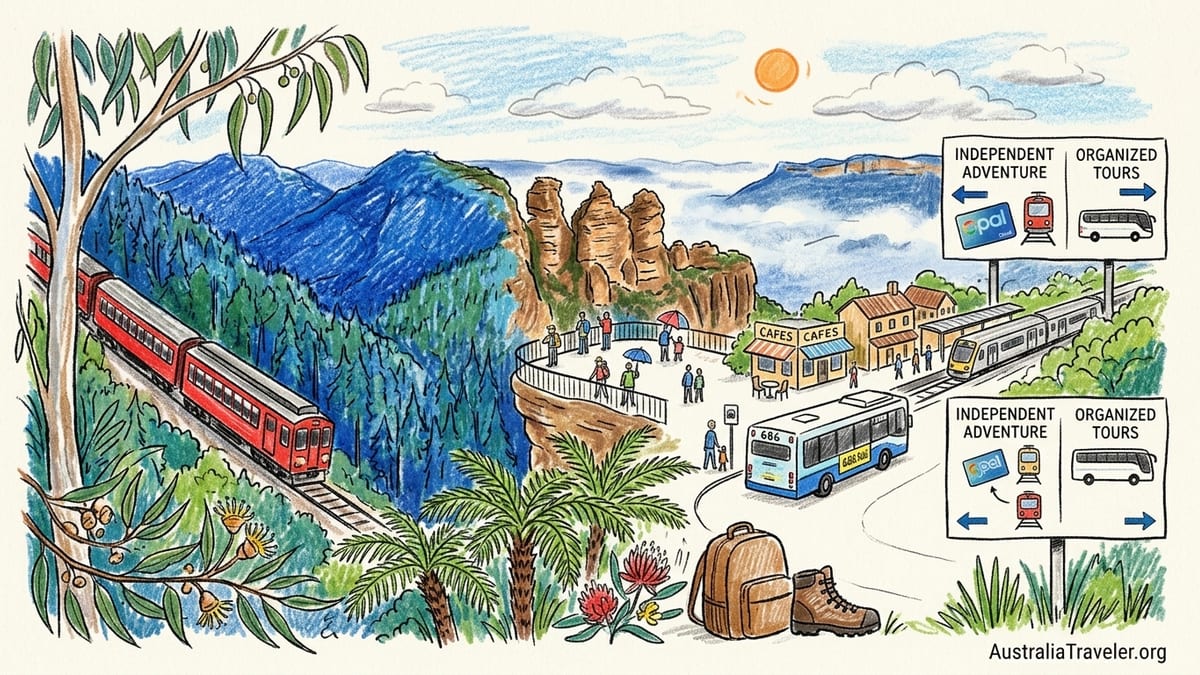
Leaving Central Station With a Plan and a Few Assumptions
I started at Sydney’s Central Station just after 7:30 a.m., determined to catch an early suburban train to Katoomba so I could be at Echo Point before the biggest crowds. Intercity services to the Blue Mountains are now operated by the intercity trains that feel closer to long distance commuters than tourist expresses, with standard Opal card fares applying. When I tapped on, the adult peak Opal fare from Central to Katoomba showed just over 10 Australian dollars each way on my app, capped by the usual daily limit, which instantly made the train feel like remarkable value compared with the 120 to 180 dollar price tags I had seen for many small group tours.
The train rolled out of Central on time at 7:48 a.m., and the carriage was a mix of commuters heading to Parramatta and Penrith, families with day packs, and a few travelers clearly bound for the mountains. For the first forty minutes the scenery was familiar Sydney suburbia. We passed Redfern and Strathfield, slipped by brick houses, car yards, and big box retail. Somewhere after Penrith the character changed. Industrial estates gave way to patches of bush, and the line began to climb. Distant ridges appeared, a reminder that the city really does end and a national park begins.
I had budgeted the roughly two hour ride as “dead time,” but it turned out to be useful planning space. I checked the live information for the Blue Mountains buses that connect Katoomba Station to Echo Point and Scenic World, and I double checked Scenic World’s same day prices, which in mid 2026 were sitting around 60 Australian dollars for an adult Unlimited Discovery Pass bought online, slightly higher at the ticket window. I still was not sure if I would buy it. My working plan was to reach Echo Point first, judge the visibility, and decide on the spot.
First Steps in Katoomba and Getting to Echo Point
We pulled into Katoomba just after 9:45 a.m. and half my carriage emptied onto the platform. The air felt at least five degrees cooler than Sydney, with a hint of eucalyptus and diesel mixing together. Outside the station there is a small bus interchange and a row of cafes. Within minutes, the line for the public 686 and 685 buses that run past Echo Point and Scenic World began to build. I tapped on with my Opal card again, paying a modest suburban bus fare that would count toward my daily cap, and squeezed into a bus that was already standing room only.
The ride to Echo Point took about ten minutes but felt longer as we inched through Katoomba’s narrow streets. The town itself felt both charming and slightly overwhelmed in peak late morning. Cafes were busy with day trippers, and groups from several tour coaches were already forming near the sidewalks. When I finally stepped off at the Echo Point stop, it was just past 10:10 a.m. From station to cliff edge, that meant about twenty five minutes including waiting and boarding. In hindsight, this was the first reminder that even a short independent trip involves a lot of stopping and starting.
Echo Point itself is designed to handle crowds. There is a broad plaza, visitor information, toilets, and multiple levels of fenced viewing platforms. The first thing I noticed was the wind. A cold gust came straight up from the Jamison Valley, carrying mist that blurred the opposite cliffs. I had imagined the Three Sisters bathed in clear, crisp light, but instead the view was hazy, with low cloud tracing the ridge lines. I could still see the famous sandstone pillars, but the further valley looked washed out. Several people around me were grumbling about “coming all this way for fog,” and I understood the feeling. The reality of mountain weather is that clear blue skies in Sydney do not guarantee postcard conditions at Echo Point.
Walking to the Three Sisters and Dealing With Crowds and Fog
From Echo Point I followed the well signed walking track toward the Three Sisters themselves. This is not a long walk, more of a stroll along the cliff top with regular side platforms, but it can be slow when the path is full of tour groups stopping for photos. On my day, several large groups arrived at once, and the narrow sections became one way channels. It took me around fifteen minutes to cover what would normally be a sub ten minute walk, simply because I was constantly stepping aside for people taking pictures or trying to pass.
About halfway to the Three Sisters I realized how much of a constraint visibility was going to be. Patches of fog drifted in and out of the valley. One moment the cliff line opened up beautifully, and the next it was a white wall. I spent at least twenty minutes playing this waiting game, standing at railings, camera in hand, hoping the mist would lift just enough to get a clean shot. For every minute actually photographing, there were probably three or four minutes just watching, checking my watch, and debating whether to move on.
Reaching the small bridge that leads onto the first of the Three Sisters felt like a milestone, even though it is still very much a tourist platform. The steps down are steep but short, and the traffic runs in bursts. I waited at the top for a lull in both directions, conscious that going down would mean waiting again to climb back up in a narrow stairway with people coming the other way. The rock ledge at the end gives a closer and more dramatic angle on the formations, but it is shared with a constant rotation of fellow visitors. I spent less than ten minutes there, partly because the fog was thickening again and partly because I could feel the pressure of people waiting behind me. This was a far cry from a solitary bushwalk, but it was still a unique vantage point that I am glad I made the effort to reach.
Lunch, Buses, and the Question of Scenic World
By midday I was cold, slightly damp from wind blown mist, and already a bit tired from managing crowds. I walked back from Echo Point toward Katoomba village via the road, which took around twenty minutes at an easy pace, passing guesthouses and small motels along the way. The sidewalks were surprisingly quiet compared with Echo Point itself, and I started to imagine what it would be like to stay a night here instead of racing back to Sydney the same day.
Back near the station I grabbed a late lunch at a casual cafe. A simple toastie, coffee, and a small pastry set me back around 20 Australian dollars and took the better part of forty five minutes once I factored in ordering, waiting, and finally sitting down. This is where the independent strategy shows its true rhythm. On a group tour, lunch is usually slotted into a tight forty minute block at a predetermined venue. Traveling alone, I lingered, browsed my photos, watched the cloud levels through the window and wrestled with my next decision. It was already after 1:30 p.m. If I went back toward Echo Point and on to Scenic World, I would have to accept that a good chunk of the afternoon would go into queuing and cable cars.
Scenic World’s pricing made that decision feel significant. At around 60 Australian dollars for an online adult Unlimited Discovery Pass, which includes the Scenic Railway, Skyway, Cableway, and boardwalk access, it is not a casual add on to a budget day. A family of four looking at walk up prices can easily spend well over 200 dollars just on this one attraction. I decided to commit, partly out of professional curiosity and partly because the weather seemed to be improving slightly on live webcams. I walked back to the bus stop outside the station, caught another public bus using my Opal card, and headed toward Scenic World. This leg took about ten minutes of actual riding and almost fifteen minutes of waiting.
Inside Scenic World: Railway, Skyway, Cableway and Boardwalk
I arrived at Scenic World at around 2:20 p.m. The car park and coach bays were busy but not overflowing. Inside, the ticket process was efficient and I was through the gate within ten minutes. The biggest surprise was the queue pattern. On my visit the Scenic Railway line was the longest, snaking back and forth for at least twenty minutes, while the Skyway and Cableway moved more quickly. Anyone expecting to just walk on to each ride will be disappointed in the middle of the day.
I joined the line for the Scenic Railway first. This is marketed as the world’s steepest passenger railway, and sitting inside the open carriage with feet braced felt more like boarding a theme park ride than a simple mode of transport. The descent takes less than two minutes, but it is undeniably thrilling, a sharp drop through a sandstone cutting into the forest. At the bottom I stepped out into dense greenery and that distinctive damp, cool smell of temperate rainforest. Combined with the anticipation on the way down, the Railway felt like the one element that could justify a chunk of the ticket price, especially for visitors who enjoy a bit of adrenaline.
From the Railway station, I joined the elevated boardwalk system that weaves through the valley floor. Scenic World has built a network of timber paths and interpretive signs that allow even casual visitors to immerse themselves in the forest without needing hiking boots. I spent around thirty minutes on these walks, taking photos of lyrebird scratchings, tree ferns, and the filtered light on mossy trunks. In practical terms, this was my favorite part of Scenic World. It offered a genuine sense of place that felt closer to a bushwalk and less like a ride queue.
To return to the top, I took the Scenic Cableway, a large cabin that glides up the cliff face with views of Katoomba Falls and the Three Sisters in the distance. The whole ride lasted about five minutes, plus ten minutes of waiting and boarding. The views were good but still a little hazy, with cloud lingering in the valley. The Skyway, which crosses the valley between cliffs, offered a different angle again when I rode it shortly after. It impressed me less, partly because the glass floor section was crowded and partly because visibility still limited those sweeping, clear vistas that appear in marketing images. By the time I finished both aerial rides and a final short loop on the boardwalk, it was already after 4:00 p.m. In effect I had spent almost two hours on a combination of queues, three short rides, and a half hour walk.
Time, Fatigue and the Reality of a One Day Train Trip
Standing outside Scenic World at around 4:10 p.m., I faced another wait for a public bus back to Katoomba Station. Several tour buses came and went in the meantime, scooping up groups that had clearly been following a tightly scripted schedule. My bus finally arrived after about fifteen minutes, and I was on the platform in time for a train back toward Sydney just before 5:00 p.m. Factoring in the two hour journey, plus a short delay near Penrith, I did not walk back into my accommodation in the inner city until close to 7:30 p.m.
Looking back at my notebook, I had spent roughly four hours of the day on trains, about one hour cumulatively on local buses, close to two hours dealing with queues or waiting for fog to clear, and another two to three hours actually walking, viewing, or riding attractions. The remaining time disappeared into lunch, coffee, and transitions. That ratio is important for anyone considering the independent train option. A Blue Mountains day trip from Sydney is not like a quick harbor cruise. Much of the experience is in the travel itself and the quiet moments between the “wow” views.
By late afternoon I was more tired than I had expected, despite only walking relatively short distances on paved paths. The constant on and off transport, changing weather, and low level time pressure to “fit everything in” all contributed. I also underestimated the mental load of managing timetables, especially with variable bus frequencies in the afternoon and early evening. None of this ruined the day, but it did color my feeling about how much ground a first time visitor should aim to cover in a single daylight window.
Costs, Tours, Rental Cars and the Value Question
Sitting on the evening train back to Sydney, I added up the day’s expenses. The return Opal fares for the intercity train and local buses came in under 20 Australian dollars in total, thanks to integrated caps. My cafe lunch, coffee stops, and snacks totaled around 40 dollars. The Scenic World Unlimited Discovery Pass added about 60 dollars. Altogether, I spent somewhere in the region of 120 Australian dollars for the day, not including any gear I already owned like a reusable water bottle and light jacket.
Comparing that with small group tours, which at the time of my visit often ranged from around 120 to 180 dollars per person including coach transport, select lookouts, and sometimes Scenic World or a river cruise, the independent train trip did not feel dramatically cheaper by the time I added the Scenic World ticket and food. The main financial saving came from the extremely affordable public transport fares. If I had skipped Scenic World entirely, my out of pocket cost would have been closer to 60 dollars for the whole day, which is where the independent option really shines for budget conscious travelers.
I also considered what a rental car would add. Daily rental rates fluctuate, but a modest compact car from the city, plus fuel and tolls, can easily approach or exceed 120 dollars for the day when all costs are included. Split between two or three people, that becomes extremely competitive and offers significant flexibility. Having a car would have made it far easier to visit additional viewpoints such as Govetts Leap near Blackheath or to detour into Leura’s quieter streets and gardens, all without depending on bus timetables. The trade off would be the stress of driving on unfamiliar mountain roads, finding parking at popular spots, and staying under speed limits on a long day.
In pure value terms, my conclusion was that the train based independent trip makes the most sense for solo travelers or couples who are comfortable with public transport and who are happy to either commit to Scenic World as their main paid attraction or skip it and focus on free walks and lookouts. For visitors who want a more curated experience, do not want to worry about schedules, or hope to squeeze multiple locations into a single long day, a well chosen small group tour or shared rental car may provide better overall value even at a higher sticker price.
Why I Would Stay a Night Next Time
My biggest realization came not at a lookout, but while walking back from Echo Point toward Katoomba in the early afternoon. The side streets, lined with old guesthouses and small hotels, felt markedly calmer than the busy viewpoints. Signs advertised midweek specials and continental breakfasts. I passed a couple in hiking boots heading out with day packs, clearly in no hurry to catch any particular bus or train. They looked like they were about to start a longer cliff top walk, something that did not fit into my own day.
If I had added a night in Katoomba or neighboring Leura, the entire pace of the trip would have shifted. I could have taken a slightly later train in the morning, avoided peak bus times, and aimed for sunset at Echo Point after most tour groups had gone. The following morning, I would have been free to pick and choose a longer walk, such as part of the Prince Henry Cliff Walk, or to reach places that are awkward on a tight day schedule, like Wentworth Falls. The midday fog that frustrated my views on day one might have lifted for clearer vistas the next morning.
Staying over also opens up the quieter side of the mountains. Leura’s main street, with its cafes and boutiques, would be an easy short train hop or even a walk from some accommodations. Evening meals at local pubs or bistros replace the hurried snack before a long train ride. Perhaps most importantly, an overnight stay removes the hard stop of the last practical train back to Sydney. Instead of clock watching from mid afternoon onward, you can follow the weather and your own energy levels.
For travelers visiting from overseas or those who may never return to the Blue Mountains, investing in one or two nights seems a logical choice. The additional accommodation cost can be offset by a calmer, more flexible experience, and by the ability to spread activities over two days rather than compressing them into a single, slightly frantic outing.
The Takeaway
Looking back on my Blue Mountains day trip from Sydney by train, the strongest memories divide neatly between small moments of atmosphere and the logistics that shaped them. I remember the rush of cold air stepping off the train at Katoomba, the sudden silence when I walked a few steps away from the busy Echo Point platform, and the damp, earthy smell of the rainforest boardwalk far below the cliff tops. I also remember glancing at my watch on bus stops and platforms, calculating whether I had time for one more ride or one more lookout before I had to turn back toward Sydney.
The independent train approach delivered exactly what I had hoped in terms of flexibility and affordability. I could arrive and leave when I wanted, adjust my plans on the fly according to the weather, and spend as long as I liked in particular places without worrying about delaying a group. Thanks to reasonable public transport fares, the core of the day trip cost far less than a comparable organized tour would have, especially once I factor in that some tours charge extra for Scenic World or meals.
At the same time, the day exposed the real trade offs. Fog and patchy visibility significantly reduced the impact of some classic views, and there was no guide on hand to suggest alternative lookouts with better conditions. Waiting for buses and queuing for rides ate into the limited daylight far more than I expected, and by early evening I felt that I had sampled several highlights rather than explored the area in any depth. Scenic World itself was a mixed investment: the Railway and rainforest boardwalk felt genuinely worthwhile, while the Skyway and Cableway were highly weather dependent and added less for me on a hazy day.
If I were advising a friend, my exact recommended strategy would be this. If you have only one full day and you are comfortable with trains, do the independent trip, but simplify. Take an early train, go straight to Echo Point, walk to the Three Sisters and part of the cliff top path, then decide whether conditions justify a Scenic World ticket. If visibility is good and you are happy to pay for at least one thrill and some easy forest immersion, buy the pass and focus your afternoon there before heading back to Katoomba for an early evening train. If the weather is poor, skip Scenic World, linger over lunch in Katoomba or Leura, and embrace a slower day of shorter walks and village wandering. If at all possible, add a night in the mountains to free yourself from the clock. The Blue Mountains reward time and patience, and the best value you can unlock is not necessarily measured in dollars, but in unhurried hours spent on the edge of those vast, blue tinged valleys.
FAQ
Q1: Is a Blue Mountains day trip from Sydney by train realistic in one day?
Yes, it is realistic if you leave Sydney early and accept that much of the day will be spent on trains and buses. You can comfortably visit Echo Point, walk to the Three Sisters, and include either Scenic World or a relaxed lunch and short walk. Trying to fit multiple towns and long hikes into a single day trip by train is likely to feel rushed.
Q2: How much did the independent day trip cost compared with a tour?
My own independent day trip cost around 120 Australian dollars, including return train and bus fares, Scenic World, and food. Many small group tours at the same time were priced between roughly 120 and 180 dollars per person, sometimes including extra stops or a river cruise. Skipping Scenic World would have reduced my independent day cost to closer to 60 dollars.
Q3: Do I need to book trains in advance from Sydney to Katoomba?
You do not usually need to book seats in advance for the regular intercity trains between Sydney and Katoomba. They operate as part of the Opal network, and you can tap on and off with an Opal card or contactless payment. At busy times, some services may be crowded, so arriving a little early can help you find a good seat.
Q4: Is Scenic World worth the cost on a day trip?
Scenic World can be worth the cost if you value the Scenic Railway experience, easy access to rainforest boardwalks, and aerial views, and if weather conditions are good. On a foggy or low visibility day, the value of the Skyway and Cableway is reduced, and some visitors may feel the price is high for the amount of time spent in queues and on short rides.
Q5: How do I get from Katoomba Station to Echo Point and Scenic World?
From Katoomba Station you can use local public buses that accept Opal payments to reach Echo Point and Scenic World. Services typically run at regular intervals during the day, but there can be waits of 10 to 20 minutes, especially later in the afternoon. Walking from the station to Echo Point is also possible and takes around 20 to 25 minutes at a steady pace.
Q6: What happens if the weather is foggy or rainy?
If the weather is foggy or rainy, distant views of the Three Sisters and Jamison Valley can be limited, and some visitors are disappointed. However, low cloud can create an atmospheric effect, and rainforest walks remain enjoyable as long as you are dressed for cool, damp conditions. In poor visibility, it may make more sense to focus on shorter walks and village time rather than paying for distant lookout experiences.
Q7: Is it better to rent a car than to take the train?
Renting a car can be better value for two or more people who want to visit multiple lookouts and towns in one day, as it offers flexibility and access to places that are less convenient by bus. The trade offs include driving on unfamiliar roads, dealing with parking near popular sites, and staying alert over a long day. The train remains a relaxed, low stress option, particularly attractive to solo travelers and those not comfortable driving.
Q8: What should I pack for a winter day trip to the Blue Mountains?
For a winter day trip, bring a warm layer, windproof jacket, comfortable walking shoes, and a small backpack with water and snacks. Conditions are often several degrees cooler than Sydney, and wind at lookouts can make it feel colder. A compact umbrella or light rain shell is useful, as showers and valley mist are common even on days that start clear in the city.
Q9: Would you recommend staying overnight in Katoomba or Leura?
Yes, if your schedule and budget allow, staying at least one night in Katoomba or Leura greatly improves the experience. It reduces time pressure, lets you see Echo Point outside of peak tour bus hours, and opens up longer walks and additional viewpoints that are difficult to squeeze into a single day trip.
Q10: If I only have one day, what is your ideal simple itinerary?
For one day by train, I would leave Sydney around 7:30 a.m., arrive in Katoomba mid morning, go straight to Echo Point, walk to the Three Sisters, then return to Katoomba for lunch. In the afternoon I would either visit Scenic World if the weather is clear and I felt happy to pay for it, or focus on a relaxed cliff top walk and some time in Katoomba or Leura before catching a late afternoon or early evening train back to Sydney.