


Sydney is one of those cities where postcard views and real life match almost perfectly, but its spread-out geography can quickly trip up first-time visitors. The harbour cuts the city into distinct pockets, the beaches run for kilometres along the coast, and some headline sights sit far from the central business district. With only a few days to explore, choosing where to sleep and how to plan your days matters as much as what you choose to see. This guide lays out two complete, realistic itineraries for international visitors: a concentrated three-day Sydney hit list, and a more relaxed five-day plan that adds depth without turning your trip into a checklist marathon.
How Sydney’s Geography Shapes Any Good Itinerary
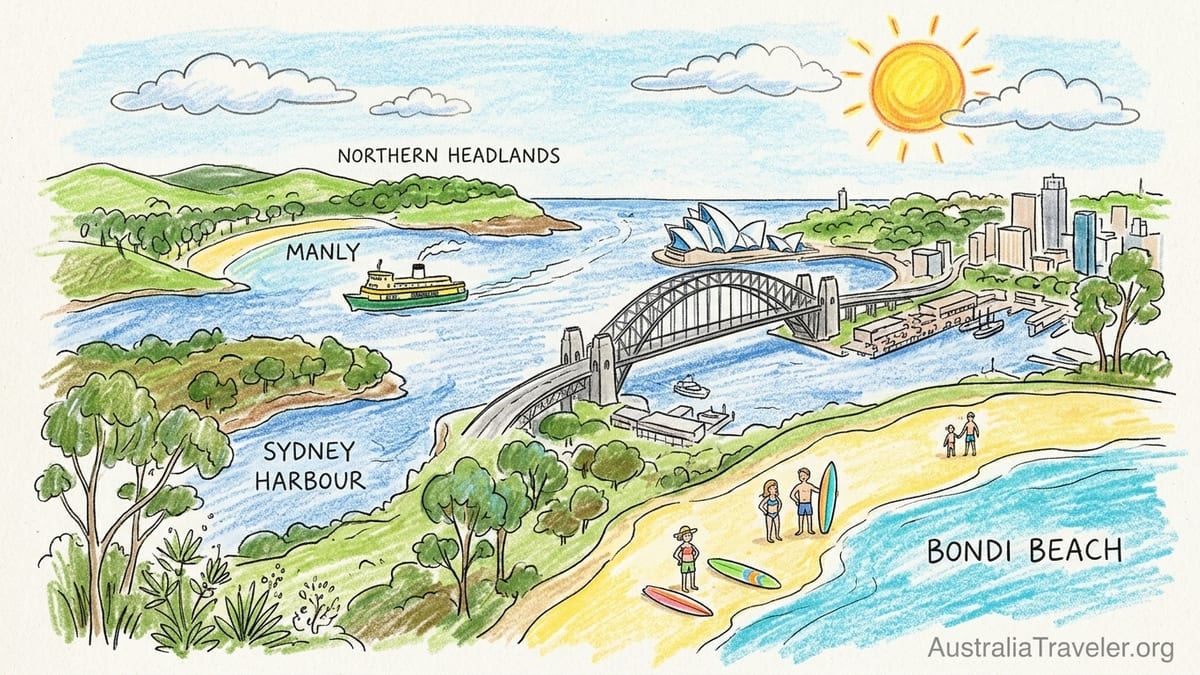
Sydney is built around a drowned river valley, which creates a spectacular harbour but also natural barriers. The historic centre and many headline attractions sit around Sydney Harbour, particularly near Circular Quay and The Rocks. East of the city centre you reach a string of ocean beaches, from Bondi south toward Coogee and Maroubra. To the north, the harbour narrows, ferries cross to Manly and beyond lie the Northern Beaches. To the west, neighbourhoods stretch inland toward Parramatta and the Blue Mountains. The result is that travel between these zones always takes longer than it looks on a flat map.
Public transport softens some of these divides but does not erase them. Trains, the light rail and most buses converge on the central station cluster of Town Hall, Wynyard, Central and Circular Quay. Ferries use Circular Quay as their main hub. To get between, for example, Bondi and Manly, you almost always need to pass back through the centre. This is why smart itineraries group each day around one or two neighbouring districts rather than bouncing between beaches and harbour viewpoints several times.
For visitors, the city can be thought of as four key sightseeing zones. Around the harbour you have Circular Quay, the Opera House, Harbour Bridge and the historic Rocks district. To the east are Bondi and the coastal walk to Coogee. To the north lie Manly and the northern harbour headlands. To the west and south are cultural venues, Darling Harbour, Chinatown, Surry Hills and eventually the greater west and Blue Mountains. Planning with these natural clusters in mind keeps travel times reasonable and your days feeling like a holiday, not a commute.
The transport network is relatively easy to understand once you know a few basics. Trains and light rail run frequently through most of the inner city from early morning until late night. Ferries link Circular Quay to Manly, Taronga Zoo, Darling Harbour and several suburban wharves. Tap-on, tap-off ticketing with contactless cards or an Opal smartcard keeps fares simple, with daily caps that help keep costs in check. This structure makes it practical to stay in the city centre and radiate out to different zones on different days, which is how both itineraries in this guide are organised.
Tickets, Transport and What Things Really Cost
Sydney’s public transport uses an integrated fare system that allows you to tap on and off with an Opal card or a contactless Visa, Mastercard or American Express. As of late 2026, adult peak fares for most inner-city train and light rail journeys sit in the range of roughly 4 to 6 Australian dollars each way depending on distance, with off-peak slightly cheaper. Ferries usually cost a little more than trains or buses over similar distances. There is a daily cap that limits how much you pay in a single day, and on Sundays the cap is significantly lower, which can make that a good day for longer excursions that involve multiple modes.
For airport transfers from Sydney Airport to the city, the train is often the fastest option but attracts a separate station access fee. The total adult fare into the city centre is usually a little over 20 Australian dollars one way when using Opal or contactless. Taxis and rideshare services will generally cost more but can be competitive for two people travelling together, especially outside peak traffic times. If you stay within the central city and main beach areas, you do not need a rental car, and parking in central Sydney is expensive enough that car hire usually works against you.
Major attractions also come with entry fees that add up over a three or five day trip. A standard adult ticket for the Sydney Opera House official guided tour usually falls somewhere between 45 and 50 Australian dollars per person, depending on the specific tour. Climbing to the summit of the Harbour Bridge with BridgeClimb is one of the city’s bucket-list experiences and is priced accordingly, often in the range of 300 to 400 Australian dollars per adult for the full summit experience. In contrast, walking across the bridge on the pedestrian path is free, and access to the Pylon Lookout, which offers impressive views, costs a small fraction of the guided climb.
On the food side, a straightforward sit-down brunch with coffee at a café in areas like Surry Hills, Bondi or the city commonly runs to about 25 to 35 Australian dollars per person, while a main course at a midrange restaurant near the harbour may be around 35 to 45 Australian dollars. Budget-conscious travellers can cut meal costs sharply by seeking out food courts in Chinatown and around George Street, where noodle bowls, dumplings or rice dishes may land in the 15 to 20 Australian dollar range. Both itineraries in this article balance a mix of paid attractions and free experiences such as walks, viewpoints and public beaches to keep overall trip budgets flexible.
Three-Day Sydney Itinerary: Harbour Icons, Bondi and Manly
For travellers with three full days, the focus is on the harbour, Bondi Beach and Manly, anchored around a central hotel base. For accommodation, the most efficient location is within walking distance of Circular Quay or Wynyard. Midrange hotels in this area might fall roughly between 260 and 380 Australian dollars per night for a standard double room, while luxury properties with harbour views can easily climb above 600 Australian dollars per night. Budget travellers will find better rates slightly further south near Central Station or in Chippendale or Surry Hills, then use trains to reach Circular Quay in under 15 minutes.
Day 1 revolves around Circular Quay, the Sydney Opera House, the Harbour Bridge, the Royal Botanic Garden and The Rocks. Aim to start around 8:30 or 9:00 in the morning. After a short stroll around Circular Quay, walk to the Opera House for a late morning guided tour. Booking an early tour slot allows you to avoid the busiest times. Afterward, enjoy lunch at the Opera Bar or one of the nearby venues if your budget allows, or pick up takeaway from a more modest café along Alfred Street and sit in the adjacent foreshore parks. In the afternoon, follow the walkway into the Royal Botanic Garden to Mrs Macquarie’s Chair, which offers one of the city’s most famous skyline views.
By mid-afternoon, angle back through The Rocks for a wander on its cobbled lanes and heritage pubs. Those interested in an architectural thrill can time a Harbour Bridge climb in the late afternoon, which often aligns the summit with golden hour views. If the full climb is too expensive or demanding, an excellent alternative is to walk across the bridge’s pedestrian path from The Rocks side to Milsons Point, which takes around 20 to 30 minutes each way at a relaxed pace. For dinner, The Rocks and Barangaroo both offer a wide spectrum of options, from casual burgers and pub meals around 25 to 30 Australian dollars up to high-end waterfront dining.
Day 2 centres on Bondi and the Bondi to Coogee Coastal Walk. Take a morning train from the city to Bondi Junction and then transfer to a local bus for the short ride down to Bondi Beach. The total journey from Town Hall or Wynyard takes around 25 to 35 minutes in light traffic and uses the same tap-on ticketing. Plan to arrive by 9:00 to enjoy the beach before midday heat in summer. Have breakfast or coffee at one of the cafés along Hall Street, then spend a couple of hours swimming, learning to surf with a local surf school or simply people-watching on the promenade. Paid surf lessons for beginners usually cost well over 100 Australian dollars per person in a small group format.
Set out on the Bondi to Coogee Coastal Walk by late morning. The full walk is about 6 kilometres and typically takes 2 to 3 hours with photo stops. The path hugs the cliffs and passes Tamarama, Bronte, Clovelly and several small coves. The route has some stairs and undulating sections, so visitors with limited mobility may prefer to walk only the Bondi to Bronte section, which still delivers classic vistas. Bring water, sunscreen and a hat in warm months. Lunch can be taken in Bronte or Coogee, both of which have casual cafés and pubs with mains often in the 25 to 35 Australian dollar range. In the late afternoon, catch a bus from Coogee back toward the city, connecting to your hotel for a shower and an evening meal in Surry Hills or Darlinghurst.
Day 3 is devoted to the harbour’s northern side and Manly. From Circular Quay, the classic Manly ferry takes around 20 to 30 minutes each way and is one of the city’s best-value sightseeing rides. Try to board a mid-morning service and sit on the outdoor deck if the weather is kind. Manly’s Corso leads directly from the ferry wharf to the beach. Spend several hours swimming, renting a board or just lying on the sand. For lunch, casual takeaway fish and chips along the promenade provide an affordable option, often around 15 to 20 Australian dollars per person. Craft beer venues and beach cafés offer more sit-down alternatives at higher prices.
In the afternoon, walk to Shelly Beach along the coastal path or, for a broader harbour view, consider a local bus or rideshare up to North Head for panoramic views back across the skyline. Walking distances vary, but a gentle day might include 5 to 8 kilometres total between the Corso, Shelly Beach and back. Return to the city by ferry in time for twilight. You can either seek out a harbour-side dinner around Circular Quay or Barangaroo, or for a more budget-friendly finale, head to Chinatown near Haymarket, where dumpling houses and noodle shops can bring dinner for two under 60 Australian dollars.
Five-Day Sydney Itinerary: Adding Depth Without Overloading
If you have five full days in Sydney, resist the temptation to cram more stops into each of the three core days. Instead, spread out the schedule and add new experiences that show different sides of the city. The first three days of the five-day version largely follow the harbour, Bondi and Manly pattern already described, but with slightly more flexibility built in for lingering over long lunches, an extra museum visit or an evening performance at the Opera House. The extra time also makes it easier to adjust plans around hot afternoons or unexpected showers.
Day 4 shifts focus to Darling Harbour, Chinatown and the Australian Museum. Start with a mid-morning stroll from your city hotel toward Darling Harbour, entering via Pyrmont Bridge or King Street Wharf. Families might prioritise attractions like SEA LIFE Sydney Aquarium or WILD LIFE Sydney Zoo, both of which sell timed-entry tickets that usually fall in the range of 40 to 60 Australian dollars per adult. Couples more interested in atmosphere than ticketed attractions can simply wander the waterfront promenades and enjoy a café stop. By lunchtime, head southeast on foot or by light rail toward Chinatown and Haymarket, where you can find inexpensive dumplings, yum cha or Southeast Asian dishes.
After lunch, walk or take a short light rail ride across to the Australian Museum near Hyde Park. General admission has alternated between being free and low cost in recent years, so check current details before arrival. Exhibits cover First Nations cultures, Australian wildlife and geology, which provide rich context if you later travel elsewhere in the country. Plan 2 to 3 hours for the museum, then enjoy a late-afternoon break on the lawns of Hyde Park. For dinner, nearby neighbourhoods such as Surry Hills offer many midrange restaurants and small wine bars, or you can return to Chinatown if you prefer a budget-friendly repeat.
Day 5 can be used in one of three ways depending on your interests: Taronga Zoo, a Blue Mountains day trip, or deeper neighbourhood exploration within Sydney. Taronga Zoo sits across the harbour from the city, reached by ferry from Circular Quay in about 15 minutes. Once there, you can combine zoo visits with sweeping harbour views. Adult tickets are usually around 51 Australian dollars when booked in advance. This makes a relaxed, animal-focused day that is especially suited to families. You will walk several kilometres on sloped paths through the zoo grounds, but there are plenty of rest spots and café options.
Alternatively, more outdoors-focused travellers might choose a guided day tour to the Blue Mountains west of Sydney. These tours usually pick up from central hotels early in the morning and return by early evening. Prices for full-day small group tours are often in the range of 160 to 250 Australian dollars per adult, including transport, guiding and sometimes a simple lunch. You will spend several hours on the bus, but in exchange see cliff-edge viewpoints, eucalyptus forest and landmarks such as the Three Sisters at Katoomba. A third option is to remain in the city and dig deeper into neighbourhoods like Newtown, Paddington or Glebe, using trains and buses to move between them and focusing on cafés, bookshops and local design stores rather than headline tourist attractions.
Across the five days, your hotel base can remain in or near the city centre. A five-night stay will represent a substantial part of a Sydney budget, so travellers often choose one of three broad approaches. Budget-minded pairs might target guesthouses, simple hotels or well-reviewed hostels in private double rooms around Central or Kings Cross, sometimes under 180 Australian dollars per night outside peak holiday periods. Midrange travellers may select modern business-style hotels near Town Hall or Wynyard. Those seeking luxury and convenience will look to waterfront properties around Circular Quay, Barangaroo and Darling Harbour. Each itinerary described here assumes a central base and relies on public transport, walking and the occasional rideshare rather than self-driving.
Weather, Seasons and Adapting the Plan
Sydney’s climate is generally mild, but conditions can change quickly, and summer days in particular can be hot and surprisingly humid. From December through February, maximum daytime temperatures often climb above 28 degrees Celsius, with hotter spikes during heatwaves. On such days, front-load outdoor activities into the morning and evening and keep indoor or shaded visits for the middle of the day. For example, on your Bondi day, start the coastal walk early, pause for a long brunch in shade and then switch to a late-afternoon swim. On harbour days, consider pairing an early Opera House or Pylon Lookout visit with a long, air-conditioned lunch, ducking into galleries, museums or shopping arcades when the sun is highest.
Rain is common in some months, including autumn and early spring, but showers can be passing rather than all-day events. If a heavy rain forecast emerges on your Bondi or Manly day, swap that day with your planned museum or Darling Harbour day. The Australian Museum, the Museum of Contemporary Art near Circular Quay, and covered sections of Darling Harbour’s attractions all provide weather-resilient experiences. The city centre also has extensive shopping arcades and food halls which can turn into useful refuges on wet afternoons.
Visitors with children will likely want to moderate walking distances and build in more playground stops. The Royal Botanic Garden offers lawns and space to roam, while Darling Quarter near Darling Harbour has one of the city centre’s most impressive playgrounds, which can fill several hours without any entry cost. On the beach days, aim to spend longer in a single place rather than trying to complete the entire Bondi to Coogee route with young kids. Bondi to Bronte is a good compromise, and it is easy to hop on a bus back to central Sydney from there.
Travellers with limited mobility or who prefer to avoid extensive stair climbing should approach the itineraries with a few adjustments. In the harbour area, it is feasible to focus on Circular Quay, the flat foreshore paths and accessible sections of the Botanic Garden. The Bondi to Coogee walk includes staircases and uneven sections, so many will be better off focusing on the Bondi promenade and a short section of the coastal path before returning to the beach. Ferries such as the Manly service are accessible, but some older wharves can present short gradients during low tide, so checking current accessibility notes before departure is wise. Rideshare and taxis can also substitute for uphill walks in The Rocks and around North Head.
Money-Saving Choices and Where to Spend
Costs in Sydney rise quickly when you add premium experiences and high-end dining, but each itinerary also has free or low-cost alternatives that deliver similar views or atmosphere. The clearest example is the Harbour Bridge. A full BridgeClimb experience is memorable but very expensive, whereas walking the bridge for free and paying a modest fee for the Pylon Lookout gives impressive views at a tiny fraction of the price. Similarly, while a multi-course dinner at a fine-dining restaurant overlooking the Opera House might run to several hundred Australian dollars for two including drinks, you can capture almost the same evening harbour ambience by buying takeaway meals from a food court and eating on the public steps or nearby lawns.
For budget travellers following the three-day plan, one realistic spending pattern for two adults might look like this, excluding flights and accommodation. Daily public transport and airport transfers might average around 40 to 50 Australian dollars per day across both people, assuming regular tapping and at least one ferry ride. Food costs can be managed to about 120 to 150 Australian dollars per day by relying on café breakfasts, food court lunches and midrange dinners, with at least a few self-catered snacks. Add one paid highlight each day such as an Opera House tour, a surf lesson or a museum combo ticket and you might add roughly 70 to 150 Australian dollars daily. Luxuries like BridgeClimb or a ticketed harbour dinner cruise would sit on top of this base.
Midrange travellers doing the five-day itinerary may be comfortable spending more on dining and experiences. Here, food and drink might rise closer to 200 or more Australian dollars per day for two, especially if wine and cocktails feature regularly. They might include a BridgeClimb, Taronga Zoo or Blue Mountains day trip, plus several paid museums and attractions, pushing total activities costs into the several hundreds across a five-day stay. Luxury travellers could choose premium harbour-view rooms, degustation dinners and private tours, sending combined spending for accommodation and experiences into many thousands of Australian dollars across five nights.
Wherever you sit on the spectrum, the main principle is to decide which one or two premium experiences matter most and budget for those, then consciously fill much of the rest of the time with excellent free options. Sydney is rich in no-cost activities, including the Bondi to Coogee walk, the Royal Botanic Garden, walking The Rocks and Barangaroo, beach days at Bondi and Manly, and window-shopping through suburbs like Paddington or Newtown. Used well, these ensure that both the three-day and five-day itineraries can feel generous without constant ticket scanning.
Sample Daily Routes You Can Drop Into a Map
To translate the itineraries into map-ready form, it helps to imagine each day as a single loop or line with only one or two backtracks. On the three-day itinerary, Day 1 forms a loop from Circular Quay to the Opera House, around the Royal Botanic Garden to Mrs Macquarie’s Chair, then back via The Domain and Macquarie Street to The Rocks and the Harbour Bridge before returning to Circular Quay. Day 2 traces a linear path from your city hotel to Bondi Junction by train, down to Bondi Beach by bus, along the coastline to Coogee on foot, then back to central Sydney by bus. Day 3 is another simple out-and-back, from Circular Quay to Manly by ferry, along the Corso to Manly Beach and on to Shelly Beach, then back to the ferry wharf and into the city.
For the five-day version, your first three days look similar on the map, but Days 4 and 5 create new patterns. Day 4 might start around Town Hall, walk into Darling Harbour, circle to Barangaroo if you wish, then angle south into Chinatown and Haymarket before turning east to the Australian Museum and finishing around Hyde Park or Surry Hills. This draws a rough C-shape across the lower city. If you choose Taronga Zoo on Day 5, the map shows a ferry line from Circular Quay to the zoo, a loop through the zoo grounds, and then a return ferry, with potential add-ons back in the city in the late afternoon. A Blue Mountains day trip looks like a corridor running west toward Katoomba, either by train from Central or on a coach tour, then small hops between lookouts.
Using your phone’s map app, you can pre-save places such as the Opera House, Bondi Icebergs, Coogee Beach, Manly Wharf, Taronga Zoo, Darling Harbour and the Australian Museum as a favourites list. Each morning, briefly review the day’s plan and trace the route you expect to walk or ride. This helps you visualise how much ground you will really cover and whether you want to trim or expand the plan. For example, seeing the full Bondi to Coogee route on the map might convince you to stop at Bronte instead, then bus back to save your legs for an evening out.
When plotting daily routes, remember that Sydney has hills, especially in The Rocks, around Darlinghurst and in parts of the eastern beaches. A straight-line distance of a kilometre does not always feel like a flat city stroll. Giving each day one main walking segment and then reserving buses, trains or rideshare for any substantial uphill stretches keeps energy levels higher. This is particularly important in summer heat, where a shaded bus ride can save you from arriving at viewpoints worn out and reluctant to explore.
The Takeaway
Both the three-day and five-day itineraries described here are built to respect Sydney’s geography rather than fight it. They keep harbour, beaches and inner neighbourhoods separated into sensible clusters, use ferries and trains where they are strongest, and anchor you in central hotels that minimize wasted movement. With three days, you will see the essential postcard views, dip your toes in both Bondi and Manly, and enjoy a snapshot of the historic centre. With five days, you trade urgency for texture, gaining time in Darling Harbour, Chinatown and at the Australian Museum, and potentially adding Taronga Zoo, the Blue Mountains or deeper neighbourhood wandering.
For visitors on tight annual leave or combining Sydney with other parts of Australia, three full sightseeing days in the city can still feel satisfying, provided you accept that you will not see every museum or suburb. Those who value slower mornings, long lunches and backtracking for favourite views will find five days markedly more comfortable. The extra time also helps when you encounter a hot spell, a rainy front or tired feet, because you can reshuffle days without feeling that you are abandoning a core sight.
In practical terms, the choice between three and five days often comes down to what else you plan to see in Australia and your overall budget for accommodation and activities. Sydney is not a city that rewards rushing between too many zones in a single day. Whether you opt for the concentrated three-day plan or the more expansive five-day version, grouping your time by area, booking one or two key tickets in advance and leaning on its ferries and trains will let you see the best of the harbour city without feeling like you are chasing it.
FAQ
Q1. Is three days in Sydney really enough for a first visit? Three days is enough to see the harbour icons, Bondi and Manly if you plan carefully and base yourself centrally, but you will not see many museums or outer neighbourhoods.
Q2. Where is the best area to stay in Sydney for these itineraries? For most visitors, staying near Circular Quay, Wynyard or Town Hall offers the best balance of train, ferry and light rail access for both the three-day and five-day plans.
Q3. Do I need an Opal card, or can I just use my bank card? Most international visitors can tap on and off with a contactless Visa, Mastercard or American Express instead of buying an Opal card, although some still prefer Opal for tracking spend.
Q4. How much walking should I expect on a typical sightseeing day? A standard day that includes the Bondi to Coogee walk or extensive harbour strolling can easily reach 10 to 15 kilometres of walking, though you can shorten distances with buses and ferries.
Q5. Is the Harbour Bridge climb worth the high price? Many travellers love the experience, but if the cost feels too high, walking across the bridge and visiting the Pylon Lookout gives excellent views at a much lower total price.
Q6. Can I visit the Blue Mountains on my own using public transport? Yes, regular trains run from Central Station to Katoomba, and local buses connect to viewpoints, though organised tours simplify logistics and may bundle multiple stops into one day.
Q7. What should I pack for a summer visit to Sydney? Bring light clothing, a brimmed hat, sunglasses, high-SPF sunscreen, comfortable walking shoes, a compact umbrella and a light layer for cooler evenings on the harbour.
Q8. Are Sydney’s beaches safe for swimming for international visitors? Main beaches like Bondi and Manly are patrolled and generally safe if you stay between the red and yellow flags and follow instructions from lifeguards about surf conditions.
Q9. How far in advance should I book major attractions? For Opera House tours, BridgeClimb, Taronga Zoo or Blue Mountains day tours, booking at least several days ahead is wise in high season, and earlier if you are fixed on a specific day.
Q10. Is it easy to eat well in Sydney on a tight budget? Yes, by using Chinatown food courts, takeaway sandwich shops, supermarket picnic supplies and avoiding daily fine dining, you can keep food costs reasonable while still eating varied meals.