


I had seen hundreds of photos of the Bondi to Coogee Coastal Walk before I ever set foot on it, but none of them quite captured what it feels like to actually move along those cliffs, to duck down the stairs to an ocean pool, to have your calves burn on the climbs while the Pacific keeps glittering to your left. When I finally walked it end to end on a mild spring day, I kept careful note of how long I really spent between beaches, what I paid for swims and snacks, and which stops felt worth lingering at. This is my honest account of how the route unfolded, what I loved most, and the version of the walk I would happily repeat tomorrow.
Arriving in Bondi: First Impressions and Starting Conditions
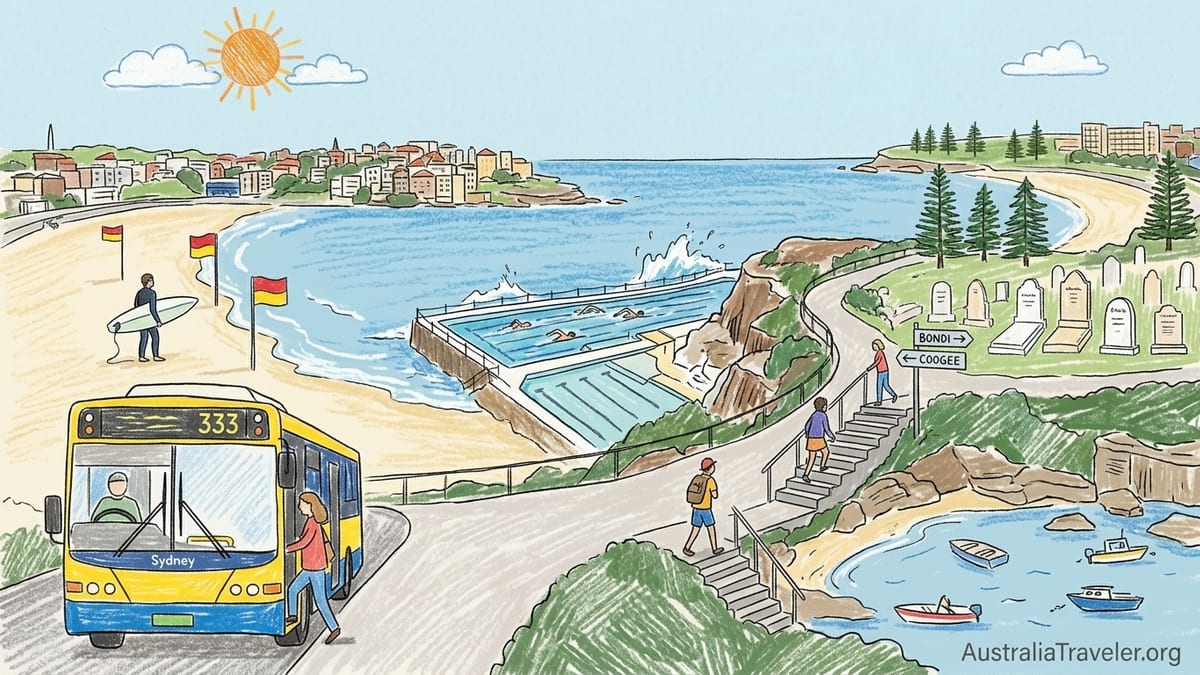
I began at Bondi’s southern end late on a Saturday morning in September, stepping off the 333 bus from Bondi Junction with a coffee already in hand. The sky was high and pale blue, the kind of spring light that makes every surface look slightly overexposed. It was warm but not punishing, about the low 20s Celsius, and a steady onshore breeze was pushing a clean shoulder-high swell into the bay. The sand was busy but not yet summer-crowded, with a mix of locals in wetsuits jogging straight to the water and visitors experimenting with rental boards near the flags.
Rather than rush straight onto the path, I walked down to the shoreline first. The flags were set slightly south of centre, lifeguards were watching a couple of rip channels, and surfers were clustered under the southern headland near the Bondi Icebergs pool. I stood in the shallows long enough to feel that the water was cool but manageable, then turned around to face the curve of the beach and the row of shops and cafes that frame Campbell Parade. It helped orient me: the walk to Coogee would take me south, around the headland to my right, tracing the cliffs beyond Icebergs.
Getting to the start had been straightforward. I used a contactless bank card instead of a physical Opal card for the bus and train, paying an adult peak fare of about four dollars for the 0 to 3 kilometre bus segment between Bondi Junction and the beach. Trains into Bondi Junction from central Sydney attract separate distance-based Opal fares, but the transfer to the bus within an hour counts as a single journey, which simplified costs for the day. I budgeted roughly twelve to fifteen Australian dollars total for my return transport, depending on how many times I tapped on and off.
From the sand, the walk does not announce itself in any grand way. A small sign near the southern ramp confirms “Bondi to Coogee Coastal Walk,” but what you see most clearly is the Bondi Icebergs complex perched on the rocks ahead. The official route is about six kilometres one way and usually estimated at two to three hours without long stops. Having read that in multiple guides, I decided to test it for myself by tracking only actual walking time on my watch and keeping a separate tally for swims and food breaks.
Bondi to Tamarama: Icebergs, Cliffs and the First Stairs
I reached the entrance to Bondi Icebergs in under ten minutes of easy walking from the sand. The walkway here is wide and fully paved, hugging the fence above the famous ocean pool. I paused on the concrete lookout just before the pool to take in what is arguably one of the most photographed views in Australia: the lap swimmers cutting lanes in turquoise water, waves detonating over the far wall, and Bondi Beach curving away behind them. Casual entry to the pool and sauna was posted at about ten Australian dollars for adults, with family and concession prices on the board at the door, and towels and lockers available for an extra few dollars. I made a mental note to swim here another day; on this walk I wanted to save my first immersion for a less famous spot.
Rounding the headland, the character of the walk changed quickly. The path narrowed, the pavement gave way to a mix of concrete and boardwalk, and low railings separated me from the drop to the rocks below. To my left the Pacific opened up, deep blue under the midday sun. To my right, dense apartment blocks clung to the hillside, their balconies stacked like boxes facing the sea. The wind channelled around the headland and picked up, strong enough that I had to tighten the strap on my hat.
About twenty minutes from Bondi’s sand at my relaxed pace, the first proper staircase appeared. It zigzagged down toward Mackenzies Bay, a rocky inlet that sometimes gathers enough sand to briefly become Sydney’s unofficial “extra” beach. On my walk it was in its rocky phase, so I stayed on the main path, which climbed again on the far side. These stairs are solid concrete, not technically difficult, but they do start to explain why the full route is not considered suitable for wheelchair users or many prams. Even with a small day pack and decent fitness, I could feel the first hint of a burn in my calves.
The approach to Tamarama Beach felt more compressed than I expected, the path funneling between rock and retaining walls before suddenly opening onto a compact crescent of sand. Locals sometimes call Tamarama “Glamarama,” and it did have a polished feel: sculpted shoreline, a neat lawn behind the beach, and a cluster of people sunbathing rather than swimming, given the strong rips common here. Lifeguards had set tight flags toward the centre, and the swell was surging heavily onto the rocks at either end. I checked the safety signage, decided to skip swimming here, and instead walked up to the small kiosk near the park to refill my water bottle and buy a banana, spending about five dollars.
Bronte: Ocean Pool, Bogey Hole and the First Swim
The section from Tamarama to Bronte is one of the most rewarding short stretches of the entire walk. It took me roughly fifteen minutes, including a couple of photo pauses, and threaded along low cliffs with uninterrupted views south. The surface stayed mostly paved, but there were several short flights of stairs interrupted by landings where people had stopped to lean on the rail and watch waves explode into spray on the rocks below.
Bronte announced itself with the sight of its ocean pool first, a simple rectangular cut into the southern rock shelf, fringed by a concrete walkway. Beyond it, the main beach opened out, backed by a large grassy park with tall Norfolk Island pines, barbecues and families spreading out picnic rugs. Compared to Bondi, Bronte felt instantly less performative and more relaxed. There were still plenty of people, especially around the kiosk and beachside cafes, but a lot fewer selfie sticks. The surf was running stronger here, and the rips looked pronounced, so most casual swimmers had gravitated to the pool.
Adult casual entry to Bronte Baths was posted at a modest fee on a small sign by the gate, the sort of amount you can comfortably pay with coins or a quick tap of a card. I paid my few dollars, ducked into the basic change area and slipped into the pool, which sat level with the ocean on the far side. The water was cold enough to sting at first, probably around 18 degrees Celsius, but calm and clear, with only the odd wave slopping over the wall. I swam slow laps for ten minutes, watching the horizon rise and fall as sets rolled in outside. This was my first real swim of the walk and immediately became one of the highlights of the day.
After drying off on the concrete and pulling my clothes back on over damp skin, I walked up to the strip of cafes that faces the park. I chose a small corner place for a late breakfast and ordered smashed avocado on sourdough and another flat white. The bill came to about twenty-eight Australian dollars, which aligned with what I had seen in recent price roundups for a casual Bondi or Bronte brunch. I took my time eating under an awning, adding about forty minutes to my stop here, and watched the traffic of walkers flow past. Quite a few people were taking Bronte as their endpoint before turning back to Bondi, which is a reasonable shorter option if you are dealing with limited time or young kids.
Waverley Cemetery and Clovelly: Quiet Paths and Sheltered Water
Leaving Bronte, the path climbed again, partly shaded by bushes and low trees. Within minutes the mood shifted as the route skirted along the edge of Waverley Cemetery, a hillside of white and pale stone headstones facing the ocean. The cemetery itself is fenced off from the main coastal path, but there are several points where you can pause and look across the graves to the sea beyond. The contrast between ornate Victorian monuments and raw sandstone cliffs made this one of the most atmospheric sections of the entire walk. It was also noticeably quieter; the casual crowds thinned out here, leaving mostly steady walkers and runners.
The path along the cemetery included some of the steeper stair runs of the day. Timber and concrete steps climbed and fell in sections, and though the track remained well maintained, I could feel my heart rate spike on the longer climbs. I passed a couple of families wrestling prams up and down the stairs, confirming that while some parts of the Bondi to Coogee route can be managed with a sturdy stroller, the full end to end walk is not realistically pram-friendly. For anyone with limited mobility or using a wheelchair, shorter, flatter segments at either end or around Bronte would be far more practical than attempting the entire route.
About thirty-five minutes of walking from Bronte, including plenty of photo pauses and a water break, brought me to Clovelly. The first sign that I was approaching was not sand, but concrete: long parallel ramps flanked a narrow inlet that looked more like a sheltered sea pool than a traditional surf beach. Clovelly’s bay is so protected that waves barely make it to the back of the inlet, which means the water is usually clear and calm. It is a favourite snorkelling spot, and on the day I walked through, a handful of people were finning slowly along the rock walls, masks in place.
I dropped my pack on the concrete, stashed valuables in a small paid locker near the surf club, and climbed down the metal ladder into the water. There is no entry fee to swim here beyond whatever you spend on lockers or gear rental if you do not have your own snorkel. Even without a mask I could see fish flickering around my legs in the green-blue water. This second swim, gentler and more meditative than the bracing laps at Bronte, reset my legs for the final stretch to Coogee. After fifteen minutes floating and a quick dry-off on the warm concrete, I bought a takeaway bottle of water and a small packet of crisps for around six dollars from the kiosk before rejoining the path.
Gordons Bay and Coogee: Understated Corners and a Busy Finale
The transition from Clovelly to Gordons Bay remains one of my favourite parts of the entire walk. The path dipped briefly onto a quiet residential street before a narrow track branched off toward the coast again. Suddenly the city receded and I found myself on a timber boardwalk suspended just above a tangle of coastal heath and low scrub. Below me, Gordons Bay curved in a tight horseshoe, dotted with small boats pulled up on skids above the high-tide line. There was no surf club, no promenade, just a pebbly strip of shoreline and clusters of people lounging on the rocks.
Gordons Bay felt far less publicised than Bondi or Coogee but in many ways more enjoyable. The water inside the bay was glassy and sheltered, and there is an underwater nature trail marked out for snorkellers with chains and plaques along the seabed. On my pass through, access to the small beach involved picking a careful route over rocks rather than a smooth ramp, and there are no lifeguards on duty, so I chose not to swim here. If you are confident in the water and prepared to enter off rocks, this could be a magical snorkelling stop. For families with small children or anyone who prefers patrolled swimming, it is better treated as a scenic lookout on the way to Coogee.
From Gordons Bay, the boardwalk and path climbed again through low bush before the first sight of Coogee appeared: the pale sweep of sand, the Coogee Pavilion at the northern end, and the low buildings of Arden Street curving around the bay. It took me around twenty minutes from Clovelly to reach the northern headland above Coogee, where several lookout points let me pause and watch the scene below. Even in shoulder season the beach was busy, with families clustered near the flagged area and groups spilling out of cafes across the road.
The official end of the Bondi to Coogee walk is usually marked near the steps that drop onto the central part of Coogee Beach. My watch showed about two hours and ten minutes of active walking time from Bondi, not counting swims, meal breaks and photo stops. If I added those in, the outing became a relaxed five-hour experience. At the southern headland I walked out toward the rock platforms near the Giles Baths and noticed swimmers using the various ocean pools and baths around Coogee. The area has multiple options, including women-only and mixed pools cut into the rock. Entry prices here were listed in the single digits for adults, paid at simple kiosks at the gate.
Practicalities: Heat, Crowds, Shade and the Return Journey
Walking this route made it clear why most guides suggest two to three hours for the six kilometres one way. It is not the distance that slows you down so much as the constant interplay of stairs, lookouts and temptations to stop for a swim or a coffee. On my spring day, the temperature never pushed into uncomfortable territory, but there were still long stretches with very little shade. In midsummer, with the sun high and the cliffs radiating heat, this would be a significantly tougher outing. Hats, sunscreen, and at least one refillable water bottle are non-negotiable, even if you plan to buy drinks along the way.
Crowds were another real factor. The section between Bondi and Bronte was busy almost end to end, with a mix of international visitors, local runners and people walking dogs. At times the path narrowed enough that I had to slow to single file and wait behind groups navigating stairs. South of Bronte, particularly along Waverley Cemetery and around Gordons Bay, the density dropped noticeably, and I could find small pockets of quiet to stand and listen to the waves. If you value solitude or want clearer photos, starting early in the morning on a weekday will make a big difference compared to a late-morning weekend start like mine.
In terms of access, the path is formally graded as an easier coastal walk, but that label conceals the reality of multiple steep flights of steps. Full wheelchair access is not possible along the entire route, and while prams appear regularly, they are often being manhandled up and down the same stairs that left my legs humming. For anyone planning with mobility constraints, I would suggest breaking the walk into shorter, flatter sections, such as Bondi to Tamarama or Clovelly to Coogee, and using local buses to bridge the more challenging parts.
After a late lunch in Coogee I considered walking back, but my legs and shoulders were already telling me I had packed enough into the day. Instead, I chose the practical local option and caught a 313 bus from Coogee up to Bondi Junction, where I transferred back to the train. Adult bus fares within the 3 to 8 kilometre band currently sit in the mid single digits when using Opal or contactless payment, so my Coogee to Bondi Junction ride cost somewhere around five to six Australian dollars. From Bondi Junction I had the option to continue by train into the city or reverse the bus ride back down to Bondi if I had left anything there.
Costs: What I Actually Spent vs Current Typical Prices
Because the coastal path itself is free, most of the costs on my Bondi to Coogee day came from transport, food and optional swims. On the day, I spent roughly twelve to fifteen Australian dollars on public transport, counting my inbound train and 333 bus to Bondi and the return bus and train combination via Bondi Junction in the afternoon. Using an Opal card or contactless payment kept the fares slightly lower than buying paper single trip tickets, which are priced higher per journey.
For food and drink, my biggest single outlay was brunch at Bronte, where smashed avocado on toast and a flat white came to about twenty-eight dollars, which reflects current cafe pricing in the eastern suburbs. Earlier that morning I had bought a takeaway coffee near Bondi for around five dollars, and later in the day I picked up a bottle of water and crisps at Clovelly for approximately six dollars. A banana and water refill stop at Tamarama added another five dollars. In total, I spent a little over forty Australian dollars on food and drinks without trying to be especially frugal.
Swimming costs were modest but not negligible. At Bronte Baths I paid a small entry fee of a few dollars in cash, in line with posted prices that keep these municipal pools accessible to locals. If I had chosen to swim at Bondi Icebergs as well, I would have budgeted an additional ten dollars for adult pool and sauna entry, plus the option of a five dollar towel or locker hire if I had not brought my own. Ocean baths around Coogee, including mixed and women-only options carved into the rock, were advertising adult casual entry in the low single digits when I walked through, usually collected at a simple gatehouse.
Separately from my own spending, I checked current guides after my walk to benchmark typical costs. Recent visitor information confirms that the walk itself remains free and open to the public, while ocean pools like Icebergs, Wylie’s Baths and McIver’s Ladies Baths set casual adult entry somewhere between a few dollars and about ten dollars. Upmarket cafes and restaurants along the route now often charge between twenty-five and thirty-five dollars for a main dish at lunch, with specialty coffee in the six to seven dollar range at some venues. It is entirely possible to walk the route on a tighter budget by bringing your own snacks and using only free beach showers, but there is definite pleasure in planning for at least one sit-down meal or pool entry along the way.
Timing the Walk: Fast Morning vs Full Beach and Food Day
My personal outing ended up as a hybrid between a fast morning walk and a full beach day, but having done it once, I can see two main approaches. The first is to treat it as exercise with great views. Starting early, say around 7am, you could comfortably complete the six kilometres from Bondi to Coogee in about two to three hours even with a few short photo stops. This would have you arriving in Coogee mid-morning, ahead of the lunch rush, with the choice of a quick coffee and bus back to the city, or a swim and a light meal before leaving. Runners and fitness walkers do this version all the time, often reversing direction to turn it into a twelve kilometre round trip.
The second approach, which is closer to what I ended up with, is to slow everything down and build the day around swims and food. On my walk, actual moving time registered just over two hours, yet I was out along the coast for a little more than five. A swim at Bronte, a long brunch there, a snorkel at Clovelly and repeat dips at Coogee can quickly expand the outing into a full day without ever feeling idle. This version does require more sun protection, more water and some mental readiness for crowds in the central sections, but it also lets you experience the full spectrum of beaches, pools and cliff-top views.
The drawback of the leisurely version is the return journey. After hours in the sun and salt, the idea of retracing the full six kilometres back to Bondi can feel daunting, especially with the stairs concentrated around the cemetery and Gordons Bay. For that reason, I recommend planning your start and end points based on where you want to linger. If you love the idea of finishing with drinks on Bondi’s promenade at sunset, begin in Coogee and walk north. If, like me, you enjoy discovering quieter corners and then collapsing into the comfortable bustle of Coogee’s beachfront bars and pools, start at Bondi and finish in Coogee with a bus and train home.
One element that does not change with either approach is the basic character of the route. Whether you are hurrying to keep to a schedule or meandering between food and swim stops, the six kilometres remain a sequence of linked vignettes: the formal icon of Bondi, the compact drama of Tamarama, the family sprawl of Bronte, the solemn detour past Waverley Cemetery, the concrete snorkel channel of Clovelly, the tucked-away boats of Gordons Bay and the lively bowl of Coogee. How much you taste of each depends on how often you let yourself stop.
What I Loved Most, What I Would Skip, and the Version I Would Repeat
Asked which beach I loved most on the walk, I surprised myself by not picking Bondi. It remains the most visually striking as a single image and the easiest to reach by public transport, but in terms of where I actually felt happiest in the moment, Bronte came out ahead. The combination of its ocean pool, wide park, family picnic atmosphere and slightly less intense level of posing on the promenade made it feel immediately usable. Swimming laps with waves slamming into the outer wall, knowing that good coffee was ten metres away on the other side of the fence, is my ideal kind of luxury.
For best viewpoint, I would choose the section of path that clings to the edge of Waverley Cemetery. Standing there with the graves falling away on one side and the Pacific stretching unbroken to the horizon on the other was quietly profound in a way that the more obvious lookouts were not. The cemetery’s position makes the cliffs here feel higher and more exposed, and the relative quiet compared to Bondi and Coogee lets you actually hear the ocean. If you only have energy for a shorter walk, I would make sure it includes this stretch.
In terms of what I would skip or compress on a repeat visit, I would probably not plan long stops at Tamarama or right in the centre of Coogee Beach. Tamarama is beautiful, but its strong rips mean I am unlikely to swim there, and the limited shaded seating fills quickly. Coogee, meanwhile, is more appealing to me as a base for exploring its rock pools and baths at either end of the bay rather than as a place to sit on the main sand. Next time I would go straight for one of the ocean baths at Coogee, take a shorter dip on the main beach itself and spend more time up on the headlands.
If I had to outline the exact version of the Bondi to Coogee walk I would personally repeat, it would look like this. Start at Bondi around 8am to avoid the worst of the heat and the densest crowds, walk steadily to Bronte and swim in the ocean pool before a late breakfast or early lunch at one of the cafes. Continue through Waverley Cemetery to Clovelly, stopping only briefly at lookouts until I can float in the sheltered water there. After a short snack and refill stop, walk via Gordons Bay to Coogee, then finish with a final swim in one of Coogee’s rock pools and a simple early dinner overlooking the bay. From there, catch the bus back to Bondi Junction and the train into the city as the light fades. It is a full day, but one that strings together everything I liked most: practical swims, genuine views and enough food and coffee to feel human.
FAQ
Q1. How long does the Bondi to Coogee walk actually take in real time?
On my day, I logged about two hours and ten minutes of active walking for the roughly six kilometre route, but swims, meals and photo stops stretched the outing to just over five hours.
Q2. Is the whole Bondi to Coogee path suitable for wheelchairs or prams?
No. While some flat sections and beach promenades are accessible, multiple steep staircases around Mackenzies Bay, Waverley Cemetery and Gordons Bay make the full end to end route impractical for most wheelchair users and many prams.
Q3. How much water and sun protection do I really need?
I carried one reusable bottle and refilled it at beachside fountains, but in retrospect I would bring at least 1.5 to 2 litres on a warm day, plus a wide-brim hat, sunglasses and high SPF sunscreen, because shade is limited on some cliff sections.
Q4. Where are the safest places to swim along the walk?
For patrolled and relatively controlled conditions, I favoured swimming between the flags at Bondi or Coogee and in managed ocean pools like Bronte Baths and the rock baths at Coogee, checking local conditions and signs before getting in.
Q5. How much did you actually spend on the day, excluding flights and accommodation?
Counting public transport, two swims, brunch at Bronte, coffee and snacks, my total came to roughly sixty to seventy Australian dollars, while the walk itself and regular beach access were free.
Q6. Can I walk Bondi to Coogee in summer without overheating?
It is possible, but I would start very early in the morning, carry more water than you think you need, build in shady rest stops at parks like Bronte, and avoid the harshest midday hours when the cliffs radiate heat.
Q7. Which lesser-known stop did you enjoy more, Gordons Bay or Tamarama?
For me, Gordons Bay felt more special, with its tucked-away boats, sheltered water and boardwalk approaches, even though I chose not to swim there due to rocky access and the lack of lifeguards.
Q8. Is it better to walk from Bondi to Coogee or from Coogee to Bondi?
I enjoyed starting at Bondi and finishing in Coogee, but if you want to end your day with Bondi’s bars and sunset over the curve of the main beach, beginning in Coogee and walking north might suit you better.
Q9. Do I need to book anything in advance for the walk?
You do not need bookings for the path itself, but on busy weekends it can be wise to reserve tables at popular cafes in Bondi, Bronte or Coogee if you plan a sit-down brunch or lunch.
Q10. What version of the walk would you recommend for someone short on time?
If you only have a morning, I would suggest walking from Bondi to Bronte, swimming in the Bronte pool, grabbing coffee or brunch there and then returning by bus or on foot, which gives you cliffs, a classic ocean pool and fewer logistics.