


Sydney is one of the few cities where you can step onto a commuter train in the morning and be staring into a wilderness canyon, vineyard valley or surf break before lunch. For travelers who want meaningful excursions without committing to overnight road trips, the challenge is not finding a day trip but choosing the one that fits your time, interests and budget. This guide compares the strongest options within roughly three hours of central Sydney, with a particular focus on the Blue Mountains, Hunter Valley, Royal National Park, Palm Beach and the Central Coast, plus Kiama, Wollongong, the Southern Highlands and Port Stephens as secondary choices where an overnight stay often makes better sense.
Understanding Distances, Travel Times and Seasons Around Sydney
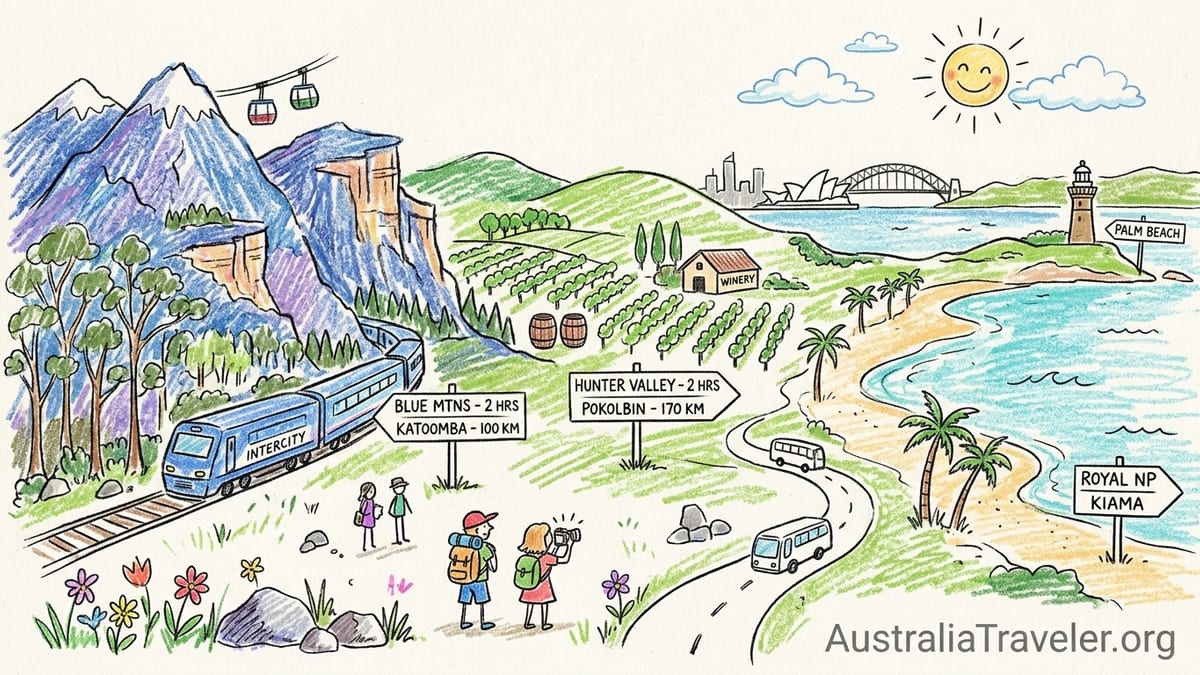
Before deciding where to go, it helps to understand Sydney’s regional geography in real-world terms. The Blue Mountains begin about 60 kilometres west of the city but the main tourist hub of Katoomba is close to 100 kilometres by road or rail from Central Station, usually around two hours each way on the intercity train. Hunter Valley wine country sits to the north-west, about 170 kilometres from the city and roughly a two hour drive in light traffic, which already accounts for about four hours of your day. In the opposite direction, Royal National Park begins less than 35 kilometres south of the CBD, while coastal towns like Kiama and Wollongong are roughly 120 kilometres and 80 kilometres away respectively, making them accessible for unhurried day trips by train or car.
To the north of the harbour, Palm Beach is about 40 kilometres from central Sydney but travel times by road are closer to 75 to 90 minutes in typical traffic because you pass through a long string of beach suburbs. Public transport routes involve at least one change to a Northern Beaches service and real-world travellers report about 90 minutes from the city to Palm Beach when buses run smoothly. The Central Coast, which includes Terrigal and Avoca Beach, is for practical purposes a separate region. Trains run from Central to Gosford or Woy Woy in around 70 to 80 minutes, followed by a short bus or taxi ride to the beach towns, bringing the total one-way trip to around two hours.
Seasonality matters almost as much as distance. The Blue Mountains can be misty, cold and windy in winter but are glorious in late spring and early autumn when daytime highs often sit in the high teens or low twenties Celsius and trails are less muddy. Hunter Valley’s vines change character through the year: harvest activity peaks in late summer, while autumn brings golden leaves and milder temperatures, but summer afternoons can be very hot for outdoor tastings. Coastal escapes such as Palm Beach, Royal National Park and the Central Coast are pleasant year-round, although ocean swimming is most comfortable from late October to April and weekends in high summer suffer from traffic bottlenecks and parking pressure that can eat into your time on the sand.
Because of these dynamics, visitors on five to seven day Sydney stays are usually best served by choosing one major inland excursion, such as the Blue Mountains or Hunter Valley, and pairing it with a closer coastal or harbour-focused outing. The following sections examine each key destination in turn, with realistic travel and on-the-ground timings, public transport options, current indicative costs for popular tours and tickets, and a clear sense of whether a day trip or overnight stay will give better value for your limited time.
Blue Mountains: Grand Canyons, Bushwalks and Scenic World
For most travelers, the Blue Mountains are the headline day trip from Sydney for scenery and bushwalking. Katoomba, the main visitor town, sits just under 100 kilometres west of Central Station. Intercity trains on the Blue Mountains Line depart from Central’s upper platforms and take around two hours to Katoomba, where many visitors either walk, catch a local bus or join an organised tour loop to the lookouts. Recent traveller reports describe a simple pattern: depart Sydney around 7.20 am, arrive about 9.30 am, then use the local 686 bus from outside the Carrington Hotel to reach Echo Point and Scenic World in a circuit that allows you to hop off at key stops.
By train, a realistic day for independent visitors gives you about six to seven hours in the mountains if you bookend the day with early morning and late afternoon departures. That is enough time to walk from Katoomba to Echo Point, take in the classic Three Sisters view, visit Scenic World for its cableway, skyway and steep funicular railway, and still squeeze in a short bushwalk such as the cliff-side track from Echo Point towards Leura. Scenic World’s own pricing is reviewed regularly, but recent guides place full-day unlimited-ride tickets at around 60 to 70 Australian dollars per adult when purchased directly. Because this is a single-operator attraction, it is worth checking the exact price close to your travel date rather than relying on older brochure estimates.
Guided coach tours compete directly with the train option. Many full-day Blue Mountains tours from Sydney advertise durations of about 10 to 11 hours door to door, with departure around 7 to 7.30 am and return about 6 to 7 pm. A typical itinerary includes hotel pickup, a drive to Echo Point lookout, timed access to Scenic World rides, a visit to Wentworth Falls or another cliff-top lookout and a wander through Leura village on the return leg. Current advertised prices for small-group tours often fall in the range of about 150 to 220 Australian dollars per adult, with more premium or very small-group offerings climbing higher, especially once lunch and park entry fees are bundled. Tour prices sometimes exclude Scenic World tickets, which can add an additional 60 or more per person at the gate, so read inclusions carefully.
The decision between train and tour comes down to priorities. The train is substantially cheaper, especially for budget-conscious couples or solo travelers using Sydney’s contactless Opal system where daily caps keep long-distance fares in check. It also gives you freedom to linger at Echo Point or take longer walks around Wentworth Falls, Leura Cascades or the Grand Canyon near Blackheath if you are a strong hiker. On the other hand, an organised tour removes all navigation stress, includes commentary that can add context on geology and local history, and often saves a little walking for those with mobility limits. For many families with young children or older relatives, a tour that bundles transport, lookouts and Scenic World into a single ticket is worth the extra cost because it removes the risk of missing a train or misjudging distances between sights.
Hunter Valley: Wine, Food and Why Tours Often Beat Self-Driving
Hunter Valley is Australia’s oldest wine region and the main reason many visitors are tempted to rent a car for the day. The heart of the valley, around Pokolbin and Lovedale, lies about 170 kilometres north of Sydney. In perfect conditions, the drive takes just over two hours each way, but real-world timing including city traffic and short rest stops means you should allow at least two and a half hours north in the morning and a similar time returning. That translates to roughly five hours of your day in the car if you self-drive, compared with perhaps four hours on a coach if you join a tour that uses motorway routes and departs before peak congestion.
The central issue is alcohol. Many cellar doors now charge structured tasting fees in the range of roughly 10 to 20 Australian dollars per person per winery, frequently offset against purchases, and a typical day might involve three to four wineries, plus perhaps a brewery or distillery visit. It is both unsafe and illegal to drive after even moderate consumption, especially in an unfamiliar region, and the rural road network around Pokolbin includes narrow lanes and wildlife hazards after dark. For this reason, full-day Hunter Valley wine tours from Sydney, where a driver and guide remain sober while guests taste freely, make compelling sense for most international visitors and for locals who want to relax.
Current price comparisons confirm this logic. Recent reviews of Hunter Valley day tours from Sydney list several reputable operators offering small-group excursions that visit three or four wineries, include a two-course or shared platter lunch and provide door-to-door transport for approximately 160 to 230 Australian dollars per adult, with some budget-focused tours from backpacker hostels slightly lower and premium private or chauffeured car experiences much higher. Chauffeur-driven Mercedes E-Class or V-Class tours, for example, may start near 1000 Australian dollars for up to three or six passengers, making them cost-effective for small groups who want a tailored itinerary. While these versus self-drive cost comparisons change with fuel and rental prices, the underlying safety and convenience arguments are stable.
There are situations where self-driving can make sense. Travellers who do not intend to drink, or who plan a day focused on food, gardens and galleries rather than multiple tastings, can rent a car in Sydney, Parramatta or Newcastle and design a flexible route that visits farm shops, cheese makers and a single flagship winery for lunch. Families staying overnight in the valley might use the first afternoon as a self-guided driving day, then join a local tour the next day so that one partner does not have to remain designated driver all weekend. However, for a strict day trip that returns to Sydney the same evening, especially where multiple tastings are planned, an organised wine tour is the more sensible default.
Royal National Park: Coastal Cliffs, Figure Eight Pools and Transport Snags
Royal National Park, established in the nineteenth century, stretches along the coast just south of Sydney and offers sea cliffs, eucalypt forest, lagoons and family-friendly picnic areas within a short radius of the CBD. By car, the northern entry points such as Audley and Bundeena are around 35 to 45 kilometres from central Sydney, commonly less than one hour in light traffic. However, the road network narrows inside the park, and popular car parks near Wattamolla Beach, Garie Beach and the trailheads to landmarks such as Wedding Cake Rock and the Figure Eight Pools fill quickly on warm weekends. Drivers should be prepared to arrive early, potentially before 9 am on summer Saturdays, or accept a longer walk from more distant parking areas.
Public transport access exists but is more fragmented than for the Blue Mountains. A common combination is to catch a suburban train on the T4 Illawarra Line to Cronulla, then take the ferry across Port Hacking to Bundeena and walk into the park’s coastal tracks from there. Another variant is to take the train to Heathcote or Otford stations and use marked trails to enter the park on foot. These options are wonderful for confident hikers with a whole day to spare, but they rely on ferry timetables, involve steep sections and do not serve family picnic areas directly. There is no single hop-on hop-off shuttle system equivalent to Katoomba’s loop, so once you are on a trail, you are committed to walking back out.
The park charges vehicle entry fees at various points. New South Wales national park fees are reviewed regularly, but as of late 2026 many car-based visitors pay a day-use fee in the ballpark of 12 to 20 Australian dollars per vehicle at Royal National Park entry stations or via digital payment apps. Independent hikers who arrive solely by public transport and on foot may avoid vehicle fees but still need to carry enough water and navigation tools, as signage can be sparse away from the main picnic grounds. Coastal tracks, including the multi-day Coast Track between Bundeena and Otford, are also subject to periodic closures due to erosion, storm damage or bushfire risk. It is essential to check the National Parks and Wildlife Service alerts page shortly before your visit and to have a backup plan in case a section is closed.
As a day trip, Royal National Park works best for fit walkers who enjoy open coastal views and are confident time-managing their return train and ferry connections, or for local drivers who know the bottlenecks and can move early. For first-time overseas visitors with only a few days in Sydney, the combination of variable transport and parking pressure can make the park feel less straightforward than the Blue Mountains, even though it lies much closer in pure distance.
Palm Beach and the Central Coast: Beaches, Headlands and Relaxed Seaside Travel
Palm Beach sits at the very tip of the Northern Beaches peninsula, around 40 kilometres north of Sydney’s CBD but effectively a world away in atmosphere. It is a long, golden surf beach with the calmer Pittwater estuary on its western side and the bush-covered Barrenjoey Headland between them. Travellers without a car typically reach Palm Beach by combining a city train to a hub such as Wynyard or Town Hall with a Northern Beaches B-Line or 190-series bus, then transferring at Mona Vale or Newport for the final ride to Palm Beach. Commuters and trip-planners who have timed these runs with current timetables report about 90 minutes door to door if connections are smooth and off-peak traffic is light.
From the final bus stop near the surf club, visitors can swim, stroll the oceanfront or take the marked walking track up Barrenjoey Headland to the lighthouse and viewpoints over Broken Bay. The headland walk is short, often completed in less than 30 to 45 minutes each way depending on the chosen route and fitness levels, but it is steep in sections and exposed in hot weather. There are no entry fees to access the beach or track, but parking near the water is metered and closely monitored on sunny weekends, encouraging many day trippers to stick with public transport. Cafes cluster around the wharf and surf club, and ferries cross Pittwater to destinations such as Ettalong on the Central Coast, enabling a one-way land and sea day trip if you plan the return route via train from Woy Woy.
Further north, the Central Coast offers a string of relaxed seaside towns such as Ettalong, Terrigal and Avoca Beach. A practical route from Sydney is the intercity train to Gosford or Woy Woy, roughly 70 to 80 minutes from Central, followed by a 15 to 30 minute bus or taxi ride to the beach itself. This means that a Central Coast day trip is broadly comparable to the Blue Mountains or Hunter Valley in raw travel time but feels gentler because the train hugs the Hawkesbury River and Brisbane Water and the walking demands on arrival are modest. Once there, activities are simple and family-friendly: swimming, stand-up paddleboarding in protected bays, coastal walks to lookouts and long lunches at waterside pubs and cafes.
Palm Beach and the Central Coast work particularly well as lower-effort days that still feel distinctly “Australian.” A practical example for a seven-day Sydney stay might be to reserve your longest day for a Blue Mountains or Hunter Valley excursion, then set aside a second day for an unscheduled Northern Beaches or Central Coast outing where you can adjust timings according to the weather and energy levels. For these coastal trips you can realistically count on five to six hours on the ground if you leave central Sydney around 9 am and return after sunset in summer, making them excellent value in terms of ratio of travel time to relaxation time.
Kiama, Wollongong, Southern Highlands and Port Stephens: When Day Trips Become Overnights
Several destinations within roughly 200 kilometres of Sydney tempt visitors with strong marketing but are better experienced with at least one overnight stay if your schedule allows. South of the city, Wollongong sits about 80 kilometres down the coast and is reachable by train in approximately 90 minutes from Central. The journey itself is a highlight, crossing the dramatic Sea Cliff Bridge and hugging forested escarpments. As a day trip, a simple pattern works well: morning train, stroll the harbour and lighthouses, swim at a patrolled beach and return in the late afternoon. However, Wollongong and its northern beaches also act as gateways to the coastal escarpment and inland drives, which are more relaxing to explore over two days with a car.
Further south again, Kiama is about 120 kilometres from Sydney by road and roughly two and a half hours by the coastal train. The lure here is the famous blowhole, clifftop paths and a compact harbour village atmosphere. It is possible to do Kiama as a long day trip by catching a morning train, spending three to four hours visiting the blowhole, rock pools and town centre, then returning in the late afternoon. Yet many domestic travellers prefer to treat Kiama as an overnight or weekend break, especially if they want to combine it with nearby beaches like Gerringong or with hinterland drives into dairy country. Trying to add multiple coastal towns or long walks into a single day from Sydney tends to convert the experience into a series of rushed photo stops.
Inland, the Southern Highlands cover a collection of cool-climate towns such as Bowral, Mittagong and Berrima, about 120 kilometres south-west of Sydney along the Hume and Illawarra highways. Trains to Bowral take around one hour and 45 minutes, and a determined visitor could sample a garden, stroll historic Berrima and visit a winery in a very compressed day. However, much of the region’s appeal lies in slow pleasures such as antique hunting, long lunches in converted homesteads, and visits to Fitzroy Falls or Morton National Park outlooks. On that basis, most guidebooks and regional tourism bodies encourage at least a one-night stay, and two nights if you plan to walk or drive widely.
Port Stephens, roughly 200 kilometres north-east of Sydney and centred on Nelson Bay, is even more clearly a short-break destination. Driving times under ideal conditions are around two and a half to three hours each way, but holiday traffic around Newcastle and along the single-carriageway approach roads regularly stretches this toward four hours, especially on summer weekends and during school holidays. Activities such as dolphin-watching cruises, sandboarding on the Stockton dunes and snorkeling or diving around the bay are all better appreciated without watching the clock for a same-day return drive. If your trip priorities include Port Stephens, it is efficient to fold it into a longer loop that might also cover the Hunter Valley or the Mid North Coast rather than treating it as a standalone day trip from Sydney.
Practicalities: Costs, Closures, Weather and Traffic
Because prices and conditions change, any visitor planning Sydney day trips in late 2026 should treat exact figures as indicative and verify them just before travel. Intercity train fares on the Opal system are reviewed annually, usually in July, but recent accounts suggest that a same-day return from Central to Katoomba or Kiama still falls under common daily caps when paid with contactless card or Opal, because off-peak discounts and caps limit the total cost. This makes rail-based day trips to the Blue Mountains, Wollongong or Kiama relatively good value compared with hiring a car, especially for solo travelers and couples.
Attraction and tour prices vary more widely. Scenic World in the Blue Mountains, for instance, has moved away from one-size-fits-all passes toward timed or dated tickets that can fluctuate by season and demand, with adults often paying somewhere in the 60 to 70 dollar range for unlimited access on a typical weekend. Blue Mountains guided tours that bundle Scenic World, Echo Point and a wildlife park now frequently advertise adult prices in the 150 to 220 dollar bracket, sometimes excluding park or attraction entry. Hunter Valley small-group wine tours from Sydney, visiting three to four wineries and providing a sit-down lunch, often cluster between about 160 and 230 dollars per adult, with cellar door tasting fees either included or added on a per-stop basis.
Weather and closures are real trip-shaping variables. Bushfire danger periods, usually in late spring and summer but increasingly unpredictable, can lead to national park closures or trail restrictions at short notice in the Blue Mountains and Royal National Park. Heavy rain can temporarily close tracks like the path to the Figure Eight Pools or lead to landslip warnings on cliff-side walks. On the coast, strong swell can shut ocean rock pools and make some surf beaches red-flagged for swimming, pushing visitors toward sheltered bays instead. Checking the New South Wales National Parks and Wildlife Service alerts, local council beach reports and transport updates the evening before your trip will help avoid disappointment.
Traffic is another factor where cautious planning pays off. Leaving Sydney after 9 am on a summer Saturday for the Northern Beaches, Central Coast or Royal National Park almost guarantees heavier congestion and parking competition. For wine country or Port Stephens, Friday evening and Sunday afternoon peaks can turn a two and a half hour drive into four hours of stop-start traffic. Drivers should build conservative buffers into any plan that involves catching evening flights or long-distance trains after a day trip. For travellers who wish to avoid these stresses altogether, choosing rail-based escapes such as the Blue Mountains, Wollongong, Kiama or the Central Coast can be a wise strategy.
Who Should Go Where: A Decision Guide by Traveler Type
Different travelers will naturally gravitate to different destinations, and thinking in terms of broad traveler profiles can clarify your priorities. Families with school-age children often find that the Blue Mountains and Central Coast deliver the best mix of novelty and low stress. A real-world family day might involve a morning train to Katoomba, time at Scenic World’s railway and skyway which function almost like theme-park rides against a wilderness backdrop, followed by hot chocolate in Leura and a relaxed train ride back, or alternatively, a Central Coast outing with shallow beaches, playgrounds and short headland walks. Palm Beach also works well for families because the beach is patrolled in season and the Barrenjoey Headland walk is short enough for energetic kids.
Hikers and nature photographers should prioritise the Blue Mountains and Royal National Park. A strong walker could use a Blue Mountains day trip to tackle sections of the National Pass around Wentworth Falls, the cliff-top trail between Echo Point and Leura Cascades, or a shorter circuit near Blackheath, accepting that more remote canyons and multi-day hikes demand overnight stays. Royal National Park’s coastal track between Bundeena and Wattamolla offers powerful cliff and ocean views in exchange for committing most of a long day to one-way walking and return logistics, which suits experienced hikers who enjoy route-finding and do not mind limited facilities en route.
Beach lovers and casual swimmers have an embarrassment of riches. Palm Beach and the Northern Beaches offer a classic surf-and-cafe culture within about 90 minutes of the CBD by public transport, while the Central Coast provides softer sand, family-friendly lagoons and sheltered bays. Wollongong and Kiama are appealing for travellers who want a coastal train ride, cliff views and ocean rock pools, but the extra travel time to Kiama makes it a better fit for those with a whole day to spare. Couples seeking romantic scenery and cooler air often gravitate to the Blue Mountains for misty morning lookouts and heritage hotels, or to the Southern Highlands, which really rewards a night or two in a guesthouse rather than a compressed day trip.
Wine-focused travelers, of course, should orient around the Hunter Valley but also consider combining it with a shorter coastal day if time allows. A five-night Sydney itinerary might support one long Hunter Valley tour day and one lower-effort Palm Beach or harbour-island outing, giving both vineyard and ocean experiences. Budget-conscious visitors, finally, may find that rail-based days to the Blue Mountains, Wollongong or Kiama deliver the most impact per dollar, since the main costs are transport and simple food rather than high-priced activities. Even here, however, it can be worth allocating funds to a single paid highlight such as Scenic World or one quality wine tour rather than scattering smaller spends across multiple half-satisfying outings.
Building Smart Itineraries: Best Day-Trip Combinations
When you only have five to seven days in Sydney, every full-day excursion competes with time in the city itself. For a five-day stay, a realistic and high-yield pattern is to take one major inland day trip plus one shorter coastal or harbour-focused outing. Combining the Blue Mountains with either Palm Beach, the Central Coast or a straightforward harbour islands cruise gives a satisfying mix. For example, you could spend day one exploring central Sydney and the harbour, day two in the Blue Mountains by train or tour, day three in neighbourhoods such as Newtown or Bondi, day four on a relaxed Northern Beaches or Central Coast run, and day five on museums and last-minute shopping.
For a seven-day visit, you can comfortably add a second full excursion. One common strategy is to pair the Blue Mountains with Hunter Valley, allowing at least one buffer day in between to stay rested and to enjoy the city. In practice, that might look like day two in the mountains, day four on a Hunter Valley wine tour and day six at the coast, perhaps Wollongong, Kiama, Palm Beach or the Central Coast depending on your interests and the weather. Travellers who are less interested in wine might swap Hunter Valley for a long coastal adventure, such as a Kiama or Southern Highlands day by train, while those who prioritise food and vineyards might choose Hunter Valley and Southern Highlands as their two main side trips and keep coastal time to Sydney’s own eastern beaches.
In terms of return relative to travel time, the standout day trip for most first-time visitors remains the Blue Mountains. Two hours each way on a direct train or a single coach ride delivers grand canyon views, Aboriginal cultural sites, accessible lookouts and optional bushwalks that feel fundamentally different from urban Sydney. For visitors who drink wine and appreciate countryside dining, Hunter Valley tours come a close second in satisfaction, especially because they remove any driving after tastings. Royal National Park, Palm Beach and the Central Coast, by contrast, trade slightly lower originality for ease, offering classic Australian coastal scenery in a half or three-quarter day format that leaves more energy for evenings back in the city.
Ultimately, the best mix for you depends on energy levels, tolerance for early starts and how far you want to stray from the harbour. If in doubt and short on time, start with the Blue Mountains for scenery and bushwalking, then add either Hunter Valley for vineyards and food or Palm Beach or the Central Coast for a relaxed day by the sea. With those combinations, you are unlikely to feel that your precious Sydney days were spent mostly in transit.
FAQ
Q1. Is the Blue Mountains really doable as a day trip from Sydney?
Yes. Trains from Central Station to Katoomba take about two hours each way, and many visitors comfortably spend five to seven hours in the mountains before returning in the evening, either independently or on a guided coach tour.
Q2. Which offers better value: a Blue Mountains tour or going by train on my own?
Going by train is usually cheaper, especially for solo travellers and couples, and gives more flexibility for bushwalks. Tours cost more but bundle transport, commentary and often Scenic World and wildlife park visits, which many families and first-time visitors find worth the extra cost.
Q3. Is the Hunter Valley too far for a day trip if I want to do wine tastings?
It is a long day but feasible. The region is about a two hour drive each way in good traffic. If you plan to taste at several wineries, a guided wine tour from Sydney makes more sense than self-driving so that nobody has to restrict their drinking or face a late-night drive after alcohol.
Q4. Can I reach Royal National Park without a car?
Yes, but it takes planning. Many visitors take a suburban train to Cronulla, ferry to Bundeena and then walk into the park, or start walks from Heathcote or Otford stations. These options suit confident hikers, but they do not serve every picnic area, and you must time your return around train and ferry schedules.
Q5. How crowded does Palm Beach get on weekends?
Palm Beach is popular on sunny weekends, with parking around the surf club and wharf filling quickly by late morning in summer. Buses remain frequent, so using public transport is often less stressful than driving and looking for a space.
Q6. Is Kiama a realistic day trip or better as an overnight?
Both are possible. A day trip by coastal train gives enough time to see the blowhole, harbour and rock pools, but travellers who want to add walks or nearby beaches often prefer to stay at least one night so the visit does not feel rushed.
Q7. Do I need to pay entry fees for Royal National Park and the Blue Mountains?
Royal National Park charges day-use fees for vehicles entering by road, usually collected at entry stations or via payment apps. The Blue Mountains public lookouts and trails are free to access, but attractions like Scenic World and nearby wildlife parks charge separate admission.
Q8. What is the best season for a Blue Mountains day trip?
Late spring and early autumn are ideal, with mild temperatures and generally clearer views. Winter can bring crisp air and occasional snow on higher plateaus, which some visitors love, while summer afternoons can be hot on exposed trails and subject to bushfire restrictions.
Q9. Are Sydney’s coastal day trips suitable for young children?
Yes. Destinations such as Palm Beach, the Central Coast, Wollongong and Kiama all have patrolled beaches in season, rock pools, playgrounds and short walks. Families still need to watch surf conditions and sun exposure closely, but these areas are popular with local parents for day outings.
Q10. If I only have time for one day trip from Sydney, which should I choose?
For most first-time visitors who enjoy scenery and light walking, the Blue Mountains offers the strongest return on travel time. If you are more interested in wine and food than hiking, a Hunter Valley tour is an excellent alternative, while beach-focused travellers might instead pick Palm Beach or the Central Coast for a simpler, more relaxed day.