

I thought I knew what I was signing up for when I decided to do Sydney’s New Year’s Eve "properly" and camp out by the harbour for the midnight fireworks. Instead, my December 31 turned into a ten-hour endurance test under a punishing sun, squeezed into a patch of grass the size of a bath towel, with security tape at my feet and strangers’ knees at my back. When midnight finally came, the fireworks were spectacular. But as I watched the Harbour Bridge explode in colour through a forest of raised phones, I realised I would never again sacrifice an entire day just to be there in person.
The Reality Behind One "Bucket List" New Year’s Eve
My most recent full harbourside New Year’s Eve was to welcome 2026. I chose Mrs Macquaries Point in the Royal Botanic Garden, one of the most photographed vantage points in the city, with a postcard view straight across Farm Cove to the Harbour Bridge and Opera House. The official Sydney New Year’s Eve guide recommended arriving early, and news coverage of previous years showed the gates opening at 10am and the site reaching capacity around midday. So I arrived at 9.40am, already in a queue that snaked through the Domain in the rising heat.
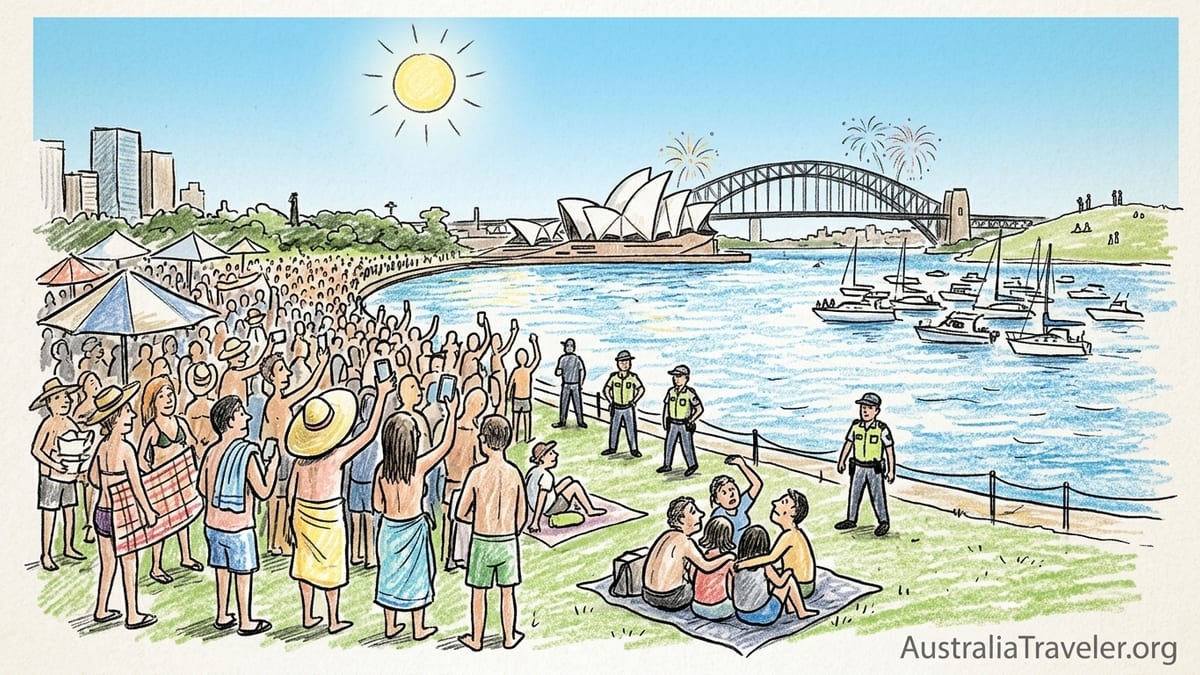
Security staff opened the gates at 10am and the line lurched forward. Bags were checked for alcohol and large umbrellas. Once inside, the scramble began: hundreds of people jogging or outright sprinting down the paths to claim a strip of grass with an unobstructed view. By 11am, volunteers were telling latecomers that spots by the water were gone. By around midday, the area had reached capacity and new arrivals were being turned away, a pattern that has played out in previous years according to local news reports and confirmed by the City of Sydney’s crowd management messaging.
The weather that day was classic Sydney early summer. Under clear blue skies and full midday sun, the harbour glittered beautifully. It also meant that anyone not under a tree baked. Shade was the most valuable commodity in the entire precinct, and there simply was not enough of it. By early afternoon people were erecting towels on sticks, wrapping themselves in sarongs and retreating under the smallest scraps of shadow while volunteers circulated with sunscreen and constant reminders to drink water. The fireworks were still more than eight hours away.
By late afternoon, the mood had shifted from excited to restless. Movement within the site was restricted by taped-off zones and tightly packed picnic rugs. If one person stood up, four others had to shuffle to make room. Going to the toilet meant threading your way over other people’s belongings and hoping you could find your square of grass again. When the 9pm family fireworks finally lit the sky, there was a brief surge of joy and phone screens. Then came three more hours of waiting in the dark, on stiff backs and tired legs, for the main show at midnight.
Iconic Images Versus Ten Hours on a Picnic Rug
Every year global media run the same breathtaking images of Sydney’s New Year’s Eve. Fireworks erupt in perfect symmetry from the arches of the Harbour Bridge. The Opera House sails glow. Boats cluster like jewels on dark water. Those moments are real, but they compress a very long, very human day into a few seconds of spectacle.
On the ground, the experience is much less glamorous. In my section at Mrs Macquaries Point, people began staking out territory with picnic blankets by mid-morning. Near me a family had brought camping chairs, an esky and enough snacks to feed a scout troop. By 2pm, they were already rationing soft drinks to avoid extra toilet trips. A British couple on my other side took turns leaving the site to stretch their legs and grab takeaway food early in the day, but once crowd density increased and capacity signage went up, re-entry was no longer guaranteed. The official vantage point guide is very clear that most areas operate on a no re-entry basis once you leave, and by late afternoon you could feel everyone there quietly calculating whether one more coffee was worth risking their spot.
The distance between expectation and reality is starkest when you compare professional photographs with your own sightlines. From Mrs Macquaries Point, the view of the bridge and Opera House is indeed excellent, but by midnight a sea of people is standing shoulder to shoulder. Almost every person is holding a phone above their head. I watched the first moments of the 2026 fireworks partly through my own camera screen, partly through someone else’s. Smoke drifted across the harbour and the loudspeakers crackled. It was still thrilling, but also oddly detached. The sensory overload of noise and colour is real, but so is the fatigue from ten hours of waiting.
Practicalities intrude in ways you rarely see in advertising images. Managing food means lugging everything in early, because many vantage points restrict glass, alcohol and large eskies, and stalls inside can be crowded and expensive. Toilets are available but heavily used; at Mrs Macquaries Point a mid-afternoon queue of around twenty people was common, and after the 9pm fireworks the line snaked back along the path. Shade is limited in prime harbourside locations like Circular Quay and the Opera House forecourt as well, and the official viewing guide explicitly warns that New Year’s Eve can be a very long day and that visitors must be prepared with water, sun protection and something to sit on. Those are not optional extras; they are survival tools.
How the Major Harbourside Vantage Points Really Compare
Circular Quay and the Opera House forecourt are usually the most iconic options. Circular Quay’s eastern and western promenades are free entry areas with toilets, clear views of the bridge and close access to trains and ferries earlier in the day. Official listings state that these zones open from mid-morning and remain open until after midnight, but alcohol is prohibited and once they reach capacity, access is closed. The Opera House forecourt has in recent years shifted to a free ticketed system with limited capacity, timed opening from around midday and a strict no re-entry policy. Tickets are released only a few days before New Year’s Eve through a ballot-style registration, and they disappear quickly.
Barangaroo Reserve, on the western side of the harbour, is promoted as a free but controlled vantage point with good bridge views and more green space than Circular Quay. Official vantage point listings show it opening late morning and operating as alcohol-free, with drinks available for purchase inside rather than allowing bring-your-own. It is easier to reach from Wynyard station and inner-west buses, and its terraced lawns offer some natural seating. The trade-off is that parts of the bridge may be partially obscured by city buildings, and the atmosphere is more subdued than at the Opera House.
Mrs Macquaries Point remains free-entry but highly regulated. It opens from 10am with alcohol sold on-site and no BYO permitted. According to both the official vantage point guide and news reports from recent years, this is one of the fastest spots to reach capacity, sometimes around midday, with people queueing well before opening time. Once full, the site closes for the rest of the evening and no re-entry is allowed. Campbells Cove, closer to The Rocks on the western side of Circular Quay, is another free vantage point with early opening and a no-alcohol policy. It offers strong side-on views of the bridge and Opera House but fills rapidly.
Blues Point, on the north shore opposite the bridge, is managed by North Sydney Council and runs as a paid ticketed event with controlled numbers, food vendors and entertainment. Bradleys Head, in Sydney Harbour National Park, operates as a ticketed location with several zones, including family areas and picnic-style sections. Official information from NSW National Parks emphasises that tickets are required, alcohol is restricted or prohibited in many areas and entry is from late afternoon only. These ticketed north shore sites can offer a more relaxed atmosphere with guaranteed space, but you trade away the flexibility (and cost advantage) of the free foreshore.
Free, Free-Ticketed and Paid: What You Actually Get
The Sydney New Year’s Eve website divides vantage points into three broad categories: free open access, free-ticketed and paid-ticketed. On paper that sounds simple. In practice, the differences matter far more to your experience than first-time visitors expect.
Free open-access zones like Circular Quay promenades, Campbells Cove and parts of The Rocks allow anyone to enter up to capacity without a ticket. The upside is flexibility and zero admission cost. The key downsides are the need to arrive early, the inability to leave and return once capacity is reached, and the lack of guaranteed personal space. If your group is separated in the crowds, you may not be allowed to rejoin them. Alcohol is almost always prohibited in these areas, and bag checks at cordon points can be strict. Signage, site maps and staff will direct you to water stations and toilets, but you should not expect to move freely once the afternoon peak hits.
Free-ticketed locations, such as the Opera House forecourt and some accessible viewing platforms around Circular Quay, limit numbers by issuing zero-cost tickets in advance. Official pages explain that tickets open for booking a few days before New Year’s Eve and are capped well below the physical capacity of the site. The advantage is more predictable density: you are less likely to be crushed shoulder to shoulder. The price is inflexibility. Entry windows can be as early as midday, and late entry is often not guaranteed. There is generally no re-entry if you leave. These sites are also alcohol-free, except where a controlled bar service operates within a fenced section.
Paid-ticketed areas fall into two groups. First, council-run or National Parks events at places like Blues Point, Bradleys Head or Dudley Page Reserve, where tickets include access to a managed space, toilets and sometimes live entertainment or food stalls. Prices can range from modest family tickets to premium packages, with strict conditions on what you can bring. Second, there are private events run by restaurants, bars, waterfront hotels and NYE cruise operators. Here ticket prices vary widely, from a few hundred Australian dollars for a sit-down multi-course dinner with drinks to much higher amounts for all-inclusive harbour cruises with upper-deck viewing. These options remove the need to queue at 10am, but they lock you into minimum spends, non-refundable deposits and, for hotels, two or three-night minimum stays over the New Year period.
Restaurants, Hotels and Cruises: Paying to Avoid the Queue
After my full-day ordeal at Mrs Macquaries Point, I spent the next New Year’s Eve in a very different way: on the terrace of a mid-range hotel in the CBD that offered partial harbour views and a New Year’s Eve dinner package. The price was high compared with a standard room night, and the hotel required a three-night minimum stay covering December 30 to January 2. The package included a buffet dinner, a bar tab and access to the rooftop from 11pm to 1am, with a clear warning that views were "harbour glimpses" rather than the full bridge. When I weighed that against a 10am queue and ten hours on the grass, the trade-off felt acceptable.
Waterfront hotels near Circular Quay and The Rocks command even higher rates over New Year’s Eve, often requiring minimum two or three-night bookings, advance prepayment and strict cancellation policies that tighten as the date approaches. Some offer ticketed rooftop parties with separate per-person charges on top of the room, including set menus and drinks. The fine print matters: many rooms do not actually face the harbour, and access to viewing terraces may depend on buying an additional event ticket rather than simply being a guest.
Harbour cruises, which the official NSW boating guidance describes as a key part of the event atmosphere, occupy another tier of paid viewing. Commercial vessels join the Sydney Harbour Lights parade between the 9pm and midnight fireworks, and many operators sell New Year’s Eve packages that include a meal, drinks and prime position inside exclusion zones. Prices can reach into several hundred dollars per person. Conditions usually include non-refundable deposits, strict boarding times in the late afternoon or early evening and limited flexibility if weather or smoke affects visibility. On the plus side, you sit, eat and move freely on deck instead of guarding a patch of grass for ten hours.
Mid-range harbourside restaurants also capitalise on the fireworks. Many run set-menu sittings on December 31 with per-head prices that are significantly higher than normal, timed so that diners are in place for the 9pm and midnight shows. Glass restrictions and police perimeters around Circular Quay affect how easily restaurant guests can move outside to watch. In some cases you view the fireworks through windows or from a small balcony, which is still a vast improvement on a packed foreshore but may disappoint anyone expecting the sweeping vistas shown in tourism marketing.
Transport, Road Closures and the Long Journey Home
Transport logistics are one of the most overlooked aspects of Sydney New Year’s Eve. The NSW Government estimates that more than a million people converge on the harbour each year, and moving them in and out requires substantial road closures and public transport changes. City of Sydney and state transport agencies publish detailed maps well before December 31, showing that major streets around Circular Quay, The Rocks, Macquarie Street and the CBD close progressively through the day and remain shut until the early hours of January 1. Parking restrictions and clearways begin earlier, often from the morning.
Trains and light rail are the backbone for getting into the city. On recent New Year’s Eves, Circular Quay station has remained open only until mid-afternoon, after which it becomes exit-only or closes to new arrivals, with visitors directed instead to nearby stations such as Wynyard, Martin Place or Town Hall. After the midnight fireworks, special late-night services run but platforms are heavily marshalled, with queuing systems and sometimes one-way pedestrian flows to manage crowds. If you are staying in the inner suburbs, walking back may actually be faster than waiting for a train.
On the north shore, North Sydney Council publishes its own access maps, showing that ferries stop serving some wharves like Milsons Point and McMahons Point by early evening and that pedestrian access around Blues Point, Bradfield Park and Kirribilli is tightly controlled. Dedicated walking routes funnel people back to Victoria Cross and North Sydney stations after midnight. Buses and rideshare vehicles are heavily affected by road closures, and it is common for drivers to be unable to reach pick-up locations near the harbour. Many residents simply accept that they will be walking uphill for twenty or thirty minutes before they can even request a car.
Getting home by water is no easier. The NSW boating guide for New Year’s Eve details a 6-knot speed limit on Sydney Harbour from mid-afternoon, expanding exclusion zones from 8pm and strict wharf closures through the night to accommodate commercial vessels and safety operations. Public ferries to and from Circular Quay stop early, often by late afternoon, and many wharves close hours before midnight. If you are not already on the correct side of the harbour by early evening, you may not be able to cross until well after the fireworks.
Family Fireworks and Less Central Alternatives
For families and anyone unwilling to spend all day in the CBD, the 9pm fireworks are increasingly the main event. The official New Year’s Eve schedule lists the 9pm Calling Country fireworks as a major show in their own right, with boats in the Harbour Lights parade illuminating the water between 9pm and midnight. From Mrs Macquaries Point, Barangaroo, Circular Quay and many of the north shore sites, the 9pm display felt nearly as impressive as the midnight burst. The major difference was that I was less exhausted at 9pm than three hours later.
The City of Sydney and surrounding councils also promote less central vantage points away from Circular Quay. The official vantage point list includes western harbour sites such as Ballast Point, Birchgrove Park and Mort Bay Park, where crowds are smaller, alcohol rules may allow limited BYO and views are more distant but still dramatic. National Parks-managed sites at Bradleys Head and other headlands combine bushland settings with structured ticketing and amenities, appealing to families willing to pay for a calmer environment. In past years, suburban councils around Sydney have hosted local fireworks or family events, which can offer a vastly more relaxed evening than the Sydney Harbour crush.
On my post-2026 visit, I tested one of these alternatives: a hilltop reserve in the eastern suburbs with distant views back to the city. Tickets were modestly priced, numbers capped and entry timed from late afternoon. I arrived around 6pm, found a comfortable patch of grass immediately and had room to stretch throughout the evening. The skyline fireworks appeared like a sparkling ribbon over the dark mass of the city, without the thunderous soundtrack but also without the claustrophobia. By 12.30am I was home, not still shuffling towards a train station.
The Viewing Strategy I Would Use Next Time
After experiencing both the full-day harbourside wait and higher-priced alternatives, my strategy for any future Sydney New Year’s Eve is clear. I would not again commit to arriving before midday for a free foreshore spot at Mrs Macquaries Point, Circular Quay or the Opera House forecourt. The hours of waiting, exposure to sun and restrictions on movement simply outweigh the extra 10 or 20 percent of spectacle you gain from being right on the water. No photograph I took from Farm Cove justified the fatigue I felt by the time the last fireworks faded.
Instead, I would choose either a moderately priced, less central ticketed vantage point with guaranteed space and a later entry time, or a hotel or restaurant package that clearly states its view limitations and cancellation conditions. I would read every line of the fine print, avoid minimum three-night stays unless I genuinely wanted a city break and accept that "harbour glimpses" may be more comfortable than a perfect bridge shot. I would time my arrival for late afternoon, enjoy the 9pm fireworks as my main show and treat midnight as a bonus rather than the sole focus of the night.
I would not again pay top-tier money for a waterfront restaurant in Circular Quay or a premium cruise simply to tick off a bucket list. Very high prices, inflexible deposits and weather risks make those options best suited to people who place a very high value on the once-in-a-lifetime photograph and are comfortable with non-refundable commitments. For most travellers, a combination of an early evening dinner away from the crush, a mid-range viewing option and a reasonably straightforward journey home will create a better memory.
Most importantly, I would be honest with friends and readers about who should avoid the busiest harbourfront areas altogether. If you dislike dense crowds, have young children, are sensitive to heat, or have mobility or health issues that make standing or sitting on the ground for many hours difficult, the CBD foreshore is not your friend. The same applies if you are prone to anxiety in confined or heavily policed spaces. The fireworks themselves are memorable wherever you see them. The context you wrap around those twelve minutes of light and sound is what will define your night.
The Takeaway
Sydney’s New Year’s Eve fireworks remain one of the world’s great urban spectacles. They are technically brilliant, tightly choreographed and emotionally powerful. But the reality of experiencing them from the most famous harbourfront vantage points involves a full day of trade-offs that glossy images rarely advertise. From 10am queues and midday capacity closures to strict alcohol bans, limited shade and long, crowded journeys home, the hidden costs are paid in time, comfort and energy rather than just money.
If you are determined to be there on the foreshore, go in with your eyes open. Study the official vantage point listings, know your entry times, check whether re-entry is allowed and understand alcohol rules and what you can bring. Prepare for heat, scarcity of shade and very limited personal space. Consider the 9pm fireworks as your main viewing, especially if you have children, and do not underestimate how draining the three-hour gap to midnight can be.
For many travellers, the smarter choice is to watch from a less central park, a modestly priced ticketed site or even a suburban hill where the skyline forms part of a wider view. A decent angle on the bridge from a quieter location can create a better New Year’s Eve than a front-row position won at the cost of an entire day. The fireworks will look spectacular on television or from a distance. The memory you carry into the new year should be of joy, not of sunburn, dehydration and a cold sandwich eaten on a crowded strip of grass at 4pm.
FAQ
Q1. Is it really necessary to arrive before midday for Sydney’s New Year’s Eve fireworks?
It depends on where you want to be. For prime free harbourside spots like Mrs Macquaries Point and popular sections of Circular Quay, capacity has been reached around midday in recent years, with gates sometimes closing to new arrivals by early afternoon. Less central or ticketed areas can be accessed later, but the closer you want to be to the Harbour Bridge, the earlier you generally need to arrive.
Q2. Are the midnight fireworks much better than the 9pm display?
The midnight display is longer and more intense, with a full bridge effect and a larger number of firing points. However, the 9pm Calling Country fireworks are a substantial show in their own right, sharing many of the same visual elements. For families or anyone who does not want to stay out past midnight, the 9pm fireworks can feel almost as impressive without the added exhaustion.
Q3. Can I leave my vantage point to get food or use the bathroom and then come back?
You can always use toilets within a vantage point, but leaving the fenced or controlled area entirely is usually a one-way decision. Many sites operate under a no re-entry policy once you exit, and even where re-entry is theoretically allowed, you may not be admitted if the site has reached capacity while you were gone. It is safest to arrive with enough food, water and supplies to avoid having to leave.
Q4. Is alcohol allowed at Sydney’s New Year’s Eve vantage points?
Alcohol rules vary by site and are clearly listed in the official vantage point guide. Many of the busiest free areas around Circular Quay and The Rocks are strictly alcohol-free, with bag checks at entry points. Some locations sell alcohol inside controlled zones but do not allow you to bring your own. If drinking is important to your evening, you may be better off choosing a licensed ticketed event, restaurant or cruise.
Q5. How bad are the crowds when the fireworks finish?
Immediately after the midnight fireworks, the streets around Circular Quay, The Rocks, Macquarie Street and the CBD become extremely crowded as hundreds of thousands of people try to leave at once. Police and marshals manage pedestrian flows, create temporary one-way routes and control access to train stations. Expect to walk slowly, queue for public transport and reach your accommodation much later than the end of the show suggests.
Q6. Are harbour-view hotels and restaurant packages worth the money?
They can be worth it if you value comfort, guaranteed seating and avoiding the all-day wait, and if you understand exactly what view you are paying for. Many packages come with minimum stays, high per-person costs and strict cancellation policies. Before booking, confirm whether your room or table has a direct line of sight to the Harbour Bridge and Opera House, or only partial "harbour glimpses," and whether terrace access requires an additional ticket.
Q7. What should families with young children consider?
Families should plan around the 9pm fireworks, which are timed specifically with children in mind. Choose vantage points with easier access to toilets, some shade and realistic exit options after 9.30pm. Avoid sites that require queuing early in the morning or where crowds remain extremely dense until after midnight, as young children may struggle with the heat, noise and long waiting times.
Q8. Are there good alternatives to the main harbourfront areas?
Yes. Official listings highlight a range of parks and headlands further from Circular Quay, including locations on the western and northern harbour and hilltop reserves in the eastern suburbs. These often have smaller crowds and a more relaxed atmosphere, with distant but still impressive views of the city fireworks. Some require paid tickets, while others remain free but less heavily publicised.
Q9. How should I prepare if I still want a prime foreshore spot?
If you decide the harbourside experience is worth it, treat the day like a mini expedition. Bring plenty of water, sun protection, a hat, a ground mat or picnic rug, light clothing layers, portable phone chargers and more food than you think you will need. Check the official rules on bags, chairs, umbrellas and glass before you pack. Arrive together as a group early, agree on a meeting point and be prepared to stay in place for most of the day.
Q10. Who is better off skipping Sydney’s harbourside New Year’s Eve altogether?
Travellers who dislike large crowds, have mobility or health issues, are sensitive to heat or anxiety in controlled spaces, or are on tightly managed budgets may find the full harbourside experience more stressful than enjoyable. Watching the fireworks from a quieter suburban location, a less crowded park, a private gathering or even on television can provide the spectacle without the physical and logistical strain.