


I stood in The Rocks staring at the BridgeClimb price board, doing mental maths that hurt more than the 1,000-plus steps ever would. A daytime Summit climb was listed from about A$375 per adult for the current season, edging higher on weekends and in peak periods. For my partner and me, we were flirting with A$800 before we had even talked about photos, food or anything else in Sydney. That was the moment I realised this was not just a bucket-list splurge. It was a serious financial decision that needed more scrutiny than the glossy brochures ever suggest.
The Sticker Shock: When an Icon Becomes a Line Item
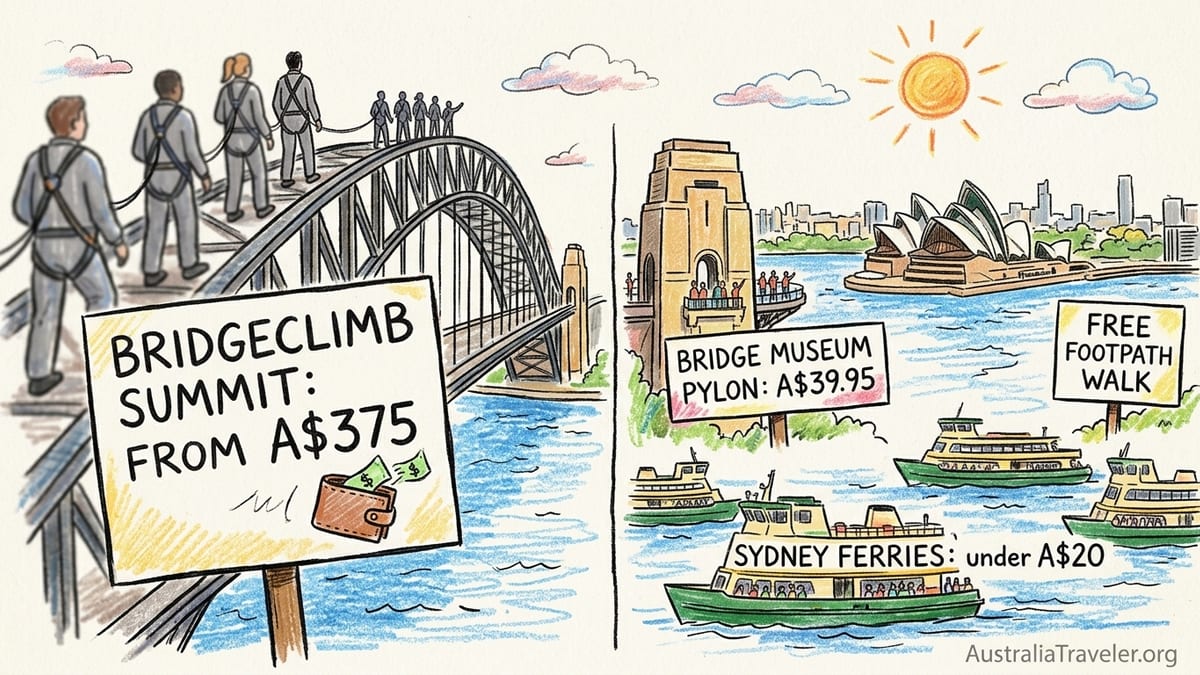
I had always imagined BridgeClimb as a non-negotiable part of a first trip to Sydney. It is the shot you see in airline ads: grey overalls, harnesses clipped to a cable, tiny figures silhouetted 134 metres above the harbour. On the ground, the pricing board told a more sobering story. The current published rates for the classic Summit Day climb for 1 April 2026 to 31 March 2027 start at around A$375 per adult on weekdays and about A$385 on weekends, with children around A$160 to A$170. That is before any peak-period surcharges, special-event climbs or photos.
Once I started running the numbers, the romance drained away. A couple on a weekend daytime Summit are looking at roughly A$770 before fees and extras. A family of four with two children is nudging A$1,100, and that is assuming you secure one of the “from” prices rather than a more expensive departure time. In a city where you can buy a decent harbour ferry ride for under A$20 and visit multiple museums for less than A$50 each, committing four figures to a single three-hour activity suddenly feels like a luxury that demands justification, not blind faith.
So I did something many travellers quietly do and few admit. I postponed booking and went to investigate alternatives first. I walked the free pedestrian footpath across the Sydney Harbour Bridge, visited the newly reopened BridgeMuseum in the south-east pylon, and rode ferries back and forth through Circular Quay. Only once I had seen those perspectives did I feel qualified to decide whether the harnessed version of essentially the same view was really worth hundreds of dollars more.
What You Actually Get: Summit, Night, Twilight, Ultimate and Burrawa
BridgeClimb’s menu looks straightforward at a glance but there are meaningful differences between the products. The core experience is the Summit climb, marketed as the classic route along the upper arch to the very top of the bridge. Recent schedules put the experience at roughly three hours end to end, with over 1,000 steps and small-group guiding limited to about 14 climbers per leader. Daytime Summit climbs are the benchmark, but there are also Summit Night and Summit Twilight departures that time your summit moment with city lights or sunset hues, at different price points.
For travellers who are anxious about ladders, there is the Summit Insider option, which takes an internal route through the bridge’s steel structure before emerging at the top. Then there is the Ultimate climb, which effectively combines two routes into one extended experience that can run around 3.5 hours or more, taking you across both the internal structure and the full upper arch. Burrawa, introduced with an Indigenous storyteller leading the commentary, follows a Summit-style route while placing First Nations history at the centre of the narrative. Prices for these remain firmly in premium territory, often similar to or higher than the standard Summit depending on departure and demand.
On paper, each product layers something on top of the basic idea of “walk to the top and look at the view.” Night and Twilight change the light and atmosphere. Ultimate adds duration and more of the bridge’s anatomy. Burrawa deepens the storytelling. Yet the physical destination is the same patch of steel overlooking Sydney Harbour. If you are value-minded, you quickly realise that while the branding varies, you are essentially being asked to decide how much you are willing to pay per hour for a harnessed escorted walk to a single viewpoint.
The Phone Ban and the High Price of Souvenir Photos
The next jolt came when I read the safety rules. For security and safety reasons, BridgeClimb does not allow climbers to take personal belongings on the bridge. Phones, cameras and GoPros must be locked away, with only prescription glasses and sunglasses attached to your suit with a lanyard. Staff are explicit that cameras and mobile devices are prohibited on the bridge itself. Your climb leader doubles as your photographer, using company cameras to capture group and individual shots that you can buy afterwards.
If you are used to summiting mountains in Europe or the United States and pulling out your phone to take a quick selfie, this feels jarring. On my test day, I spoke with climbers coming out of their tour who described being shown their images on screens in the base building, then steered toward packages. Exact prices can vary with promotions, but a set of digital downloads or printed photos can quickly add another A$40 to A$100 or more to the total if you want more than a token souvenir. For a couple or family who want everyone to have their own shots, the add-on spend becomes substantial.
This policy may be entirely rational from a safety and security standpoint, but it fundamentally changes the nature of the experience for modern travellers. You are paying several hundred dollars for access to a spectacular viewpoint yet cannot capture the scene in your own way. If your relationship with travel memories is heavily tied to taking your own images and videos, BridgeClimb’s strict phone ban is not a detail. It is a deal-breaker or at least a major devaluation of what you are buying.
Safety, Briefings and How Much Time You Actually Spend on the View
To BridgeClimb’s credit, the check-in and briefing process is thorough. Before you ever touch the steel, there is a registration desk, alcohol breath testing, a detailed health questionnaire and a security-style screening of what you are wearing and carrying. You change into a dedicated jumpsuit, remove watches and loose jewellery, and secure anything allowed with tethers. There is a practice section where you clip onto a demonstration cable and learn how to shuffle your harness attachment along the line. Guides reinforce the no-phone rule and set expectations about pace and behaviour on the bridge.
All of this is necessary for an experience that combines heights, traffic, strong harbour winds and large numbers of tourists. It does, however, mean that a three-hour “climb” includes a significant amount of time in windowless rooms. Travellers I interviewed, and online accounts I cross-checked, suggested that actual time spent on the upper arch and at the summit platform feels closer to 30 to 40 minutes within a three-hour block. The rest is kitting up, safety talk, ascending internal catwalks, waiting for other groups at pinch points and carefully paced walking suitable for the least fit person in the group.
If you are moderately active, the physical challenge is rarely the issue. The route is more of a long staircase hike at a controlled pace than a technical climb. Guides are adept at spotting anyone struggling and pausing to regroup. The greater risk is frustration. Once you reach the summit, you cannot wander where you like or linger indefinitely. Groups need to cycle through their allocated photo poses and clear space for the next set of climbers. Visibility is at the mercy of Sydney’s weather: on a grey haze or drizzle day, you may still pay full price despite significantly subdued views, with limited flexibility to reschedule at short notice unless conditions are deemed genuinely unsafe.
Free Footpath, A$39.95 BridgeMuseum and Ferries: The Value Competition
Before handing over nearly A$800 for two Summit Day tickets, I decided to test the free and lower-cost vantage points first. The most obvious competitor is the pedestrian footpath along the eastern side of the Sydney Harbour Bridge. Accessed by stairs and lifts from The Rocks and Milsons Point, it costs nothing and delivers classic sightlines across to the Opera House and down the harbour. The railing and security fencing make photography slightly fiddly, but you can stop, wait for a harbour ferry to drift into frame and take as many images as you like without a guide hurrying you along.
Next is the BridgeMuseum inside the south-east pylon, the revamped successor to the old Pylon Lookout. It reopened in late May 2026 with a refreshed exhibition on the bridge’s construction and history, plus a climb of about 200 steps to a viewing platform roughly 87 metres above sea level. Online adult tickets currently start around A$39.95, with slightly higher walk-up prices. From the top, you can see the same Opera House sweep, city skyline and western harbour stretches that Summit climbers enjoy, albeit from a slightly lower level and a fixed enclosed terrace.
As a value proposition, the BridgeMuseum is startling. For around one-tenth of the cost of a weekday Summit Day climb, you get substantial interpretive displays, historical photographs, and the freedom to take your own shots from the lookout. I spent almost an hour reading exhibits and another 45 minutes on the terrace, waiting for changing light and ship movements. No one pushed me to move on, and my camera stayed in my hand the entire time.
Then there are Sydney’s ferries, which operate as part of the public transport network. For less than A$20 on a standard adult fare, you can ride out from Circular Quay to Manly, Taronga Zoo, or simply loop around the harbour and back, getting constant shifting perspectives on the bridge and Opera House. A late afternoon Manly run gave me golden light on the bridge’s structure and skyline and enough spray and motion to feel the harbour’s energy in a way no static viewpoint can match. Combined, the footpath, BridgeMuseum and a ferry ride cost me under A$70 and delivered hours of varied, photograph-friendly harbour experiences.
How the Costs Stack Up for Couples and Families
It is only when you multiply BridgeClimb’s ticket price that you see how brutal the maths becomes. A solo traveller prepared to spend A$375 on a once-in-a-lifetime experience may reasonably accept the hit. Couples and families face a different calculus. Two adults on a weekend Summit Twilight are quickly in A$800 territory, especially if peak-period surcharges apply around Christmas or New Year. Add two children and you have spent more than many travellers allocate to an entire week of accommodation in some parts of Southeast Asia.
Now layer in the photo issue. A couple who want at least a handful of high-resolution images are likely to end up purchasing a digital package that can easily push the total another A$70 to A$100 or more. A family of four who want both group and individual child shots may need a more expensive bundle or multiple orders. Suddenly the difference between BridgeClimb and a combination of BridgeMuseum plus a harbour cruise is not A$200 or A$300. It is several hundred dollars that could fund winery tours, Blue Mountains day trips or multiple restaurant meals.
There is also the psychological side of spending that much on something weather-dependent and tightly controlled. Parents I spoke to outside the BridgeClimb base building admitted they felt pressure for everyone to enjoy the experience because of the price tag. One father described his eight-year-old freezing halfway up, overwhelmed by the heights and the harness, and spending much of the summit segment clinging to the handrail. “We still paid full price,” he said. “It is a great story now, but in the moment it was a lot of money to watch my kid be terrified.”
Cost Versus Experience: BridgeClimb Against the Alternatives
To make sense of the numbers, I sketched a simple cost-versus-experience comparison across the main harbour options. All prices below are approximate but based on current typical figures in late 2026.
For BridgeClimb’s Summit Day product, you are looking at around A$375 per adult for about three hours total, with the summit at roughly 134 metres above sea level. Photography is restricted to official shots, with no personal devices allowed. Accessibility is moderate to limited, given the 1,000-plus steps, ladders and harness requirements. By contrast, the BridgeMuseum asks about A$39.95 for an adult online ticket, with visits typically lasting one to two hours, a viewing height around 87 metres and full freedom to use phones and cameras. The primary limitation is the 200-step staircase, which may be challenging for those with mobility issues but is far more manageable for most people than the full bridge ascent.
The free pedestrian crossing costs nothing, can take 20 minutes or two hours depending on how often you stop, and sits roughly 50 to 60 metres above the water depending on your position. Photography is unrestricted, and there are lifts at both ends of the bridge, making it one of the more accessible high-view experiences in Sydney for those who can manage some walking. Ferries vary by route but generally sit at the lowest height, only a few metres above sea level, and offer constant movement rather than altitude drama. They are inexpensive, camera-friendly, and fully integrated with Sydney’s public transport accessibility standards.
Looked at through this lens, BridgeClimb delivers the greatest height and a strong sense of achievement but scores poorly on cost per hour, photography freedom and accessibility. BridgeMuseum and the footpath cross high on value, photographic potential and flexibility. The ferry network adds motion and changing angles without any of the harnessed anxiety. None give you the precise feeling of standing on the arch itself, but they collectively cover much of what makes Sydney’s harbour views memorable at a fraction of the price.
The Takeaway
After a week of testing viewpoints and interrogating my own FOMO, I made a decision that would have surprised my younger self. I chose not to book BridgeClimb this time. Instead, I walked the bridge twice, visited the BridgeMuseum, criss-crossed the harbour on ferries and watched the lights come up on the skyline from Mrs Macquaries Point. At no stage did I feel I was missing a vital perspective of Sydney. What I did feel was relief that I had several hundred extra dollars to spend on food, neighbourhood exploring and a last-minute day trip.
That does not mean BridgeClimb is a bad product. It is well run, safety-conscious, and for many people, deeply moving. If you have a strong emotional connection to Sydney, a milestone celebration to mark or a long-held dream of standing on that arch, the cost may be justified once in a lifetime. In that scenario, I would lean toward Summit Twilight for the drama of sunset light or Burrawa if you want your investment to come with richer, Indigenous-led storytelling.
For most value-conscious travellers, though, the maths is hard to escape. When a couple can replicate much of the visual experience through a free bridge walk, an A$39.95 BridgeMuseum visit and a couple of harbour ferries for under A$150 total, paying A$750 to A$800 for a tightly managed three-hour climb without your own camera feels like a luxury more than a must-do. Families, in particular, should think carefully before committing four-figure sums to an experience that may overwhelm younger or height-sensitive children.
My verdict is blunt. BridgeClimb is worth considering if you are a committed bridge lover, marking a major life event, or have a budget where A$400 is a rounding error rather than a serious decision. If you wince at that number, do not let marketing convince you that your Sydney story will be incomplete without a harness. The bridge, the harbour and that skyline are all still gloriously yours from the footpath, the BridgeMuseum terrace and the deck of a simple green-and-cream ferry. Those, in my experience, offer the strongest return for your money.
FAQ
Q1. How much does the Sydney Harbour BridgeClimb Summit cost right now?
For the 1 April 2026 to 31 March 2027 season, standard adult Summit Day tickets start around A$375 on weekdays and about A$385 on weekends, with children around A$160 to A$170, before any peak surcharges or photo purchases.
Q2. Can I take my phone or camera on the BridgeClimb?
No. For safety and security reasons, personal items like phones, cameras and GoPros are not allowed on the bridge. They must be stored in lockers, and only prescription glasses or sunglasses attached to your suit are permitted.
Q3. How long does the BridgeClimb take from start to finish?
Most Summit climbs are advertised as about three hours. That includes check-in, breath testing, safety briefings, suiting up and practice, plus the actual time on the bridge and at the summit.
Q4. Is the climb very physically demanding?
The climb involves over 1,000 steps and some ladders but is taken at a controlled, steady pace. Most reasonably fit adults manage it without trouble, though those with knee, heart or mobility issues should seek medical advice first.
Q5. What happens if the weather is bad on the day of my climb?
Climbs generally continue in light rain or overcast conditions, with special rain gear provided. Only in unsafe conditions such as high winds or storms are climbs cancelled or rescheduled, so you may still pay full price for a grey, hazy day.
Q6. How does the BridgeMuseum in the pylon compare to BridgeClimb?
The BridgeMuseum costs from about A$39.95 per adult online, offers substantial historical exhibits and a lookout about 87 metres above sea level, and allows full use of your own camera, making it a strong value alternative.
Q7. Is the free pedestrian walk across the bridge worth doing?
Yes. The eastern footpath gives excellent views of the Opera House and harbour at no cost. You can take your time, stop for photos and cross in either direction using stairs or lifts at both ends.
Q8. Are there age limits or rules for kids on BridgeClimb?
Children need to meet the operator’s minimum age and height requirements, and every group of younger climbers must be accompanied by adult guardians. Families should also consider whether children are comfortable with heights and harnesses before booking.
Q9. Do I need to book BridgeClimb far in advance?
Popular times such as Twilight, weekends and peak holiday periods often sell out, so advance booking is strongly recommended if you have limited dates. Midweek and off-peak sessions can sometimes be booked closer to the day.
Q10. If I skip BridgeClimb, which combination of alternatives gives the best value?
A practical high-value combo is a free walk across the bridge, a visit to the BridgeMuseum, and one or two harbour ferry rides. Together they usually cost under A$70 per adult and deliver varied views, photography freedom and plenty of time to enjoy Sydney’s harbour without the BridgeClimb price tag.