


The first thing I ate in Sydney on this trip was not a postcard bowl of seafood against the harbour, but a plastic tray of char siu and roast duck in the fluorescent basement of Dixon House Food Court in Chinatown. It was a Tuesday, just after 1 pm, and I had squeezed into a shared table with three office workers and a student. The stallholder hacked through the duck with a cleaver, spooned on glossy soy gravy and slid the plate towards me for just under 17 Australian dollars. The duck skin was properly crisp, the fat rendered, the rice soft and slightly sticky, and there were still bone shards that made me work for every bite. It was fast, noisy, a little cramped and absolutely perfect as a reintroduction to Sydney food.
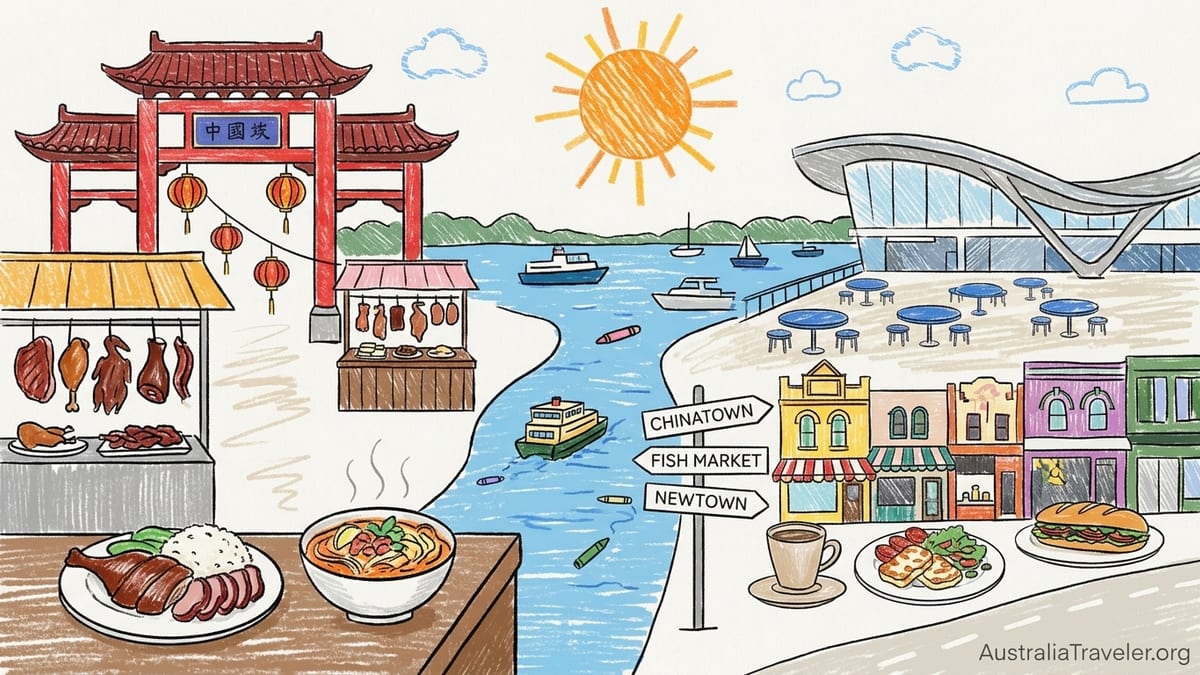
Finding My Feet (and Appetite) in Chinatown and Haymarket
Chinatown in Haymarket sits on the southern edge of the CBD, a tight grid around Dixon Street where red lanterns hang above pedestrians and the air smells like grilling meat, incense and durian all at once. I like to start any Sydney food trip here because you can eat well before your body clock knows what time zone you are in. On this visit, I based myself around Dixon Street, Market City and the food courts that spill under and around them, chasing whatever looked busiest with locals.
That first roast duck and char siu plate at Dixon House Food Court came from a tiny stall with roast meats hanging in the window, surrounded by A4 menus laminated over the years. The portion was generous: a mound of rice, a line of duck, a line of pork and a scoop of blanched choi sum. At about 17 dollars in 2026, it felt like one of the better-value full meals in central Sydney, especially compared with sit-down restaurants nearby that were charging 25 to 30 dollars for a single main. I waited around ten minutes between paying and getting my tray, mostly because the line ahead of me ordered takeaway boxes of duck by the kilo.
Eating there is not for anyone precious about ambience. The basement space is low-ceilinged, fluorescent and always a bit chaotic. You bus your own tray, water is from a shared jug and you will hear at least three languages at any given table. Service is brisk and not particularly chatty, but it is efficient. For me, that anonymous, slightly rough-around-the-edges feeling is exactly what makes it comforting. When I want linen napkins, I go somewhere else; when I want a plate of rice and meat that tastes like it was cooked for regulars, this is where I come.
From there I usually walk up to Dixon Street proper, under the paifang arches that bookend the pedestrian strip. On this trip I stopped into a small Cantonese bakery for a still-warm pineapple bun and a paper cup of Hong Kong milk tea. The bun was around 4.50 dollars and large enough to share, the top cracked and sweet, the inside fluffy. Service here was friendlier, with the woman behind the counter switching between Cantonese and English effortlessly and insisting I try a salted egg yolk cookie “for later.” Chinatown can feel touristy at street level, but the pricing at these older bakeries still sits below the polished dessert chains that now line parts of Dixon Street.
Eating Across Asia in a Few City Blocks
One reason I dedicate so much of any Sydney trip to Haymarket is that you can hop between regional Asian cuisines in a single afternoon. This time, after my roast meats and bakery wander, I headed into Market City for Malaysian food. On level three, a casual Malaysian stall was turning out steaming bowls of curry laksa for around 18 to 20 dollars. My bowl arrived in less than ten minutes, packed with egg noodles, tofu puffs, fish cake slices and a chicken leg that fell off the bone. The broth was coconut-rich without being cloying, with enough chilli to make my nose run gently but not so much that I regretted it on a warm day.
Portion sizes in these food courts tend to be slightly larger than a standard single-person bowl in Southeast Asia, and this laksa was no exception. It would easily work as a shared snack between two people if you were grazing your way through the building. The staff called out order numbers over the general hum; tables turned quickly; no one minded that I lingered for a few minutes after finishing to scroll through photos of the food I had already eaten that day.
Vietnamese food in Haymarket is another standby. On this trip I ducked into a narrow pho shop just off George Street, one of several that always seem to have a queue at lunchtime. A regular-sized bowl of beef pho cost around 18 dollars, with a noticeable bump if you upgraded to a “special” loaded with tendons and tripe. The broth here was lighter than some I have had in Sydney, more subtle on star anise, which suited the humid afternoon. The herb plate was on the modest side, with a few sprigs of Thai basil and a heap of bean sprouts. Service was almost comically fast; my bowl landed on the table within five minutes of ordering, and the bill followed the minute I put my chopsticks down.
If I am craving Korean, I head towards the cluster of Korean barbecue and fried chicken places closer to Darling Harbour. This time I chose a modern Korean barbecue restaurant where a basic set for two, including beef, pork and a few sides, started around 80 dollars. That is a noticeable jump compared with my Chinatown food court meals, but it does buy you spacious seating, table grills and more attentive service. Staff patiently explained the cuts, swapped out grill plates without prompting and kept the banchan topped up. The meat quality was clearly higher than the cheaper all-you-can-eat places nearby, but by the time we added a seafood pancake and a couple of beers, the bill reached just over 65 dollars per person. It was fun, but considering how many good 20 dollar meals you can get within a ten-minute walk, I would save this for a small group celebration rather than a casual weeknight dinner.
From Chinatown to Newtown: Crossing the City for King Street
When my jet lag finally allowed for a later start, I pointed myself towards Newtown. King Street is Newtown’s main artery, a long strip of independent shops, bars and restaurants that feels scruffier and more alternative than the CBD. I usually travel there by train, changing at Central and hopping off at Newtown Station, although buses along Parramatta Road also work if you are already in the inner west. From Haymarket, the trip can take around 20 to 30 minutes door to door, so it is realistic to eat lunch in Chinatown and dinner in Newtown on the same day.
King Street remains one of Sydney’s best areas for vegetarian and vegan food, and that is where I focused this time. My first stop was a bustling vegetarian cafe a few blocks south of the station, where the menu ran from big salads and burgers to plant-based takes on classic breakfast plates. I ordered a halloumi and roast vegetable plate with poached eggs, which came in at about 26 dollars. Portion-wise, it was generous without being overwhelming: plenty of roasted pumpkin and beetroot, a few chunks of halloumi, two eggs with runny yolks and good sourdough on the side. The coffee, made with a local roast, was around 5 dollars and strong enough to cut through the food coma that was already building from my morning snacks.
Service culture in Newtown is different from Haymarket. Staff are more likely to introduce themselves by name, check in about dietary requirements and chat about the music playing over the speakers. That can mean a slightly longer wait for food at peak times; at this cafe, we waited about 20 minutes for our plates on a busy Saturday brunch. The upside is that you feel welcome to linger. I worked on my laptop for another hour and was never rushed, even as a line formed near the door.
Later that afternoon, I walked further down King Street towards a tiny banh mi shop known in local online forums for offering one of the cheapest lunches in the suburb. In late 2026, a classic pork roll here was still around 10 dollars, which makes it one of the better-value bites on a street where many mains now start north of 25 dollars. The roll came tightly wrapped, with crisp pork, pate, pickled carrot and daikon, coriander and an assertive smear of chilli. It was exactly the kind of everyday, grab-and-go food that keeps Newtown feeling like a place for locals, not just a weekend destination.
Cafes, Casual Dining and Nighttime Newtown
As evening falls, King Street’s lights come up and the food landscape shifts from daytime cafes to dinner crowds. On this trip I booked into a small independent restaurant just off the main drag, one that specialises in vegetable-forward dishes with a flexible approach to dietary preferences. Mains hovered in the 32 to 38 dollar range, with smaller plates from 18 dollars. I ordered a dish built around roast cauliflower with tahini, pickled currants and crispy chickpeas. The flavours were well balanced: smoky, nutty, bright with acid. The portion looked modest when it arrived but turned out to be more filling than expected once I mopped up the sauce with the house bread.
The room seated maybe 40 people at full capacity, and on a Friday night every table was taken. Even with a booking, we waited about ten minutes at the bar before being seated. Service struck that very Newtown balance between relaxed and informed. Staff could confidently talk through the provenance of the wines and the cooking techniques, but they also happily topped up water without interrupting conversation. By the time we left, we had spent around 75 dollars per person, including a shared dessert and a glass of wine each. It was the most expensive meal of my Newtown stint, but it felt fair for the quality of cooking and the sense of occasion.
Newtown after dark can skew heavily towards bars and craft beer spots, yet there are still plenty of low-key options if you want something simple. One night I found myself at a long-standing Thai restaurant just off King Street that does a brisk trade in takeaway as well as dine in. A plate of pad see ew with vegetables and tofu was about 22 dollars, arriving at the table in under fifteen minutes despite the constant flow of delivery bags going out the door. The flavours were solid rather than life-changing, and the fluorescent-lit space did feel a bit tired, but for a quick, reliable plate of noodles before a gig it did the job. If you are after atmosphere or regional Thai specialties, there are better options around; if you want noodles at 9.30 pm, it is hard to complain.
Comparing pricing between Newtown and Haymarket is instructive. In 2026, a filling Chinatown food court meal can still be had for well under 20 dollars, while many Newtown mains now land above 25 dollars, especially in venues that emphasise local produce and sustainable sourcing. You are often paying for space, service style and neighbourhood vibe as much as for the ingredients on the plate. Personally, I find the mix appealing: Chinatown when I want functional, flavour-first food; Newtown when I am in the mood to linger and people-watch over a long meal.
First Impressions of the New Sydney Fish Market at Blackwattle Bay
The food experience that changed most between my earlier Sydney visits and this one was the move from the old Sydney Fish Market in Pyrmont to the gleaming new complex at Blackwattle Bay, which officially opened on 19 January 2026. Walking across the bridge and seeing the new building rise out of the water, with its curving roof and tiers of glass, felt almost surreal if you remember the old, slightly rundown sheds next door. The scale has doubled, the design is polished and the smell is, at least for now, much fresher.
Inside, the market hall stretches across multiple levels with more than 40 food and retail operators. Many of the names are familiar from the old site: long-standing seafood retailers selling fresh fish and prawns, takeaway counters for grilled plates and fried seafood, and bakeries and cafes. Prices for fresh seafood, from what I saw and what regular shoppers were saying around me, have stayed roughly in line with the old market. On my visit, a dozen fresh Sydney rock oysters at one of the big retailers was marked around 30 dollars, with Pacific oysters slightly cheaper. Cooked prawn prices varied by size, but a kilo of large cooked prawns hovered in the low 30 dollar range.
Where the shift is more obvious is in the ready-to-eat food. At one popular seafood cafe, a grilled salmon and chips plate was listed around 23 dollars. Mixed seafood platters for one started in the mid 30s and climbed quickly if you added lobster or premium shellfish. Sitting at a communal table overlooking the water with a plate of grilled fish, chips and salad, I could see the appeal. The fish was fresh and nicely charred, the chips crisp, and the seagulls oddly well behaved thanks to staff patrolling the outdoor terraces. But there is no getting around the fact that you are paying inner-city restaurant prices to eat in what is, effectively, a very attractive food court.
The queues on my first visit were long. I arrived just after 11 am on a weekend, thinking I was ahead of the lunch rush, and still waited nearly 25 minutes in line at a popular takeaway stall before ordering a mixed seafood box. Another 20 minutes passed before my buzzer went off. The box, which cost around 32 dollars, included fried calamari, fish, a couple of prawn cutlets and chips. Everything was hot and freshly cooked, and the batter was lighter than at many suburban fish and chip shops, but the portion did not feel particularly generous for the price. Sitting on the balcony, watching families queue behind me and tourists juggle trays, I could not shake the feeling that the setting was carrying the experience more than the food itself.
Vendors, Menus and What Stands Out at the New Market
Not everything at the new Sydney Fish Market feels like a premium-priced food court, though. Some of the more specialised vendors are where the complex shines. One stall focused on oysters and champagne offers tastings of different regional oysters at the counter. I ordered three Sydney rock oysters and three Pacifics, shucked to order and served simply with lemon, for around 22 dollars. Standing at a high table, looking out over Blackwattle Bay while slurping briny oysters, felt every bit as special as many white-tablecloth seafood lunches I have had elsewhere, even if the setting involved reusable plastic trays instead of porcelain.
There are also non-seafood options that unexpectedly impressed me. A Vietnamese street food stall in the main hall was doing brisk trade in banh mi and rice paper rolls. Their grilled pork banh mi, at around 14 dollars, is noticeably more expensive than the 10 dollar Newtown version I mentioned earlier, but the bread was excellent and the fillings plentiful. It was an easy, quick option when the seafood queues became overwhelming. Another standout was a gelato shop on an upper level, where a single scoop cost about 7 dollars. The flavours skewed towards Italian classics and local fruit, and my scoop of blood orange gelato was vivid, not oversweet, and the perfect palate cleanser after too much fried seafood.
In terms of sit-down dining, the new complex also includes a couple of more formal restaurants. On one evening visit, I splurged on dinner at a waterfront restaurant inside the market. Starters sat around 24 to 28 dollars, with mains often in the 45 to 60 dollar band, especially for whole fish or premium shellfish dishes. I ordered a whole roasted fish to share, dressed with lemon and herbs, and a side of charred greens. The fish was beautifully cooked, moist and flaky, and the service here felt more like a conventional restaurant, with staff topping up wine and pacing the courses properly. The bill, however, climbed to over 110 dollars per person once drinks and dessert were included. For that money, you could eat extremely well at many of Sydney’s top seafood restaurants outside the market, with arguably more distinctive atmosphere.
Compared with the former Pyrmont site, the new market is undeniably more comfortable. There is more natural light, more seating, wider walkways and better ventilation. It feels cleaner, the harbourside promenade is lovely and there are spaces to sit even if you did not buy anything. Yet some of the character that came from the slightly scruffy, working-market feel of the old sheds has been replaced by a more polished, almost shopping centre-like environment. Whether that is a pro or a con will depend on what you are looking for.
Comparing Cheap Eats, Midrange Meals and Premium Seafood
After a week of eating my way through Chinatown, Newtown and the new fish market, it was clear that each area fills a different role in Sydney’s food landscape. For cheap, flavour-packed meals under 20 dollars, Haymarket still leads. That roast duck and char siu plate in Dixon House, a bowl of Malaysian laksa in a Market City food court or a basic pho on a side street near George Street all fed me thoroughly without denting the budget. Service might be curt and ambience functional, but the value is hard to beat in a city where a simple cafe breakfast can easily top 25 dollars.
Newtown largely lives in the midrange. A vegetarian brunch plate, a casual dinner at a neighbourhood restaurant or a laid-back Thai noodle meal will often fall between 22 and 40 dollars for a main, before drinks. You are paying for more considered plating, roomier seating, staff who can discuss dietary needs in detail and the general vibe of a creative, lived-in neighbourhood. Coffee culture is strong, and for around 5 dollars a cup you can drink very well across multiple cafes in a single day.
The new Sydney Fish Market straddles all three tiers but rarely feels cheap. Fresh seafood to cook yourself is reasonably priced relative to other Sydney fishmongers, and can become good value if you are feeding a group. On-site, the grilled fish plates in the 20 to 25 dollar range are comparable to midrange restaurants elsewhere in the city, but the portions can feel modest when you factor in queues and the self-service setup. Premium dining inside the complex reaches price points similar to high-end CBD seafood restaurants, with mains often above 50 dollars and tasting-style experiences climbing higher.
In practice, I would treat the fish market less as a bargain lunch stop and more as a destination where the setting and sense of occasion are part of the cost. If your priority is eating the most seafood for the least money, you may be better off buying fresh fish or prawns to cook at an apartment or hostel with kitchen access. If you want to sit by the water with oysters and a glass of wine, accepting that you could probably eat more cheaply a few suburbs away, then the new market delivers.
A One- or Two-Day Sydney Food Itinerary
If you have limited time in Sydney and want to weave these three areas into a coherent eating plan, it is possible to do a lot in one or two days without feeling rushed. On a single intense day, I would start in Chinatown. Aim to reach Haymarket by 9.30 or 10 am, when the bakeries and cafes are in full swing but the biggest crowds have not arrived. Grab a pineapple bun or egg tart and milk tea from a Cantonese bakery on Dixon Street, then wander through Paddy’s Markets or Market City to build an appetite.
By lunchtime, head down into one of the food courts such as Dixon House or the basement of Market City. Order roast meats on rice, laksa, Taiwanese-style fried chicken or whatever stall seems busiest with local workers. Expect to spend 15 to 20 dollars and to share a table with strangers. After lunch, walk or catch the light rail towards the new Sydney Fish Market at Blackwattle Bay. The trip from Haymarket to the market can take around 20 minutes, depending on your route, and makes for a pleasant transition from inner-city bustle to harbourfront space.
At the fish market, spend a couple of hours grazing lightly rather than committing to one big plate. Share half a dozen oysters at the oyster bar, pick up a small box of grilled fish or calamari from a takeaway counter and finish with gelato on the outdoor terrace. This way you can sample different vendors without queueing repeatedly for large orders. Budget around 40 to 60 dollars per person if you plan to eat oysters, a hot dish and a drink or two.
As the afternoon fades, make your way towards Newtown for dinner. Buses from near the fish market or a train from Central will get you to Newtown Station in 20 to 30 minutes. Once there, stroll along King Street to get a feel for the area, then choose between a vegetarian-forward restaurant, a neighbourhood bistro or a simple banh mi or Thai noodle shop depending on your energy levels and budget. Expect to spend around 30 to 50 dollars on dinner without drinks at a midrange sit-down spot, or considerably less if you just grab a 10 dollar pork roll and a 5 dollar coffee.
If you have two days, I would split things out. Dedicate the first day to Chinatown and the fish market, taking your time to eat, shop and explore the harbourfront boardwalks around Blackwattle Bay. On the second day, give Newtown the spotlight. Start with a late brunch on King Street, spend the afternoon browsing bookshops and vintage stores and finish with dinner and drinks at one of the many independent restaurants or small bars. This slower pace allows you to return to a favourite stall or cafe from day one without the pressure of fitting everything into a few frantic hours.
The Takeaway
After a week of eating around these three parts of Sydney, a few meals stand out as things I would happily pay for again. The roast duck and char siu rice plate in Dixon House remains one of the city’s most satisfying value meals for me, especially when followed by a pineapple bun from a nearby bakery. In Newtown, that 10 dollar banh mi on King Street is the kind of everyday lunch I wish I had in my own neighbourhood, while the vegetable-forward dinner at an independent restaurant off the main strip justified its higher price with thoughtful cooking and warm service.
At the new Sydney Fish Market, the moments I would repeat involve focused, high-quality bites rather than big mixed platters. A small oyster tasting at the dedicated oyster bar, eaten standing up while looking over Blackwattle Bay, felt special without tipping into excess. A simple grilled fish plate eaten outside on a clear day also made sense when I thought of it as paying for the harbour views as much as the food. I would be slower, however, to return for the more expensive sit-down dinner I tried inside the complex; for similar money, I could have had a more distinctive meal in the CBD or a coastal suburb.
There were disappointments along the way. Some of the fried seafood boxes at the fish market felt overpriced for their portion sizes, particularly when long queues and self-service collection were part of the experience. A tired Thai dinner in Newtown reminded me that not every long-standing spot on King Street is still at the top of its game. Even in Chinatown, a few newer dessert chains felt interchangeable and less appealing than the older, slightly worn bakeries that have been feeding locals for decades.
If you are planning a trip to Sydney around food, I would build the itinerary around two pillars. First, give Chinatown and Haymarket at least half a day to chase roast meats, noodles, dumplings and pastries at everyday prices. Second, choose either the new Sydney Fish Market or Newtown for your main evening focus, depending on whether you prefer harbourfront seafood or inner west cafe and bar culture. You can absolutely visit all three areas in a couple of days, but the meals that have stayed with me are the ones where I slowed down enough to notice the details: the crackle of duck skin in a basement food court, the smell of espresso on King Street, the briny snap of an oyster eaten within sight of the bay where it was shucked.
FAQ
Q1. Is Sydney’s new Fish Market at Blackwattle Bay worth visiting for food alone?
The new Sydney Fish Market is worth visiting if you care about both food and setting. The seafood quality is generally high and there is an impressive variety of vendors, but prices for ready-to-eat meals are often comparable to midrange restaurants elsewhere and can feel expensive once you factor in queues and self-service. I would not visit solely for a bargain lunch, but I would absolutely go for the combination of oysters or grilled fish and a harbourside view.
Q2. How much should I budget for a meal at the new Sydney Fish Market?
For a light visit with half a dozen oysters, a small hot dish and a non-alcoholic drink, budgeting around 40 to 60 Australian dollars per person is realistic in 2026. A simple grilled fish and chips plate can sit in the low 20 dollar range, while mixed seafood boxes or platters climb towards 30 dollars or more. Sit-down restaurant meals with table service inside the complex can easily reach 80 to 120 dollars per person once you add drinks and dessert.
Q3. Are there still cheap eats in Sydney Chinatown and Haymarket in 2026?
Yes. Despite rising costs across the city, Chinatown and Haymarket still offer some of the best-value meals in central Sydney. Food court dishes like roast meats on rice, laksa or noodle soups often land between 15 and 20 dollars. Bakeries sell buns and pastries for under 5 dollars, and you can assemble a very filling, multi-stop meal for less than what a single main might cost in many sit-down restaurants elsewhere in the CBD.
Q4. What is the easiest way to travel between Chinatown, Newtown and the Sydney Fish Market?
From Chinatown and Haymarket, light rail or a short walk connects you to the new Sydney Fish Market at Blackwattle Bay in roughly 20 minutes, depending on your starting point. To reach Newtown, trains from Central Station to Newtown Station are usually the quickest option, taking around 10 minutes once you are on the platform. Buses along Parramatta Road also link the inner city to Newtown, though travel times can vary with traffic.
Q5. Do I need to book restaurants in Newtown in advance?
For popular independent restaurants and Friday or Saturday night dinners, booking ahead in Newtown is wise. Smaller venues can fill up quickly and may have limited walk-in capacity, especially around standard dining times. Cafes, casual Thai spots and banh mi shops along King Street usually accept walk-ins and takeaway without any issues, particularly at lunch.
Q6. Is the new Sydney Fish Market more expensive than the old Pyrmont site?
From what I observed and from conversations with regular shoppers, prices for fresh seafood such as oysters and prawns are broadly similar to the old market, though individual retailers set their own prices. The main difference is perceived in the ready-to-eat food: grilled plates, mixed boxes and sit-down restaurant meals can feel pricier relative to the informal, slightly scruffy experience at the old Pyrmont sheds, partly because the new complex is larger, cleaner and more architecturally polished.
Q7. Where can vegetarians and vegans eat well on this route?
Newtown is the strongest area for vegetarians and vegans, with multiple cafes and restaurants on and around King Street offering fully plant-based menus or clearly marked options. Dishes range from hearty brunch plates to vegetable-driven dinners and vegan desserts. Chinatown and the fish market have fewer fully vegetarian venues, but you can usually find tofu-based dishes, vegetable stir-fries, salads, rice paper rolls and snacks if you are willing to ask staff and read menus carefully.
Q8. How crowded does the new Sydney Fish Market get, and when is the best time to visit?
The new market can be extremely crowded on weekends, public holidays and around festive seasons, with long queues at popular vendors and packed seating areas. If you want a calmer experience, try visiting on a weekday morning or arriving before 11 am, when lines for cooked food are shorter and there is more space to wander. Late afternoons outside peak tourist periods can also feel more relaxed, especially if you are mainly interested in the views and a small snack.
Q9. Is it better to eat cooked seafood at the market or buy fresh and cook at home?
If you have access to a kitchen, buying fresh seafood at the market and cooking it yourself is usually better value and gives you more control over how it is prepared. Prices for fresh fish, prawns and oysters are competitive with other quality fishmongers, and you avoid paying the labour and overhead costs of the ready-to-eat stalls. For visitors staying in hotels without cooking facilities, the on-site food is a convenient way to enjoy seafood with minimal effort, but it rarely qualifies as a budget option.
Q10. Can I realistically visit Chinatown, the new Fish Market and Newtown in one day?
Yes, you can cover all three in one long day if you plan your route. A common pattern is breakfast and an early lunch in Chinatown and Haymarket, an afternoon visit and light grazing at the Sydney Fish Market, and then dinner in Newtown. Travel times between each area are usually under 30 minutes, but you should allow extra time for queues at the market and for wandering King Street in the evening. If you prefer to eat more slowly or revisit favourite spots, splitting the areas over two days will feel more relaxed.