


I only realised I had miscalculated my Sydney airport transfer when the Opal gates flashed the fare back at me: more than 23 Australian dollars had vanished for a thirteen-minute train ride. I had smugly walked past the taxi queue at Sydney Airport’s Terminal 1, convinced the train would be the sensible, budget-friendly option into the CBD. Instead, I discovered the sting of the Sydney Airport station access fee and how easily it can make a quick rail trip more expensive than expected.
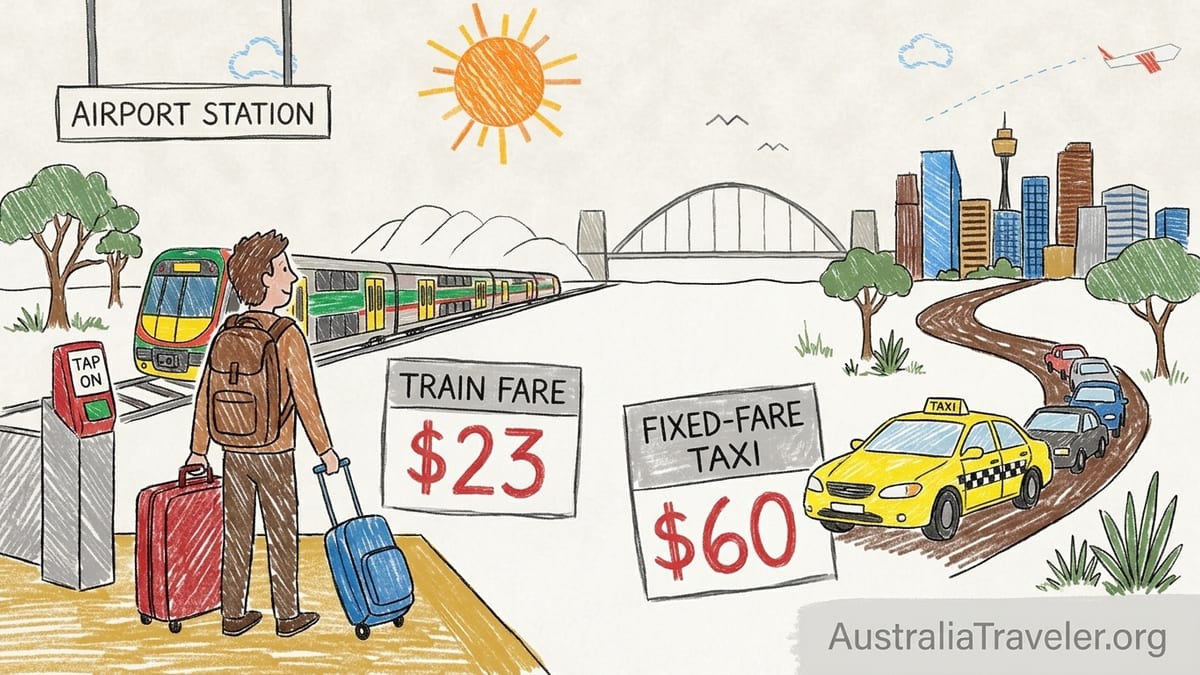
When a “cheap” airport train ride cost more than my lunch
I landed in Sydney on a mild weekday afternoon, still groggy from an overnight flight. The arrivals hall at Terminal 1 was crowded, the taxi queue snaking past the doors, rideshare pickup zones glowing on arriving phones. I had done what many seasoned travellers do: checked the public transport website, confirmed there was a frequent airport train to the city and decided it would be faster and cheaper than a cab.
At the ticket machines I skipped buying a paper ticket and chose to simply tap my contactless bank card, as the official advice suggested. The screens talked about off-peak discounts and daily caps. In my head I did a rough conversion. The regular suburban train fares around Sydney for a short to medium journey are usually under 6 Australian dollars for an adult paying with Opal or contactless. I mentally rounded that to “under ten” to be safe and walked down to the platform feeling frugal and efficient.
Thirteen minutes later we rolled into Central, the city’s main station. I followed the crowd up the escalators and tapped my card to exit. The gates clicked open and flashed the charge: about A$23 from the airport to Central. The base Opal train fare for that distance is closer to A$4.60 in 2026, so the difference was the Sydney Airport station access fee, currently A$18.61 for adults at Domestic and International stations. That extra charge, owned and set by the private Airport Link company, had just blown my careful mental maths apart.
Later that day, comparing notes with friends in the city, I realised I was not alone. Many visitors, and even infrequent locals, treat the airport train like any other suburban service, unaware that the dedicated airport stations carry a separate, hefty access fee on top of the standard rail fare. The result is that the “sensible” train can, in some circumstances, cost more than a regulated taxi fare right to your hotel door.
How the airport train really works: fast, frequent and quietly expensive
There is no question that the airport train itself is excellent from a pure transport perspective. Services on the T8 Airport & South Line run roughly every 10 minutes for most of the day between Sydney Airport and the city, typically from around 5 am until close to midnight. Travel time from International or Domestic to Central Station is around thirteen minutes, and a few minutes further to Town Hall, Wynyard and Circular Quay. In peak traffic, it is hard for any car, taxi or rideshare to compete with that consistency.
The catch sits in the payment system. When you tap on or off at either Sydney Domestic or Sydney International stations, a Sydney Airport station access fee is charged in addition to the normal Opal rail fare. For adults using Opal or contactless payment in late 2026, that access fee is A$18.61 for each use. Because the base fare for a trip to Central is only a few dollars, the fee is usually the dominant part of what flashes up at the gate.
What makes this particularly confusing for visitors is that the access fee is treated very differently to normal Opal fares. Everyday journeys on trains, buses, ferries and light rail contribute to daily and weekly Opal caps, which limit how much you pay in total across the week. The Sydney Airport station access fee, however, sits outside those caps. Transport for NSW is explicit that airport station access fees do not count toward the usual daily or weekly Opal fare caps. There is instead a separate weekly cap just for the airport access fee, currently around A$37.75 for adults, but most visitors will not hit it unless they ride to or from the airport several times in a single Monday to Sunday week.
In practice, that means you can hit the normal Opal weekly cap on city travel and still be charged the full A$18.61 each time you go to or from the airport. For someone here on a long weekend, the effect is simple: one airport trip can cost more than all their other public transport travel that day combined. For families or couples who pay that fee multiple times, the total rises quickly and erodes the perceived value of “taking the train to save money.”
Why Mascot and Green Square are cheaper: the invisible line in the sand
One of the more counterintuitive quirks of Sydney’s airport rail line is that only the two stations actually within the airport precinct charge the station access fee. The next stops towards the city, Mascot and Green Square, sit on the same line but operate as ordinary suburban stations. There is no special surcharge there, and journeys starting or ending at Mascot or Green Square are simply priced as standard Opal train trips.
For a traveller heading to the CBD, the fare from Mascot or Green Square to Central using Opal or contactless payment is usually well under A$5 one way for an adult, depending on the time of day and exact distance band. The moment you shift that journey one stop further south to Domestic or International, the A$18.61 station access fee lands on top. That is why blogs, message boards and even some locals quietly recommend a “Mascot hack”: ride or be dropped at Mascot Station, then continue to the airport terminal on a bus such as the 350 or 420, or on foot if you are lightly loaded and know the way.
The government itself acknowledges the divide. Public information about the station access fee makes clear that the surcharge is specific to Sydney Domestic and International stations and is set by the private Airport Link Company under a long-term agreement. The revenue from that fee is partly shared with the state, which helps cover the cost of having removed earlier surcharges at Mascot and Green Square. For passengers, the result is a stark line in the sand: use the airport platforms and you pay a premium price; move one station away and the same tracks suddenly become ordinary public transport again.
For many weary arrivals with luggage, navigating a train-bus combination from Mascot or Green Square is not appealing, and the airport stations are by far the most straightforward way into the network. But understanding that the extra A$18.61 is attached to those platforms, not the train line itself, is crucial when comparing against taxis, rideshare services or private transfers. It is the invisible line that makes the train seem cheap on paper yet surprisingly expensive at the Opal gate.
Enter the A$60 fixed-fare taxi: a new benchmark for value
In November 2025, New South Wales introduced a fixed-fare taxi trial from Sydney Airport to the CBD. For every non-booked taxi trip that begins at the airport taxi ranks and travels directly to a destination inside the defined CBD zone, standard taxis charge a flat A$60 fare. Maxi cabs with five or more passengers, or maxi vehicles specifically requested at the airport ranks, are capped at A$80. The trial is set for 18 months, from 3 November 2025 to 2 May 2027.
This A$60 figure is important because it represents a regulated maximum for rank and hail trips from the airport to the CBD, including typical road tolls, the airport access fee charged to taxis, and the state passenger service levy. In the past, visitors frequently complained of taxi rides to central Sydney creeping towards or beyond A$100 in heavy traffic. The new flat rate aims to eliminate bill shock and make the taxi option transparent and predictable.
The fixed fare applies only from the airport to the CBD, not the other way around. If you take a taxi from your hotel back to the airport, the usual distance and time-based meter still applies, subject to regulated maximums. It also only covers the designated CBD area shown in official maps, not outlying suburbs. But for many travellers staying in central hotels around Circular Quay, Town Hall, Darling Harbour or Haymarket, that A$60 cap is now a very real alternative to the compounded cost of multiple airport-train tickets.
Private transfer companies and rideshare platforms like Uber, Ola and DiDi also sit in this mix. On many daytime journeys between Sydney Airport and the CBD, typical rideshare fares hover somewhere in the A$35 to A$55 range before any surge pricing, depending on the exact drop-off point and traffic. During peak periods or late at night, surge multipliers can push those prices towards or beyond the A$60 taxi flat rate. The fixed-fare taxi has effectively set a psychological ceiling: anything much over A$60 to a central CBD address now feels poor value when the meter in a rank-and-hail cab is legally capped at that level.
Running the numbers: solo, couples and families compared
To understand how the economics play out in real life, it helps to look at some concrete, rounded examples for a trip between Sydney Airport and Central or nearby CBD stations. These figures assume an adult arriving in late 2026, paying with Opal or contactless for public transport and using the current A$18.61 airport station access fee and approximate train fares around A$4.60 to Central.
For a solo traveller, the airport train from International to Central costs roughly A$23 one way (about A$4.60 base fare plus A$18.61 access fee). The journey takes around thirteen minutes, plus walking and waiting time. A fixed-fare taxi to a Central-area hotel is A$60. Even if a daytime rideshare clocks in at A$40, the train is still less than two-thirds of the cost. For one person with light to moderate luggage staying near a CBD train station, the rail option remains financially compelling despite the surcharge.
For two adults travelling together, the calculation flips quickly. Two train tickets at about A$23 each total around A$46 into Central. A fixed-fare taxi to the same area is A$60, door to door. Once you account for the convenience of being dropped directly at a hotel entrance, rather than navigating escalators, platforms and sidewalks with two suitcases, many couples will see the extra A$14 as a price worth paying. If the hotel is slightly beyond walking distance of a station, or requires a connecting tram or bus, the taxi begins to look even more attractive.
For a family of four adults, the gap becomes dramatic. Four airport train tickets at around A$23 each total about A$92 one way to Central. The same family could walk to the taxi rank and pay a flat A$60 in a standard cab, saving more than A$30 and avoiding busy platforms. If one of the four is a child entitled to discounted Opal fares and a lower station access fee, the total would drop slightly but still remain broadly comparable with, or higher than, the taxi flat rate. Even with a maxi cab at A$80, bigger groups often still come out ahead compared with paying the access fee per person, especially once suitcases and strollers enter the picture.
Across Circular Quay, Darling Harbour and the broader CBD, the pattern is similar. The train is charged per person, with the A$18.61 fee repeating each time an individual uses the airport stations. The taxi is capped per vehicle for the journey. That is why couples and families so often assume, wrongly, that “the train will be cheaper” simply because it is public transport. In Sydney, on the airport route, the presence of the access fee means you must always multiply the train cost by the number of adults in your party and compare that against a single vehicle fare.
What about the buses: routes 350 and 420 in practice
For travellers determined to avoid the airport station access fee entirely, buses offer an intriguing alternative. Two routes in particular intersect with the airport precinct: the 350 and the 420. Route 350 links Bondi Junction and Sydney Airport Domestic, passing through the eastern suburbs. Route 420 runs between Burwood and Mascot, serving both the Domestic and International terminals along the way.
Crucially, boarding the 350 or 420 at the airport stops counts as a normal bus trip in the Opal system. There is no special surcharge on top of the usual bus fare, which for an adult is typically in the A$3 to A$4 range for many journeys, with off-peak discounts applying at quieter times. For someone heading directly to a destination like Bondi Junction, Mascot, or parts of the inner west, these buses can be markedly cheaper than taking the airport train.
However, there are practical disadvantages. Travel times are longer and less predictable, particularly in peak traffic around the airport and on the approach to the city. Buses can be crowded, luggage space is limited, and boarding with large suitcases is more awkward than rolling directly onto a train from an underground platform. If you need to connect from a bus to a train at somewhere like Mascot, Green Square or Bondi Junction, you introduce an extra change and more time spent hauling bags.
For a visitor landing late at night or early in the morning with family in tow, working out the right bus stop on an unfamiliar kerb can easily feel like too much. But for budget-conscious solo travellers, backpackers and returning students who know the network, a combination such as airport bus 350 to Mascot or Bondi Junction, then train, can add only 15 to 30 minutes to the journey while cutting the per-person cost to a small fraction of the airport train.
Door-to-door examples: Central, Circular Quay, Darling Harbour and Bondi
Costs only tell part of the story. Door-to-door experience, luggage and your exact destination inside Sydney matter just as much. It is worth taking a closer look at how different options feel in practice for four common arrival goals: Central, Circular Quay, Darling Harbour and Bondi.
For Central, the train is in its element. From International or Domestic, it is a simple ride to Central Station, then a short walk or an additional one-stop hop on the train or light rail to nearby hotels in Surry Hills, Haymarket or Chippendale. A solo traveller with a rolling suitcase can often be in their hotel lobby within 30 to 40 minutes of leaving the terminal, for around A$23. A taxi on the flat A$60 fare might take 25 to 45 minutes depending on traffic, but it will drop you at the door. For two or more adults staying within a few hundred metres of a station exit, the train still makes sense if you value speed and do not mind a short walk.
For Circular Quay, the train remains competitive. Airport services run directly to Circular Quay station without a change, and journey time is usually under 20 minutes from the airport. Many major hotels and cruise terminals are within a few minutes’ walk. A solo traveller going straight to Circular Quay might pay about A$24 to A$25 on the train, compared with A$60 for a taxi. For two adults, about A$48 on the train competes with A$60 in a cab that will deliver you to a hotel driveway on George Street or Alfred Street. Once a third or fourth adult is involved, the flat taxi fare usually wins on price and convenience combined.
Darling Harbour illustrates the limitations of rail. There is no station directly on the waterfront. Most travellers arriving by train get off at Town Hall or Wynyard and walk, or change to the light rail. Dragging wheeled suitcases through crowded streets and over pedestrian bridges is manageable, but not pleasant after a long flight. In this case, the extra cost of a taxi can quickly feel justified, particularly for couples, families or anyone with mobility issues. Rideshare services to Darling Harbour often sit close to the A$40 to A$55 band in normal conditions, while the fixed-fare taxi caps that cost at A$60. Four airport train tickets, on the other hand, can easily approach or exceed A$90 for the group.
Bondi presents yet another pattern. There is no train station in Bondi Beach itself, only at Bondi Junction. A logical public transport routing from the airport is train to Central, then train to Bondi Junction, then a bus to the beach such as the 333 or 380. The airport train segment will attract the station access fee, and the remainder will be normal Opal fares. Total travel time can exceed an hour, and involves at least two, sometimes three, vehicle changes. By contrast, the 350 bus from the airport goes to Bondi Junction, where you can change once to a bus to the beach, avoiding the airport station fee entirely but spending longer on the road.
A taxi or rideshare directly from the airport to Bondi Beach will usually sit higher than the A$60 CBD flat fare because Bondi is outside the defined CBD zone. But for a family of four with surfboards and suitcases, the convenience of a door-to-door car journey might still outweigh the financial saving of threading multiple transfers with luggage through central Sydney. In each case, the airport station access fee distorts the usual expectation that rail will be the cheapest option, and the correct door-to-door choice depends as much on your group size and energy level as it does on the headline fare tables.
The Takeaway
By the end of my stay in Sydney, I had come to view the airport train not as the obvious budget choice, but as a premium express service priced accordingly. It is fast, frequent and, for solo travellers heading near a CBD station with manageable luggage, still represents good value at around A$23 for a thirteen-minute ride that shrugs off traffic jams. The problem is not the train itself, but the lack of transparent understanding about the airport station access fee and how it interacts with Opal caps, group sizes and alternative modes.
Next time I land at Sydney Airport alone, aiming for a hotel near Central or Circular Quay, I will probably take the train again, but I will do so consciously, recognising that nearly A$19 of the fare is the station access fee that sits outside my normal Opal caps. If I arrive as a couple, or with family or friends, I will almost certainly head for the taxi rank and take advantage of the A$60 fixed fare into the CBD, or compare rideshare prices if the app shows a clear saving without surge pricing. For ultra-budget trips, especially if I am staying near Mascot, Green Square or Bondi Junction, I will consider the 350 or 420 buses and plan for a longer but cheaper journey that bypasses the airport train gates entirely.
The key to avoiding unnecessary airport-transfer expense in Sydney is to think in complete door-to-door costs per person, not just per vehicle or per trip. Ask yourself three questions: how many adults are travelling, how much luggage do we have, and how close is our accommodation to a train station or bus stop served directly from the airport. Once you plug the known figures into that framework, including the A$18.61 access fee at airport stations and the A$60 flat taxi fare to the CBD, the right answer usually reveals itself. The train is rarely a rip-off if you walk into it with open eyes, but for many couples and families it may no longer be the bargain they assume.
FAQ
Q1. How much does the Sydney Airport train really cost to the CBD?
The total adult cost from International or Domestic to Central is usually a little over A$23 one way, including the current A$18.61 station access fee on top of the normal Opal train fare.
Q2. Does the Sydney Airport station access fee count towards my Opal daily or weekly cap?
No. The airport station access fee is separate from ordinary Opal caps. It does not count towards your daily or weekly fare caps, although a separate weekly cap applies specifically to airport access fees if you use the airport stations multiple times in one week.
Q3. Is the airport train or taxi cheaper for a solo traveller?
For a solo adult heading to a central area like Central or Circular Quay, the train at around A$23 is usually noticeably cheaper than a fixed-fare A$60 taxi, especially during the day when trains are frequent.
Q4. When does a taxi become better value than the train?
For two adults, the total train cost is often around A$46, close enough that a A$60 taxi may be worth it for door-to-door convenience. For three or four adults, a single A$60 taxi will usually be cheaper overall than buying individual airport train tickets for everyone.
Q5. Is rideshare cheaper than the fixed-fare taxi from Sydney Airport?
Often it can be. Typical non-surge rideshare fares between the airport and CBD sit roughly in the A$35 to A$55 range, but during peak times or with surge pricing they can match or exceed the A$60 fixed taxi fare.
Q6. Can I avoid the airport station access fee by using Mascot or Green Square?
Yes. If you start or end your train journey at Mascot or Green Square instead of the airport stations, you pay only the normal Opal train fare with no airport access fee. Some travellers combine this with bus routes 350 or 420 or a short walk, though it adds time and effort.
Q7. Are buses 350 and 420 realistic options from the airport?
They can be, particularly for budget-conscious solo travellers or those heading to areas they directly serve, such as Bondi Junction for the 350 or parts of the inner west for the 420. They are slower and less comfortable with luggage than the train or a taxi.
Q8. Does the A$60 fixed taxi fare apply everywhere in Sydney?
No. The fixed A$60 fare applies only to non-booked taxi trips from Sydney Airport to a designated CBD zone. Trips to suburbs outside that zone, such as Bondi Beach or the inner west, use the regular time and distance-based taxi meter instead.
Q9. How long does the airport taxi fixed-fare trial run?
The fixed-fare trial started on 3 November 2025 and is scheduled to run for 18 months, until early May 2027, covering rank-and-hail taxis from the airport to the CBD.
Q10. What is the best value option overall between Sydney Airport and the city?
For solo travellers with light luggage heading near a CBD train station, the airport train is usually the best balance of speed and cost. For couples and families staying in central hotels, the A$60 fixed-fare taxi often offers better overall value and convenience, while buses like the 350 or 420 suit those willing to trade time and comfort for the lowest possible fare.