


I boarded my first Sydney Harbour ferry at Circular Quay expecting a cheap way to get from A to B. By the time I stepped off at Manly Wharf that morning, and later at Watsons Bay in the golden light of late afternoon, I realised I had stitched together a full harbour sightseeing day for a fraction of the cost of a commercial cruise. What follows is my real experience riding the F1 Manly and F9 Watsons Bay routes, how the views compared with the big sightseeing boats, and when it actually makes sense to pay cruise prices.
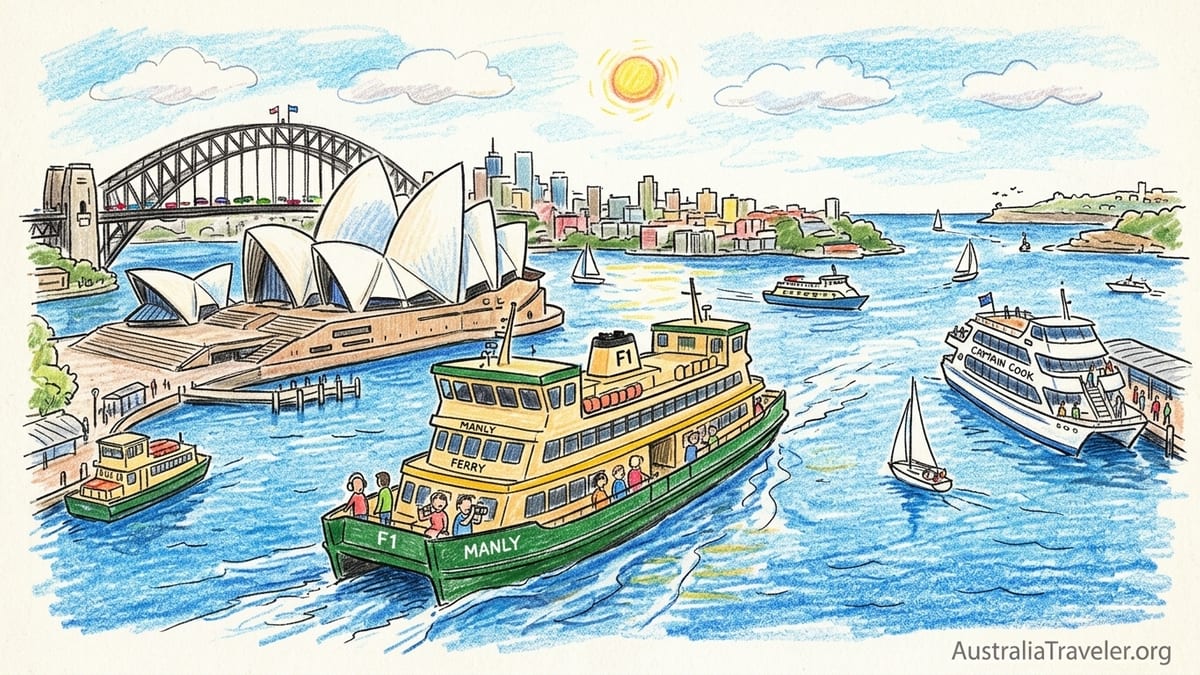
Leaving Circular Quay: First Impressions of Sydney by Water
My day started at Circular Quay on a mild late spring morning, with patchy cloud, bright sun and enough breeze to ruffle the flags above the wharves. Ferries were sliding in and out every few minutes, each one flashing a route code on the digital sign: F1 for Manly, F9 for Watsons Bay, and others heading to Taronga Zoo and Parramatta. It felt more like a suburban train station than a tourist attraction, except that every direction I looked was pure Sydney postcard.
From Wharf 3 I had the Sydney Opera House almost close enough to touch, its tiles catching the light in a soft off-white rather than the bright white you see in edited photos. To my left, the Harbour Bridge framed the view, traffic humming along the deck and a few tiny figures of climbers edging over the arch. On the harbour itself there was the usual mix of green-and-gold public ferries, sleek white harbour cruise boats, and small yachts tacking between them with surprising confidence.
As I tapped my contactless credit card on the Opal reader at the wharf gates, I could see a Captain Cook sightseeing vessel boarding on a neighbouring pier. The contrast in atmosphere was immediate. The cruise staff were lining passengers up for the obligatory boarding photo and upselling drink packages. On the public ferry side there were commuters with headphones in, school kids in uniforms, a couple wheeling suitcases to Manly, and a handful of camera-swinging visitors like me. It already felt more like stepping into Sydney’s everyday rhythm than joining a curated tour.
When the Manly ferry nosed into the wharf, the attendant dropped the ramp and we shuffled on in a relaxed but efficient flow. No assigned seating, no pre-boarding groups, just the quiet clank of the gangway and a chorus of transport card beeps. Within minutes we were pulling back from Circular Quay, the Opera House on one side and the bridge on the other, and it struck me that this “commuter boat” had taken the prime harbour line that many cruises advertise in their brochures.
Riding the F1 Manly Ferry: Seats, Weather and the Classic Harbour Run
I made a beeline for the outdoor deck at the stern, which on the older Freshwater-class ferries gives you a wide, low view straight back to the city skyline. Seating out here is simple metal benches, a bit scuffed and salty, but with the kind of uninterrupted panorama that would cost a premium on a private cruise. There is no shade on this section, so on a bright day sunscreen and sunglasses are essential. The indoor saloons have padded bench seating and large windows, ideal if the wind picks up or a southerly change barrels through mid-journey.
As we eased out of Circular Quay, the ferry swung past the tip of Bennelong Point. From the stern I had a perfect profile of the Opera House, its overlapping shells stacked against the dark green of the Royal Botanic Garden. A few minutes later, as we crossed the main channel, the Harbour Bridge lined up behind the sails in a way I had only ever seen on postcards. The movement of the ferry meant the composition shifted constantly. I had to work a little for each photo, moving side to side and timing shots between other passengers, but that effort is part of the appeal compared with standing on a dedicated cruise viewing platform.
On a weekday morning the crowd leaned more local than tourist. Office workers in hi-vis vests stood by the rail chatting over takeaway coffees. A father pointed out Navy ships at Garden Island to his daughter. Two visitors next to me compared the fare on their phones with the price of a one-hour sightseeing cruise they had almost booked. At off-peak rates the adult fare from Circular Quay to Manly with an Opal or contactless card is typically under 9 Australian dollars one way, and it counts toward the daily and weekly caps that significantly limit how much you can spend in a day on public transport. By comparison, many basic harbour sightseeing cruises sit in the 35 to 55 dollar range per adult for roughly an hour on the water, outside special deals or bundles.
The crossing to Manly takes around 20 to 30 minutes, depending on the specific vessel and conditions. Once we cleared the inner harbour, the swell picked up as we approached the Heads. I noticed a few people retreat from the outer deck to the sheltered interior; if you are sensitive to motion, the centre of the lower deck is the steadiest place to sit. For me, the extra movement only added to the sense that I was sailing on a working piece of the city, not an amusement ride smoothed out for comfort.
Arriving in Manly: Corso, Beaches and a Taste of the Northern Beaches
We slipped into Manly Cove with a soft turn, and suddenly the harbour swell calmed to a gentle ripple. Manly Wharf itself has a polished, resort-like feel, with restaurants and bars opening onto the water. Disembarking took less than two minutes, and instead of being funnelled past souvenir stands or sales desks, I walked straight into a sunlit plaza where locals were meeting for coffee and kids were already dangling fishing lines off the pier.
I followed the flow through the Corso, the pedestrian spine that runs from the harbour side to the ocean beach. It is a straightforward two or three minute walk, lined with surf shops, bakeries, casual clothing stores and a few chain cafés. I stopped at a small espresso bar midway along for a flat white and a basic breakfast roll, paying roughly what I would for a similar snack in central Sydney rather than a cruise-ship markup. One practical benefit of the ferry approach is the sheer choice of food at normal street prices once you land, as opposed to being a captive audience to onboard catering.
On the ocean side, Manly Beach spread to both horizons, a long curve of pale sand with consistent lines of surf. I walked south along the foreshore path towards Shelly Beach, a scenic 15 to 20 minute stroll that hugs the base of the headland. The views along this stretch take in surfers carving across the waves, rocky pools catching the light, and occasional inland peeks into quiet residential streets. Reaching Shelly Beach, a smaller, more sheltered cove framed by bush, I understood why many locals advise visitors to go that little bit further than the main surf beach.
Later, I climbed towards North Head along one of the marked walking tracks that begin near Shelly. The ascent is steady rather than steep, but it quickly rewards with sweeping views back to the city skyline framed by the cliffs at South Head. From here, the path of the Manly ferry looks like a pale trail on the water, underscoring just how much harbour you cover for a standard public transport fare. By the time I returned to Manly Wharf for my afternoon sailing back to the city, I felt I had combined a classic beach suburb experience with what many cruise brochures promise as a “Sydney Harbour highlights” itinerary.
Switching to the F9 Watsons Bay Ferry: Different Route, Different Vistas
Back at Circular Quay, I transferred to the F9 Watsons Bay service for a late afternoon trip. The wharf area for this route was busier with day-trippers and small groups clearly out for a scenic ride. The ferry on this run was a smaller, modern catamaran-style vessel, with both indoor seating and an open foredeck that quickly filled with people holding cameras and phones at the ready.
The departure route for Watsons Bay is not identical to the Manly run. Instead of heading straight across the main channel, we hugged closer to the southern shore for sections, which shifted the familiar icons into new alignments. Leaving the quay, the Opera House fell behind us quicker, but I found that standing along the starboard side early on gave one of the closest water-level looks at its sails of any regular ferry. The bridge, meanwhile, receded into the backdrop of skyscrapers sooner than on the Manly crossing, so if your priority is the classic bridge-plus-city panorama, the F1 still holds the edge.
Seating on this smaller ferry felt more crowded, especially on a sunny weekend afternoon. Outdoor spots vanished within minutes of boarding, and a few late arrivals ended up standing along the rail. Weather exposure is more of a factor here, as the forward outdoor area faces into the wind for much of the trip. A light spray came over the bow in choppier sections, earning a laugh from the front row and a quick retreat from a couple of passengers guarding their cameras.
Despite the tighter space, I found the photography from this boat surprisingly rewarding. The lower elevation of the deck put my lens closer to the water line, exaggerating the reflections of apartments and headlands along the Rose Bay and Vaucluse shoreline. Because the route threads between moored yachts and small sailing schools, the human scale of harbour life feels very present. It is less about that single postcard shot and more about a sequence of intimate vignettes: a sailing class practising tacks, a lone paddleboarder crossing a quiet bay, couples on balconies watching the ferries pass.
Watsons Bay on Foot: The Gap, Harbour Beaches and a Plate of Fish
Watsons Bay wharf has a more compact, village-like feel than Manly. Stepping off the ferry, I was immediately greeted by the hum of a waterside takeaway fish-and-chips counter, the clink of cutlery from sit-down restaurants looking back towards the city, and the soft rustle of a small harbour beach where families were spreading towels. It felt almost like a harbourfront cul-de-sac, with the water on one side and low streets fanning gently up the hill.
My first stop was The Gap, the dramatic ocean-side cliff a short uphill walk from the wharf. The paved path climbs past shady parkland before opening to safety-fenced lookout points that stare straight into the Tasman Sea. The air here is cooler, often with a steady breeze even on warm days, and the sound of waves crashing against the rocks below drowns out most city noise. From certain angles, you can look back across the harbour mouth and see Manly’s North Head opposite, better appreciating the route the ferries have to negotiate when seas are up.
Back near the wharf, I spent time along the small harbour beaches that frame Watsons Bay. One narrow strip of sand sits almost directly beside the pier, perfect for paddling while keeping an eye on the ferry schedule board. Another, slightly larger beach curves away behind a row of trees and cottages, offering a quieter place to sit and watch the city skyline glow at dusk. I grabbed a late lunch at a casual waterside spot, ordering classic battered fish, chips and a salad. The prices reflected the area’s popularity, but still felt more reasonable than what I had seen on printed menus for set meals on premium dinner cruises.
What stood out most was the ability to pace my own day. On a commercial cruise you are committed to a predefined loop and timetable. On the public ferry, I could linger over a second drink, decide on the spot to walk another section of coastal path, or catch an earlier return if the wind sharpened. When a sudden grey bank of cloud rolled in and a light shower began, I simply waited under the wharf shelter and boarded the next inbound ferry twenty minutes later. No rearranging bookings, no lost ticket value, just another tap of the card.
Prices, Caps and Cruises: What You Actually Pay on the Water
One of the key reasons I leaned toward the public ferries was cost, but the details matter. With an Opal card or a linked contactless debit or credit card, Sydney ferries sit within the same fare system as trains and buses. Off-peak single fares between Circular Quay and Manly or Watsons Bay are usually several dollars cheaper than peak fares, and there are daily and weekly caps that limit how much you can be charged on standard public services. Once you reach those caps through a combination of rides, additional eligible trips are effectively included, which can make heavy sightseeing days very economical.
Commercial operators are a different story. Sightseeing cruises on Sydney Harbour, run by companies such as Captain Cook Cruises and others, typically price one-hour to ninety-minute daytime sightseeing sailings somewhere in the 35 to 55 Australian dollar range per adult, depending on inclusions and season. Sunset or dinner cruises that include multi-course meals, alcoholic drinks and reserved window seating can climb well above 100 dollars per person, particularly on weekends or during special events. These tickets are separate from the public transport system and do not count toward Opal caps or concessions.
There are also privately run fast ferries on certain routes, including services to Manly that run alongside the government-operated F1 line. These private boats can be faster and sometimes more frequent in peak commuting times, but they charge separate fares that tend to be higher than the standard Opal rate and generally do not benefit from the same caps or transfer discounts. If you simply tap a bank card assuming all ferries are treated equally, you may be caught off guard, so it is worth confirming the operator and fare rules before boarding.
When I compared my actual spending at the end of a full day that included multiple ferry journeys, inner-city train transfers and a bus ride back to my accommodation, my total transport cost under the cap was still below what I would have paid for a single mid-range sightseeing cruise ticket. That saving translated directly into extra budget for meals, gelato on the Corso, and an afternoon drink at Watsons Bay with a direct skyline view.
Views, Commentary and Comfort: Are Cruises Worth the Premium?
The obvious question is whether the extra money for a harbour cruise buys experiences the ferries simply cannot provide. There are genuine advantages. Many dedicated sightseeing cruises include live or recorded commentary that explains the history of headlands, the stories behind waterfront mansions, and the role of naval bases and islands you pass. On the public ferries, beyond a basic route announcement and safety information, you are on your own. If you enjoy context and storytelling delivered as you glide by landmarks, a cruise fills that gap.
Cruises also offer more structured seating. You may have reserved window tables, cushioned indoor lounges, and upper decks outfitted with dedicated viewing platforms rather than just functional benches. Some boats angle their routes deliberately to linger in front of the Opera House or to pass under the Harbour Bridge at specific times of day for dramatic light. Sunset cruises in particular time their departures so that the sky changes colour as you approach key viewpoints, and many include a drink on arrival, canapes or a plated dinner in the fare.
On the public ferries, comfort is more utilitarian. You might be standing during busy commuter periods, and outdoor seating is strictly first come, first served. There is often a small kiosk selling coffee, soft drinks and basic snacks, but you will not find multi-course menus or cocktail lists. At times I shared my rail space with bikes, strollers and the occasional dog. For some travellers this “everyday life” texture is part of the charm; for others hoping for a special occasion atmosphere, it can feel less polished.
For me, the most compelling measure is view quality. On both the F1 Manly and F9 Watsons Bay routes I enjoyed unobstructed Opera House and bridge vistas at multiple points in the journey. No one was herding me away from the rail after a set number of minutes, and I could move from side to side to chase the angle I wanted. The key trade-off is that ferries are primarily about getting somewhere, so they do not circle back repeatedly past the same sights. If your dream is to sit near a window with a glass of wine and have the captain slowly pivot the boat to showcase each landmark in turn, a cruise does deliver something different.
Managing Crowds, Weather and the Occasional Missed Ferry
Not everything about travelling by public ferry is smooth. On one occasion returning from Manly in the late afternoon, a sudden queue built up as a large group arrived just before departure. The wharf staff counted people through the gate until the vessel reached its capacity, and a handful of us, myself included, were left behind. The wait for the next F1 service was around twenty minutes, hardly disastrous, but it served as a reminder that you need a bit of flexibility in your schedule, especially on sunny weekends and school holidays.
Weather is another variable less under your control than on a larger, more stable cruise ship. On a separate day trip, a forecasted light breeze intensified mid-crossing into a stiff wind, sending spray across sections of the deck and nudging a few standing passengers into the rail for balance. Staff kept things calm and professional, and the ferry continued operating, but some people looked decidedly less comfortable. If conditions had worsened, services can be delayed or cancelled, particularly on exposed routes near the harbour mouth. Harbour cruises are also subject to weather, but some larger vessels may ride rough conditions more smoothly.
In terms of comfort, I learned to treat the exposed outer decks as bonus spaces rather than guaranteed seats. I always identified an indoor backup spot as soon as I boarded, especially in winter or on days with changeable skies. Wearing layers, including a windproof jacket, made a big difference; temperatures out on the water can feel significantly cooler than in the city streets, even under bright sun. For photography, I carried a simple lens cloth to wipe off occasional salt spray, something that came in handy more than once on the Watsons Bay run.
These minor inconveniences never outweighed the benefits for me, but they highlight why some travellers, especially those with mobility concerns or very fixed timetables, might prefer the predictability and controlled environment of a pre-booked cruise.
The Takeaway
By the end of my day stitching together the F1 Manly and F9 Watsons Bay ferries, I felt I had experienced a full Sydney Harbour itinerary without ever stepping onto a dedicated sightseeing cruise. I had departed and returned through Circular Quay, glided past the Opera House and under the gaze of the Harbour Bridge, watched the city peel away into headlands and beaches, and eaten in waterside neighbourhoods that felt lived-in rather than staged.
If I could repeat only one journey, it would be the Manly ferry. The combination of inner harbour cityscapes, open water around the Heads, and the reward of Manly’s twin beaches and coastal walks at the other end makes it exceptional value. I would choose a mid-morning or mid-afternoon departure in good weather, stake out a spot on the stern outdoor deck early, and allow several hours on shore before the return.
That said, I do see a place for paid cruises. For a special occasion dinner, an evening when you want someone else to manage timing, commentary and catering, or a trip with travellers who might find multiple wharf transfers confusing, a sunset or dinner cruise can be worth the premium. You are paying not just for transport but for hospitality: the narration, the plated meals, the curated route and the assurance that all you have to do is show up.
For most visitors with a full day to explore, my ideal low-cost harbour plan would be this: start early from Circular Quay on the Manly ferry, walk the Corso, enjoy Manly and Shelly Beach, perhaps include a short hike towards North Head if time and fitness allow, then return to the city in mid-afternoon. After a break around the quay, switch to the Watsons Bay ferry for late-afternoon light, walk to The Gap and back, have fish and chips or a simple harbourfront meal, and ride back into the city under the first stars. With a bit of awareness about fares and caps, you can fit all of that within a modest public transport budget, keeping your money for the things that make travel memorable: good food, unhurried walks, and the quiet thrill of watching one of the world’s great harbours slide by your ferry window.
FAQ
Q1. Can I ride Sydney ferries using only my contactless bank card?
Yes, on most public ferries you can tap on and off with a contactless debit or credit card, and your fares count toward standard daily and weekly Opal caps.
Q2. Which ferry gives the best views of the Sydney Opera House?
The F1 Manly ferry usually offers the most sustained Opera House views, especially from the stern as you depart Circular Quay and cross the main channel.
Q3. Is the Manly ferry rough in bad weather?
It can be choppy near the Heads in strong winds or swell. If you are prone to seasickness, sit inside near the centre of the vessel where movement feels least intense.
Q4. How crowded do Sydney ferries get during peak times?
On sunny weekends, school holidays and commuter peaks, popular routes like Manly and Watsons Bay can fill to capacity, so you may need to wait for the next departure.
Q5. Are harbour cruises better at sunset than public ferries?
For a structured sunset experience with commentary, drinks and timed viewpoints, dedicated cruises have the edge. Ferries still offer lovely light but are focused on transport.
Q6. Do public ferries have food and drink on board?
Many larger ferries have small kiosks selling coffee, soft drinks and simple snacks, but they are not full-service restaurants, so meals are best planned on shore.
Q7. Can I use public ferries to visit Taronga Zoo and Cockatoo Island too?
Yes, separate ferry routes serve both Taronga Zoo and Cockatoo Island, and they can be combined with Manly or Watsons Bay trips if you start early and watch the timetables.
Q8. Are the public ferries accessible for travellers with mobility issues?
Major wharves and newer ferries have ramp access and designated spaces, but there can be gaps or gradients, so checking current accessibility information before travel is wise.
Q9. Is it worth booking harbour cruises in advance?
For popular sunset or dinner cruises, advance booking is sensible, especially on weekends or during holidays, to secure preferred times and sometimes better prices.
Q10. How can I plan a full day on Sydney Harbour without an expensive tour?
Combine public ferries to Manly and Watsons Bay from Circular Quay, allow generous time ashore for walks and meals, and use trains or buses to reach and return from the quay.