


Choosing where to stay in Melbourne can shape your entire experience of the city. The compact centre, creative inner-north and relaxed bayside suburbs all feel quite different, and hotel prices can swing sharply when major events are in town. This guide compares Melbourne’s key visitor neighbourhoods and several representative hotels to help you decide which area fits your style, budget and plans before you start comparing individual properties.
How Melbourne’s Neighbourhoods Fit Together
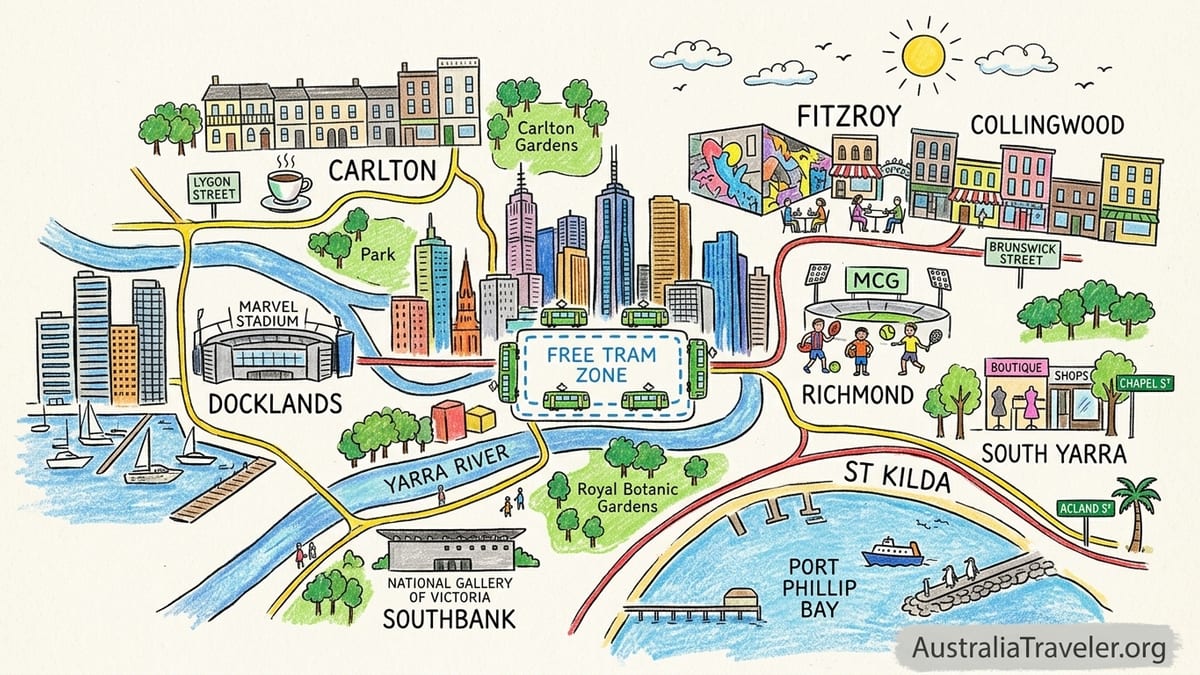
Melbourne’s inner suburbs form a rough horseshoe around the central business district, known simply as the CBD. The CBD sits inside a rectangle of tram routes and trains, bordered by the Yarra River to the south and connected to almost every other area you are likely to visit. Southbank lies directly across the river, while Docklands is just to the west along the water. Fitzroy, Collingwood and Carlton sit in the inner north, Richmond directly east of the CBD, and South Yarra a little further southeast along the Yarra. St Kilda curves around Port Phillip Bay, about 6 to 7 kilometres from the CBD.
Because distances are short and public transport is extensive, it is entirely possible to stay in one neighbourhood and explore others during the day. Trams are frequent through the centre, and there is a Free Tram Zone that covers a rectangle of streets in and around the CBD, including sections of Swanston, Flinders and La Trobe streets. Trains radiate from Flinders Street Station and Southern Cross Station, while light rail and trams connect to St Kilda and the bayside suburbs. The main choice is less about what you can reach, and more about the feel you want on your doorstep when you step out of your hotel.
Events play a substantial role in how these neighbourhoods feel and how much they cost. During the Australian Open in January, the Formula 1 Australian Grand Prix in March, the AFL Grand Final in late September and major stadium concerts scattered through the year, central hotels can sell out or rise significantly in price. Booking 3 to 6 months ahead for popular dates can make the difference between a wide choice and very limited availability at high rates.
Melbourne CBD: Laneways, Free Trams and Classic City Energy
The CBD is the most popular base for first-time visitors and business travellers. This grid of streets is known for its laneways filled with street art, tiny espresso bars and small restaurants. It is also where you will find many skyscraper hotels alongside older heritage properties. From the CBD you can walk to Federation Square, the theatre district, the main shopping precincts on Bourke Street Mall and Collins Street, and key transport hubs at Flinders Street Station and Southern Cross Station.
Walkability is a major advantage here. Most sights within the CBD are 5 to 15 minutes apart on foot, and trams are an easy backup in bad weather. The Free Tram Zone covers much of the CBD, so you can hop on and off without buying a ticket as long as you stay within the marked area. For trips further out, such as St Kilda or the zoo, you will need a myki transport card or compatible digital ticket. Crossing the river on foot to Southbank typically takes less than 10 minutes via several bridges.
Food and nightlife options are dense. The CBD has tiny laneway wine bars, late-night dumpling houses, fast-casual ramen and upscale dining in and around Flinders Lane. It feels lively into the evening, especially on Thursday through Saturday. In terms of safety, central streets are generally busy and well lit, although as in any large city you should stay aware late at night around nightlife strips and near stations.
Hotel prices in the CBD range from budget hostels and simple three-star hotels to premium international brands. As an example, a midweek night booked several weeks in advance in spring might see standard rooms in reputable four-star hotels starting somewhere in the lower to mid hundreds of Australian dollars, while luxury five-star options can be several hundred dollars higher. Prices climb substantially during event weeks and can also rise when large conventions are on at the Melbourne Convention and Exhibition Centre, still walkable or a short tram ride away.
CBD Hotel Examples: Grand Hyatt, QT and The Victoria
Several well-known hotels illustrate what staying in the CBD feels like. Grand Hyatt Melbourne sits near the top of Collins Street, an address long associated with luxury shopping and business offices. Rooms generally offer city or river views at higher floors, with categories that may include standard king or twin rooms, club-level rooms with lounge access and various suites. Typical inclusions can feature free Wi-Fi, access to a fitness centre and indoor pool, and optional buffet breakfast at an additional charge unless included in a package. Many rates now offer free or flexible cancellation up to a set time before arrival, but the exact rules depend on the specific offer you choose.
Parking at central hotels is often charged separately and can be significant. At properties like Grand Hyatt, you may find options for valet or self-parking in an associated garage, usually billed per night. Travellers relying on public transport can easily walk to Parliament Station and tram stops on Collins and Spring streets, which connect to the rest of the CBD and inner suburbs.
QT Melbourne, another CBD example, has a more playful, design-focused personality. Located close to the theatre precinct and a short walk from Bourke Street Mall, it appeals to couples and style-conscious travellers. Rooms are often described by quirky names rather than standard categories, but effectively range from compact doubles to larger suites. Many room-only rates do not include breakfast by default, though you can usually add it. Street-facing rooms may pick up some city noise, which is worth considering if you are sensitive.
For a more modest budget, The Victoria Hotel near Little Collins Street is a long-running, centrally located choice. Rooms here are simpler and often slightly smaller than those in premium hotels, but you are only a short walk from the Free Tram Zone, major shopping and Flinders Street Station. Prices are often noticeably lower than nearby upscale properties, except on very high-demand dates. As with most city hotels, you should check whether your chosen rate is refundable and whether housekeeping and Wi-Fi are included or charged separately.
Southbank and Docklands: Riverside Views and Modern Towers
Southbank stretches along the southern bank of the Yarra River directly opposite the CBD. It is dominated by high-rise apartment towers, hotels, the Crown entertainment complex and a continuous promenade of restaurants and bars facing the water. Visitors choose Southbank for its skyline views, riverside atmosphere and easy walking access to both the CBD and South Wharf, where the Melbourne Convention and Exhibition Centre is located.
Southbank is highly walkable if your main plans involve the central city, the National Gallery of Victoria and the Royal Botanic Gardens. Pedestrian bridges at Princes Bridge, Evan Walker Bridge and others connect directly to Flinders Street Station and Federation Square. At night the area remains active with diners and people visiting the Crown casino, but some streets one or two blocks back from the river can feel quieter. Public transport consists mainly of trams skirting the edges of Southbank and nearby train stations in the CBD, so you may walk 5 to 10 minutes to reach most tram stops.
Docklands lies to the west of the CBD along Victoria Harbour. It features modern waterfront apartments, office buildings, Marvel Stadium and an increasing number of chain hotels and serviced apartments. The area feels more spacious than the CBD, with wider streets and fewer heritage buildings. Walkability is good within Docklands itself, but some sections can feel quiet outside office hours. Trams connect Docklands to the Free Tram Zone and Southern Cross Station, giving access to the broader network.
Hotel prices in Southbank and Docklands cover a range from midscale to high-end. In Southbank you pay at least partly for the view. River-facing rooms and higher floors in upmarket hotels can cost significantly more than standard city-facing rooms. In Docklands, waterfront rooms and apartments also tend to cost extra, but rates can sometimes be more competitive than equivalent CBD river-view properties because Docklands is a little further from some central attractions.
Southbank Hotel Examples: The Langham, Crown Metropol and Serviced Apartments
The Langham Melbourne is one of Southbank’s best-known luxury hotels, located almost directly on the river. Many rooms offer views of the Yarra and CBD skyline, especially on higher floors. Typical room categories include river view and city view rooms, executive rooms with lounge access and suites. Breakfast is often available as a buffet in the main restaurant, either included in certain packages or charged separately. The hotel offers an indoor pool, spa facilities, a fitness centre and classic-style decor that appeals to couples and travellers seeking a more traditional luxury feel.
Parking at The Langham is usually available either via valet or nearby self-parking arrangements, almost always for a separate nightly fee. The hotel sits within a short walk of Flinders Street Station via pedestrian bridges, which means you can arrive by train from the airport SkyBus terminal at Southern Cross Station and then transfer on foot or by tram.
Crown Metropol is part of the larger Crown complex, which also includes Crown Towers and Crown Promenade. Crown Metropol typically positions itself as a contemporary, design-led option, with a large indoor pool that has become one of its visual calling cards. Rooms range from standard king and twin layouts to studios and suites, often with floor-to-ceiling windows offering skyline or bay views. Breakfast is usually served in a dedicated dining space and may or may not be included in the rate you choose. Being inside the Crown precinct means restaurants, casual eateries and bars are at your doorstep, but it also brings a steady flow of visitors, especially on weekends and during events.
Serviced apartments in Southbank and Docklands appeal to families, groups and longer-stay guests who want kitchen facilities and separate living areas. Buildings managed by large serviced-apartment brands typically offer one-, two- and sometimes three-bedroom units, usually with washing machines, dryers and basic cooking equipment. They can represent good value on a per-person basis, particularly when sharing a two-bedroom apartment among friends. Most do not automatically include breakfast, and housekeeping frequency can vary. Parking is often underground and charged separately, while proximity to tram stops or Southern Cross Station determines how convenient they are for car-free visitors.
Inner North: Fitzroy, Collingwood and Carlton
Fitzroy and Collingwood appeal strongly to visitors interested in cafés, independent shops and creative culture. Just north of the CBD, these neighbourhoods mix Victorian-era terraces with street art, small galleries and some of Melbourne’s most talked-about bars and restaurants. Brunswick Street in Fitzroy and Smith Street between Fitzroy and Collingwood are long strips of dining, vintage stores, live-music venues and casual bars. The atmosphere here is relaxed and bohemian, with a noticeably younger crowd at night compared with more corporate-feeling parts of the CBD.
Walkability in Fitzroy and Collingwood is excellent for local exploring. Streets are in a traditional grid, and most cafés and bars are within 5 to 10 minutes’ walk if you stay near the main strips. Several tram routes link these areas to the CBD in roughly 10 to 20 minutes, depending on your exact location and time of day. Cycling is popular, and there are bike lanes on many streets. Safety is generally good, although as with any nightlife area it is wise to stay aware late at night around busy intersections and venues.
Carlton, immediately north of the CBD, is known for its strong Italian heritage and Lygon Street dining strip. Here you find clusters of Italian restaurants, gelato shops and bars, along with the University of Melbourne and major cultural institutions such as the Melbourne Museum and the Royal Exhibition Building in Carlton Gardens. Carlton provides a quieter base than Fitzroy in many pockets, especially on residential side streets, while still keeping you close to both the CBD and the artistic energy of the inner north.
Accommodation in Fitzroy and Collingwood consists mainly of small boutique hotels, guesthouses and short-stay apartments scattered through residential streets. In Carlton there is a broader mix, including midrange hotels and student-focused properties near the university. Prices often undercut full-service CBD hotels for similar room sizes, though tax and cleaning fees for apartments can narrow the gap. Tram access to the CBD is strong, but you should expect to pay for public transport daily rather than relying on the Free Tram Zone unless you are prepared to walk further.
Case Studies: Space Hotel, Museum Access and Independent Stays
Space Hotel, located on Russell Street just north of the CBD and close to Carlton’s museum precinct, is a hybrid property that illustrates how budget-conscious travellers can stay central without sacrificing too much comfort. It offers both dormitory beds and private rooms. Dorms typically have shared bathrooms, while private rooms may have en-suite facilities. Many private rooms are basic but clean, aimed at backpackers, young couples and budget travellers who want a central location steps from the Free Tram Zone. The property has shared kitchen facilities, which can save money on meals, and a rooftop area with city views.
Because it caters to budget travellers, Space Hotel’s prices are usually far below those of full-service CBD hotels, though they do rise during peak events and busy summer periods. As with most hostels, breakfast is not usually included by default, although there may be simple food and drink options to purchase. Cancellation policies tend to be stricter on the cheapest non-refundable rates, with more flexible options costing slightly more. Access to Melbourne Central Station and multiple tram lines is a key advantage for those exploring Carlton, Fitzroy and the rest of the CBD.
In Carlton itself, several midrange hotels and serviced apartments sit within walking distance of Lygon Street and the Melbourne Museum. These properties commonly offer studio or one-bedroom layouts with basic kitchens, appealing to families or guests attending conferences at nearby universities. Breakfast is often either an add-on or not provided, encouraging guests to take advantage of the many cafés on Lygon Street each morning. Parking is usually provided in small on-site lots or underground garages, with nightly fees that are generally lower than those at large CBD towers, but still significant enough that car-free travellers may come out ahead by skipping a rental car.
In Fitzroy and Collingwood, independent guesthouses and design-led boutique hotels may provide a handful of rooms above or behind cafés and shops. These can be very atmospheric, with thoughtful interiors and strong café culture at your doorstep, but amenities like 24-hour reception, daily housekeeping or elevators may be limited. When comparing prices, consider not just the nightly rate but also whether these properties include Wi-Fi, whether rooms have air conditioning and how close they are to late-night noise from bars or live music.
Richmond and South Yarra: Shopping, Sport and Dining Strips
Richmond, just east of the CBD, is a convenient base for sports fans. The Melbourne Cricket Ground, AAMI Park and Rod Laver Arena are all reachable in 15 to 25 minutes on foot from parts of Richmond or even less by tram or train. Bridge Road and Swan Street are the key dining and shopping strips, lined with pubs, casual restaurants and a mix of outlet stores and boutiques. The atmosphere is energetic on event days, particularly during the AFL season and the Australian Open.
Accommodation in Richmond is more scattered than in the CBD, consisting of a mix of small hotels, motels and serviced apartments. This can work well for people attending matches or concerts who want to walk back after an event rather than relying on crowded trains. However, if your main focus is sightseeing in the CBD, the lack of a dense cluster of hotels and fewer late-night transport options compared with staying centrally may offset the convenience.
South Yarra, further southeast along the Yarra River, is known for shopping on Chapel Street and Toorak Road, along with an established café and bar scene. It feels more upscale and residential than Richmond, with tree-lined streets and many apartment buildings. South Yarra Station connects directly to the CBD by train, often in around 10 minutes, and there are trams along Chapel Street that link to other inner suburbs. Walkability is strong within the local area, and the Royal Botanic Gardens are within reach for longer walks or short tram rides.
Hotels in South Yarra and Richmond tend to be midrange to upper-midrange, with some boutique properties positioned as stylish bases for nightlife and shopping. Prices can be comparable to or slightly below equivalent CBD properties on standard dates, though during the Australian Open or major sporting events, Richmond in particular can see significant price rises due to its proximity to stadiums. Serviced apartments are common, giving families and longer-stay visitors more space and kitchen facilities while still keeping them comparatively close to the centre.
St Kilda: Beach Vibes and a Longer Tram Ride
St Kilda offers a different feel from the inner-city neighbourhoods. Located on the shore of Port Phillip Bay, it combines a broad beachfront promenade, a pier with views back to the city skyline and a mix of historic and modern properties. Acland Street and Fitzroy Street are the main eating and drinking strips, with cake shops, casual restaurants and bars. The atmosphere is relaxed by day, with walkers and cyclists along the foreshore, and more lively at night, especially on weekends.
The key trade-off in St Kilda is the longer tram journey into central Melbourne. Trams from St Kilda to the CBD often take between 20 and 30 minutes, longer in peak traffic. You also sit outside the Free Tram Zone for most of the journey, so you will need to factor in public transport fares. If you are planning repeated early-morning departures for tours or events in the CBD, this extra travel time can add up. On the other hand, if your priority is a more laid-back stay by the bay, daily trips into the centre may feel less essential.
St Kilda has a wide range of accommodation, from backpacker hostels close to the beach to midrange hotels and serviced apartments along the foreshore and side streets. Some older properties offer larger rooms and balconies but more dated decor, while newer builds emphasize contemporary interiors and sometimes smaller footprints. Parking availability varies. Bayside properties may offer on-site paid parking, but street parking can be in high demand during summer weekends and events such as the Formula 1 Grand Prix, which takes place nearby around Albert Park.
In terms of safety, St Kilda’s main streets are usually busy in the evening, but late-night noise and occasional disturbances around bars are not unusual. Choosing a hotel on a quieter side street can help light sleepers. For families, proximity to the beach, playgrounds and the local amusement park can outweigh the longer rides into the CBD, especially during warmer months when spending much of the day by the water is appealing.
How Events and Seasons Affect Rates and Value
Melbourne’s accommodation market is sensitive to its events calendar. The Australian Open tennis tournament in January concentrates demand around the CBD, Southbank and Richmond, as fans and media want quick access to Melbourne Park. In practice, this can mean central hotel rates that are noticeably higher than the same days a few weeks either side. During popular matches, availability at midrange CBD hotels can tighten, leaving mainly high-end rooms or properties further from the centre.
In March, the Formula 1 Australian Grand Prix uses the street circuit around Albert Park, close to South Melbourne and St Kilda. Visitors attending the race often favour Southbank, the CBD and St Kilda, as these offer relatively direct tram routes to the circuit and plentiful dining options. Accommodation in these areas usually costs more over the race weekend than on adjacent weekends, and some hotels may impose minimum stay lengths or stricter cancellation policies because demand is strong.
The AFL Grand Final, traditionally held at the Melbourne Cricket Ground in late September, drives demand for stays in the CBD, Richmond and Southbank. Footy fans often book months ahead, especially for hotels within easy walking distance of the stadium. Major concerts at venues such as Marvel Stadium, Rod Laver Arena and the MCG similarly cause spikes on particular nights throughout the year. When multiple events collide with school holidays or long weekends, price rises can be sharp.
These peaks mean that travellers flexible on dates can save money by avoiding the busiest event periods, or by shifting their stays a few days before or after. Those committed to attending these events should watch for accommodation releases and book as early as they can commit, while also paying close attention to cancellation terms so they understand how easy it is to change plans if needed.
Who Should Stay Where and When Suburban Rooms Stop Making Sense
Families who want easy sightseeing often do well in the CBD, Southbank or Docklands, especially in serviced apartments with kitchen facilities. Being close to the Free Tram Zone and main train stations simplifies outings to attractions like the Melbourne Museum, the Royal Botanic Gardens, the zoo and suburban markets. For couples focused on dining and atmosphere, Fitzroy, Collingwood, Carlton and South Yarra provide immediate access to strong restaurant and café scenes, while Southbank and the CBD work well for theatre, galleries and riverside walks.
Backpackers and budget travellers frequently gravitate to central hostels such as Space Hotel near the museum precinct or similar properties near the southern CBD edge and St Kilda. Staying central reduces late-night transport costs after bar and club visits, while St Kilda hostels appeal to those who want a beach lifestyle and are comfortable with longer tram rides. Event visitors, such as tennis or AFL fans, often prioritize being walking distance or one simple tram ride from stadiums in Richmond, Southbank or the CBD, accepting higher nightly rates in exchange for convenience and the ability to avoid crowded post-game trains.
For travellers without cars, central or inner-suburban bases along frequent tram or train lines generally provide the best experience. The CBD, Southbank, Carlton, Fitzroy, Collingwood, Richmond and South Yarra all allow car-free stays with straightforward access to sights and dining. St Kilda also works well without a car if you are content with the longer tram trip, particularly in warmer months when the beach is a daily focus.
A common question is whether it is worth booking a cheaper suburban room further from the centre. In some outer suburbs, nightly rates can be noticeably lower than in the CBD. However, once you factor in daily public transport fares for each person, the time cost of 30 to 45 minutes each way, and the reduced flexibility to pop back to your room between activities, the savings can erode quickly. For example, if a room in an outer suburb is around a certain amount cheaper per night but you are paying for multiple myki fares each day and spending an extra hour commuting, the net benefit may be modest. For most short stays of three to five nights, a slightly more expensive inner-city or inner-suburban hotel often represents better overall value than a distant bargain where you are paying in both time and transport.
FAQ
Q1. Is it better to stay in Melbourne CBD or Southbank for a first visit?
For a first visit, the CBD is usually the most convenient because you are inside the Free Tram Zone, close to both Flinders Street and Southern Cross stations, and surrounded by laneways, shops and a huge range of dining. Southbank suits travellers who prioritise river and skyline views and do not mind a short walk to most tram and train connections.
Q2. How long does it take to get from St Kilda to central Melbourne?
Trams from St Kilda to the CBD typically take around 20 to 30 minutes each way, depending on your exact stop and traffic conditions. This is significantly longer than walking or taking a short tram hop within the inner suburbs, so it is worth considering if you plan to travel in and out of the centre several times a day.
Q3. Are Fitzroy and Collingwood safe areas to stay?
Fitzroy and Collingwood are generally considered safe for visitors and are popular with both locals and tourists. As they have active nightlife around Brunswick Street and Smith Street, late evenings can be busy and sometimes noisy, so standard inner-city precautions apply, but most travellers find them comfortable and welcoming.
Q4. Does the Free Tram Zone cover Southbank and Docklands?
The Free Tram Zone covers the Melbourne CBD and parts of Docklands, but not all of Southbank. If you stay in Southbank you will usually walk a short distance to cross into the zone or pay a fare for trams that operate outside it. Some Docklands stops fall inside the zone while others are just beyond, so you should check the specific stop locations when planning your journeys.
Q5. When do hotel prices in Melbourne increase the most?
Hotel prices in Melbourne tend to increase during major events such as the Australian Open in January, the Formula 1 Australian Grand Prix in March, the AFL Grand Final in late September and nights with large stadium concerts. Rates can also rise during school holidays, long weekends and when major conferences are on at the convention centre.
Q6. Is it worth renting a car if I stay in the CBD or Southbank?
For most visitors staying in the CBD or Southbank, renting a car is not necessary and can add extra costs through parking fees and congestion. Public transport covers most attractions, and walking is often the quickest way to get around the central areas. A car becomes more useful only if you plan several day trips beyond the city where tour buses or regional trains are less convenient.
Q7. What type of accommodation suits families best in Melbourne?
Families often find serviced apartments in the CBD, Southbank, Docklands, Richmond or South Yarra particularly practical. These typically offer separate bedrooms, living areas and kitchens, which make self-catering and early bedtimes easier. Proximity to tram and train lines also helps with prams, tired children and quick returns to the room during the day.
Q8. Are hostels in central Melbourne and St Kilda a good option for solo travellers?
Yes, hostels such as those near the museum precinct and in St Kilda are popular with solo travellers and backpackers. They provide social common areas, shared kitchens and a choice of dorms or private rooms at lower prices than most hotels. Central hostels are convenient for nightlife and sightseeing, while St Kilda offers more of a beach and outdoor focus.
Q9. How early should I book for the Australian Open or AFL Grand Final?
For major events such as the Australian Open and AFL Grand Final, it is wise to book accommodation as soon as match dates and your travel plans are confirmed, which can be several months in advance. Availability at popular central hotels tightens quickly, and booking early improves your chances of finding a room near stadiums at a manageable price.
Q10. When does a cheaper outer-suburban hotel stop being good value?
A cheaper outer-suburban hotel becomes less attractive when daily public transport costs, longer commute times and reduced flexibility outweigh the savings on the room rate. For short city-focused trips, paying a moderate premium to stay in the CBD, Southbank or inner suburbs like Carlton, Fitzroy, Richmond or South Yarra usually offers better overall value and a more convenient experience.