


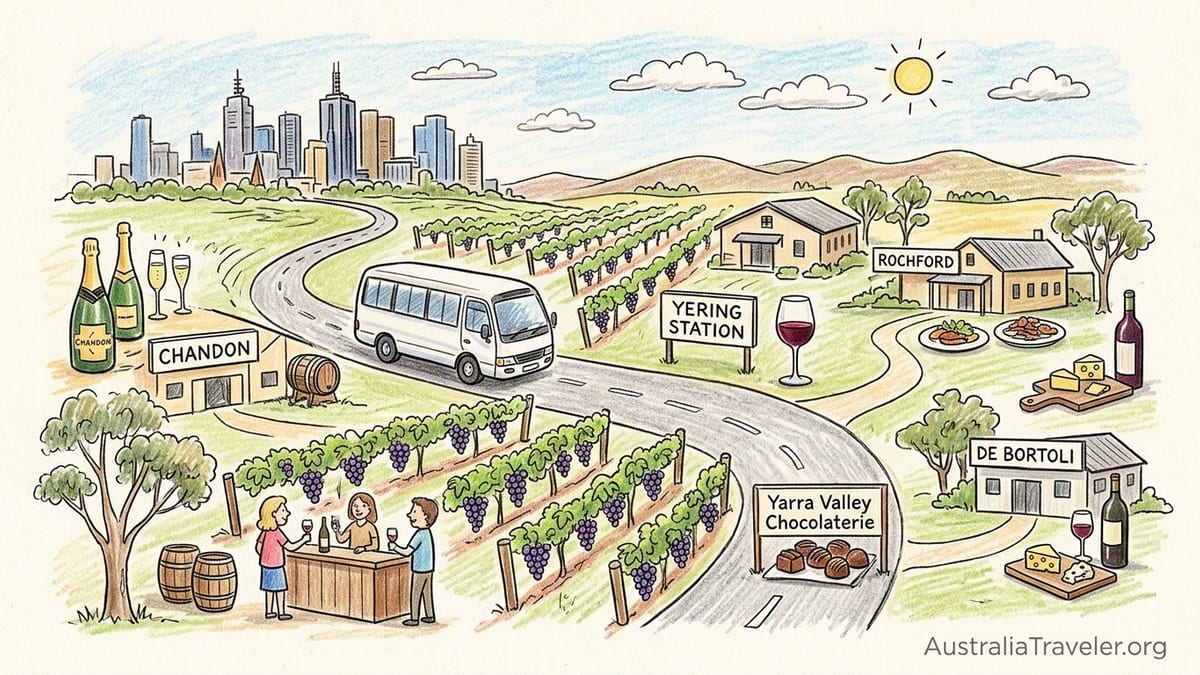
I left central Melbourne just after 8am with a keep cup of coffee in one hand and a very firm promise to myself in the other: I was going to taste as much Yarra Valley wine as possible without once worrying about driving. Over one long, indulgent day I joined a small-group guided tour that took in Domaine Chandon, Yering Station, De Bortoli and Rochford, plus a stop at the Yarra Valley Chocolaterie. By the time we rolled back into the city at dusk, I had very clear opinions about which wineries were worth the early alarm, which tastings felt rushed or commercial, and what kind of tour I would happily book again.
Rolling Out From Melbourne And First Impressions Of The Tour
My day started outside a hotel on Russell Street in Melbourne’s CBD, one of several common pickup points used by Yarra Valley operators. A twelve-seat minibus pulled in right on 8:15am, already carrying a quiet German couple and two friends from Sydney. By the time we looped past Parliament and into Fitzroy to collect the final pair, there were ten of us plus the driver-guide, which already felt like a good sign. I have seen Yarra Valley coaches with upwards of twenty guests, and the smaller group promised more time at the tasting bench and less shouting to be heard.
The guide, a former sommelier, set the tone early. As we eased onto the Eastern Freeway he outlined the day: four wineries, one chocolate stop, a proper sit-down lunch and a likely return to the city around 5:30pm. He was frank about the trade-offs between cheaper large-bus tours and smaller vans. Most of the A$120 to A$140 full-day group products cluster around four stops, hotel pickup and an included basic lunch or fixed tasting fees. Premium small-group or semi-private options, like the six-guest Mercedes van days or curated Chandon, Soumah and De Bortoli itineraries, often push into the A$250 to A$320 range but add more generous pours, higher-end venues and more relaxed pacing.
On my particular day, the brochure price sat in the middle. I paid just under A$150, which included all tasting fees and a one-course winery lunch with a glass of wine. That is noticeably more than the leaner full-day tours that start around A$85 by skipping lunch, but less than the top-tier experiences that climb past A$300 when you factor in premium tastings and multi-course meals. Knowing I would not be asked to pay extra tasting charges at each cellar door turned out to be one of the big advantages of booking this mid-range guided excursion.
The other immediate benefit, of course, was not having to worry about blood alcohol limits or navigating unfamiliar country roads. The Yarra Valley sits roughly an hour’s drive from Melbourne, and between a couple of flights at each stop, palate-cleansing sparkling here and a sticky dessert wine there, the drinks add up faster than you think. Sitting in a clean, air-conditioned minibus while someone else stayed sober and handled the logistics was worth a significant portion of the ticket price all on its own.
Domaine Chandon: Sparkling Views And A Surprisingly Structured Tasting
Domaine Chandon was our first stop, and arriving just after opening was a smart piece of scheduling. The estate sits on gently rolling slopes near Coldstream, with manicured lawns and rows of vines leading the eye toward low hills on the horizon. The modern glass and stone tasting room feels more like an architect’s showcase than a rustic cellar door, and when large buses roll in it can become a bit of a fizz-fuelled zoo. Hitting it early meant we walked straight to a reserved section of the bar, with a dedicated Chandon host ready for our flight.
Our tasting focused on four sparkling wines poured side by side. We started with the flagship non-vintage brut, crisp and citrusy, the sort of wine that is almost dangerously easy to drink. That was followed by a rosé with a pale salmon hue, all strawberries and cream on the nose, then a Blanc de Blancs with tighter acidity and a finer bead. The final glass was a vintage cuvée with more autolytic character, brioche and toasted nuts showing through the fruit. The host walked us through the basics of traditional method sparkling, the length of lees ageing and why the Yarra Valley’s cool climate suits bubbly so well. It was polished, informative and pitched well for a mixed group of casual drinkers and a couple of more serious wine nerds.
In terms of hospitality, Chandon was professional rather than warm. Staff were attentive, but there is no getting around the fact that this is a large, globally owned operation that handles a lot of visitors. Our group had about 45 minutes allocated. That was enough to taste, wander the terrace to take photos of the vineyards and browse the shop, but not enough to sit down for the full restaurant experience or add a cheese plate. On independent visits you pay tasting fees directly, and they credit a portion back against purchases. Because our tour had prepaid, there was no pressure to buy, which I appreciated. I would happily return to Chandon under similar conditions, but I would be less keen to fight for bar space on a crowded weekend afternoon without that reserved slot.
From a value perspective, Chandon made sense as part of a curated itinerary. Booking a sparkling-specific experience there on your own can push the day’s total cost close to that A$300 mark once you add lunch and transport, so having it built into a mid-priced group tour meant I could enjoy the scenery, bubbles and cellar-door theatre without feeling like I needed to justify a big splurge.
Yering Station: Heritage Cellars And A Standout Pinot Noir
Leaving Chandon, we drove ten minutes along quiet back roads to Yering Station, one of the region’s oldest wine names. The property blends heritage buildings with a sleek tasting space overlooking a broad lawn and distant hills. Compared with Chandon’s contemporary gloss, Yering Station felt more grounded and less like a brand showroom. Our guide used the short drive to talk through Yarra Valley history, including how some of the oldest plantings date back to the 19th century before phylloxera and shifting tastes pushed grape growing out, only for it to surge again in the late 20th century.
At Yering Station we stood at a long counter in a stone-walled hall and worked through a mix of whites and reds. The chardonnay showed the region’s hallmark combination of citrus, white peach and restrained oak, with a gentle creaminess from lees stirring. The pinot noir was the real highlight for me: bright cherry and raspberry fruit with savoury forest floor notes and fine tannins that lingered. We also tasted a more robust shiraz with cooler-climate pepper and spice rather than the dense jammy style you might find in hotter regions. The staff member pouring for us was notably relaxed. He asked about our preferences and quietly swapped in an off-list wine for a couple of guests who wanted something lighter, a level of flexibility you rarely see on very large-group tours.
We had slightly more time here than at Chandon, close to an hour. That meant a quick wander through the gallery space and a few minutes out on the lawn, watching other visitors pose for photos against the vine rows. There was a subtle but noticeable difference between our group of ten and a thirty-strong crowd that arrived about fifteen minutes after us. Their guide seemed to be shepherding them through a set tasting at speed, with glasses lined up in advance and little room for questions. It reinforced why I had opted for a capped small-group tour rather than the cheaper big-bus alternatives.
In terms of purchases, Yering Station was where I chose to spend. Knowing that the tour had already covered tasting fees made it easier to buy a bottle of that pinot without second-guessing. The cellar door team were happy to ship mixed six-packs back to Melbourne or interstate, but there was no hard sell. If anything, the lack of purchase pressure and the chance to ask nerdier questions made me more inclined to support them with a sale.
Lunch In The Valley: Winery Dining Versus Healesville Cafés
By late morning hunger was setting in, and this is where Yarra Valley tours diverge significantly. Some of the cheapest full-day products avoid sit-down winery lunches altogether to keep the sticker price around A$85 to A$100, leaving guests to buy their own food at a café or bakery stop. More mid-range and premium days build lunch into the itinerary, either as a one-course main with a glass of wine, or as a more elaborate two or three-course meal. My tour went for the middle ground: a one-course lunch at a winery restaurant, with the option to pay extra on the day for dessert or another side.
We ate at Rochford, a sizable estate that doubles as a major events venue, complete with outdoor stage area and large indoor spaces often used for concerts and corporate functions. On arrival we went straight to a long table by the window with views over vines and a dam. The included menu offered a choice of dishes. I chose a slow-cooked lamb shoulder over soft polenta, paired with a glass of estate shiraz. Others in the group went for pan-seared fish and a vegetarian gnocchi with mushrooms. The food was solid rather than life-changing, plated attractively and served promptly. Portions were sufficient for a long day of tasting, and the included glass of wine felt generous compared with tours that only offer a basic house pour.
Later in the afternoon, as we drove past Healesville, the guide pointed out several cafes, bakeries and the local brewery. He made the case that travellers who prioritise food variety over convenience might want to book a tour that stops in Healesville for an hour instead of committing to a fixed winery lunch. Eating in town can open up options from excellent bakeries to casual pubs and burger joints, and can sometimes be cheaper than set winery menus that hover around A$35 to A$45 for a main. On the other hand, leaving the vineyard setting at midday breaks the scenic flow of the day, and you lose that quintessential experience of looking out over vines with a glass of local wine in hand.
Comparing both approaches, I was happy we ate at a winery. The balance of time, view and simplicity worked. If I were planning a return visit on a private or self-guided day with non-drinkers in tow, I might instead schedule lunch in Healesville or nearby Yarra Glen to give everyone more choice and to avoid the slightly conveyor-belt feel that large winery restaurants can develop on busy weekends.
De Bortoli And Rochford: Tasting Pace, Group Size And Purchase Pressure
After lunch we stayed at Rochford for a short tasting flight. This was the most obviously commercial stop of the day. Our group joined another small tour at a long counter, and a single staff member poured pre-selected wines for roughly twenty people at once. The line-up leaned toward approachable styles: a crisp sauvignon blanc, a medium-bodied pinot noir and a fuller shiraz among them, with a sweet late-harvest wine to finish. The explanations were brief and functional. It felt more like ticking off a promised inclusion than a chance to explore the range in depth.
This was also the only point in the day where I felt even mild purchase pressure. At the end of the tasting our host pointedly reminded everyone that tasting fees were usually charged per person but were being covered because we were on tours, and that buying at least a bottle would help support the cellar door. The comment was understandable, but the tone verged on transactional, and a few people in the combined group looked uncomfortable. With wine clubs, events and giftware clearly a big part of the business model, Rochford came across as a venue optimised for scale rather than intimacy. I did not dislike it, and the shiraz we tasted was decent, but it is not a winery I would go out of my way to revisit without a specific concert or event as the draw.
De Bortoli, by contrast, was a highlight. Set among gently undulating vineyards, its Yarra Valley estate combines a well-run cellar door with a cheese counter that has rightly earned a following. Our group was led to a private corner of the tasting area where pre-poured flights waited alongside a small shared board of local and imported cheeses. The line-up ranged from a bright, citrussy riesling to an estate chardonnay and pinot noir, followed by a more structured cabernet blend. The final pour was a luscious dessert wine served next to a bite of blue cheese, a pairing that converted at least one previously sceptical member of our group.
The staff at De Bortoli struck the best balance of the day between education and ease. The host gave just enough regional context to connect what we were tasting to the wider story of the Yarra Valley, then stepped back to answer individual questions. When I asked about how the Yarra site differed from the company’s larger Riverina base, she explained the climatic contrast without wandering into jargon. Our scheduled time here was around an hour, which felt right for a structured tasting, cheese, a wander through the shop and a quick stroll outside for vineyard photos. There was no sense of being rushed back onto the bus.
Purchases, meanwhile, happened almost organically. The cheese board had several of us eyeing wedges to take home, and I added a bottle of chardonnay to my earlier Yering Station pinot. Because the tour price already included this premium tasting with cheese pairing, there were no extra charges to sign for, and the staff never pushed us to buy. If I were to book a higher-end small-group or private tour in future, De Bortoli would be on my must-visit list, ideally with an expanded cheese and wine pairing experience or a longer, seated tasting focused on specific ranges.
Guided Tours Versus Self-Driving: Cost, Convenience And Safety
Spending a full day with a guide gave me a clearer sense of when a structured excursion makes more sense than hiring a car or designating a sober driver. On the cost side, standard full-day group tours without lunch start from around A$85 to A$100, including three or four wineries and covered tasting fees. Mid-range products that add a winery lunch and sometimes a chocolate or dairy stop tend to fall between A$120 and A$160. At the top end, small-group premium or semi-private days that cap numbers at six to eight guests, include upgraded tastings at places like Domaine Chandon and De Bortoli and sometimes offer multi-course lunches can rise above A$300 per person.
If you drive yourself, fuel and car hire for a day from Melbourne loosely sit around A$80 to A$150 depending on the vehicle and timing, with each cellar door charging tasting fees that often hover between A$10 and A$25 per person, sometimes rebated on purchase. A relaxed day of visiting four wineries and a chocolate shop could easily see two drinkers spending a similar total to a modest group tour once you factor in lunch and tastings, but with no guide, no designated local expert and one person obliged to spit or abstain all day.
For me, the crucial advantage of the guided format was safety. Across four cellar doors I tasted at least five or six wines at each, even sticking to modest pours. The legal blood alcohol limit for driving in Victoria is strict, and rural policing around major wine regions can be active, particularly on weekends. Removing any temptation to drive after “just one more taste” made the entire day more relaxed. It also freed me from worrying about navigation, opening hours or booking tasting slots, all of which Yarra Valley operators strongly recommend reserving in advance during busy periods.
The trade-off comes in flexibility. On a group tour you accept a set itinerary and timing. If you fall in love with a particular winery, you cannot simply linger for an extra hour. My day allowed roughly 45 minutes to an hour at each stop, which was enough to taste and take a few photos but not enough to, say, settle in for a long coffee at the Four Pillars gin distillery in Healesville or wander the shops at leisure. Travellers who care more about autonomy and already know which producers they want to visit might prefer to hire a private driver or arrange a bespoke small-group day, which can start from roughly A$250 per person for a group of six once tastings and lunch are factored in.
Options For Non-Drinkers: Cheese, Chocolate, Gin And Scenery
One of the surprises of my tour was how engaged the non-drinkers in our group remained throughout the day. We had one guest who tasted sparingly and another who chose not to drink at all. The guide and cellar doors handled this with more creativity than I expected. At Chandon and Yering Station, they were poured half-serves of a couple of wines and offered sparkling water and non-alcoholic options. At De Bortoli, they tucked into the cheese board with the rest of us, and the staff were happy to talk through textures and flavours without tying everything back to the wine.
Our final stop before heading home was the Yarra Valley Chocolaterie, a place that divides locals but delights sweet-toothed visitors. Here, the focus shifted entirely away from alcohol. Floor-to-ceiling displays of truffles, bars and novelty chocolates sat alongside an ice-cream counter and a café looking out over paddocks and distant vineyards. The non-drinkers in our group came into their own, comparing flavours and loading up on gifts. The stop only lasted about half an hour, but it rounded out the day and provided a break from structured tastings.
Beyond chocolate and cheese, many Yarra Valley itineraries now blend wine with other attractions to appeal to broader groups. Some full-day tours fold in a stop at a gin distillery for those who prefer botanicals to barrels, while others visit local dairies or farm shops. Scenic highlights, such as viewpoints over the valley and short walks near rivers or forested ridges, can also be built into private or premium small-group days. Non-drinkers who still want to join friends on a tour should look out for operators that clearly mention food, chocolate, dairy or gin stops in their descriptions, and ask in advance how they cater for guests who are not tasting wine.
From a value perspective, non-drinkers may bristle at paying full fare for a tour that revolves around alcohol. Some companies offer a modest discount for passengers who skip tastings, while others will ensure they are not charged individual cellar-door fees. If I were travelling with someone who did not drink at all, I would either seek a tour that explicitly lists non-wine inclusions or consider a private driver for the day so we could skew the itinerary more toward scenery, food and relaxed exploring, with just one or two short tastings for the wine lovers.
The Takeaway
By the time we reached the edge of Melbourne in early evening, the sun dropping behind the city skyline and a few snoring guests in the back seats, I had a much clearer idea of what matters on a Yarra Valley wine tour. Not all cellar doors or tour formats are created equal. Domaine Chandon offered polished sparkle and sweeping views but felt somewhat corporate, worth visiting as part of a curated itinerary rather than as a sole focus. Yering Station delivered my favourite still wine of the day, a pinot noir that captured the region’s elegance in the glass, with flexible, friendly staff and a calm tasting environment. Rochford provided a convenient lunch venue and fulfilled its role as a large, visitor-ready estate, but its group tasting felt rushed and mildly transactional.
De Bortoli, though, stood out above the rest. The combination of thoughtful wine flight, generous cheese pairing, unhurried hosting and gently rolling vineyard views delivered the most complete experience of the day. It was here that conversation flowed most naturally, questions were welcomed without condescension and purchases felt like a genuine response to quality rather than a guilt-tinged obligation. If I were designing a future Yarra itinerary from scratch, De Bortoli would be non-negotiable.
As for tour type, this experience confirmed that I would always choose a capped small-group or premium guided excursion over the cheapest big-bus option. Paying somewhere in the A$140 to A$180 range for a full day with four cellar doors, all tasting fees included and a proper winery lunch felt like strong value once I factored in transport, safety and the elimination of logistical stress. I would consider stepping up to a more expensive six-guest premium day or private tour if I were travelling with fellow wine enthusiasts who wanted longer, more technical tastings or a bespoke mix of wineries and food stops.
For travellers budgeting a realistic full day in the Yarra Valley from Melbourne, I would suggest allowing roughly A$150 to A$180 for a quality small-group tour with lunch, another A$30 to A$60 for incidental snacks, coffee and chocolate, and anywhere from A$50 upward for bottles to bring home, depending on your willpower. That puts a satisfying, comfortable day in the vicinity of A$230 to A$290 per person before any big splurges on premium experiences or multiple cases of wine. Having now tested the waters, my personal choice next time would be a slightly more premium small-group tour that repeats De Bortoli and Yering Station, adds one or two smaller, owner-operated producers in place of a larger commercial stop, and again leaves me free to watch the vineyards from the passenger seat, glass in hand and car keys blessedly out of reach.
FAQ
Q1. Is a guided Yarra Valley wine tour from Melbourne worth the cost compared with self-driving?
For most visitors who plan to taste at several cellar doors, a guided tour is worth it once you consider fuel, tasting fees, parking, navigation stress and the legal need for a sober driver. Group tours bundle transport, pre-booked tastings and basic hosting into one price, which often ends up close to what two people would spend driving themselves while allowing everyone to relax and enjoy the wines.
Q2. How much should I budget for a full-day Yarra Valley wine tour including food and purchases?
A realistic budget for a quality small-group full-day tour with a winery lunch sits around A$150 to A$180 per person, with an additional A$30 to A$60 for coffee, snacks and chocolate stops, plus at least A$50 if you plan to buy a couple of bottles. Altogether, many travellers find that A$230 to A$290 covers a satisfying day without major splurges.
Q3. Which Yarra Valley wineries stood out most on your tour and why?
De Bortoli stood out for its combination of thoughtful wine flights, cheese pairing and relaxed, informative staff, while Yering Station impressed with elegant pinot noir and a calm, heritage-rich setting. Domaine Chandon offered beautiful sparkling wines and views but felt more polished and corporate, and Rochford worked best as a convenient lunch venue rather than a destination for in-depth tastings.
Q4. Are large-group bus tours in the Yarra Valley a bad idea?
They are not necessarily bad, but they do change the feel of the day. Larger buses can mean more crowded tasting benches, pre-poured flights and less time for questions or personal preferences. If you care most about learning, conversation and a relaxed pace, a capped small-group tour or private driver usually provides a noticeably better experience.
Q5. Can non-drinkers still enjoy a Yarra Valley wine tour?
Yes. Many tours include stops at places like the Yarra Valley Chocolaterie, local dairies or gin distilleries, and cellar doors will often provide non-alcoholic options or focus on cheese and food pairings. Non-drinkers should ask operators in advance about discounts or alternative inclusions, but they can still enjoy the scenery, food and social atmosphere without tasting wine at every stop.
Q6. What is the best time of day to visit Domaine Chandon on a tour?
Early in the day is ideal. Arriving near opening, as my tour did, meant our small group had a reserved section of the tasting bar and more attentive hosting, avoiding the mid-afternoon crowds that can make the space noisy and rushed when multiple large buses arrive at once.
Q7. How many wineries can you realistically visit in one day without feeling rushed?
Four wineries plus a short food or chocolate stop is about the upper limit for a relaxed full day from Melbourne. That allows around 45 to 60 minutes at each cellar door and time for a proper lunch. Pushing to five or six stops tends to compress tastings, increase fatigue and reduce the enjoyment of each individual winery.
Q8. Is it better to eat lunch at a winery or in a town like Healesville?
Eating at a winery offers scenic views and the classic experience of a glass of estate wine overlooking the vines, which I enjoyed and would choose again on a first visit. However, towns like Healesville and Yarra Glen offer more varied food choices and can be better for mixed groups or those who want more casual or budget-friendly options. Your preference should guide the type of tour you book.
Q9. What type of Yarra Valley tour would you personally book next time?
Based on this experience, I would book a slightly more premium small-group tour that caps numbers around six to eight guests, revisits De Bortoli and Yering Station, skips the more commercial large venues and allows longer, seated tastings. I would accept a higher ticket price in exchange for slower pacing and more flexibility at each stop.
Q10. How far in advance should I book a Yarra Valley wine tour from Melbourne?
For weekends and peak seasons such as public holidays, school breaks and harvest time, it is wise to book at least a couple of weeks in advance, especially for small-group or premium tours with limited seats. Midweek and off-season dates can sometimes be secured a few days out, but booking early gives you the best choice of itineraries and departure points.