


The first flat white that really stopped me in Melbourne arrived in a thick, warm ceramic cup on Degraves Street. It was just after 9am on a cool weekday morning, the tables already full of commuters negotiating laptop space and couples sharing newspapers. My coffee came with a faint tulip of latte art, a short glass of tap water and a smile that felt neither rushed nor rehearsed. The beans were a house blend, chocolate and hazelnut rather than bright fruit, and the milk was stretched to the point where it felt like silk. I ordered simple sourdough toast with Vegemite, half expecting the setting to be more memorable than the food. Instead, the toast was cut thick, properly buttered and hot enough that the butter soaked straight in. It set the tone for my Melbourne days: modest expectations, exceeded so often that I stopped being surprised.
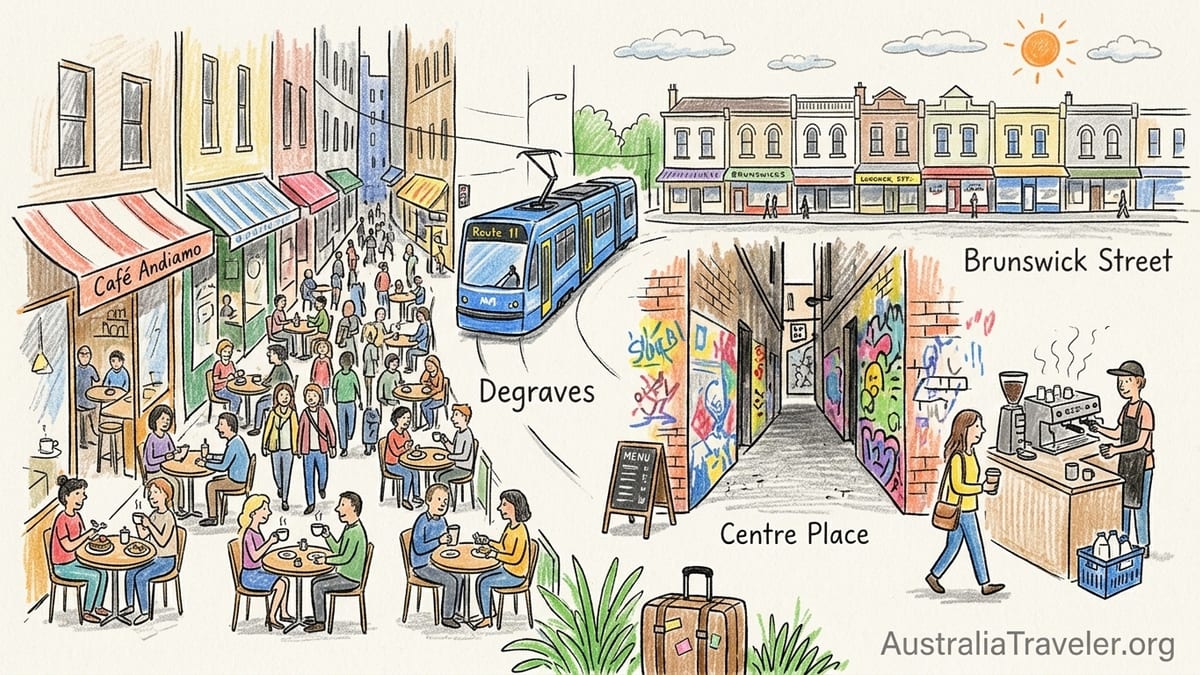
Starting Among the Steam on Degraves Street
I began my Melbourne coffee and laneway exploration at the Flinders Street Station end of the CBD, stepping off the train and walking straight into the crush of Degraves Street. This pedestrian laneway is short, but at peak hours it feels like an entire neighborhood squeezed into a corridor. Menus lean against bricks, baristas shout orders over the hiss of steam wands, and tiny tables push so far into the walkway that you almost brush plates as you pass. It can feel chaotic, but it is a vivid introduction to how seriously the city takes its espresso.
On one visit I sat under the awning at Café Andiamo, a long‑standing Degraves institution that has outlasted trends and Instagram cycles. I ordered a flat white and a plate of poached eggs with grilled tomato. The coffee landed around the 5 Australian dollar mark and the breakfast just under 25, which immediately reminded me that Melbourne brunch is not cheap. The quality, though, justified the spend. The eggs arrived with golden yolks, the bread had a proper chew, and staff moved at speed without that harried edge you sometimes feel in touristy spots. Sitting there, watching office workers dart into holes‑in‑the‑wall for takeaway long blacks while visitors compared menus, I felt as if I were in the middle of a living advert for the city’s coffee culture.
Not every Degraves stop hit the same notes. At one busy café advertising “best coffee in Melbourne” in bold letters, my long black felt a little flat, more bitter than complex, and it arrived lukewarm after a fifteen minute wait. The staff were polite but overwhelmed, trays weaving between the tightly packed chairs, and I could see why the place drew crowds: its corner location and constant buzz looked perfect in photographs. It was a reminder that in this laneway, reputation and foot traffic sometimes outpace what is in the cup.
What struck me most, though, was not a single outstanding café but the density of options. Within a few steps you can choose between French pastry at Lemon and Butter, all‑day eggs at casual spots, or takeaway espresso from windows barely wider than a doorway. Prices across Degraves tend to cluster in the same bracket, with milk coffees usually sitting between 4.50 and 6 dollars and most sit‑down breakfasts landing somewhere between 20 and 30 dollars. If you arrive with a budget and reasonable expectations, the laneway delivers exactly what it promises: a bustling, if sometimes smoky and tightly packed, slice of central Melbourne life.
Centre Place, Block Place and the Tangle of CBD Lanes
A few steps from Degraves, Centre Place feels narrower and grittier, with tall buildings keeping much of the lane in shade. Street art creeps up the bricks, menus hang on clipboards, and the sound shifts from clattering cutlery to a more intimate murmur. I slipped into a tiny café serving sandwiches and espresso, grabbing a seat at a high bench that looked directly onto the foot traffic. My flat white arrived quickly and cost slightly less than on Degraves, hovering around 4.80 dollars, and while it did not have the polish of my earlier coffee it felt more personal. The barista chatted about beans between orders, and there was no pressure to vacate the stool as soon as my cup emptied.
From there I walked toward Block Place and the Block Arcade, where the laneway experience turns grand. Mosaic tiles, decorated ceilings and polished shopfronts replace graffiti and milk crates. It is easy to be seduced by the elegance of this part of the CBD, but it comes with a price tag. A simple cappuccino at one of the heritage‑style cafés can sit above 5 dollars, and cakes and pastries creep toward double figures. I treated myself to coffee and a shared slice of sponge at a marble‑topped table and felt that while the quality was good, I was paying as much for the setting as for what was in front of me. For travelers who prize atmosphere and history, it is worth it. For those counting every dollar, a quick stroll through the arcade followed by coffee in a quieter laneway might be the better call.
Hardware Lane, further north, provided a different contrast again. During the day, canvas awnings and fairy lights hang above a strip that leans more toward restaurants than all‑day cafés. I stopped midmorning, when the dinner spruikers were absent and a few places were serving breakfast and espresso under outdoor heaters. The coffee here sat in a similar price range to Degraves, but the extra elbow room made a difference. I watched office workers take long meetings over lattes and tourists pick at large plates of eggs and avocado that easily topped 25 dollars. My own simple toast and long black felt almost austere by comparison, but it suited the quieter, more measured pace.
One surprise in the CBD was how often some of the hyped specialty cafés delivered without fuss. At Brother Baba Budan on Little Bourke Street, one of the city’s small but legendary coffee bars, I queued in a line that pushed out the door but moved quickly. Inside, seats are famously scarce, with stools and chairs even suspended from the ceiling, so most customers grab takeaway. My flat white, using beans roasted by Seven Seeds, cost just over 5 dollars and was the most technically precise coffee I had in the CBD. Bright acidity balanced by sweetness, perfect temperature, and milk so silky it tasted almost like melted ice cream. It was busy and a little cramped, but there was no sense of complacency. Here, at least, the reputation felt earned rather than inherited.
Street Art, Hosier Lane and the Walk Toward the North
No exploration of central Melbourne’s laneways feels complete without standing in Hosier Lane, the open‑air gallery of graffiti and murals that runs off Flinders Street opposite Federation Square. I walked its cobbles midmorning, cup in hand, and watched a group of school students photographing newly painted walls. There are fewer cafés directly on Hosier Lane than in Degraves or Centre Place, but its side streets and nearby Flinders Lane offer plenty of options. I grabbed a takeaway filter coffee from a small specialty bar just around the corner, where prices for black coffee hovered around 5 dollars and pour‑overs cost a bit more, and carried it back into the laneway to drink among the spray paint and tourists.
From Hosier I followed smaller backstreets, cutting across Swanston and up toward the State Library before looping back to the tram stops on Bourke Street. This walking route made it easy to connect clusters of laneways without ever feeling far from public transport. Melbourne’s tram network is particularly kind to visitors in the CBD thanks to the free tram zone, which meant I could hop on and off without tapping a card when staying within central streets. For my northbound explorations toward Fitzroy and Collingwood, I relied mostly on services running along routes like the 86 and 11, which connect the city directly with Brunswick Street and Smith Street.
Those trams became part of my café rhythm. A typical pattern was coffee and a light breakfast in the CBD, a midmorning tram ride north, then another coffee and something sweet in Fitzroy or Collingwood. The ride itself provided a short digestive window between indulgences and a glimpse of how locals move through their city. I saw office workers balancing reusable cups, parents wrestling prams, and students scrolling through course notes, all folding coffee into their routines with an ease that explained why the city’s café culture feels so ingrained.
Before leaving the CBD on one afternoon, I tried a sit‑down brunch at a laneway spot just off Flinders Lane that had been recommended for its “legendary” pancakes. The plate arrived piled high with fruit, mascarpone and syrup, and the bill came to just under 30 dollars for food and a coffee. The pancakes were good, but not 30‑dollars good, and I left thinking about how easy it is in central Melbourne to pay premium prices for dishes that are competent rather than exceptional. It is not that the city lacks great food. It is that the standard is high enough in many places that travelers can be more selective than the marketing suggests.
Brunswick Street: Fitzroy’s Comfortable Chaos
My first foray into Fitzroy began with a tram ride up from the CBD to the corner of Brunswick Street and Gertrude Street, where the atmosphere shifted immediately. Here, wide footpaths take the place of tight laneways, and terrace houses and low‑rise shopfronts host everything from vintage clothing boutiques to vegan bakeries. While the CBD felt built for speed and spectacle, Brunswick Street invited lingering. People walked more slowly, café tables sprawled onto the street, and there was an easy mix of students, families and remote workers.
I chose a busy corner café on Brunswick Street for a second breakfast, lured by the promise of single‑origin espresso and a brunch menu that ran from granola to shakshuka. My long black cost about the same as in the city, around 5 dollars, but the portion sizes on the food side were more generous. I ordered smashed avocado with feta and pickled onion, which arrived on thick sourdough with a side of greens and came in just under 24 dollars. The coffee was solid rather than life‑changing, but the atmosphere was what made me linger: natural light pouring through large windows, playlists at a volume low enough that I could hear conversations, and staff who had time to recommend neighboring bookshops and bottle‑shops.
Fitzroy’s strength, for me, lay in its balance between high‑end specialty coffee and comfortable, lived‑in cafés. On one corner, a minimalist espresso bar served single‑origin pour‑overs to fans discussing tasting notes like wine. A few doors down, an older Italian bakery pushed strong cappuccinos across the counter next to trays of cannoli, all at price points closer to what locals might pay daily. It was possible to spend 7 or 8 dollars on a meticulous hand brew, then pay 4.50 for an old‑school flat white around the corner. That contrast kept the neighborhood from feeling curated solely for visitors.
Brunswick Street’s independent shops also shaped my café experience. After one midafternoon coffee, I spent an hour browsing secondhand records and local clothing designers, and when I sat down again later at a different café, the staff recognized the shop tote and asked what I had found. There was a sense of cross‑pollination between businesses, with flyers for gallery openings sitting beside menus and baristas recommending nearby natural wine bars for the evening. This web of connections made Brunswick Street feel less like a checklist of coffee stops and more like a community that happened to have excellent caffeine.
Gertrude and Smith Streets: Collingwood’s Specialty Heart
East of Brunswick Street, Gertrude Street forms a short but dense strip that bridges Fitzroy and Collingwood. I walked its length in under ten minutes, passing design stores, galleries and small bars, before turning down a quieter side street toward one of the city’s best known specialty cafés: Proud Mary in Collingwood. Located on Oxford Street, Proud Mary has grown from a neighborhood café into a name recognized well beyond Melbourne. It recently appeared in international lists of top global coffee shops, and on weekends the queues often snake out the door.
I visited on a weekday morning and still waited close to twenty minutes for a table. Once seated, I ordered a flat white from the standard coffee menu and, tempted by the kitchen’s reputation, a plate of potato hash with poached eggs and smoked bacon. The coffee, priced around 5.50 dollars, was exceptional. The espresso had layers of flavor that unfolded as it cooled, the milk was flawlessly textured, and staff were happy to talk through the different single origins on offer without any hint of snobbery. The hash, sitting in the low 30‑dollar range, arrived as an architectural stack of crisp potato, bright yolks and rich sauce. It was a memorable dish, but also one of the most expensive breakfasts of my trip.
In terms of atmosphere, Proud Mary felt closer to a buzzing restaurant than a quiet corner café. There was constant movement, the soundtrack of grinders and conversations colliding, and a visible mix of locals and visitors who had clearly made a special trip. I left impressed by the coffee and food, but also conscious that this is a place where you commit both time and budget. If you only have one serious specialty breakfast in Collingwood, it is a strong contender. If you are watching costs, you might be just as happy getting beans to go and eating elsewhere.
Nearby, I noticed the former site of Aunty Peg’s, Proud Mary’s dedicated brew bar and roastery space. It had once offered standing‑room tastings of filter coffee and a deep dive into the roasting side of the business. During my recent visit, that space was no longer operating as a public café in the same way, a reminder that even big names in Melbourne’s coffee scene evolve or close over time. It is worth checking the current status of any roastery or brew bar before making a pilgrimage, rather than relying on old guidebooks.
Smith Street, a short walk from Proud Mary, provided another perspective on Collingwood’s coffee identity. Here, supermarkets and discount stores sit beside natural wine bars and designer homeware shops, and the café scene mirrors that mix. I stopped at a relaxed corner café offering both espresso drinks and batch‑brew filter for around 5 dollars a cup. The food menu was simpler than Proud Mary’s, with toasties and pastries mostly under 15 dollars, and there was no wait for a table at midmorning. The coffee was not as intricate as my earlier flat white, but it was very good, and the room felt calm enough that I could read for an hour without feeling guilty. If Proud Mary is Collingwood’s showstopper, Smith Street’s smaller cafés are its dependable everyday players.
Moving Between Neighborhoods: Trams, Trains and Footpaths
One of the quiet pleasures of exploring Melbourne’s coffee scene is how easy it is to move between the CBD, Fitzroy and Collingwood without ever getting into a car. I started many days by taking the train into Flinders Street Station, which places you within a short walk of Degraves Street, Centre Place and Hosier Lane. From there, the free tram zone covered my hops along Swanston, Collins and Bourke Streets as I zigzagged between laneways and arcades.
When it was time to head north, I usually boarded the tram near the corner of Bourke and Swanston, catching an 86 or 11 in the direction of Brunswick Street and Smith Street. The ride to Fitzroy took around fifteen minutes in light traffic and required only a short walk from the tram stop to the heart of Brunswick Street. This made it realistic to treat the day as a series of short neighborhoods rather than a commute. I could sip a last CBD espresso, jump onto a tram, and be ordering my next coffee in Fitzroy before the caffeine from the first had worn off.
Walking connected everything else. The distance between Fitzroy and Collingwood is small, and I often wandered from Brunswick Street across to Smith Street via Gertrude Street in under ten minutes. These walks revealed more than just coffee: small galleries tucked into terrace houses, community noticeboards advertising life‑drawing classes, and street art climbing the sides of apartment blocks. In many cases, the best coffee finds were not the spots I had circled on a map, but the cafés I stumbled across while cutting between my planned destinations.
Public transport also made it easy to judge value against organized tours. Several companies advertise paid coffee crawls and laneway tours in central Melbourne, often including a handful of drinks and a local guide for a fixed price that can easily reach 100 dollars or more per person. Weighing that against my own daily Myki card spend and café bills, I realized that for the price of a tour I could sample coffee in twice as many places, at my own pace, and still have money left over for a small bag of beans to take home. For travelers who enjoy stories, history and social context, a guided tour will add structure and background. For those who prefer wandering with a loosely planned route, the tram and train network offers all the access you need.
Half‑Day and Full‑Day Routes for Independent Coffee Hunters
After several days of experimenting, two routes emerged that I would recommend to anyone wanting to explore these neighborhoods without a guide. The first is a half‑day CBD focus, ideal if you have only a morning or afternoon to spare. Start at Degraves Street around opening time, when the laneway is busy but not yet congested. Have your first coffee and a light breakfast at a café that looks busy with locals rather than only camera‑wielding visitors. From there, walk across to Centre Place for a second, smaller coffee at a different venue, then wander through the Block Arcade and Block Place for a more elegant midmorning espresso and a shared pastry. Continue past Hosier Lane to take in the street art, then loop back through smaller lanes toward your tram or train home. This route keeps walking distances short while still giving you three distinct expressions of the CBD’s café scene.
For a full‑day route that adds Fitzroy and Collingwood, I started again in the CBD but kept my first breakfast modest. One flat white and toast in Degraves or a neighboring lane is enough. From there, I caught a late morning tram up to Fitzroy, hopping off near Brunswick Street for a second coffee and a midmorning snack. After browsing the independent shops, I walked along Gertrude Street toward Collingwood, stopping for a gallery or two if one caught my eye. By early afternoon I reached Proud Mary or another Collingwood café for a more substantial lunch and a third coffee. The rest of the afternoon was open to wandering along Smith Street, grabbing water or tea to break up the caffeine, and then either walking back toward the city or catching a return tram before dinner.
Comparing this self‑guided approach with a paid tour, the main trade‑off is storytelling. A guide will point out historical details about buildings, explain how certain laneways evolved from service alleys into café hubs, and perhaps provide introductions at specific cafés. On my own, I relied more on staff conversations, small plaques and my phone for context. However, in exchange I could set my own pace, skip places with long queues or inflated prices, and return to any spot that felt particularly welcoming. On one day I liked a Fitzroy café so much that I went back for an afternoon filter coffee, something that would have been impossible on a fixed route.
Cost was another clear difference. A structured tour that includes tastings can make sense for short visits, especially if you want to compress a lot of learning into a few hours. Over several days, though, the flexibility of paying per cup won out. My average spend on a self‑guided coffee day, including brunch and a snack, hovered between 40 and 70 dollars, depending on how indulgent I felt. That was easily less than a premium tour ticket, and it spread the money among a wider range of independent businesses.
The Takeaway
By the end of my time in Melbourne, certain patterns had become clear. The CBD delivers intensity and convenience: laneways like Degraves, Centre Place and Hardware Lane cluster so many cafés together that you can drink well without ever walking more than a few minutes. The trade‑off is price and pressure. Tables are close, queues can be long, and some venues lean heavily on their address and history rather than pushing the quality of what is in the cup. I had coffee in the city that was competent but forgettable, served at a premium simply because it occupied a famous corner.
Fitzroy and Collingwood, by contrast, offered a slower burn. On Brunswick Street, I found cafés where staff remembered my order on a second visit and where brunch, while still not cheap, felt more generous and less hurried than in the CBD. On Gertrude and Smith Streets, I met roasters and baristas who spoke about beans with both passion and practicality. Proud Mary in Collingwood lived up to its status in the cup, even if the bill for breakfast made my eyes widen a little. Smaller spots nearby provided equally enjoyable experiences at lower prices, with no need to queue down the footpath.
If I had to choose a single favorite neighborhood, it would be the Fitzroy and Collingwood axis anchored by Brunswick, Gertrude and Smith Streets. The combination of strong coffee, independent shops, approachable street art and relaxed footpaths made it easy to spend entire days there without realizing how many hours had passed. Cafés I would happily revisit include the specialty bars along Brunswick Street that balance serious coffee with friendly service, as well as the quieter Smith Street corners where you can still find a good flat white for under 5 dollars and a simple toastie that feels like a bargain after CBD prices.
As for whether Melbourne deserves its global reputation for coffee, my answer, after many cups, is yes, with caveats. The city’s average standard is impressively high. It is hard to find truly bad coffee in the central neighborhoods I explored, and world‑class espresso is readily available for around the same price as an average cup in many other cities. At the same time, reputation has created pockets of complacency and inflation. Some cafés trade more on their laneway address or mural‑backdrop than the care they put into extraction. The joy of exploring Melbourne’s coffee scene lies in looking beyond the loudest names, talking to baristas, and paying attention to the details in the cup and on the plate. Do that, armed with a tram card and a loose plan, and the city more than earns the stories told about it.
FAQ
Q1. Is it worth visiting Degraves Street for coffee, or is it just a tourist trap?
Degraves Street is crowded and touristy, but it is still worth visiting once for the atmosphere and density of cafés. You will find some average coffee, but there are also long‑running spots serving solid espresso and decent breakfasts if you are willing to look beyond the loudest signage.
Q2. How much should I budget for a typical Melbourne café breakfast with coffee?
For a sit‑down brunch with a milk coffee in central Melbourne, expect to spend between 25 and 35 Australian dollars, depending on how elaborate your meal is. In Fitzroy and Collingwood, prices are similar, although you can keep costs down by choosing simpler dishes like toasties or pastries instead of full plated breakfasts.
Q3. Are Fitzroy and Collingwood really better for coffee than the CBD?
The CBD has excellent coffee and unbeatable convenience, but Fitzroy and Collingwood often provide a better balance of quality, atmosphere and space. You are more likely to find relaxed seating, conversations with staff and slightly less pressure to vacate your table, which can make the coffee experience feel richer even when the espresso quality is similar.
Q4. How many cafés can I realistically visit in a single day without feeling rushed?
In my experience, three to four café stops in one day felt enjoyable without turning into a chore. A good rhythm is a full breakfast and coffee in the morning, a midmorning or early afternoon coffee and pastry, and then a final drink later in the day. Beyond that, the caffeine and cost both start to add up quickly.
Q5. Do I need to book ahead for places like Proud Mary in Collingwood?
Walk‑ins are common at Proud Mary, but waits of 15 to 30 minutes are not unusual at busy times, especially on weekends. If you want to minimize queuing, aim for a weekday morning visit or arrive soon after opening. For most smaller cafés in Fitzroy and Collingwood, you can simply show up without a booking.
Q6. Is it easy to explore these neighborhoods using only public transport and walking?
Yes, it is very straightforward. Trains bring you into Flinders Street Station for the CBD laneways, and trams running along routes such as the 86 and 11 connect the city with Brunswick Street and Smith Street. Once you are in Fitzroy and Collingwood, most of the interesting streets are within an easy ten‑minute walk of each other.
Q7. Are Melbourne café prices higher in the CBD than in Fitzroy and Collingwood?
Base coffee prices are relatively similar, with most milk coffees between 4.50 and 6 dollars in all three areas. However, food in the CBD often feels more expensive for what you receive, especially in high‑profile laneways and arcades. In Fitzroy and Collingwood, I generally found portions more generous and the overall value better, even at popular specialty spots.
Q8. Is a paid coffee or laneway tour good value compared with exploring independently?
A paid tour can be worthwhile if you are short on time or want structured stories, historical context and built‑in tastings. If you are comfortable navigating trams and reading maps, exploring independently will usually be better value. You can visit more cafés, follow your own interests and adjust on the fly if a venue looks too busy or overpriced.
Q9. How busy do Melbourne cafés get on weekends, and how can I avoid long queues?
Popular cafés in both the CBD and inner north get very busy from late morning to early afternoon, particularly on Saturdays and Sundays. To avoid long waits, arrive soon after opening, consider a weekday visit, or choose slightly less famous venues on side streets rather than the best‑known names on main strips.
Q10. If I only have one day in Melbourne, which neighborhood should I prioritize for coffee?
If time is short, start in the CBD for the classic laneway experience, then take a tram up to Fitzroy and Collingwood for at least one more coffee and a wander along Brunswick and Smith Streets. If you prefer a single focus, I would personally choose Fitzroy and Collingwood, where the combination of coffee, independent shops and relaxed streets made my best overall day.