


I went to Melbourne Skydeck with my card already out and my expectations set high. On a clear Sunday in September 2026, I prebooked a late-afternoon "Ultimate Skydeck" style bundle online for a 5:30 pm entry slot. For one adult, I paid just over 70 Australian dollars once booking fees were added, which covered general admission to Level 88, The Edge glass cube, the Voyager Theatre experience and a VR Plank add-on. The marketing promised Southern Hemisphere superlatives, "multi-sensory" immersion and unforgettable skyline views. I wanted to test, as a paying visitor, whether Melbourne’s most famous lookout actually delivers enough value to justify both the base ticket and the premium extras.
What I Actually Bought and What I Expected
I booked my ticket directly through an authorised reseller the day before my visit, choosing a package that mirrors Melbourne Skydeck’s current higher-tier offers: timed general admission, The Edge, Voyager Theatre and a VR Plank experience bundled together. Recent listings in September 2026 show standard adult admission to the Skydeck itself in the mid 30 dollar range if bought online, with Edge and VR products pushing a full package closer to 70 dollars or more once fees are included. I wanted to experience the attraction the way many first-time tourists do: seduced by phrases like "ultimate" and "all experiences" into paying for everything in one hit.
I picked the 5:30 pm entry specifically to straddle sunset and the onset of night. Official information shows Melbourne Skydeck generally opens from midday until at least 9 pm or later depending on season, with last entry around half an hour before closing, so a late afternoon arrival is heavily promoted as ideal for golden-hour light. I arrived about 20 minutes early to allow time for security and lifts, expecting to be on Level 88 by 5:30 and on The Edge shortly after, giving me both daylight and dusk.
From the marketing, my expectations were set unambiguously high. The attraction positions itself as the highest public vantage point in a building in the Southern Hemisphere, located on the 88th floor of Eureka Tower in Southbank. Promotional copy leans hard on language like "unparalleled 360 degree views," "state-of-the-art VR" and "heart-stopping Edge". Photographs on official material show near-perfect visibility, glowing sunsets and almost empty windows. Walking in, I expected a polished, crowd-managed experience where the premium upsells genuinely extended the visit rather than just nibbling at my wallet.
What I found instead was more complicated: not terrible, not a scam, but a mix of solid views undermined by reflections, crowding, short add-on durations and a constant push toward spending a little more for incremental gains.
First Impressions on Level 88: Views Versus Reflections
Once the lifts shot up to Level 88, the first feeling was familiar to anyone who has been to a big-city observation deck. There is an instinctive thrill in emerging from an elevator into an open panorama of the city. At around 285 metres above the streets, Melbourne spreads beneath you: the curve of the Yarra, the cricket grounds and tennis complex to one side, Port Phillip Bay in the distance and the sprawl of suburbs fading to low hills on clear days.
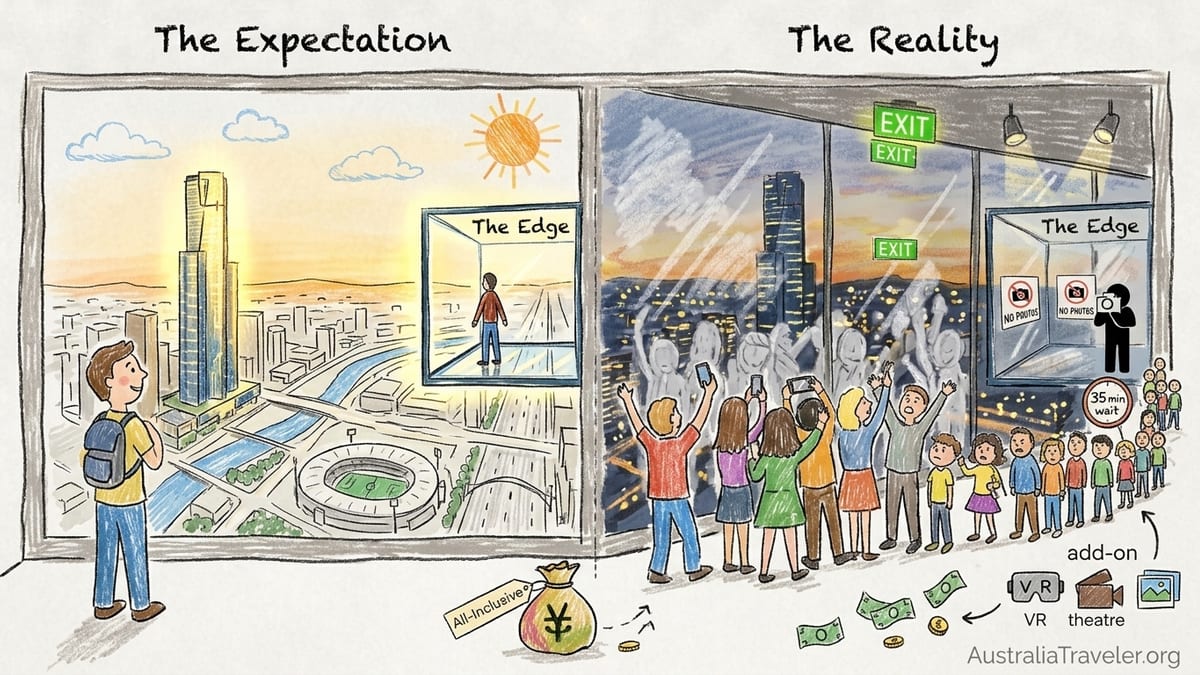
On my visit, visibility at first glance was good. Low cloud was well above the tower, and there was little haze. The disappointment crept in when I tried to really enjoy the view and take photographs. The Skydeck windows are mostly floor to ceiling, but indoors the lighting is not dimmed enough to avoid heavy reflections, especially once the sun begins to drop and interior lights switch on. Every time I lifted my camera or phone, I caught ghostly shapes of other visitors, bright spotlights overhead and the green glow of emergency exit signs bouncing back at me.
At several points I found myself pressing my camera lens directly against the glass to minimise reflections, an awkward experience when there is a line of people behind you waiting for their turn at a corner or a popular bay-facing angle. Staff do not rush you away, but the unspoken pressure of the crowd means you rarely settle in one spot for long. In practice, the "360 degree views" translated to a handful of short stops at the clearest windows, punctuated by shuffling sideways as more people arrived.
The biggest mismatch between expectation and reality was sunset. Timed tickets mean many visitors converge just before the sun goes down. Instead of a quiet, contemplative moment, the west-facing windows filled quickly. People jostled for space, lifting phones above heads and squeezing in front of each other whenever there was a gap. It was not chaotic, but it did feel more like a busy bar than a premium observation experience. I found myself spending more time looking for a gap in the crowd or a clean patch of glass than actually soaking up the scene.
How Long the View Was Truly Enjoyable
From scanning my ticket to leaving the building, I spent just under two hours at Melbourne Skydeck. The surprising part is that the portion of that time that felt genuinely worthwhile on Level 88 alone was less than half an hour. After an initial circuit and some quick photos, the law of diminishing returns set in. Once you have seen the CBD grid, the river, the sports precinct and the bay from above, there is not much to discover by circling again and again.
I tried to slow down, lingering by the less crowded windows that look inland over the suburbs, but even those perspectives began to blur together. Unlike some observation decks that offer detailed, interactive displays or guided commentary at multiple viewpoints, Skydeck’s educational content feels secondary to the simple act of looking out. There are information panels and some VR and theatre content if you have paid for them, but the core experience is the view itself.
For photographers, the issues mount quickly. Reflections from the interior lights are a persistent problem once the sun is low. Tripods are not allowed, which is consistent with many observation decks, so low-light shots after dark require higher ISO or bracing against the glass. Window smudges and fingerprints, almost inevitable in a busy family attraction, show up clearly in images at night when bright points of light in the city catch every streak.
By 6:30 pm, as the city lights fully emerged, I realised I was going through the motions: walking another loop, pausing briefly, then checking my watch. Had I paid around 35 dollars just for general admission, I might have shrugged and called it a decent, if short-lived, urban overview. Knowing I had committed more than double that for the add-ons made me scrutinise every minute far more critically.
The Edge: High Price for a Very Short Thrill
The Edge is Melbourne Skydeck’s signature add-on, and the one that divides opinion most sharply. It is a glass cube that slides out from the side of the building, holding a small group of visitors who stand on a transparent floor around 300 metres above the ground. For this, you pay an additional fee on top of general admission or choose a bundle that includes it. Current pricing information from booking partners in late 2026 suggests that The Edge on its own adds roughly 15 to 25 dollars to an adult ticket, depending on how and where you book, and packages with photos or extra experiences cost more again.
On my visit, prebooking The Edge did not mean walking straight on. An attendant on Level 88 allocated times and managed a separate queue. Even with a quieter Sunday crowd, I waited close to 35 minutes between joining the line and stepping into the cube. Visitors without prebooked Edge tickets faced longer waits and were warned that they might not get a time slot before closing. Online complaints in 2025 and 2026 echo this, with some guests reporting Edge waits of an hour or more on busy evenings and expressing frustration that high-priced packages did not translate into efficient access.
Once you are finally shepherded inside, the experience is tightly choreographed and brief. Doors close, lighting inside the cube is dimmed, and for a moment the floor panels go opaque before clearing to reveal the drop below. There is the obligatory scream or nervous laugh. Staff trigger a few lighting and sound effects, then encourage everyone to stand near the edges, look down, and pose for official photos. From stepping into the cube to stepping out, I timed the experience at just under five minutes, with only about two minutes where the floor was fully transparent and static.
From a value perspective, it is a hard sell. The actual view once you are in The Edge is not dramatically better than what you see from the main windows. You are slightly further out from the facade, which gives a marginally cleaner downward angle, and the novelty of looking past your shoes to the street is undeniably vivid. But you cannot linger, you cannot return later without paying again, and you cannot take your own photos without significant restrictions. Many guests rely on the official photographer, which adds still more to the cost if you want a printed or digital image. When you divide the surcharge by the number of minutes of genuine "wow," The Edge ends up as one of the most expensive micro-experiences in Melbourne.
Queues, Procedures and the Quiet Friction of Upselling
Besides visibility and value, one of the big questions around Melbourne Skydeck is how smoothly the visit runs. My own entry was reasonably efficient: a short line for security, a quick photo at a green screen (used later to sell souvenir images) and then a lift ride to Level 88. Staff were polite and efficient. Where the friction emerged was in the finer details that many recent online reviews highlight as recurring irritations rather than outright disasters.
The first is queues that do not quite match what you were sold. Prebooking a timed entry creates the impression that capacity will be carefully controlled, yet in practice several time slots converge on Level 88 at once, and walk-up visitors can still enter if space allows. This is understandable from a business perspective but means that a "5:30 pm" ticket does not guarantee a quiet floor. For The Edge, even having a bundled ticket does not automatically assign you a short wait; you still need to approach the separate Edge desk, receive a time or line up, and then fit into the throughput of a single small cube servicing a large crowd.
The second is unclear or inconsistent information about what is included and when you can use it. Some guests in 2025 and 2026 have reported confusion over where to redeem VR experiences, whether their package included a drink at the bar, and whether the Voyager Theatre should be visited before or after Level 88. In my case, the Voyager Theatre was running on a set schedule, and I had to choose between cutting short my time on the main deck or waiting for a later session that would push my visit close to closing time.
The third is equipment that is out of order or unavailable. In a recent scan of negative reviews, there are complaints about telescopes not working, VR headsets being offline, or certain interactive displays being temporarily closed. Attractions that position themselves around cutting-edge technology carry a higher risk of disappointing guests when parts of that tech inevitably need maintenance.
All of this happens in an environment where upselling is ever-present. From the moment you enter, you are nudged toward buying photos, drinks, extra VR rides or package upgrades. None of these offers are individually outrageous, but they create a background hum of "spend a little more" that can wear thin when you have already committed upwards of 70 dollars for what you reasonably assumed would be a pretty complete experience.
Packages, Weather Risk and Nighttime Reflections
Current Melbourne Skydeck products broadly fall into four categories: general admission to Level 88; general admission plus The Edge; general admission plus a mix of Edge, VR and Voyager Theatre; and top-end "ultimate" style bundles that might also include a drink or photo package. General admission alone for an adult purchased online typically sits somewhere in the mid 30 dollar range. Edge add-ons through the official channels or reputable partners tend to push a combined ticket into the 50 to 60 dollar bracket. Once you include Voyager and VR Plank in a premium bundle, you approach the 70 dollar mark for a single adult.
The major problem is that all of these prices buy you exposure to Melbourne’s weather. Melbourne is famous for rapid shifts in conditions, and an overcast afternoon or a smoky summer day can flatten the skyline and eliminate the bay view almost completely. Official terms for many observation decks worldwide, and commentary from local booking guides, make clear that poor visibility does not automatically trigger refunds or rescheduling. Visitors who chose expensive bundles on a foggy or rainy day report leaving underwhelmed, having paid for the same add-ons as a clear-day visitor but with none of the dramatic vistas shown in the marketing.
Even in good weather, nighttime brings its own challenges. Once it is dark, the city lights up beautifully, but the reflection issue worsens. Interior lighting, bright screens from VR areas and illuminated signage all bounce off the glass, especially for those trying to photograph the view. Unless you find a very dark corner or cup your hands around your phone, you end up with ghosted reflections of people and furniture superimposed on your skyline shots. You still see the city, and some visitors actually prefer the twinkling lights to the daytime sprawl, but from a hardcore viewing perspective, the "highest vantage point" advantage is partly squandered by design choices inside.
For travellers trying to decide which package to buy, the key question becomes how much risk you are willing to accept. On a crystal-clear late afternoon or early evening, general admission plus one add-on might feel justifiable. On a hazy or rainy day, anything beyond the cheapest ticket can feel like throwing good money after bad. Because Melbourne weather forecasts can be wrong even a few hours ahead, there is a real gamble involved in prebooking expensive bundles days in advance just to secure a time slot.
Cheaper and Free Alternatives with Real Views
Melbourne does not hide all its best viewpoints behind ticket barriers. Several alternatives deliver excellent or at least very good city vistas at a fraction of the cost of Skydeck or completely free, especially if you are comfortable trading a bit of height for better value and atmosphere.
The most obvious comparison point is the Shrine of Remembrance in Kings Domain. Official visitor information emphasises that admission is free, with donations encouraged but not required, and that the balcony provides panoramic views back toward the city skyline, the memorial gardens and St Kilda Road. The elevation is much lower than Level 88, but the perspective is open air, without glass between you and the city. On a clear afternoon, the Shrine’s balcony gives you a sweeping view of Melbourne’s towers framed by parkland, something the Skydeck’s higher but more enclosed viewpoint cannot replicate.
Closer to the water, the riverside paths along Southbank and Birrarung Marr offer ground-level but atmospheric views of the city’s architecture, especially at dusk when office lights reflect in the Yarra. These walks cost nothing except time, and while they lack the novelty of looking down from 285 metres, they give you context that a top-down view cannot: the sound of trams crossing bridges, rowers on the river, buskers under the pedestrian bridges.
Then there are rooftop bars and restaurants, which sit between free public viewpoints and paid observation decks. Venues in and around the CBD and Southbank routinely operate on mid‑ to high-rise roofs, charging you not an entry fee but the price of a drink or a light meal. A glass of wine or a cocktail in such a venue will often cost between 15 and 25 dollars, similar to what a single Edge or VR add-on might cost. For that, you get both a view and a tangible product, plus the ability to linger for an hour or two in an open-air or semi-open setting instead of being shuttled through a short attraction.
If your only goal is to say "I saw Melbourne from above," these alternatives weaken the case for a full Skydeck package. The observation deck’s unique selling point is its extreme height, not the basic enjoyment of a city skyline, and for some travellers that extreme height premium is not worth the additional 30 to 40 dollars when a free Shrine balcony or a single drink on a rooftop terrace can scratch the same itch more pleasantly.
Cost Comparison for Solo Travellers and Couples
To understand the true value proposition, it helps to translate these experiences into concrete numbers for one adult and for a couple visiting together. For a solo traveller buying online in late 2026, general admission to Melbourne Skydeck at around 35 dollars is comparable in price to a mid-range museum ticket or a decent casual lunch in the city. Adding The Edge pushes the outlay closer to 50 or 60 dollars. Opting for a premium bundle that layers on Voyager Theatre and VR Plank takes the spend to roughly 70 dollars or more.
For a couple, those figures double quickly. Two adults entering on general admission are already spending roughly 70 dollars before any extras. If both want to ride The Edge and try at least one VR or theatre experience, the total can climb to 120 to 140 dollars, not including drinks at the bar or any souvenir photos. At that point, you are approaching the cost of a very good dinner for two in central Melbourne, or tickets to a live performance plus drinks.
Compare that to alternatives. The Shrine of Remembrance balcony is free for both solo travellers and couples, although a small donation is courteous. A riverside stroll along Southbank costs nothing. A rooftop bar visit might involve buying two drinks at 20 dollars each, putting a couple’s total at 40 dollars, less than even the simplest pair of Skydeck general admission tickets. With that spend, you receive at least an hour of relaxed sitting, conversation and people-watching alongside your view.
These numbers matter when building an itinerary for a short visit. If you love city views and can comfortably afford it, paying 35 dollars to tick off "southern hemisphere’s highest observation deck" may feel like a fair indulgence once in a lifetime. When the bill starts to resemble triple digits for two people, and especially when you realise that some of that money buys mere minutes on The Edge or inside a VR theatre, it becomes much harder to argue that Skydeck’s premium packages are a good use of a travel budget.
The Takeaway
Looking back at my own visit, I do not regret going to Melbourne Skydeck. I do, however, regret how much I paid for the add-ons. The view from Level 88 on a clear afternoon is undeniably impressive, and there is a primal thrill to seeing an entire city laid out beneath you at once. That baseline experience is worth something, but it is more fragile than the marketing suggests, heavily dependent on weather, crowd levels and your own interest in tall-building vistas.
If I were buying a ticket again, I would choose online general admission only, timed for a clear day checked on the morning of my visit, and I would aim for late afternoon rather than peak sunset to reduce crowds and reflections. I would skip The Edge, Voyager Theatre and the VR Plank entirely. The Edge in particular felt like a short, expensive gimmick: a five‑minute adrenaline hit that barely enhances the view you have already paid to access and that strains both time and wallet if you are not, by nature, a thrill-seeker.
I would also pair Skydeck with at least one free or low-cost vantage point, such as the Shrine of Remembrance balcony or a rooftop bar visit, to balance the experience. Seeing Melbourne from multiple levels, not only from 285 metres behind reflective glass, gives a richer sense of the city’s shape and character. It also makes Skydeck feel like one part of a broader exploration rather than the definitive must‑do attraction that marketing campaigns imply.
There are, of course, visitors who adore Melbourne Skydeck. For some, the Edge experience becomes a memorable travel story, and families with teenagers might find the VR and theatre elements a fun way to keep everyone engaged. If you have a clear evening forecast, a flexible budget and a particular love of tall buildings, then general admission plus one carefully chosen add-on can still be worthwhile. But if the weather looks marginal, if you are sensitive to queues and upsells, or if your budget already feels stretched, this is one Melbourne attraction you should feel comfortable skipping without fear of missing the soul of the city.
FAQ
Q1. Is Melbourne Skydeck general admission alone worth the money?
For many visitors, general admission can be worth it once, especially on a clear day, but the experience is relatively short, and alternatives like the free Shrine of Remembrance balcony offer strong competition if you are watching your budget.
Q2. Does The Edge glass cube add enough extra value?
The Edge provides a brief adrenaline jolt and a novel feeling of standing on glass, but it is expensive for only a few minutes inside and does not dramatically improve the actual city view compared to the main windows.
Q3. How bad are the queues for The Edge and other extras?
Wait times vary by day and season, but recent visitors report Edge queues from 30 minutes to over an hour during busy periods, even with prebooked tickets, so you should not assume fast access.
Q4. What happens if the weather is poor on the day of my visit?
In overcast, rainy or smoky conditions the view can be significantly reduced, and typical ticket conditions indicate that poor visibility alone does not guarantee a refund or free rescheduling, which makes expensive bundles a financial gamble.
Q5. When is the best time of day to visit for views and photography?
Late afternoon on a clear day usually offers the best balance of light and lower reflections, whereas peak sunset and night can be crowded and more affected by reflections from interior lighting.
Q6. Are the VR and Voyager Theatre experiences worth adding?
They can be enjoyable, especially for families or tech enthusiasts, but they are short and add noticeably to the total cost, so they make more sense if you have a generous budget than if you are counting every dollar.
Q7. How does Melbourne Skydeck compare to free viewpoints in the city?
Skydeck wins on sheer height, but free spots such as the Shrine of Remembrance balcony and riverside paths give satisfying skyline views without tickets, and some rooftop venues offer good perspectives for the price of a drink.
Q8. Is Melbourne Skydeck suitable for people afraid of heights?
Level 88 itself feels secure behind thick glass, but those with serious height anxiety may find even the main deck uncomfortable, and The Edge can be confronting, so it is wise to consider your comfort level before paying for add-ons.
Q9. Can I avoid heavy reflections in my photos?
Reflections are manageable during brighter daylight if you press your camera close to the glass, but they become difficult to avoid at night when interior lights and screens are more visible on the windows.
Q10. Under what conditions would you skip Melbourne Skydeck entirely?
I would skip it on days with low cloud, heavy haze or rain, when short on time or money, or if I already had access to good rooftop or balcony views elsewhere in the city and did not feel a strong personal desire to stand on the highest deck.