


By the time my flight finally bumped down onto the tarmac at Melbourne Airport at Tullamarine, my brain felt like it had been left somewhere over the desert. It was a late afternoon arrival after a long-haul, the kind of flight where you have watched too many mediocre movies, your spine resents you and your hand luggage feels twice as heavy as when you left. I cleared immigration, wrestled a checked suitcase and a bulging backpack off the carousel, and then hit the first big travel decision of any visit to Melbourne: how on earth do I get into the city without paying an eye-watering amount for what is, in the end, just a 25 kilometre journey?
The Missing Train Line That Shapes Every Decision
Melbourne likes to present itself as a sophisticated, liveable city, and in many ways it earns that reputation. Which is why it still surprises first-time visitors when they step out of Tullamarine in October 2026 and discover that there is still no direct rail link between the airport and the CBD. The long-planned airport rail line is officially “in the works” but, as the airport itself points out, there is no operating train yet, only a promise of another option sometime in the future. For now, every transfer into town relies on wheels, not rails.
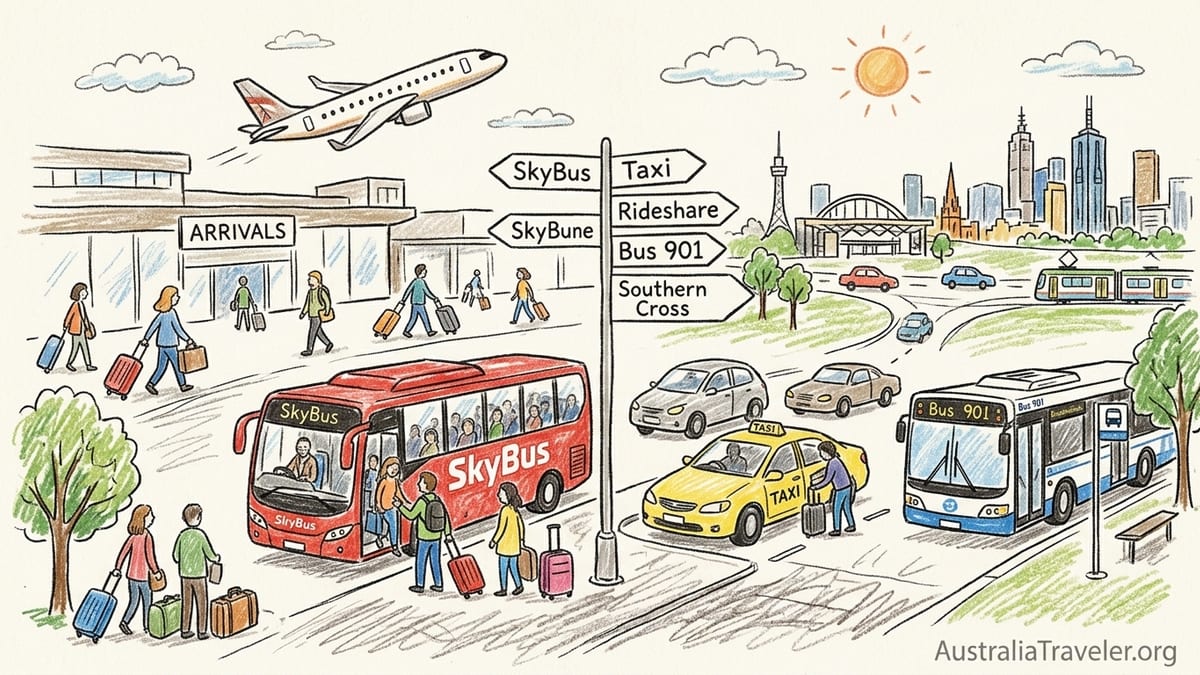
You feel that gap as soon as you emerge into the arrivals hall and start hunting for signs. In many big cities, you would simply follow the little train icon, buy a ticket and be in the city centre on a predictable timetable and a fixed fare. In Melbourne, you instead face a fan of choices that all involve different kinds of buses, taxis, rideshare vehicles and a somewhat intimidating suburban bus called the 901 if you really want to save money. Each comes with trade-offs in price, convenience, luggage handling and stress, especially when you are jet-lagged.
My frustration that afternoon was not just about cost. It was the sense that, in 2026, Australia’s second-largest city was still relying on a patchwork of surface options that push a significant burden onto the traveler to calculate, compare and gamble. You do not simply “catch the train.” You do mental arithmetic, scan apps for surge pricing, interpret bus timetables and then hope you chose well. In that exhausted moment at the terminal, that felt like an unnecessary test.
So I did what any mildly obsessive travel writer does: I turned my own weary arrival into a real-world experiment. I compared SkyBus, taxis, Uber and other rideshare services, private transfers and the 901 plus suburban train, using current prices and actual door-to-door logistics, to answer a simple question: when is SkyBus actually worth it, and when is it just an expensive habit?
SkyBus Melbourne City Express: Fast, Polished and Not Always Cheap
The most heavily advertised option inside the terminal is the SkyBus Melbourne City Express. It brands itself as the default connection between Tullamarine and the CBD, and to its credit the service is frequent and straightforward. Buses run roughly every ten minutes for much of the day, with operating hours typically stretching from early morning into late night. The trip to Southern Cross Station in the western edge of the CBD is usually quoted at around 30 minutes in light traffic, although peak-hour congestion can stretch that longer.
As of mid-October 2026, the adult fare for the Melbourne City Express is around 25.90 Australian dollars one way and 43.40 dollars for a return ticket purchased in advance. Those are real, date-specific numbers that matter, because they set the baseline against which everything else needs to be judged. For a solo traveler who just wants to get reasonably quickly to Southern Cross, with no need for taxis or trams afterward, that one-way fare is not outrageous. But if you are traveling as a couple, a family or a group of adults, the arithmetic looks very different.
On my arrival day, I stood in front of the SkyBus ticket kiosk, did the math and realized that two one-way adult tickets would cost just over 51 dollars. That would deliver both of us to Southern Cross Station, but we were staying in Southbank, a good fifteen-minute walk away with luggage or a short tram or taxi hop. If we added a quick taxi ride from Southern Cross to the hotel, the total door-to-door cost started drifting toward, and in some cases past, what a direct Uber or taxi from the airport would be, especially when split between two people.
It is also worth noting that SkyBus has other routes besides the City Express, including services to St Kilda, Frankston and several suburban hubs. On paper, this sounds ideal if you are staying in those areas. In practice, the St Kilda service in particular can be slower and runs less frequently than the City Express, meaning that the time advantage over a direct car is reduced. For my Southbank stay, the core issue was that the main City Express still terminates at Southern Cross and leaves you to solve the “last kilometre” puzzle yourself.
Southern Cross Station: The “Almost There” Problem
SkyBus sells itself as a city transfer, but for many visitors it is actually a station transfer. Southern Cross is a busy transport hub at the western fringe of central Melbourne, excellent for connecting to regional trains and some suburban lines, but not ideal as a final destination unless you are staying in walking distance or directly on certain tram routes. On that tired afternoon, I pictured dragging my rolling suitcase down Collins Street in peak-hour crowds and felt my enthusiasm for the “express” part fading.
If you are heading to Southbank, you either walk for 10 to 20 minutes, depending on your exact hotel, or hop on a tram or free CBD shuttle if it happens to line up. For Fitzroy and Carlton, you are looking at an onward tram ride up to the inner north. For South Yarra, you may need to connect to a suburban train from Flinders Street or grab a rideshare. For St Kilda, you could theoretically transfer to the separate SkyBus St Kilda route at Southern Cross, but that adds waiting time and another fare unless you booked a combined ticket in advance.
None of these onward segments are disastrous for light packers or locals. Melbourne’s tram network is dense across the inner suburbs and, within the Free Tram Zone in the CBD, you can move without tapping on a card at all. But if you have a heavy suitcase, a stroller, surfboard bag or simply a body that has been folded into an economy seat for fourteen hours, the prospect of multiple modes can feel punishing. You also need to factor in evening or late-night arrivals, when tram frequencies drop and carrying luggage through quieter streets may feel less comfortable.
This “almost there” problem is where SkyBus often stops making sense once you move beyond a single adult heading to a central hotel. Every onward leg, whether it is a short taxi, a rideshare or just an extra twenty minutes of dragging luggage, erodes the apparent simplicity of the bus fare printed on the billboard at the terminal. At that point, paying more upfront for a direct door-to-door ride can begin to feel like a rational choice rather than a luxury indulgence.
Taxis and Rideshare: Door-to-Door Convenience at a Price
Melbourne Airport has a large, well-organised taxi rank located outside the terminals, and metered taxis remain the most straightforward way to get directly from the airport to your exact address. You wheel your luggage to the rank, join the queue, and a dispatcher feeds you into a constant stream of yellow and silver cabs. There is usually a small flagfall charge, a distance-based fare and, importantly, an airport access fee baked into the total. In normal traffic, a taxi into the CBD or Southbank will often come in somewhere in the 60 to 80 dollar range, depending on traffic and the precise destination.
Rideshare services like Uber, DiDi and Ola also operate at Melbourne Airport, using dedicated pickup areas signposted outside each terminal. The airport confirms that there is a specific rideshare access charge per trip from the airport, which as of late 2026 sits a little above four dollars and is usually passed through to the passenger. Each operator builds that access fee into your quoted fare. The key advantage of rideshare is that you see an estimated price before you confirm, along with options for standard vehicles, larger cars or premium services.
In my post-flight experiment, I pulled out my phone and checked an UberX quote from Tullamarine to a Southbank hotel. The price hovered in the mid-70s in late-afternoon traffic. That was roughly 35 dollars each for two people, compared with about 26 dollars each plus an onward tram or short taxi ride if we chose SkyBus. For a solo traveler, the difference between paying approximately 26 dollars for a bus to Southern Cross and 70 dollars for a direct car is significant. But the moment you add a second adult, the per-person gap narrows dramatically.
Dynamic pricing complicates things further. During quiet mid-morning or mid-afternoon windows, I have seen UberX fares to central Melbourne slide down into the low 60s. After major events or when several long-haul flights arrive at once on a rainy evening, surge multipliers can push that same trip into the 90s or beyond. Taxi meters, while regulated, are not immune to this either, as slow-moving traffic can quietly tick your fare upwards. When you are doing these calculations at the arrivals curb with a jet-lagged brain, SkyBus’s fixed, clearly posted price can look like a soothing anchor even when it is not the mathematically cheapest choice for your group.
How the Numbers Stack Up for Different Group Sizes
It is only when you sketch out full, door-to-door costs that the real picture comes into focus. Let us start with one adult. A SkyBus Melbourne City Express ticket is around 25.90 dollars. If your hotel is within a ten or fifteen-minute walk of Southern Cross or you are comfortable hopping on a free CBD tram with luggage, that is essentially your total. Even if you factor in a 10 dollar tram-card top-up for future travel, you are still comfortably under half the price of a taxi or Uber in regular conditions. For solo travelers heading to central hotels or backpacker hostels, SkyBus is clearly excellent value.
Now take two adults traveling together, staying in the same areas. Two one-way SkyBus tickets total about 51.80 dollars. Add even a modest 20 dollar taxi from Southern Cross to a Southbank or Carlton hotel and your combined cost sits in the low 70s, which is very close to a rideshare going directly from Tullamarine to your front door. If the Uber quote happens to be on the lower side of its usual range, you might even pay only slightly more than the combined bus plus inner-city taxi. In that scenario, choosing SkyBus is less about savings and more about your tolerance for connections.
The calculation tilts even more toward cars once you are three or four adults or a family with older children. Three SkyBus tickets land near 78 dollars. Four tickets push you to just over 103 dollars. That is before you pay anything for onward local transport. A standard UberX often caps at four passengers, so the same group could fit into a single car for perhaps 70 to 90 dollars, or book a larger vehicle type for slightly more. Given that you avoid handling luggage on and off buses and trams, the door-to-door ride becomes compelling, particularly if any member of your party has mobility issues.
Families with younger children face another set of considerations. Some parents are comfortable juggling prams, car seats and suitcases through Southern Cross and onto trams, especially during daylight. Others will gladly pay a premium to strap a drowsy toddler into a rideshare with the boot swallowing all the bags. SkyBus does not require child seats, since buses are treated differently under Australian road rules, whereas taxis and rideshare vehicles may allow lap-sitting under certain conditions but are still subject to safety regulations. The finer points are something parents need to check in advance, but practically speaking, many families find the idea of a single vehicle attractive even when the skybus fare sheet suggests theoretical savings.
The 901 Bus Plus Train: Melbourne’s Cheapest, Slowest Transfer
Then there is the true budget option that few first-time visitors know about: Public Transport Victoria’s 901 SmartBus route from Melbourne Airport. This is a long orbital bus line that runs all the way from Tullamarine to Frankston via Broadmeadows, Greensborough, Ringwood and Dandenong. For airport travelers heading to the city, the meaningful stretch is simply from the airport to Broadmeadows railway station, where you can transfer to a suburban train on the Craigieburn line into the CBD.
The 901 departs from a bus bay in the airport ground transport area, and as of October 2026 it continues to operate frequently during the day, with an official timetable maintained by PTV. The journey from the airport to Broadmeadows generally takes around 20 to 25 minutes, depending on traffic along the Tullamarine Freeway and local roads. At Broadmeadows, you wheel your luggage across to the adjacent train station and catch the next city-bound service, which might take another 30 to 35 minutes to reach central stations such as Southern Cross or Flinders Street.
The catch is not the mechanics of the journey but the time and effort involved. Even with well-timed connections, you should allow at least an hour from airport to CBD, and closer to 75 or 90 minutes if you are unlucky with frequencies or traveling in peak congestion. Factor in the added friction of unfamiliar ticket machines, station layouts and bus bays, especially if English is not your first language or you are arriving late at night, and the 901 route starts to feel like an adventure rather than a straightforward airport transfer.
On the other hand, the price is hard to ignore. Because both the bus and the train fall under Melbourne’s integrated public transport system, your fare is calculated as a regular zone-based ticket rather than a special airport surcharge. In practice, that often means paying under 10 dollars for the combined bus and train trip into the city, provided you have or purchase the standard contactless payment or transport card used across Victoria. For solo backpackers, students or anyone on a tight budget who is not in a rush, this is by far the cheapest legal way to travel from Tullamarine to the CBD.
Private Transfers and Hotel Cars: When Paying More Buys Peace of Mind
Beyond taxis, rideshare and buses, Melbourne also offers a range of private transfer services and hotel-arranged cars. These can range from basic prebooked sedans to SUVs and people movers geared toward small groups. Prices vary widely depending on the operator, vehicle class and whether the fare includes tolls and airport access charges. As a general rule, you can expect a private transfer for two to four passengers between Melbourne Airport and most inner suburbs to cost somewhere in the same ballpark as a premium rideshare or higher-end taxi trip, and sometimes more.
For many travelers, the appeal of a private transfer has little to do with saving money. It is about predictability and care. You receive a confirmation email before your trip, a driver waits in the arrivals hall with your name on a sign, helps you with luggage and leads you directly to a parked vehicle. For older travelers, people arriving very late at night or anyone anxious about navigating a new transport system, that smooth one-person-to-another handover can be hugely reassuring.
In my own comparison, I tested a prebooked car on a separate trip a few months before my SkyBus-versus-Uber experiment. The fare for a solo late-night arrival to a South Yarra hotel came in slightly higher than an average UberX but below what I have seen during heavy surge pricing. The driver monitored my flight for delays, met me just outside customs and had me at the hotel door with minimal fuss. From a strictly financial perspective, it was not the cheapest choice. But when I replayed the experience later, subtracting the low-level stress of decision-making at the curb, I understood clearly why private transfers remain popular among certain travelers.
Where private transfers become especially compelling is for groups of four or more adults or families carrying bulky gear such as musical instruments, sports equipment or multiple large suitcases. A people mover or van booked in advance often costs only marginally more than a standard sedan but solves the problem of fitting both bodies and bags comfortably. In those cases, SkyBus begins to feel less like a high-capacity bus and more like an extra change of vehicle you would rather avoid entirely.
Real-World Scenarios: When Each Option Makes Sense
To turn these numbers and impressions into something more concrete, it helps to picture actual trips. Imagine you are a solo business traveler arriving on a Tuesday at 10 a.m., staying at a hotel a block from Southern Cross. You have a small wheeled case and a laptop bag. SkyBus costs about 25.90 dollars and drops you five minutes’ walk from your lobby. An Uber is quoting 65 dollars. In this case, SkyBus is almost certainly the best value choice, combining cost savings with minimal hassle.
Now imagine a couple arriving from Asia on an evening flight, landing around 7 p.m., staying in Southbank near the river. Between them they have two checked suitcases and two carry-ons. SkyBus would cost them roughly 51.80 dollars, plus either a 20 dollar taxi from Southern Cross or a tram ride followed by a ten to fifteen-minute walk in the dark. A rideshare quote hovers around 75 dollars door-to-door. For an extra 23 dollars or so, they can avoid queueing for the bus, moving luggage twice and negotiating crowded CBD pavements. Many people in that situation will decide that the extra spend is justified.
Finally, picture a family of four on a budget holiday, landing mid-afternoon and heading to an Airbnb in Carlton. Four SkyBus tickets come to just over 103 dollars before any onward tram fares. A single rideshare XL or taxi van may cost in the 90 dollar range, and will set them down right at the property door. Factor in the challenge of keeping children together around bus bays and station platforms, and the marginal or non-existent savings from SkyBus evaporate. In this scenario, the bus is difficult to recommend unless the family is extremely cost conscious and willing to consider the 901 bus plus train combination, which would slash fares but stretch travel time.
At the absolute budget end, I met a German backpacker at the airport who was heading to a hostel near Flinders Street and had already planned his route via the 901 bus to Broadmeadows and then train. He had a single large hiking pack, no checked suitcase, and plenty of time. His expected outlay for the entire airport-to-hostel trip was under 10 dollars, a fraction of the SkyBus fare and barely a twelfth of a taxi. For him, the extra hour on public transport was not a hardship. It was part of the travel story, and he cheerfully accepted the journey as a kind of rolling introduction to suburban Melbourne.
The Takeaway
Standing in the arrivals hall at Tullamarine, juggling luggage and fatigue, it is tempting to look for a single “right” answer to the airport transfer question. The reality in October 2026 is messier. Melbourne still lacks the direct rail link that would flatten many of these choices into a simple platform decision, so travelers are left to triangulate between SkyBus, taxis, rideshare, private transfers and the 901 bus plus suburban train based on their specific needs.
SkyBus remains a strong proposition for solo travelers and for anyone staying very close to Southern Cross Station. Its fixed price, high frequency and relatively fast journey in light traffic justify the roughly 25.90 dollar fare, especially when compared with taxi and rideshare quotes that can more than double that figure. The trouble starts as soon as you add extra adults, children, heavy luggage or a hotel located in neighborhoods like Southbank, Fitzroy, Carlton, South Yarra or St Kilda. Then, the savings erode quickly and the convenience of a door-to-door car begins to dominate.
Taxis and rideshare services fill that gap effectively, offering direct hotel drops at prices that, while higher than SkyBus for one person, become competitive or even cheaper on a per-person basis for groups of two or more. Private transfers push the convenience further, aligning with travelers who value predictability, meet-and-greet service and minimal on-the-ground decision-making. At the opposite end of the spectrum, the 901 bus plus train route shows just how cheap public transport can be in Melbourne if you are willing to trade money for time and complexity.
Until the long-promised rail link finally delivers trains to Tullamarine, this is the fragmented reality visitors must navigate. The best antidote is to know your priorities before you land. If you care most about saving money, know the 901 route and how to buy a transport card. If you care about simplicity and comfort, factor in the real total cost of multiple SkyBus tickets plus inner-city transfers and compare that honestly with a rideshare quote that includes the airport access fee. Once you see the full picture, the choice at the curb stops feeling like an exhausting on-the-spot puzzle and becomes a decision you made calmly, long before your plane’s wheels touched down.
FAQ
Q1. Is SkyBus still operating from Melbourne Airport to the city in October 2026?
Yes. The Melbourne City Express is still running frequent services between Melbourne Airport at Tullamarine and Southern Cross Station, with buses typically departing every 10 minutes for most of the day.
Q2. How much does SkyBus cost compared with a taxi or Uber?
An adult SkyBus Melbourne City Express ticket is around 25.90 dollars one way or 43.40 dollars return, while taxis and Uber-style rideshare trips into the CBD usually fall somewhere in the 60 to 80 dollar range in normal traffic, although car fares can be higher during busy periods.
Q3. Why is there still no train from Melbourne Airport to the CBD?
Work on an airport rail link has been announced and discussed for years, but as of October 2026 there is no operating direct train service between Melbourne Airport and the CBD, only ongoing planning and preparatory works.
Q4. Where does SkyBus drop you off in the city?
The main Melbourne City Express route runs between the airport and Southern Cross Station at the western edge of the CBD, so travelers staying in areas like Southbank, Fitzroy, Carlton, South Yarra or St Kilda usually need an additional tram, train, walk or taxi from there.
Q5. Are rideshare services like Uber allowed to pick up at Melbourne Airport?
Yes. Services such as Uber, DiDi and Ola are permitted to pick up at Melbourne Airport using marked rideshare pickup zones, and each rideshare trip from the airport includes an access fee of a little over four dollars built into the fare.
Q6. When does SkyBus offer the best value?
SkyBus offers the best value for solo travelers or light-packers staying near Southern Cross Station, where the bus fare is substantially cheaper than a taxi and there is no need for additional paid transport at the city end.
Q7. Is the 901 bus plus train option really worth the extra time?
For budget-conscious travelers, students or backpackers who have more time than money, the 901 bus to Broadmeadows and a suburban train into the CBD can cost under 10 dollars in total, though it usually takes at least an hour and involves more steps and navigation.
Q8. What should families with young children consider when choosing an airport transfer?
Families need to weigh the cost of multiple SkyBus tickets and transfers against the convenience of a single taxi, rideshare or private transfer, especially if they are managing prams, car seats and tired children and prefer a simple door-to-door ride.
Q9. Are private airport transfers in Melbourne worth the premium?
Private transfers are rarely the cheapest option but can be worth the extra cost for travelers who want a driver waiting in arrivals, help with luggage, guaranteed vehicle size and minimal decision-making after a long flight.
Q10. How should I decide which Melbourne Airport transfer is right for me?
Consider your group size, destination neighborhood, arrival time, luggage and budget. Solo travelers near Southern Cross often do best on SkyBus, while couples, families or groups staying outside the CBD core may find that taxis, rideshare or private transfers deliver better value and far less hassle overall.