


I still remember the first time I rose out of Jolimont station and saw the Melbourne Cricket Ground looming over the treetops of Yarra Park. It was a cool Saturday evening early in the AFL season, and the floodlights were already cutting through the autumn dusk. Ahead of me stretched a slow river of people in team scarves and beanies, half in red and blue, half in black and white, all drifting toward the same glowing bowl of noise. That walk, and the game that followed, became the Melbourne experience I now recommend to every visitor, even those who claim not to like sport.
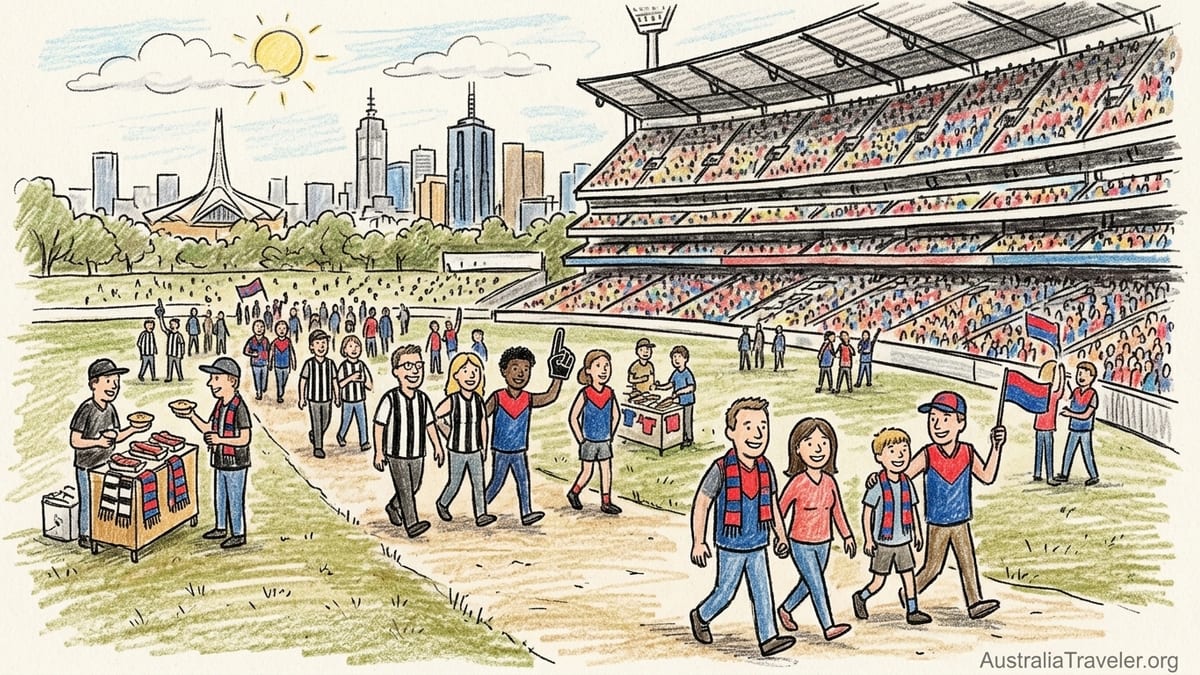
Arriving at the MCG on Game Day
My AFL baptism came on 20 April 2024, when I saw Melbourne play Collingwood at the MCG. I had read about the “G” so often that it almost felt mythical, but nothing prepared me for the way it dominates its corner of the city. From the moment I stepped off the train at Jolimont station, the stadium filled my entire field of vision, its ring of lights floating above the dark shapes of the trees in Yarra Park.
Outside the station, stewards in high-visibility vests were directing fans and answering questions about gates and seating levels. I followed the crowds along the gently sloping path that cuts through the park. Underfoot, the grass had been worn into dirt by decades of match-day traffic. Around me were families in Collingwood black and white stripes, Melbourne supporters in red and blue, and a sprinkling of neutral fans wearing AFL club jackets from almost every state. It felt more like joining a city-wide ritual than attending a single event.
As we drew closer, the sound hit first. It was not yet the full roar of a crowd, but a constant hum of conversation, punctuated by the occasional burst of a team song from a portable speaker or a spontaneous chant that would start in one pocket of supporters and die away as quickly as it began. Vendors were already doing brisk business at pop-up merchandise stalls, selling scarves, foam fingers and children’s guernseys. The smell of grilled sausages and chips drifted from the food trucks parked along the perimeter path.
My first proper view of the arena interior came as I slipped through a turnstile at Gate 3 and stepped onto the concourse. Ahead of me, the stadium suddenly opened up. Three steep tiers of seating encircled a vast, bright green oval, cut up by crisp white lines and dotted with players warming up in contrasting colours. I had seen high-capacity grounds before, but the MCG’s sheer scale, combined with the intimacy of people sitting so close to the field, was unlike anything I had experienced.
Finding the Right Gate, Seat and Understanding AFL Basics
As a newcomer, the most confusing part of my first visit was not the game itself but the logistics of navigating my way to the right spot. My ticket, booked through Ticketek a week earlier, had a string of information that initially looked like code: “Gate 1, Level 1, Aisle 40, Row J, Seat 10.” Outside, the stadium is ringed with numbered gates, and the trick is to follow the clear signage rather than simply go through the first opening you see. Once I realised that the gate number on the ticket really mattered, it became straightforward.
Inside, each gate leads to particular seating levels and aisles. Stewards checked my ticket, pointed me toward an escalator and then to my aisle, where another attendant confirmed that I was heading the right way. The seat itself was a plastic fold-down, fairly standard in size, with enough legroom for an average adult but a tight squeeze if you have a backpack. From my spot on the wing at Level 1 the visibility was superb; you are close enough to hear the thud of bodies in a tackle, but high enough to read the patterns of play.
Understanding the rules of Australian Rules football turned out to be less intimidating than I expected. The scoreboard and the fans do a lot of teaching. Each end of the oval has four posts. A kick between the two tall central posts is a goal and scores six points, while a kick between a tall and a short post is a behind worth one point. The running score is always written as goals behinds total. So if Melbourne had 10.6 (66), that meant 10 goals at six points each plus six behinds, for a total of 66. After about ten minutes, I was reading the scoreboard as easily as any local.
Other nuances came more slowly. I learned to watch for marks, where a player who catches a ball that has been kicked more than 15 metres is rewarded with a free kick. I began to recognise the unique flow of AFL, a mix of rugby’s physical collisions, soccer’s running patterns and something entirely its own. The crowd around me seemed delighted to explain. When I asked a man in a Collingwood scarf what had just been paid as a holding-the-ball free kick, he gave me an animated two-minute lesson and then turned back to the field just in time to join the next roar.
Crowd Energy, Chants, Food and Facilities
The most distinctive feature of an AFL game at the MCG is the sound. More than 60,000 people were there that night, and the noise rose and fell in waves that felt almost physical. When a player lined up for goal, a low murmur ran around the ground before snapping into either a triumphant roar or a collective groan. Every time Collingwood surged forward, the black and white sections would rise to their feet in anticipation, their chant of “C’mon Pies” cutting through the general noise.
Crowd behaviour struck me as passionate but mostly good-natured. Banter between opposing fans was constant but usually playful. Families sat side by side with groups of young adults who had clearly started their evening at one of the nearby Richmond bars. Security presence was visible but not intrusive, and stewards were quick to step in when someone tried to stand in an aisle or block a stairway. I saw plenty of children in team colours, which gave the night a more relaxed feel than some European football matches I have attended.
Food at the MCG is functional and expensive rather than gourmet. The classic choice is the meat pie with tomato sauce, still the most Australian option in the stadium. On my visit, a basic pie and a soft drink cost a little over 10 Australian dollars combined, and a larger meal of hot chips and a burger pushed closer to 20. For many visitors the price will feel high compared with street food in the city, but it is in line with major stadiums elsewhere. Expect queues at half-time, especially for hot food and beer. I waited about 15 minutes for a pie and coffee and missed the first few minutes of the third quarter as a result.
Facilities are abundant but can still feel stretched during peak times. Toilets are located at regular intervals along the concourse, and despite the crowd size they were reasonably clean for most of the night. There are dedicated accessible seating bays and lifts, and clear signage throughout the ground. One thing I appreciated was the presence of water refill stations, which allowed me to top up my reusable bottle rather than buying multiple plastic drinks. Seating comfort is adequate for the two to three hours you will be in your spot, although on a cold evening a cushion or folded scarf under you is not a bad idea.
Tickets, Categories and What You Can Expect to Pay
For most visitors, the starting point is a standard home-and-away AFL match, not a final. The easiest and safest way to buy tickets is through the authorised ticketing partner listed on the AFL website for each fixture. For games at the MCG, that is typically Ticketek. From there you will see different options, starting with general admission tickets, moving up to reserved seating, and sometimes into special packages or member allocations that are not usually relevant for short-term visitors.
General admission is the entry-level category. It gets you into the ground and allows you to sit or stand in designated unreserved sections on a first-come, first-served basis. At the MCG that usually means parts of Level 1 and Level 4 in the public reserve, with details for each game published closer to the date. Recent match-day information has shown adult general admission tickets priced around the high 20s to mid 30s Australian dollars for regular season games, with concessions a bit lower and children cheaper again. Prices can vary slightly by opponent and demand, but this gives you a realistic ballpark.
Reserved seating costs more but removes the uncertainty. When you buy a reserved ticket you choose a specific bay and seat, which is then printed on your ticket. For popular games, especially traditional blockbusters such as ANZAC Day or Collingwood versus Carlton, the cheapest reserved seats can push well above 50 dollars and into the 70 dollar range for better positions. Higher categories around the wing or closer to the field cost more again. You are paying for both the view and the guarantee that you will not be hunting for a spare seat shortly before the first bounce.
Member areas add another layer. The MCG is divided into several distinct zones: the public reserve, where most casual tickets are sold; the MCC Members’ Reserve, accessible only to members and their guests; and the AFL Reserve, which caters to AFL members. These areas have their own ticketing rules and price structures. As a short-term visitor you are unlikely to hold an MCC or AFL membership, but you may find visitor tickets through local friends who are members. These passes can sometimes be good value, with visitor prices published each season, although they do require you to attend with the member who arranged the ticket.
Finals and the Grand Final: A Different Ticketing World
Once the regular season ends in late August, ticketing changes significantly. AFL finals and especially the Grand Final are in a category of their own, both in demand and in price. Weeks one to three of the finals series, which include qualifying, elimination, semi and preliminary finals, are still ticketed through the authorised agencies such as Ticketek, but general admission areas are often reduced or removed altogether. Most seats are sold as reserved, reflecting the higher stakes and demand.
Government and league announcements for the 2024 and 2025 finals series indicated that entry-level finals tickets in certain categories were kept at relatively accessible levels, with prices for some seats around or slightly above regular season reserved prices, but better-category tickets increased by a few percent. More crucially for visitors, the finals allocation prioritises club members. Competing club members are given the first opportunity to buy, followed by AFL members and sometimes MCC members, with any remaining seats then offered to the general public. By the time non-members see availability, pickings can be slim for the most sought-after games.
The Grand Final is Melbourne’s sporting crown jewel and is treated accordingly. Official price lists released for recent Grand Finals show a wide spread. At the top end, premium seats on Levels 1 and 2 in central bays can cost close to 500 Australian dollars per adult. Even mid-tier Level 4 front seats sit in the 350 to 400 dollar range, while restricted-view and standing-room allocations, when offered, have been in the mid 100 dollar bracket. There are no junior prices for many Grand Final categories, which means families can face a serious outlay.
On top of standard tickets, there are official hospitality and experience packages sold through the AFL Event Office and partners. These might bundle a Level 2 seat with a pre-game function, food, drinks and entertainment. Prices in recent seasons have frequently exceeded 1,000 dollars per person, and in some cases gone well beyond 2,000 dollars for the most exclusive options. While they guarantee entry, they are designed for corporate guests and dedicated fans rather than casual visitors. If you are travelling specifically for the Grand Final and do not have club membership, it is sensible to budget as if you were buying a long-haul flight rather than a normal match ticket.
MCG Tours and the Australian Sports Museum for Off-Season Visitors
Not everyone can visit during the AFL season, and not everyone wants to sit in a cold evening breeze for three hours. For those travellers, the MCG still offers rich ways to experience Melbourne’s sporting heritage. The first is the official MCG Tour, which runs most days when major events are not scheduled. Information from 2025 operating guidelines indicates that standard tour hours usually run from 10 in the morning until mid-afternoon, with the last tours leaving about two hours before closing. Tours typically last around 75 minutes and take visitors through the player changing rooms when available, the MCC Long Room, media areas and the boundary line.
Ticketing for tours and the Australian Sports Museum is managed directly by the MCG. Current price boards show combined packages that offer better value than buying each separately. A common option is a bundle ticket that covers both an MCG Tour and entry to the Australian Sports Museum for the same day. Standard adult prices for this combined experience have recently sat in the 40 to 50 dollar range, with children and concessions lower, and family passes available. Exact figures change by season and special promotions, so it is worth checking current pricing when you plan.
The Australian Sports Museum itself, located inside the stadium near Gate 3, is far more engaging than the word “museum” might suggest. Interactive exhibits allow you to test your reflexes against virtual cricket bowlers, measure your vertical leap or try kicking an AFL ball through projected goals. There are also thoughtful displays on Indigenous sporting history, women’s sport and the evolution of Australian Rules football from its 19th century origins. For visitors outside football season, a couple of hours here can provide context that will make any future live game more meaningful.
For families, the museum can be a gentler introduction than a night match. Opening hours vary on match days, often closing earlier when there is an evening game, but on non-event days you can usually expect a full daytime schedule. One advantage is climate control; while the stands can be icy on a winter evening, the museum is warm and sheltered, with plenty of seating and a café nearby. If you are short on time, I recommend a morning tour, lunch at one of the nearby cafes in Richmond and then an afternoon in the museum, which together will give you a full picture of the MCG’s place in Australian culture.
Getting There: Trains, Trams, Walking and the Post-Match Crush
The MCG is blessed with several excellent access points, and which one you use can significantly shape your experience. Jolimont station, on the Mernda and Hurstbridge train lines, is the closest. Services are usually frequent on event days, and from the platform it is a very short walk through Yarra Park to the main stadium gates. This is the most direct option if you are arriving from the northern or eastern suburbs. Trains can be very crowded in the 45 minutes before a blockbuster match, so if you are noise or crowd-sensitive, aim to arrive earlier.
Richmond station sits on the opposite side of the ground and serves multiple lines from the east and south-east. It is slightly further from the stadium than Jolimont in terms of walking distance, but it connects to more services and is a better choice if you are staying around South Yarra, Prahran or further along the Frankston or Pakenham lines. The walk from Richmond station to the MCG takes you past a strip of pubs, bars and eateries on Swan Street, many of which lean heavily into pre-match trade. This can be an excellent way to soak up the atmosphere, but it also means large, sometimes boisterous crowds.
If you are based in central Melbourne, walking to the MCG is entirely feasible and often the most pleasant option. From Federation Square it is around 15 to 20 minutes on foot, either along the Yarra River or through the Treasury Gardens and Fitzroy Gardens. On match days you will rarely be walking alone; streams of fans move in the same direction, effectively creating a human signpost. Trams also run along Wellington Parade and Batman Avenue, but on big nights they can be as crowded as the trains.
The only real downside of public transport is the post-match journey home. When a major game finishes, up to 100,000 people empty into the surrounding streets almost simultaneously. Platforms at Jolimont and Richmond become dense and noisy. Metro staff use barriers and one-way systems to manage the flow, which makes it safe but sometimes slow. On my first visit, I queued for about 20 minutes to get onto a city-bound train at Jolimont. If you dislike crowds, consider staying in the area for a late meal or drink and catching a later, quieter service.
Weather, Comfort and Small Things I Would Do Differently
Melbourne’s reputation for having four seasons in one day is not a cliché. My first MCG visit started under clear skies and mild temperatures, but by quarter time a sharp wind had swept in and the temperature dropped noticeably. Even on nights that do not look especially cold on the forecast, the open nature of the stands and the exposure to wind can make it feel several degrees cooler than in the CBD. Many locals come prepared with thick jackets, scarves, beanies and even small blankets, especially on Level 4, where you are more exposed.
Sitting still for two to three hours also magnifies any minor discomforts. On my first night I underestimated the chill, wore only a light jacket and found myself stamping my feet by half-time to keep warm. I also did not bring any snacks, assuming that it would be easy to grab food quickly during breaks. Instead, I ended up in the half-time crush, paying more than I expected for a quick bite and spending most of the break in a queue rather than stretching my legs or soaking up the atmosphere.
If I were planning my first visit again, I would bring an extra layer, arrive a bit earlier and take a more relaxed approach to food. Eating a substantial meal in the city or around Richmond beforehand and then buying just a drink or a snack inside is both cheaper and less stressful. I would also consider a small cushion for longer games, especially if seated higher up. Finally, I would build in some time after the match to linger. Watching the stadium slowly empty, the ground staff roll up the boundary advertising and the players do their warm-downs gives you a final appreciation of the scale of what you have just experienced.
In terms of value, I now recommend a high-attendance regular season game between big Melbourne clubs as the sweet spot for most travellers. You get the huge crowd, the chanting and the tension without Grand Final prices or ticketing complications. A Friday night or Saturday twilight match at the MCG, with tickets in the general admission or lower reserved categories, offers the best balance of atmosphere and affordability.
The Takeaway
My first AFL game at the Melbourne Cricket Ground turned out to be much more than a night of sport. It was a window into how Melbourne understands itself, a city that measures its seasons not only by weather but by fixtures, finals and long-running rivalries. From the walk through Yarra Park to the surge of noise when a goal sails through, everything about the MCG experience speaks to the central role that Australian Rules football plays in Victoria’s culture.
Even if you have never watched a single minute of AFL on television, a live game at the MCG is an accessible and rewarding experience. The rules reveal themselves quickly, the crowd helps you learn, and the stadium staff keep the practicalities manageable. Tickets for regular season matches are relatively affordable by global standards, particularly if you are willing to sit in general admission areas, and the transport connections make it easy to include a game in any Melbourne itinerary.
For those visiting outside football season or who are unsure about committing to a long evening in the stands, the MCG Tour and Australian Sports Museum provide rich alternatives. Together they tell the story of how this one patch of turf has hosted cricket World Cups, Olympic events and generations of AFL stars. You do not need to be a sports fanatic to appreciate the blend of architecture, social history and community spirit on display.
If I had to summarise my advice to a first-time visitor, it would be this. Choose a big regular-season clash at the MCG rather than chasing a Grand Final ticket. Arrive early, dress warmly, eat before you get there, and embrace the train rides, the queues and the cold breeze as part of the story. Whether you leave as a die-hard supporter of one club or still blissfully neutral, you will carry away a vivid memory of Melbourne at its most alive.
FAQ
Q1. Do I need to understand AFL rules before going to a game at the MCG?
It helps to know the basics, like goals being worth six points and behinds one, but you can easily pick it up as you go. The scoreboard shows the running totals clearly, and locals are usually happy to explain free kicks or decisions if you ask.
Q2. How far in advance should I buy tickets for an AFL game at the MCG?
For regular season matches, buying a week or two in advance is usually enough, though big rivalry games can sell popular sections earlier. Finals, especially the Grand Final, require planning months ahead and often membership access, so casual visitors are best to target standard home-and-away games.
Q3. What is the difference between general admission and reserved seating?
General admission gives you entry and the right to sit in designated unreserved areas on a first-come basis, while reserved seating assigns you a specific seat in a chosen bay. Reserved tickets cost more but guarantee your spot and often offer better views, especially for high-demand matches.
Q4. How much should I budget for a regular AFL match ticket at the MCG?
As a guide, recent pricing has placed adult general admission tickets around the high 20 to mid 30 Australian dollar range, with reserved seats starting higher and increasing for prime positions. Finals and special event games are more expensive, but standard home-and-away fixtures remain comparatively affordable.
Q5. How different is Grand Final pricing from a normal game?
The Grand Final is significantly more expensive. Premium seats have recently approached 500 dollars per ticket, mid-tier Level 4 seats have sat in the mid 300s to around 400, and even restricted-view or standing-room allocations have been well into three figures. There are also no junior prices for many Grand Final categories.
Q6. Is the MCG Tour or Australian Sports Museum worthwhile if I cannot attend a game?
Yes. The guided tour takes you behind the scenes into changing rooms, media centres and members’ areas, while the Australian Sports Museum offers interactive exhibits and historical displays. Together they provide a strong sense of the stadium’s significance and are particularly good for visitors outside the AFL season.
Q7. Which station is better, Richmond or Jolimont, for getting to the MCG?
Jolimont is slightly closer in terms of walking distance and is ideal if you are coming from the north or east. Richmond serves more train lines and offers a lively pre-match scene along Swan Street, which suits those arriving from the south-east or who want food and drinks before the game.
Q8. What should I wear for an evening game in Melbourne?
Even when daytime temperatures are mild, the stadium can feel much colder at night due to wind and exposure. Dress in layers, bring a warm jacket, scarf and beanie, and consider gloves or a blanket if you are seated higher up in the stands, especially in the winter months.
Q9. Is stadium food at the MCG very expensive?
Food and drinks are pricier than in the city, similar to other major stadiums worldwide. A basic hot snack and drink can easily exceed 10 dollars, while more substantial meals approach 20. Many locals eat beforehand and top up with a snack inside to keep costs manageable and avoid queues.
Q10. Will I still enjoy an AFL game at the MCG if I am not a sports fan?
Many non-fans find the experience memorable because of the atmosphere rather than the result. The crowd noise, the stadium setting, the rituals like team songs and the sense of participating in a Melbourne institution all add up to a cultural experience, even if you never become a dedicated supporter.