


Melbourne, or Narrm in the language of its Traditional Owners, rewards visitors who slow down and explore by neighbourhood rather than checklist. This is a city of lived-in laneways, deep sporting passions and contemporary Aboriginal culture, with a personality very different from Sydney’s harbour-and-beach focus. The guide below brings together 25 standout attractions and experiences, grouped by area so you can link nearby sights into easy half-day walks and tram rides.
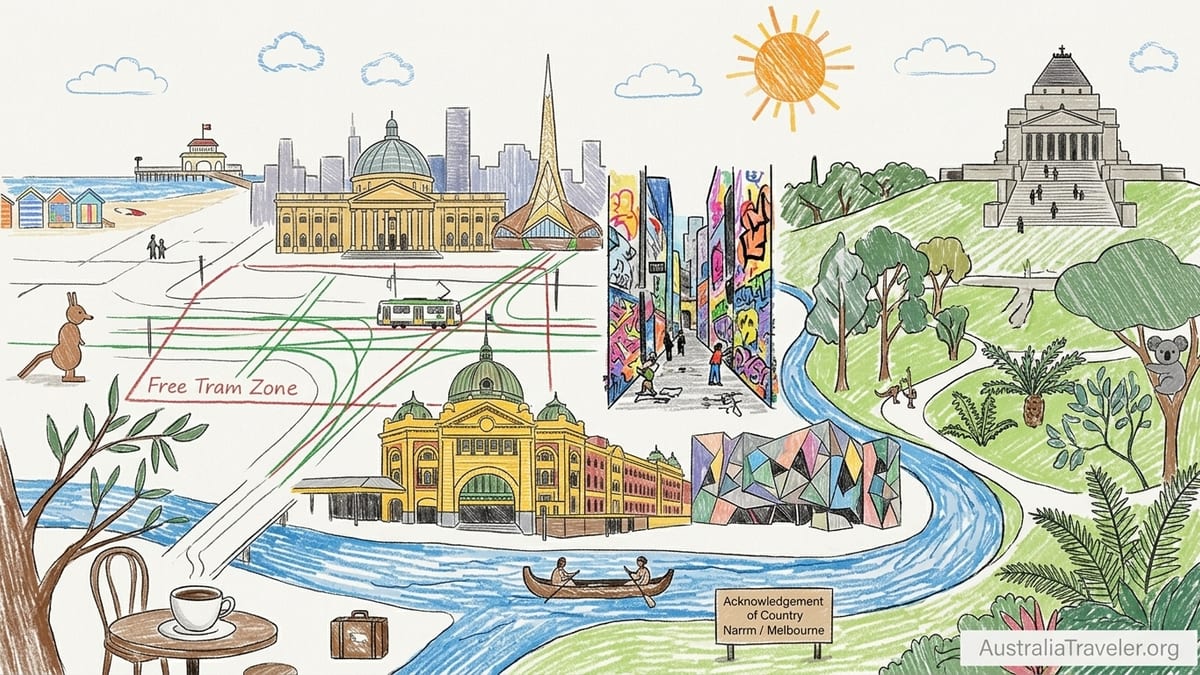
Understanding Place: Country, Culture and How Melbourne Fits Together
Melbourne sits on the lands of the Wurundjeri Woi Wurrung and Bunurong Boon Wurrung peoples of the Eastern Kulin Nation. Many locals now use the name Narrm alongside Melbourne, and you will see acknowledgements of Country at major attractions and in everyday public spaces. As you move around the city, remember you are travelling across Country that has been cared for over tens of thousands of years, with stories that run far deeper than the modern grid of streets.
For visitors who want to move beyond a basic land acknowledgement, the most accessible starting point in the city centre is the Koorie Heritage Trust at Federation Square. Here you can browse exhibitions of South Eastern Aboriginal art and cultural objects, or join a paid Aboriginal Cultural Walking Tour that explains connections between local language, stories and the Birrarung (Yarra River). These tours usually run several times a week, last around 90 minutes and should be booked in advance, especially in Australian school holidays.
Aboriginal perspectives are also woven into a number of other major attractions. At Melbourne Museum, the Bunjilaka Aboriginal Cultural Centre presents stories from across Victoria, often through community co-curated displays. At Royal Botanic Gardens, the Aboriginal Heritage Walk focuses on plant use, food and medicine on Country, guided by Aboriginal educators. Together, these create a distinctly Melbourne way of understanding place that is far less common in most Australian cities.
From a practical point of view, many of the city’s headline sights sit within Melbourne’s Free Tram Zone, bounded roughly by Queen Victoria Market, Docklands, Spring Street and Flinders Street. Within this area you can hop on most trams without touching on a Myki card, which makes it easy to link laneways, markets, libraries and the Yarra River in a single day. Suburban highlights such as Fitzroy, Carlton, St Kilda and Brighton are an easy tram or train ride beyond the free zone.
City Heart: Federation Square, Flinders Street and the Laneways
If there is a single urban snapshot that sums up Melbourne, it is the triangle between Flinders Street Station, Federation Square and the laneways behind them. Start at Flinders Street Station, the domed, butter-yellow building that anchors almost every local rendezvous. Trains from across the suburban network converge here, and even if you are not travelling by rail it is worth stepping inside the main concourse to feel the rush-hour energy and look up at the heritage clocks. The station operates from early morning to late evening, and there is no admission charge.
Directly opposite, Federation Square functions as Melbourne’s public living room and a cultural hub rather than a classic monument. The open plaza hosts festivals, protests, fan zones during major sporting events and outdoor screenings. Underneath the angular facades you will find the Ian Potter Centre: NGV Australia, ACMI and the Koorie Heritage Trust. The square is open at all hours, while galleries and museums generally open from late morning to late afternoon or early evening. From almost anywhere in the central grid it is one or two stops by tram within the Free Tram Zone to the “Federation Square / Flinders Street Station” stops.
Step a block or two back from Flinders Street and you enter the intimate world of Melbourne’s laneways. Hosier Lane, opposite Federation Square, is the most photographed spot, its walls layered with ever-changing street art. Visitors wander slowly, photograph murals, watch artists at work and duck into tiny bars or galleries. There is no entry fee and the lane is accessible at all hours, although daylight and early evening feel liveliest. For coffee and café culture, Degraves Street, reached via a short walk or one stop on most trams to Flinders Street’s “Degraves Street” exit, delivers tightly packed tables, strong espresso and a quick primer on how seriously locals take brunch.
A short walk north brings you to Block Arcade, one of Melbourne’s most beautifully preserved Victorian shopping arcades. Under its mosaic floors and glass roof, visitors linger at tearooms, browse specialty chocolate and watch the passing parade. The arcade generally opens during standard retail hours, roughly 10 am to 5 or 6 pm, and there is no admission charge. Taken together, Federation Square, Hosier Lane, Degraves Street and Block Arcade can easily fill three to four hours, especially if you stop for coffee or lunch, and they showcase Melbourne’s love of small-scale spaces in a way few other Australian cities match.
Culture Cluster: Galleries, Screen Stories and the State Library
One feature that distinguishes Melbourne from many destinations is how tightly its cultural institutions are clustered. You can move on foot from galleries to libraries and film museums in a single loop, with almost all of it under tram lines. Start with ACMI at Federation Square, the city’s museum of screen culture. Its free permanent exhibition explores film, television and video games, while paid temporary exhibitions dive into specific directors, genres or media. ACMI usually opens daily from around 10 am to 5 pm; allow 90 minutes to two hours, more if you are a film enthusiast or visiting with media-savvy teenagers.
In the same precinct, The Ian Potter Centre: NGV Australia focuses on Australian art, including significant holdings of First Nations work from across the continent. Entry to the main collection is free, with ticketed special exhibitions at published prices that vary by show. Across the river on St Kilda Road, NGV International houses European, Asian, Pacific and contemporary collections in a modernist gallery building with its famous water wall. NGV International also offers free general entry, with paid blockbuster exhibitions attracting timed-entry crowds. Both sites are usually open daily, typically 10 am to 5 pm, and are reachable by multiple trams stopping along St Kilda Road or within the Free Tram Zone at Federation Square.
A short tram ride or a 10 to 15 minute walk north from the river brings you to State Library Victoria on Swanston Street. From the outside it resembles a neoclassical museum. Inside, the highlight is the La Trobe Reading Room, a soaring octagonal space with a domed skylight and rows of wooden desks. Visitors typically climb to upper balconies to take overhead photographs, browse exhibitions on Victoria’s history or simply rest in the quieter heritage rooms. The library usually opens from morning until early evening, with later hours some weekdays, and admission is free. The nearest tram stops and the Melbourne Central train station sit directly in front of the building.
To round out this cultural arc, consider the Immigration Museum, housed in the Old Customs House a few blocks from Flinders Street along the Yarra corridor. While not as large as Melbourne Museum, it offers thoughtful exhibitions about migration stories to Victoria. Entry involves a modest admission fee, and opening hours broadly follow museum norms of roughly 10 am to 5 pm. This mix of free and paid cultural spaces, most within walking distance of each other, explains why many travellers spend more time indoors in Melbourne than in Sydney, especially during changeable weather.
Gardens, Memory and Riverlife: Royal Botanic Gardens, Shrine and Yarra
South of the central grid, Melbourne shifts from streets to parklands. From Federation Square, it is a pleasant 20 to 25 minute walk or a short tram ride along St Kilda Road to the Shrine of Remembrance and Royal Botanic Gardens. The Shrine sits on a rise overlooking the city, Victoria’s principal memorial to Australians who served in war and peacekeeping operations. Visitors climb the steps for skyline views, explore the underground galleries and, if timing allows, witness the Ray of Light ceremony in the Sanctuary. The main building and outdoor terraces are free to enter, with paid guided tours available. According to current visitor information, the Shrine typically opens daily from about 10 am to 5 pm, with final entry before closing.
Just behind the Shrine, Royal Botanic Gardens Melbourne provides a large green escape that locals often treat as an outdoor living room. Paths wind past ornamental lakes, themed plantings and sweeping lawns that feel far removed from the CBD despite being only a tram ride away. Entry to the gardens is free and they usually open in the morning and close in the late afternoon or early evening, with specific times varying slightly by season. Many visitors pack a picnic, join a free volunteer-led walk or simply loop The Tan, the popular running track that circles the gardens and Shrine precinct.
For a distinctly Aboriginal perspective on this landscape, the gardens’ Aboriginal Heritage Walk is a standout paid tour. Guided by Aboriginal staff, it explores how local plants were used for food, medicine and tools, and how stories connect to Country. The walk generally runs on scheduled mornings, lasts around 90 minutes and includes tea made from native ingredients. Advance bookings are strongly recommended, particularly in spring and autumn when demand is highest.
To connect all of this with the city’s defining waterway, consider a Yarra River cruise. Several operators run sightseeing cruises from near Southbank and Princes Bridge, with options ranging from one-hour city loops to longer journeys to the Docklands or upriver toward leafy suburbs. Daytime cruises typically operate multiple departures between late morning and late afternoon and offer running commentary on Melbourne’s history, bridges, rowing culture and development along the river. Prices vary by operator and length but commonly sit in the moderate range for a city sightseeing boat trip. Evening dinner cruises are more expensive and require advance booking, especially on weekends and during major events.
Museums, Sport and Carlton Gardens: Melbourne Museum, Royal Exhibition Building and the MCG
North of the CBD grid, Carlton Gardens and the surrounding blocks host another tight cluster of experiences. Melbourne Museum, one of the country’s largest, sits within the gardens alongside the ornate Royal Exhibition Building. Inside the museum, families gravitate toward the Science and Life Gallery, forest gallery and children’s spaces, while adults often spend longer in Bunjilaka Aboriginal Cultural Centre and the section devoted to Melbourne’s social history. The museum generally opens daily from 10 am to 5 pm. Entry is free for children and a modest ticket price applies for adults, with extra charges for special exhibitions and IMAX screenings. The nearest tram stop sits on Nicholson Street, or you can walk around 15 minutes from the city along La Trobe or Victoria Streets.
Right next door, the Royal Exhibition Building is one of the world’s oldest surviving exhibition pavilions. Today, you can often admire its exterior and the surrounding fountains free of charge, while interior access is usually via paid, timed tours or event tickets when expos or shows are in residence. Dome Promenade tours, when operating, take visitors up to the rooftop walkways for views across Carlton Gardens and the city skyline. Check current schedules before planning around a specific tour, as access varies by season and events calendar.
A couple of tram stops or a short train ride east leads to the Melbourne Cricket Ground, the sporting heart of the city. The MCG hosts cricket in summer and Australian Rules football in winter, but you do not need a match ticket to explore its history. Guided MCG Tours operate on most days when the ground is not in event mode, generally departing every 30 minutes between about 10 am and 3 pm and lasting around 75 minutes. Visitors walk through the players’ change rooms, the Long Room and media facilities, and step into the stands to appreciate the scale of the arena.
Admission for an MCG Tour involves a set per-person ticket price, with discounts for children and family groups, and combination tickets available that include entry to the adjacent Australian Sports Museum. The museum itself is an interactive celebration of cricket, AFL, Olympic sports and more, appealing particularly to children and sports fans. Both experiences are paid and it is sensible to book online in advance during school holidays or on days surrounding big matches, when visitor numbers spike. Richmond and Jolimont train stations, along with several tram routes along Wellington Parade and Bridge Road, serve the precinct.
Neighbourhood Colour: Fitzroy, Carlton, Southbank and the Yarra
Beyond the central blocks, Melbourne’s character really emerges in its inner suburbs. Fitzroy, just north of the CBD, is a leader in street art, live music and independent retail. Start along Brunswick Street for cafés, bars and vintage stores, then wander across to nearby laneways and side streets where murals spill across brick walls and warehouse doors. Gertrude Street offers a slightly more upscale mix of galleries and design stores. There is no admission fee to explore; you simply ride the tram from the city along Brunswick or Smith Streets and hop off near the action. Two to three hours is enough for a first taste, longer if you settle into a courtyard bar or record shop.
South of the Yarra, Southbank runs as a continuous promenade lined with riverfront restaurants, public art and the Melbourne Arts Centre spire just inland. This is one of the best places to appreciate the city’s relationship with the Yarra, especially in late afternoon when office workers and theatre-goers share the paths with visitors. It is also the most convenient base for Yarra cruises, which usually depart from berths near Princes Bridge or further downstream toward Crown. Walking the length of Southbank between the pedestrian bridges makes for an easy hour’s stroll that can be combined with a visit to NGV International or a Melbourne Skydeck session.
Melbourne Skydeck, in the Eureka Tower on Southbank, is the city’s elevated viewing platform. From high above the river, glass walls provide panoramas toward Port Phillip Bay, the Dandenong Ranges and the grids of the CBD. Standard admission gives access to the enclosed deck, with optional paid extras such as a glass cube experience projecting from the side of the tower. The Skydeck generally opens from late morning until late evening, with extended hours on weekends and in summer. Timed tickets are available online and can be worthwhile on busy nights, especially for sunset and early evening views when queues lengthen.
Carlton, adjacent to Fitzroy and a short walk from Melbourne Museum, is known for Lygon Street’s Italian dining and historic terrace houses. This is an easy neighbourhood to tack onto a museum visit. After exploring the galleries and Carlton Gardens, stroll to Lygon Street for a long lunch or dinner, gelato and late-night coffee. Trams along Swanston and Lygon Streets, plus nearby train stations at Melbourne Central and Parliament, make getting to and from these areas straightforward.
Bay Breezes: St Kilda, Brighton and Life by the Water
While Sydney is better known internationally for beaches, Melbourne’s bayside suburbs offer their own drawcards, particularly around sunset. St Kilda, about 25 to 35 minutes from the CBD by tram, combines a slightly faded seaside amusement strip with busy bars and a wide foreshore. Visitors typically walk the palm-lined Esplanade, grab coffee or cake along Acland Street and head to St Kilda Pier for skyline views back toward the city.
At the far end of St Kilda Pier’s breakwater, a small colony of little penguins shelters among the rocks. Volunteer guides are often present around sunset to help manage crowds and protect wildlife. Viewing is free, but you will need to check up-to-date guidance on access arrangements and viewing platforms, which can change due to pier works or conservation measures. In any case, an evening walk to the end of the pier, even without penguin sightings, remains one of Melbourne’s most atmospheric free experiences.
Further around the bay, the Brighton Bathing Boxes are one of Victoria’s most photographed beach scenes. These brightly painted wooden sheds line a stretch of Brighton Beach about 20 to 30 minutes from the city by Sandringham line train, followed by a short walk. Visitors come to stroll along the sand, photograph the colourful doors and, in warmer months, paddle in the shallows with the city skyline in the distance. There is no entry fee to the beach, though paid parking applies in nearby lots, and you should be respectful of private property, as the boxes themselves are privately owned.
A practical way to combine these bayside highlights is to spend a half day in St Kilda, then continue on to Brighton by tram and train or vice versa, depending on your base. Families often prefer St Kilda for its playgrounds and occasional pop-up amusement rides, while photographers prioritise Brighton for that classic postcard shot. Both locations feel quite different from central Melbourne, and spending time by the bay helps explain why locals talk about “the beach” even when they live in a city better known for coffee and culture.
Free Experiences vs Paid Highlights: How to Plan Your Time
One advantage of Melbourne for budget-conscious travellers is the sheer number of worthwhile free experiences. You can easily build two or three full days almost entirely around free entry attractions: wandering Federation Square, shooting street art in Hosier Lane and Fitzroy, exploring Degraves Street and Block Arcade, reading or people-watching at State Library Victoria, strolling through Carlton Gardens, the Shrine’s terraces and Royal Botanic Gardens, and finishing with sunsets at St Kilda Pier or Brighton Beach. All of these require only your tram fare where relevant and whatever you choose to spend on food and coffee.
On the paid side, it makes sense to choose a few high-impact experiences rather than trying to do everything. Strong candidates include an MCG Tour (especially for sports fans), Melbourne Skydeck for views, an Aboriginal Heritage Walk at Royal Botanic Gardens, a Koorie Heritage Trust cultural walking tour from Federation Square, and a Yarra River cruise. Each of these typically requires one to two hours and can be slotted into a broader day of free wandering. Museum and gallery special exhibitions, IMAX screenings at Melbourne Museum and Australian Sports Museum entry at the MCG are worthwhile add-ons depending on your interests and budget.
When it comes to booking, advance purchase is most useful for structured tours and vantage points with limited capacity. Pre-book MCG Tours, the Aboriginal Heritage Walk, Koorie Heritage Trust walking tours, Yarra cruises and Melbourne Skydeck, especially in Australian school holidays, on weekends or when major events such as the Australian Open or AFL Grand Final draw extra visitors. For free-entry institutions like the NGV, ACMI and State Library, simply checking opening hours on the day is usually sufficient, as queues tend to be manageable except during blockbuster exhibitions.
Transport is another area where planning pays off. Within the Free Tram Zone, you do not need to tap your card, but once you head to Fitzroy, Carlton, St Kilda or Brighton you will. Buying and topping up a Myki card at major train stations, convenience stores or online is the standard approach, with fare caps that keep daily costs predictable. Trains run late into the evening on key lines, and trams and buses provide additional options, so it is rare to need a taxi or rideshare unless returning home very late at night.
Two-Day Priority Shortlist and Traveler-Specific Tips
If you have just two full days in Melbourne, focus on neighbourhood clusters to minimise travel time. On Day One, stay mostly within and just south of the CBD. Start at Flinders Street Station and cross to Federation Square, where you can dip into ACMI or NGV Australia and spend time at the Koorie Heritage Trust. Wander through Hosier Lane, then head up to Degraves Street and Block Arcade for lunch and laneway browsing. In the afternoon, walk or tram along St Kilda Road to the Shrine of Remembrance and Royal Botanic Gardens, perhaps timing an Aboriginal Heritage Walk if pre-booked. Finish with a Yarra River cruise departure from near Southbank, or an evening session at Melbourne Skydeck.
On Day Two, work north and outward. Begin at Queen Victoria Market for breakfast from the deli or produce halls, then ride a tram or walk to State Library Victoria for a short visit. Continue to Melbourne Museum and Carlton Gardens, taking in Bunjilaka Aboriginal Cultural Centre and, if available, a Royal Exhibition Building tour. In the mid to late afternoon, head over to Fitzroy for street art and bar-hopping, or south to St Kilda for a bayside walk and potential penguin spotting at St Kilda Pier. If you have additional time or energy, you can substitute a morning or evening excursion to Brighton Bathing Boxes for one of these neighbourhoods.
Families should prioritise Melbourne Museum, the Australian Sports Museum and MCG Tour, Royal Botanic Gardens, St Kilda foreshore and the more interactive parts of ACMI. Allow time for playground stops in Carlton Gardens or along the Yarra, and consider booking Skydeck earlier in the day when younger children are less tired. Couples might lean toward a combination of laneway cafés, NGV visits, evening river cruises and a Brighton or St Kilda sunset, with a Skydeck session timed for twilight and drinks along Southbank afterward.
Budget travellers can build days almost entirely around free-entry attractions, using paid experiences very selectively. A common approach is to choose one signature paid outing such as an MCG Tour or Aboriginal Heritage Walk and keep the rest of the itinerary to galleries, libraries, gardens and laneways. Art lovers should allocate more time to NGV International, NGV Australia, ACMI, smaller commercial galleries in Fitzroy and Collingwood, and Bunjilaka at Melbourne Museum, while sports fans will naturally centre their plans around the MCG, Australian Sports Museum and, if visiting in winter, a live AFL game at the ground or nearby Marvel Stadium.
FAQ
Q1. How many days do I need to see Melbourne’s main attractions?
Most visitors find that three full days allows time for the central laneways, key museums and galleries, the MCG or Skydeck, and at least one bayside suburb such as St Kilda or Brighton. With five days you can move at a more relaxed pace and add neighbourhoods like Fitzroy and longer walks along the Yarra.
Q2. What is the best way to get around Melbourne as a visitor?
In the city centre the Free Tram Zone makes it easy to move between Flinders Street Station, Federation Square, Queen Victoria Market and Docklands at no cost. For trips to Fitzroy, Carlton, St Kilda or Brighton you will need a Myki card for trams and trains, which you can buy and top up at major stations and convenience stores. Walking is often the fastest way within the compact CBD.
Q3. Do I need to book MCG Tours, Skydeck and river cruises in advance?
For MCG Tours, Melbourne Skydeck and Yarra River cruises, booking ahead is strongly recommended in Australian school holidays, on weekends and during major events like the Australian Open or big AFL matches. On quieter weekdays you can often secure same-day tickets, but booking still helps you lock in preferred times.
Q4. Which Melbourne attractions are best for bad weather days?
On rainy or very hot days, focus on indoor highlights such as ACMI and NGV at Federation Square, NGV International, State Library Victoria, Melbourne Museum and the Immigration Museum. The MCG Tour and Australian Sports Museum are mostly indoors as well, with only brief outdoor sections.
Q5. Where can I learn about Aboriginal culture in central Melbourne?
The Koorie Heritage Trust at Federation Square is the most accessible starting point, with free-entry exhibitions and paid cultural walking tours that explore local stories along the Birrarung. Bunjilaka Aboriginal Cultural Centre at Melbourne Museum and the Aboriginal Heritage Walk at Royal Botanic Gardens offer additional, complementary perspectives.
Q6. Are Melbourne’s laneways and street art areas safe to visit?
Hosier Lane, Degraves Street and central laneways are generally busy and feel safe during the day and early evening, with a constant mix of locals and visitors. As in any large city, it is sensible to stay aware of your surroundings late at night and avoid very quiet alleys if you are alone.
Q7. What are typical opening hours for major museums and galleries?
Most of Melbourne’s major museums and galleries, including ACMI, NGV, Melbourne Museum and the Immigration Museum, open around 10 am and close by 5 pm. Some extend hours on selected evenings for special events or exhibitions, so it is worth checking same-day information if you plan an after-hours visit.
Q8. Is St Kilda Pier currently open for penguin viewing?
Access to penguin viewing areas can change due to repair works or conservation measures, so conditions vary over time. Before planning your visit specifically around penguin sightings, check the latest local guidance, but even when access is limited the walk along St Kilda Pier at sunset remains a worthwhile free outing.
Q9. When is the best time of year to visit Melbourne?
Spring and autumn are often the most comfortable seasons, with milder temperatures that suit walking between neighbourhoods and enjoying gardens and outdoor dining. Summer brings major events like the Australian Open but can be hot, while winter is cooler yet well suited to Melbourne’s strong indoor culture scene.
Q10. How does Melbourne differ from Sydney for first-time visitors?
Sydney is defined by its harbour, beaches and big coastal views, while Melbourne’s appeal lies more in neighbourhood life, laneways, sport and contemporary culture. You spend more time in cafés, galleries, libraries and at live events, often moving between compact areas by tram rather than focusing on a single waterfront icon.