


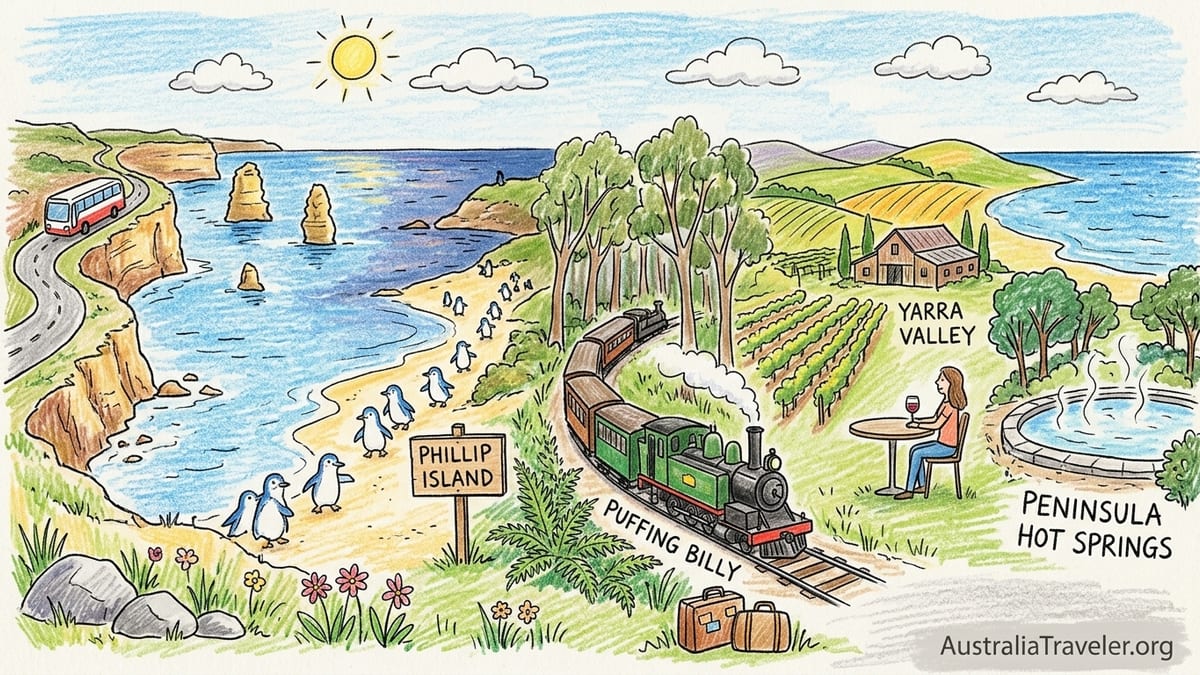
Melbourne is surrounded by day trips that many cities would happily claim as once-in-a-lifetime journeys. Within a two-hour radius you can watch penguins emerge from the ocean at dusk, taste cool-climate wines at source, soak in mineral hot springs, step onto a goldfields main street from the 1850s, or ride an open-sided steam train through towering forest. Choosing how to spend limited time is the real challenge. This guide compares Melbourne’s strongest day excursions with current, real-world details so you can match the right experience to your time, budget and travel style.
Overview: How Melbourne’s Signature Day Trips Compare
From central Melbourne, most classic day trips fall within 60 to 180 minutes of driving one way, but the feel of each excursion is very different. A Great Ocean Road and Twelve Apostles coach day is a 12 to 13 hour epic with roughly 8 hours spent on the road. A Phillip Island Penguin Parade run usually leaves mid-afternoon and returns late evening, built around a single wildlife event at sunset. A Yarra Valley winery circuit might involve no more than 3 to 3.5 hours of driving in total, with the rest of your day spent at cellar doors, farm gates and lunch venues. Mornington Peninsula wellness days often blend gentle coastal walks, seaside villages and a pre-booked bathing session at Peninsula Hot Springs, with travel times of around 90 minutes each way from the city.
Shorter excursions fill out the picture. The Dandenong Ranges and Puffing Billy Railway sit less than an hour from central Melbourne, so a family can ride the steam train from Belgrave to Lakeside and still have time for a treetop playground or forest walk. Ballarat’s Sovereign Hill open-air museum lies about 110 kilometres west of Melbourne, a comfortable highway drive that feels very different from the coastal bends of the Great Ocean Road. Healesville Sanctuary, a benchmark native wildlife park, pairs well with either a half-day escape or as one stop in a fuller Yarra Valley itinerary.
Two famous regional landscapes, Wilsons Promontory and the Grampians, technically fit into a very long day from Melbourne but are much better matched to overnight or multi-day trips. The return drives alone absorb most of the daylight hours, and the best experiences there involve unhurried hiking, wildlife encounters at dawn and dusk and quiet evenings in small-town accommodation. Treat them as short getaways rather than box-ticking day excursions.
The comparison table below summarises the main characteristics of Melbourne’s strongest day trips as of late 2026. Driving times assume light to moderate traffic and minimal stops; tour prices are approximate adult fares on mainstream operators, checked against current 2025–26 brochures and booking engines.
Comparison Table: Distances, Seasons and Practicalities
Destination | Return driving distance from Melbourne CBD | Typical return travel time by road | Strongest season | Key experiences | Minimum realistic time on location (excluding driving) | Public transport practicality | Approximate price of common guided day tour (adult)
Great Ocean Road & Twelve Apostles | About 520 to 600 kilometres depending on route | Around 12 to 13 hours total day, including stops, with roughly 8 hours in the vehicle | Late spring to early autumn, and clear winter days for dramatic seas | Coastal lookouts, surf towns, rainforest stops, Twelve Apostles and Loch Ard Gorge | At least 3 to 4 hours spread across multiple stops | No practical public-transport day trip; V/Line coach and local buses work only for overnight stays | Around 150 to 210 Australian dollars for a full-day coach tour, sometimes a little more if lunch or extras such as helicopter flights are included
Phillip Island & Penguin Parade | About 280 to 320 kilometres return depending on route and hotel pickup pattern | Around 6 to 9 hours total excursion, heavily dependent on sunset time, with around 3 hours in the vehicle | November to March evenings for warmth and long light, but penguins appear year-round | Penguin Parade viewing, coastal boardwalks, Nobbies scenery, optional wildlife parks | Around 3 to 4 hours on the island including Penguin Parade time | Limited: V/Line coach and local buses can reach Cowes, but connections and late return after the parade are difficult without a tour or car | Around 130 to 190 dollars for an afternoon and evening tour including transport and standard Penguin Parade entry
Yarra Valley wineries | About 130 to 180 kilometres depending on route and stops | Around 7 to 9 hours total tour day, with 3 to 3.5 hours of driving | Spring and autumn for vineyard colour and mild temperatures; winter weekends are popular for fireplaces and long lunches | Tastings at 3 to 4 wineries, regional lunch, farm-gate produce, chocolate and cheese stops | Around 5 to 6 unhurried hours in the valley | Partial: suburban trains and local buses reach some townships, but are impractical for a tasting-focused day | From roughly 70 dollars for a no-frills seat on a budget tour up to 200-plus dollars for small-group or premium-lunch options
Mornington Peninsula & hot springs | About 200 to 260 kilometres return depending on side trips | Around 8 to 9 hours door to door, with about 3 hours of driving | Year-round; outdoor bathing is especially atmospheric in cooler months | Peninsula Hot Springs bathing sessions, coastal viewpoints, seaside villages, optional wineries or farm-gate stops | Around 4 to 5 hours on the peninsula, including a 2 to 3 hour bathing block | Partial: trains to Frankston and local buses towards Rye and Fingal work, but connections are slow and awkward at night | Around 150 to 220 dollars for small-group wellness or wine and hot-springs combinations, including bathing entry
Dandenong Ranges & Puffing Billy | About 100 to 140 kilometres return | Around 5 to 7 hours total outing, with under 2 hours of driving | Spring and autumn for forest colour and comfortable temperatures, school holidays for family atmosphere | Puffing Billy steam-train ride, fern gullies, village cafes, short forest walks | Around 3 to 4 hours on location including train journey | Good: suburban trains to Belgrave connect directly with the Puffing Billy station | Around 120 to 160 dollars for coach-plus-train packages from Melbourne, including the railway ticket
Ballarat & Sovereign Hill | About 220 kilometres return via freeway | Around 7 to 8 hours total day, with roughly 3 hours of driving | Year-round, with special events such as Winter Wonderlights in mid-winter | Recreated 1850s main street, mine tours, gold panning, costumed interpreters | Around 4 to 5 hours at Sovereign Hill to see main exhibits | Good: regular V/Line trains to Ballarat, then local buses or short taxi ride to Sovereign Hill | Around 140 to 190 dollars for a full-day Ballarat and Sovereign Hill coach tour including entry
Healesville Sanctuary | About 140 kilometres return via the outer east | Around 5 to 7 hours total outing, with around 2 hours of driving | Spring and autumn for comfortable walking weather, but suitable year-round | Native wildlife exhibits including koalas, kangaroos and bird shows, plus bushland setting | Around 3 to 4 hours inside the sanctuary | Moderate: regional buses run from Lilydale station, but travel time stretches compared with a car or tour | Around 120 to 170 dollars when combined with Yarra Valley stops on a small-group tour
Great Ocean Road & Twelve Apostles: An Epic Single-Day Push
The Great Ocean Road is often described as Australia’s premier coastal drive, and its headline sight is the cluster of limestone stacks known as the Twelve Apostles, inside Port Campbell National Park. A standard coach tour from Melbourne usually departs between 7 and 8 am and returns between 8 and 9 pm, making it a 12 to 13 hour commitment. Current touring guides describe about eight hours of total driving time for a full return loop to the Apostles and back, even when using the quicker inland highway in one direction and the actual coastal road in the other.
For travellers with only one spare day in Melbourne, this raises a real question of fatigue versus reward. You might spend 45 minutes at the official Twelve Apostles lookout, 30 minutes at nearby Loch Ard Gorge and scatter the rest of your off-bus time across lunch, a rainforest walk near Maits Rest or Melba Gully, and photo stops at towns like Lorne or Apollo Bay. The landscape is outstanding, but you will be sharing viewing platforms with busloads of fellow visitors, and you will arrive back in Melbourne ready for a quiet night rather than a late dinner reservation.
Self-driving gives greater control but not much extra time unless you are comfortable with pre-dawn starts and late-night finishes. Guides produced for independent drivers talk about roughly eight hours of pure driving time on a Melbourne to Twelve Apostles loop, not counting fuel stops, meals or lookouts. That is a very long day for one driver, especially on a road that demands concentration with frequent curves, changing speed limits and slow-vehicle turnouts. Many local drivers recommend the “reverse” pattern taken by newer coach itineraries: heading inland to the Apostles early, reaching the coastline near Port Campbell, then meandering back east along the sea in the afternoon.
Cost-wise, a one-day guided tour at the budget end of the market often starts close to 150 dollars per adult, while small-group operators that include lunches, National Park contributions or fewer pick-up stops can run past 200 dollars. Compare that with the cost of a rental car for a day, which might sit around 90 to 120 dollars before fuel and insurance on a mid-size automatic booked from a city depot in high season. Add roughly 60 to 90 dollars of fuel for a 500 to 600 kilometre day and paid parking at some stops, and the savings over a tour may be modest once you factor in that at least one person cannot drink wine with lunch and must shoulder the entire driving burden.
Phillip Island Penguin Parade: Compact Day, Focused Payoff
Phillip Island’s Penguin Parade is one of Australia’s most controlled and carefully managed wildlife experiences. Hundreds to more than a thousand little penguins come ashore at sunset depending on the time of year and ocean conditions, and visitor numbers are capped across a set of viewing categories. As of late 2026, “General Viewing” admission remains the standard ticket type, giving access to large tiered stands set back from the main landing beach. While this offers the widest panorama, visitors often note the physical distance from the penguins themselves once they leave the ocean.
Upgraded viewing options build on this base. Current descriptions list “Penguins Plus” as a smaller, closer viewing platform near a favoured landing point, with rangers on hand and a reduced crowd size compared with General Viewing. The “Underground” viewing area sits at eye level with the sand, behind glass, letting you see penguins waddling past only a few metres away without exposure to wind or rain. Some operators and the attraction itself also promote ranger-led tours with limited group sizes, and an exclusive “Skybox” format aimed at private groups seeking a more secluded vantage.
Most organised Phillip Island trips leave central Melbourne between 1 and 3 pm depending on the season and sunset time, then weave through coastal lookouts around the Nobbies and the western end of the island before centring the evening on the parade itself. Return times to the city fall between 10 pm and midnight in summer when dusk is late, and earlier in winter. On the ground you can expect at least three hours on the island, including time spent on boardwalks where penguins shuffle right beside the paths on their way to burrows.
In terms of pricing, an afternoon and evening coach tour with General Viewing admission currently clusters around 130 to 160 dollars for adults. Packages that include Penguins Plus or Underground tickets trend higher, commonly peaking around or a bit above 190 dollars. Self-drivers pay separately for petrol and entry, but the crucial limitation is timing: there is no practical late-evening public transport back to Melbourne after the parade, so non-drivers are almost always better off with an organised excursion.
Yarra Valley Wineries: Relaxed Days and Tasting Logistics
The Yarra Valley begins less than an hour from the eastern suburbs of Melbourne but feels far removed from the city grid. It is Victoria’s flagship cool-climate wine region, known for pinot noir, chardonnay and sparkling wines along with a growing reputation for craft gin and farm-to-table dining. Recent pricing guides for 2026 suggest that a full-day shared coach or minibus tour from Melbourne typically starts just above 70 dollars per adult at the very budget-conscious end, with many popular options hovering around 90 to 130 dollars. Small-group and premium-lunch formats can sit anywhere between about 150 and 250 dollars depending on inclusions.
The key question in the Yarra Valley is what those inclusions actually buy you. Some lower-cost tours cover the transport, driver-guide and basic tastings at three wineries but leave you to purchase lunch separately. Mid-range days more often bundle a set-menu lunch at one venue and structured tastings at several cellar doors. Premium products might add extras such as a gin tasting flight at a local distillery, cheese or chocolate stops and occasionally behind-the-scenes sessions with a winemaker.
For self-drivers, tasting fees at individual cellar doors often sit in the ballpark of 10 to 20 dollars per standard flight, sometimes waived if you buy a bottle. A three-winery day might therefore involve 30 to 60 dollars per person in tastings alone before lunch, coffee stops or purchases. Designated-driver planning is serious here: Victoria’s blood alcohol limits are strict, and rural policing can include random breath testing. That reality nudges many visitors toward shared tours, especially couples, groups of friends and international travellers unused to local drink-driving laws.
Time on the road within the valley is modest. A typical itinerary leaving Melbourne around 9 am and returning by 5 pm might involve 60 minutes on the freeway each way and short hops between Coldstream, Healesville, Yarra Glen and other villages. Compared with a Great Ocean Road marathon, this is a far more relaxed day built around tastings and conversation rather than long driving shifts.
Mornington Peninsula: Coastal Villages and Hot Springs Wellness
Across Port Phillip Bay from the city skyline, the Mornington Peninsula combines beach culture, vineyard-covered hills and increasingly sophisticated wellness offerings. For many Melburnians, the magnetic draw is Peninsula Hot Springs near Fingal, which pairs geothermal mineral pools with landscaped bathing areas, saunas and relaxation zones. Current published price lists show a range of “Bath House” general bathing products that vary by arrival time and inclusions, with adult admission for core bathing commonly sitting between roughly 70 and 110 dollars once seasonal changes and time-of-day premiums are accounted for.
Beyond basic entry, the hot springs operate packages that stitch together bathing with spa treatments, dining credit or robe hire. The “Revitalise” concepts, for instance, combine Bath House access with a massage or facial and robe hire at a higher overall price point, currently illustrated by offerings that exceed 200 dollars per adult. All of these are subject to capacity, and day-of bookings attract a surcharge, so advance planning is critical during school holidays and weekends.
A Mornington Peninsula day trip might begin with a 90-minute drive from Melbourne to coastal spots near Sorrento or Arthurs Seat, breaking for coastal walks or viewpoints, then pivoting to a pre-booked two or three hour bathing session in the middle of the day. Alternatively, some operators now lean fully into wellness, running small-group tours that collect guests mid-morning, head directly to the hot springs for a multi-hour soak, then add a quiet winery tasting or seaside stop on the way home. These often price between about 150 and 220 dollars including bathing entry and transport.
Independent travellers can reach parts of the peninsula by taking a suburban train to Frankston and then changing to local buses. In reality this can double or triple travel time compared with a car and complicates evening returns, particularly if you are leaving the hot springs after dark. For that reason, organised excursions or rental cars remain the most practical options, especially if you plan to combine bathing with wine tasting or a restaurant lunch.
Dandenong Ranges, Puffing Billy and Family-Friendly Escapes
The forested ridges of the Dandenong Ranges climb immediately east of Melbourne’s outer suburbs. Here the Puffing Billy Railway, a century-old narrow-gauge steam line, runs from Belgrave through fern gullies and temperate rainforest to Lakeside and further towards Gembrook. Official timetable and ticketing information confirm that trains operate on set return journeys, with Belgrave to Lakeside services running daily except Christmas Day and extended routes offered on selected days.
Puffing Billy tickets are sold per journey rather than as hop-on, hop-off passes. Fares vary by route and class of travel, but a return trip between Belgrave and Lakeside for a standard adult seat currently represents the core product around which many Melbourne day tours are built. Some special trains like themed evening services or winter “Train of Lights” runs attract separate pricing and can temporarily replace parts of the ordinary timetable, so it is important to check availability before promising a particular departure to children.
One major advantage of the Dandenong Ranges for visitors without cars is straightforward public transport. Electric suburban trains from central Melbourne run to Belgrave station, where a short walk connects straight to the Puffing Billy terminus. Independent travellers can therefore combine a return train fare with a Puffing Billy ticket and local bus or taxi hops to gardens and lookouts to build a value-conscious day out. Full-day coach and train packages from the city add the convenience of hotel pick-ups, curated stops at spots such as Sassafras or Olinda, and sometimes morning tea with scones as part of the experience.
Compared with a Great Ocean Road mission, a Puffing Billy day is short and child-friendly. Even with a leisurely forest walk or playground stop at Lakeside, families often find themselves back in Melbourne by mid-afternoon or early evening, leaving time for dinner in the city. The moderate travel time, predictable schedule and novelty of riding in open-sided carriages make this one of the most accessible outings for multi-generational groups.
Ballarat’s Sovereign Hill and Healesville Sanctuary: Heritage and Wildlife
Ballarat was the epicentre of Victoria’s 1850s gold rush, and Sovereign Hill recreates that boomtown atmosphere across a large hillside site. Official visitor information describes the attraction as a living museum, with a main street of period shops, costumed interpreters, underground mine tours and hands-on activities such as gold panning. Recent local commentary places standard adult admission above 50 dollars, with two-day passes, evening sound-and-light shows and special seasonal events such as Winter Wonderlights sold on separate tickets.
Reaching Sovereign Hill from Melbourne is straightforward. The Western Freeway carries drivers roughly 110 kilometres west in about 80 to 90 minutes in normal conditions. V/Line regional trains depart Southern Cross Station for Ballarat several times a day, typically taking about 70 to 80 minutes as well. From Ballarat station, local buses or short taxi rides connect to the attraction. Guided day tours that package transport, admission and sometimes a stop at the Eureka Centre or Ballarat Wildlife Park cluster around the mid-hundreds of dollars for adults as of the 2025–26 season.
Healesville Sanctuary, operated under the Zoos Victoria umbrella, focuses on Australian native species in a bushland setting east of Melbourne. Current ticket pages list adult entry in the mid-40-dollar range, with children admitted free on certain designated days. The sanctuary is often woven into Yarra Valley tours that combine morning wildlife viewing with afternoon wine tasting or food stops. Typical small-group offerings trade some winery time for a solid three hours inside the sanctuary, giving families and wildlife-focused travellers a balanced day.
Public transport can reach Healesville via train to Lilydale and regional bus links, but total travel times and waiting periods can be long. Car travellers can drive there in about 75 to 90 minutes from the CBD, and tour guests trade the independence of a rental car for the convenience of door-to-door transport and packaged timing. In practical terms, Healesville pairs especially well with a shorter stay in Melbourne where you want a concentrated hit of native wildlife without committing to a multi-day outback trip.
Day Tours vs Self-Drive: Cost, Fatigue and Flexibility
Comparing organised excursions with self-driving involves more than headline ticket prices. On paper, two adults considering a Yarra Valley day might see a shared tour at 120 dollars per person and calculate that renting a small car for 100 dollars plus fuel would be cheaper. Yet once you add 40 to 80 dollars of tasting fees per person, lunch, and the fact that one person must moderate or skip tastings to drive safely, the saving narrows or vanishes. A similar pattern emerges on the Great Ocean Road where fuel and rental costs for a 500 kilometre loop quickly approach or exceed the per-person price of a budget coach seat when shared among just two travellers.
Fatigue is the second major factor. A twelve-hour Great Ocean Road day involves at least eight hours of driving or being driven. On a coach, you can sleep, stare out the window, read or chat between stops. In a rental car, you must concentrate, manage unfamiliar road rules, share narrow coastal bends with local traffic and stay alert into the evening. That trade-off may still be worth it for travellers who value flexible stop times, camera setups and lesser-known detours, but it is less appealing for jet-lagged visitors or those unaccustomed to long days behind the wheel.
Parking and access also matter. Phillip Island’s Penguin Parade and Peninsula Hot Springs both operate large car parks for self-drivers, but their peak-time crowds can leave independent visitors circling for spaces at busy periods. Coach groups, by contrast, are dropped near entrances and follow reserved schedules. Attractions that involve alcohol, such as wineries and some hot springs dining venues, tilt the equation further toward tours, since no one in the group needs to count standard drinks before driving.
That said, self-driving comes into its own for travellers with very specific interests. Photographers wanting dawn or blue hour at the Twelve Apostles will not find a mainstream coach timetable that delivers those conditions in a single day. Food-obsessed visitors might prefer to hire a car and craft a Mornington Peninsula itinerary that lingers over a two-hour lunch at a hatted restaurant before or after a hot springs session. Families with young children sometimes find that being able to change plans mid-afternoon, skip a winery or cut a day short is worth the navigational effort.
Who Each Day Trip Suits Best
Families with primary-school-age children tend to thrive on shorter travel days with built-in activities. The Dandenong Ranges with Puffing Billy, combined with gardens or a treetop playground, fits neatly into this pattern, as does Sovereign Hill with its mine tours and gold panning. Phillip Island’s Penguin Parade can work well provided children can cope with late nights and cooler coastal temperatures after dark. For younger kids or jet-lagged families, a Yarra Valley trip that swaps out multiple wine tastings for Healesville Sanctuary and a single family-friendly winery can strike a good balance.
Couples often gravitate toward the Yarra Valley, Mornington Peninsula or Phillip Island. A relaxed winery circuit with a long lunch offers plenty of time for conversation and scenery with minimal logistical stress. Mornington Peninsula days that combine coastal walks with a pre-booked Peninsula Hot Springs session lean into shared wellness and are particularly appealing in the cooler months when outdoor pools steam against crisp air. An evening at the Penguin Parade, especially in one of the upgraded viewing categories, can feel surprisingly intimate despite the crowds, as you watch penguins shuffle past boardwalks only a few metres away.
Wildlife-focused travellers have two standout options close to Melbourne. Phillip Island delivers a single dramatic wildlife event in the form of the Penguin Parade together with coastal birdlife. Healesville Sanctuary, by contrast, provides a fuller cross-section of Australian native animals including koalas, kangaroos, platypus and birds of prey, in a controlled environment that rewards slow exploration. Combining both across two days offers an excellent introduction to southern Australian fauna without needing to board a domestic flight.
Visitors who love hiking and expansive landscapes may feel drawn to Wilsons Promontory and the Grampians. While it is theoretically possible to visit either as a very long day trip, in practice the driving consumes the majority of daylight. Trails like Wilsons Promontory’s Mount Oberon or the Grampians’ Pinnacle Walk and MacKenzie Falls walks are far more enjoyable when you can start early, take long breaks and linger at lookouts without watching the clock. These regions are better approached as overnight getaways, leaving your one spare Melbourne day for a closer destination.
The Takeaway
If you have just one free day in Melbourne and want maximum visual drama, a Great Ocean Road tour to the Twelve Apostles delivers iconic coastal scenery at the price of a very long coach day. Travellers who value a shorter outing with a single signature event often come away equally satisfied from an afternoon and evening at the Phillip Island Penguin Parade, particularly if they book one of the closer-viewing options.
For a more relaxed pace centred on food and conversation, a Yarra Valley winery tour stands out. It offers a full but gentle day with limited driving and readily understood costs, especially when tasting fees and lunch are bundled into a clear per-person price. Mornington Peninsula wellness days, anchored by Peninsula Hot Springs, suit visitors looking to slow down among coastal landscapes rather than chase a checklist of sights.
Families and non-drivers will usually find the Dandenong Ranges and Puffing Billy, Ballarat’s Sovereign Hill or Healesville Sanctuary most practical. All combine well with public transport or straightforward tours and keep coach time short. Wildlife enthusiasts should look at Phillip Island and Healesville in tandem, while serious hikers are better off dedicating separate multi-day trips to Wilsons Promontory or the Grampians rather than crushing them into rushed day runs from Melbourne.
In the end, the best day trip from Melbourne is the one that matches your energy, your interests and the time you actually have. Use the comparisons in this guide to decide whether your limited hours are better spent on a once-only epic drive, a focused wildlife spectacle, a rolling day of tastings or a long soak in hot mineral water. Each can be the highlight of a Victorian visit when chosen with clear eyes about distance, cost and pace.
FAQ
Q1. Is the Great Ocean Road worth doing as a one-day trip from Melbourne?
For many visitors it is, provided you accept that it will be a very long day with a lot of time on the coach or behind the wheel. You will see headline sights like the Twelve Apostles and Loch Ard Gorge, but your time at each stop is limited and you will return to Melbourne tired. If you have two days to spare, an overnight stay along the coast allows a far more relaxed experience.
Q2. Which is better if I only have one free evening, Phillip Island or a Yarra Valley winery tour?
If your spare time falls in the afternoon and evening, Phillip Island’s Penguin Parade makes better use of the hours because the penguins arrive at sunset. If you have a full free day that ends earlier in the evening, a Yarra Valley winery trip will be more relaxed and avoids a late-night return.
Q3. Can I visit the Penguin Parade on public transport from Melbourne without a tour?
It is technically possible to combine regional coaches and local buses to reach Phillip Island’s main town, but there is no practical way to get back to Melbourne after the parade finishes late in the evening. For most visitors without a car, an organised excursion is the only realistic option.
Q4. How far in advance should I book Peninsula Hot Springs sessions?
During weekends, school holidays and peak summer dates you should book hot springs bathing sessions at least several days ahead, and longer for spa treatments or packages. Same-day bookings are subject to availability and attract a surcharge, so planning ahead protects both your budget and your chances of getting your preferred time slot.
Q5. Is a rental car cheaper than joining a tour for the Yarra Valley?
A rental car can be cheaper on paper, especially for three or more adults sharing, but you should factor in tasting fees, fuel, insurance and the need for a designated driver. Once you account for these, a mid-range shared tour that includes tastings and lunch often represents good value and lets everyone enjoy the experience.
Q6. Are Puffing Billy tickets included in Dandenong Ranges day tours?
Many Dandenong Ranges and Puffing Billy day tours from Melbourne include a standard return ticket on the steam railway in their advertised price, but some low-cost options only cover transport and require you to buy train tickets separately. Always check the inclusions section carefully before booking.
Q7. Is Sovereign Hill suitable for very young children?
Yes, Sovereign Hill can be enjoyable for young children thanks to open spaces, costumed characters and hands-on activities like gold panning, but prams must handle some unpaved areas and slopes. Allow time for breaks and consider the weather, as the site is largely outdoors and can be hot in summer or cold in winter.
Q8. Can I combine Healesville Sanctuary and multiple wineries in one day?
It is possible to visit Healesville Sanctuary in the morning and two or three nearby wineries in the afternoon, especially on an organised tour that manages timings for you. Self-drivers attempting this combination should be realistic about how long they want to spend with the animals and careful not to over-schedule tastings.
Q9. Are Wilsons Promontory and the Grampians realistic as day trips?
They are technically possible as very long days, but the return drives can exceed six hours in total and leave only limited time on the ground. Both regions are far better suited to at least an overnight stay so you can walk trails, look for wildlife at dawn and dusk and avoid driving long distances in the dark.
Q10. What is the best first-time day trip from Melbourne for non-drivers?
For a first visit without access to a car, the most straightforward choices are a Yarra Valley wine and food tour, a Phillip Island Penguin Parade excursion or a combined Healesville Sanctuary and Yarra Valley day. All three rely on established tour infrastructure with hotel pick-ups, clear inclusions and relatively simple pacing.