


I thought I understood Melbourne’s famous Free Tram Zone. I had the official visitor map folded in my back pocket, a bright green "Free Tram Zone" sticker on the tram stop sign in front of me and a hotel receptionist’s reassurance ringing in my ears: "Anything in the city is free." Twenty minutes later I was standing on St Kilda Road near the Royal Botanic Gardens, wondering why my supposedly free tram ride had just triggered a myki charge and why other confused visitors were arguing with an authorised officer about fines. That short journey perfectly captured how Melbourne’s "free" trams are not nearly as simple as the brochures make them look.
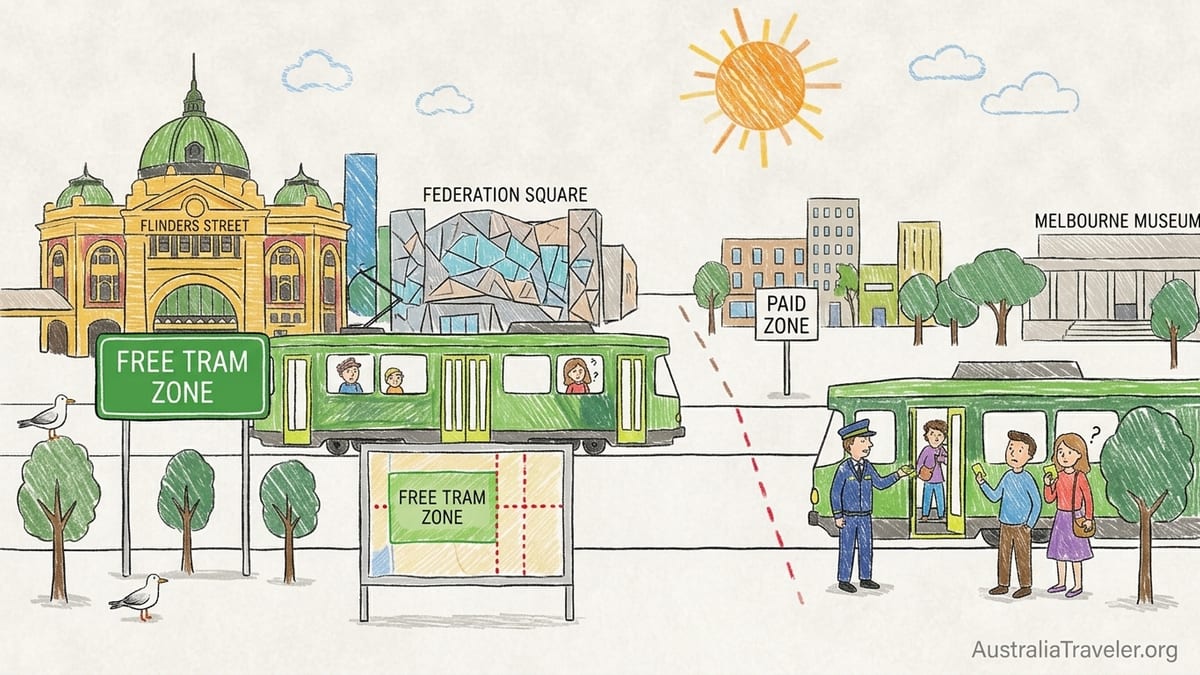
How I Got Caught Out By A Free Tram That Wasn’t
My own education in Melbourne’s Free Tram Zone began on a sunny weekday morning at Flinders Street Station. I boarded a southbound St Kilda Road tram outside Federation Square, heading to the Royal Botanic Gardens. The stop shelter carried the familiar Free Tram Zone strip map and the audio announcement on board welcomed passengers to the "city’s Free Tram Zone." Confident I was still within the free area, I stayed seated as we rolled across Princes Bridge.
Somewhere between the Yarra River and the manicured lawns of the gardens, the reality changed. The conductor-style announcements stopped mentioning the Free Tram Zone and a quiet chime reminded passengers to tap on with myki. I did not. When an authorised officer stepped on near the Shrine of Remembrance and asked to see tickets, several tourists in my section, myself included, produced untouched myki cards and explained we were told "the trams are free in Melbourne." We had crossed out of the Free Tram Zone without any dramatic change in scenery, and every one of us was technically travelling without a valid ticket.
In my case, the officer chose to issue a formal warning after checking my passport and recent myki activity. Others on board were not as lucky and were advised they would receive an infringement notice by mail once their details were processed. As I stepped back onto St Kilda Road, what surprised me most was not the enforcement itself but how subtle the paid boundary had been. One stop you are inside Melbourne’s highly promoted Free Tram Zone, the next stop you are not, and unless you know exactly which stop numbers mark the edge, it is painfully easy to get it wrong.
Later that day, I discovered a second unpleasant surprise. On a separate trip I had dutifully tapped my myki when boarding a tram entirely within the Free Tram Zone, thinking it was safer to pay if there was any doubt. That trip showed up on my online account as a charge that would require a reimbursement request to reverse. In other words, you can be penalised financially even when you are trying to do the right thing.
What The Free Tram Zone Actually Is (And Is Not)
The first mental reset visitors need is simple: Melbourne’s Free Tram Zone is not the whole tram network. It is a tightly defined area covering the central business district and Docklands, aligned with a specific boundary map published by Transport Victoria and used on official visitor guides. It stretches roughly from Queen Victoria Market in the north, to Docklands and Victoria Harbour in the west, to Spring Street in the east, and a short way over the Yarra River to Federation Square and Flinders Street Station in the south.
Within this rectangle of streets, most tram stops carry green "Free Tram Zone" branding and many have the boundary map displayed on the shelter. Trams that run through the area, such as the routes 35 City Circle, 75, 96 and 109, are free only while they remain inside this zone. As soon as the tram passes the last free stop and heads into the suburbs, normal myki fares apply from the first stop outside the boundary.
Docklands, including popular spots around Marvel Stadium and Victoria Harbour, is firmly inside the Free Tram Zone. That means a ride from Southern Cross Station to the Docklands library or the shopping and restaurant precinct along Bourke Street can legitimately be free on multiple routes, as long as you do not stay on past the final free stop. On the eastern side, Spring Street and Parliament Station mark another hard edge: go beyond here on routes that climb towards Fitzroy or Carlton and you are suddenly in paid territory.
The detail that catches so many people out is that Melbourne’s visitor marketing often leans on the phrase "free trams in the city" without emphasising the strict limits. The city in tourist imagination includes leafy boulevards, major gardens and cultural institutions that sit just outside the technical Free Tram Zone, which is where confusion and unplanned charges begin.
Common Trap Destinations: St Kilda, Fitzroy, Carlton & South Yarra
Consider St Kilda, one of Melbourne’s most famous seaside suburbs. The route 16 and 96 trams connect the city to Luna Park, Acland Street and the beach, and both are heavily used by visitors. Only the small inner section of these routes near the CBD sits within the Free Tram Zone. Once you pass the last free stop close to the city centre, you are required to tap on and pay. Tourists who assume a "city to beach" ride is fully free can easily find themselves travelling several kilometres on a paid section of track without a valid fare.
Fitzroy and Carlton create a different kind of trap. From the northern edge of the CBD, trams slide almost imperceptibly into these inner suburbs, past terraces filled with cafes and boutiques and on towards the Melbourne Museum and the heritage streets around Lygon Street. While the Melbourne Museum itself is close enough to walk from Parliament or Melbourne Central stations, many visitors hop on a tram for what appears to be a short city ride. The challenge is that once the tram crosses out of the zone near Victoria Parade or Nicholson Street, the journey becomes a paid one, yet there is rarely a distinct announcement spelling that moment out.
South Yarra offers another instructive example. Trams along St Kilda Road and Toorak Road serve the dense hotel corridor leading towards the Domain precinct and further to Chapel Street and South Yarra Station. Some stops just beyond the river, including those near the National Gallery of Victoria and Federation Square, sit inside the Free Tram Zone. Continue only a few more stops towards Domain Interchange, however, and you leave the free area. International visitors staying in South Yarra hotels often learn this the hard way when their supposedly free morning commute into "the city" triggers myki deductions.
In all of these cases, the scenery does not dramatically change at the boundary. You do not leave skyscrapers for suburbs in a single block. The tram simply keeps rolling and, unless you have memorised the stop numbers shown on the official map, there is little to tell you that the free ride you boarded has quietly become a paid one.
Inside Or Outside: Melbourne Museum, Royal Botanic Gardens And Other Grey Areas
Two of Melbourne’s marquee attractions illustrate how the Free Tram Zone map collides with visitor expectations. The Melbourne Museum sits in Carlton Gardens, just north east of the CBD. On the official Free Tram Zone map used in visitor publications, the zone ends around the northern edge of the CBD grid near Victoria Parade. That means the last free stops are clustered near Bourke Street, Swanston Street and Spring Street. From there the museum is a 10 to 15 minute walk across parks and past heritage buildings. Any tram ride that carries you closer to the museum gates, such as along Nicholson Street, will quickly move you into the paid area.
The Royal Botanic Gardens, where I had my own brush with fare confusion, are a short distance south of the Yarra along St Kilda Road and Alexandra Avenue. Federation Square and the immediate stretch of St Kilda Road by Flinders Street Station are inside the Free Tram Zone, which is why so many people board a tram there assuming the free coverage extends all the way to the gardens. In practice, the zone stops partway down the boulevard. The official government transport maps that were updated for 2026 show the line dipping just beyond the river, placing the core of the gardens and the Shrine of Remembrance outside the free boundary.
There are, however, ways to use free travel strategically. From Southern Cross Station or Flinders Street Station, you can ride a free tram to the nearest boundary stop and then walk the final stretch to these attractions. For the Melbourne Museum, that might mean turning the last free City Circle stop into a short stroll up Lonsdale and Nicholson Streets. For the Royal Botanic Gardens, it can mean riding free to the last CBD stop on St Kilda Road, then enjoying a scenic walk past the Arts Centre spire and the Shrine.
This "tram and walk" pattern is worth adopting. It respects the legal limits of the Free Tram Zone while keeping you off crowded trams for one or two stops that tend to confuse people. It also saves you from relying on the sometimes hard to read platform stickers that show whether a stop number is inside or outside the zone.
How Easy It Is To Drift Into A Paid Zone Without Realising
On paper, the Free Tram Zone has a clean boundary. On the ground, that boundary is anything but obvious. The transition from free to paid can happen in a single stop. One moment you are in dockside Docklands, the next you are under the shadow of stadiums and office towers in a normal fare zone. Likewise, trams that loop around the CBD, such as the City Circle, pass so close to the edge that a distracted traveller can stay aboard as the route curves away from the free section.
Signage exists but is inconsistent. Some tram shelters are wrapped in green branding with a very clear "You are leaving the Free Tram Zone" warning. Others are older and carry only small stickers or maps that require you to know exactly which stop you are at. Inside trams, digital screens may display "Free Tram Zone" when you are inside the area, but this relies on you watching at the right moment. Audio announcements vary by route and sometimes fail to mention the boundary at all when services are busy.
The other subtlety is that Melbourne’s grid is not perfectly aligned with how visitors talk about the city. Many hotel concierges and tourism brochures describe the "city" as stretching to major attractions along St Kilda Road, into Carlton and down towards Southbank and South Yarra. From a cultural point of view they are correct. From a fare enforcement point of view, this can be dangerously misleading. The Free Tram Zone follows a line of specific streets and intersections that carves across this broader mental map, so you can very easily think you are still in the city while your myki balance insists you are not.
Finally, routes that change number or continue under a different sign can mask the way boundaries apply. For example, several north south tram lines use the same tracks through the CBD before splitting towards inner suburbs. A traveller who boards a route 75 tram outside Flinders Street Station is entirely within their rights not to tap on while inside the Free Tram Zone. If they stay on past the last free stop, however, that same physical journey instantly switches to a paid ride. There is no barrier at the edge of the zone, only an expectation that you understand the invisible rules.
Authorised Officers, Inspections And Infringements
Melbourne’s tram network is patrolled by authorised officers who are empowered under Victorian law to check tickets, ask for identification and initiate infringement notices when people are travelling without a valid fare. These officers work for the state’s transport operators but are appointed and regulated by the government. They carry official identification, including a badge and identification number, and are required to show it if asked.
On trams, inspections often happen at busy stops or on runs that serve major events, but they can occur at any time of day. Officers will usually board at one or more doors, announce a ticket check and then move through the vehicle scanning myki cards, Mobile myki and contactless cards on portable devices. If you are in the Free Tram Zone and clearly boarded and alighted within it, the check is generally quick. Once trams are in paid territory, officers expect all passengers to have tapped on with a valid ticket or payment method before boarding or immediately after.
When someone does not have a valid ticket, officers have discretion. They might issue a warning, particularly if it appears to be a first genuine mistake, or they may record the person’s details and refer the matter for an infringement notice to be mailed later. The process is explained on Victorian government channels, but one crucial detail is that there is usually a delay of several weeks between the incident and the arrival of the notice, which can be a nasty surprise for visitors already back home. The exact fine amounts and options for review or payment are set in state regulations, updated periodically and listed in government schedules. They are not something to gamble with for the sake of a few dollars in myki credit.
Authorised officers are also responsible for handling surrendered myki cards in certain situations, such as where a passenger chooses to hand over a card. In those cases, unused credit can be refunded through processes described by Transport Victoria, although for short stay visitors the administrative burden often outweighs the small amounts involved. The key takeaway is that tram fare enforcement in Melbourne is real, active and not something you can avoid simply by claiming you thought the tram was free.
The Myki Catch: Why Touching On In The Free Tram Zone Can Still Cost You
The counterintuitive twist in Melbourne’s system is that you are not meant to touch on with your myki for a trip that is entirely within the Free Tram Zone. The official maps and platform posters state this, but many cautious visitors are so anxious about being fined that they tap anyway. On older myki readers, that tap can trigger a standard Zone 1 fare deduction, particularly if the system interprets your travel as extending beyond the free boundary or connecting with previous trips.
When you tap on inside the Free Tram Zone and then tap off outside it, the situation is clear: you are taking a paid journey, and the fare is calculated across the full section travelled. The confusion arises when both your origin and destination are inside the free area, yet the system still charges you. This can happen when the reader is not correctly configured, when a tram briefly leaves and re enters the zone as part of its route, or when your tap history combines with other trips within the two hour fare window in a way that triggers a debit.
Transport Victoria acknowledges that customers can occasionally be charged for travel that should have been free and provides a reimbursement process. Registered myki users can log into their account, review their online travel history, and submit a request to have incorrect charges refunded or converted to additional myki credit. Unregistered users may need to call the customer service line or visit a staffed station or PTV Hub to initiate a review. None of this is instant, and by the time your claim is processed you may already have left Australia, which demonstrates how a moment of over caution can create as much hassle as failing to tap at all.
The simplest rule is ironically the hardest to trust: if your entire tram journey is clearly within the Free Tram Zone, you should not touch on or off with myki or contactless at all. If there is any possibility that you will travel outside the zone, you should tap on before crossing the boundary and be prepared to pay for that portion of the ride. Half measures, such as tapping only when you see an authorised officer, are both unethical and likely to backfire.
Physical Myki, Mobile Myki And New Contactless Payments In 2026
For years, Melbourne relied on physical myki cards and, for Android users, Mobile myki stored in Google Wallet. By late 2026 the landscape has shifted. Contactless payments using Visa and Mastercard credit or debit cards, as well as compatible smartphones and smartwatches, are now available across trains, trams and buses in Victoria. Transport Victoria’s official contactless information confirms that you can tap your bank card or device on myki readers to pay for standard fares, with charges set at the same rate as myki.
In practice, this means visitors arriving from overseas can step off the plane, board a SkyBus alternative or metropolitan service and start using their familiar bank card to ride trams and trains without ever buying a physical myki, as long as they are travelling on full fare. Mobile myki remains an option on eligible Android phones through Google Wallet, useful for people who prefer to load a balance or a pass in advance. At the time of writing, a fully equivalent Mobile myki is still not available for iPhone, even though iPhones can of course be used for contactless tap and go payments linked to a bank card.
There are important caveats. Contactless payments initially applied to full fare travel and have been progressively expanded to cover more passenger types. To receive concession fares through contactless, such as those available to seniors or eligible students, you must follow Transport Victoria’s process to link your concession status to your card or device. Without that linkage, taps will be treated as full fare. For concession travellers who value simple proof of entitlement, a physical or Mobile myki set to the correct concession type can still be the safer choice.
Then there is the Youth myki. From 2026, Victoria introduced a Youth myki that provides free or heavily discounted travel for people under a set age threshold, typically under 18, across trains, trams and buses. This product sits alongside existing concession arrangements and relies on the passenger holding a dedicated card type. It is not the same as simply being young and tapping a bank card. For families visiting Melbourne, this can mean a mixed payment environment where parents are best served by contactless while teenagers eligible under local rules should use a Youth myki arranged in advance, if they qualify.
Temporary Half Price Fares And Why They Do Not Make The Zone Less Confusing
From 1 June 2026 until 1 January 2027, the Victorian Government has made all public transport across the state half price. Official transport announcements explain that this applies to trains, trams and buses, including regional services, with the maximum full fare daily cap in metropolitan Melbourne effectively cut in half for this period. For concession passengers, including those on student or seniors discounts, their already reduced fares are also halved again.
There was also a separate window earlier in 2026 when public transport was made completely free for a limited period, as documented in state budget papers. That short term universal free travel has since ended. As of late October 2026, the operative rule is half price fares until the start of January 2027, apart from other standing offers such as the early bird free train program for very early commuters.
For visitors, it is tempting to treat "half price" as a signal that the details no longer matter. After all, if your daily cap is temporarily lower, why worry about where the Free Tram Zone begins and ends. This is misleading for two reasons. First, half price does not mean no enforcement. Authorised officers still check for valid taps outside the free area, and infringement processes remain unchanged. Second, the financial hit can still be significant if multiple family members are fined or repeatedly travel without paying, especially over a multi day stay.
The half price period also has an end date. Anyone visiting around New Year’s Eve 2026 into New Year’s Day 2027 should pay close attention to official announcements about when fares revert to their normal levels. Some special event free travel windows can overlap with these dates, particularly overnight New Year services, but they are limited in time and scope. The Free Tram Zone, by contrast, operates continuously and is unaffected by the temporary pricing experiment. Its confusing boundaries will still be in force long after the discount headlines fade.
The Takeaway: A Simple Strategy For Getting Around Without Costly Surprises
After multiple trips, a warning from an authorised officer and several hours studying official maps, I have settled on a straightforward approach to Melbourne’s trams that I wish someone had spelt out clearly on my first day. It does not eliminate the quirks of the Free Tram Zone or the occasional myki glitch, but it dramatically reduces the chances of being charged when you thought you were free, or fined when you thought you were safe.
When you are moving strictly within the heart of the CBD and Docklands, think of the tram as a horizontal lift. If both the stop you are boarding from and the stop you are getting off at are unmistakably inside the Free Tram Zone, do not tap on or off at all. Use the trams to hop between Southern Cross Station, Federation Square, Queen Victoria Market, Docklands, Parliament and the core shopping streets without ever presenting a card to the reader.
For anything that involves crossing the edge of the map, pay. If you are heading to St Kilda, Fitzroy, Carlton, South Yarra, the Royal Botanic Gardens or any other location you would not reasonably describe as being in "the CBD or Docklands," assume it is outside the zone. Tap on with either a physical myki, Mobile myki or a supported contactless card or device as soon as you board, and tap off where required. Accept the small cost, knowing that until at least 1 January 2027 you are benefiting from temporarily reduced fares across the network.
Finally, walk with intention. Melbourne is a compact, walkable city at its core. From the last free stop near Parliament to the Melbourne Museum, from the CBD boundary on St Kilda Road to the Royal Botanic Gardens, from the edge of Docklands to the stadium precinct, a ten or fifteen minute walk can keep you firmly within the rules, avoid ticket inspections altogether and help you understand the city at street level. The Free Tram Zone is a useful tool, but it is not a blanket pass. Treat it as a narrow corridor of genuinely free movement rather than a promise of citywide free transport, and you will enjoy Melbourne without the myki mistakes that caught me out.
FAQ
Q1. Is all tram travel in Melbourne free for visitors?
Tram travel is only free within the clearly defined Free Tram Zone that covers Melbourne’s CBD and Docklands. Anywhere outside that zone, including suburbs like St Kilda, Fitzroy, Carlton and South Yarra, requires a valid paid fare.
Q2. How do I know if a tram stop is inside the Free Tram Zone?
Stops inside the zone usually display green Free Tram Zone branding and appear within the boundary on official transport and visitor maps. If the stop is beyond the CBD grid or Docklands area, especially on routes heading towards residential suburbs, you should assume it is outside the free area unless an up to date map clearly shows otherwise.
Q3. Should I tap my myki or contactless card if I am only travelling within the Free Tram Zone?
No. For tram trips that both start and end inside the Free Tram Zone, you should not tap on or off. Tapping for these journeys can occasionally trigger a charge, which then has to be reversed through a reimbursement process.
Q4. What happens if I stay on the tram past the edge of the Free Tram Zone without tapping?
If you travel beyond the last free stop without tapping on, you are considered to be travelling without a valid ticket. During inspections, authorised officers can record your details and an infringement notice may later be issued, even if the initial part of your ride was legitimately free.
Q5. Are Melbourne Museum and the Royal Botanic Gardens inside the Free Tram Zone?
No. Both Melbourne Museum and the Royal Botanic Gardens sit just outside the Free Tram Zone. You can ride a free tram to the closest boundary stop and then walk, or you can tap on and pay for the tram journey that carries you closer to their entrances.
Q6. Can I just use my bank card or phone instead of buying a myki?
Yes, most visitors can now tap on with a contactless Visa or Mastercard, or a compatible smartphone or smartwatch, to pay the same fares as a physical myki. This applies across trains, trams and buses, although concession users need to meet extra requirements if they want concession fares.
Q7. What is the difference between physical myki, Mobile myki and contactless payments?
A physical myki is a reloadable plastic card, Mobile myki is a digital version stored in Google Wallet on eligible Android phones, and contactless payments let you tap a bank card or device directly on the reader. All three can pay for standard fares, but only myki products store passes, and concession or Youth myki benefits rely on having the correct card or linked status.
Q8. How do temporary half price fares affect what I pay as a visitor?
Between 1 June 2026 and 1 January 2027, standard fares across Victoria are automatically charged at half their usual rate when you tap on, whether with myki or contactless. This reduces the cost of paid trips but does not change where the Free Tram Zone starts and ends or how infractions are enforced.
Q9. What should I do if I am charged for a trip that should have been free?
If your myki or contactless history shows a charge for a tram trip entirely within the Free Tram Zone, you can contact Transport Victoria to request a review and reimbursement. Registered myki users can usually start this process online, while others may need to call or visit a service counter.
Q10. What is the safest simple rule to avoid fines on Melbourne trams?
Use trams for free only within the obvious CBD and Docklands core without tapping, and assume every journey to or from outer neighbourhoods or major attractions beyond that core requires a paid tap on. When in doubt, check a current Free Tram Zone map or choose to walk the final stretch.