


I thought I knew what I was signing up for when I booked a Phillip Island Penguin Parade evening tour from Melbourne. It was marketed as a relaxed “eco adventure,” the perfect way to watch Australia’s little penguins waddle ashore without worrying about driving or logistics. Instead, I spent most of the day sitting on a bus, shuffling through crowds and clock-watching, with only a sliver of meaningful time actually on Phillip Island. After investigating the way these rushed excursions are structured, I would not book another one.
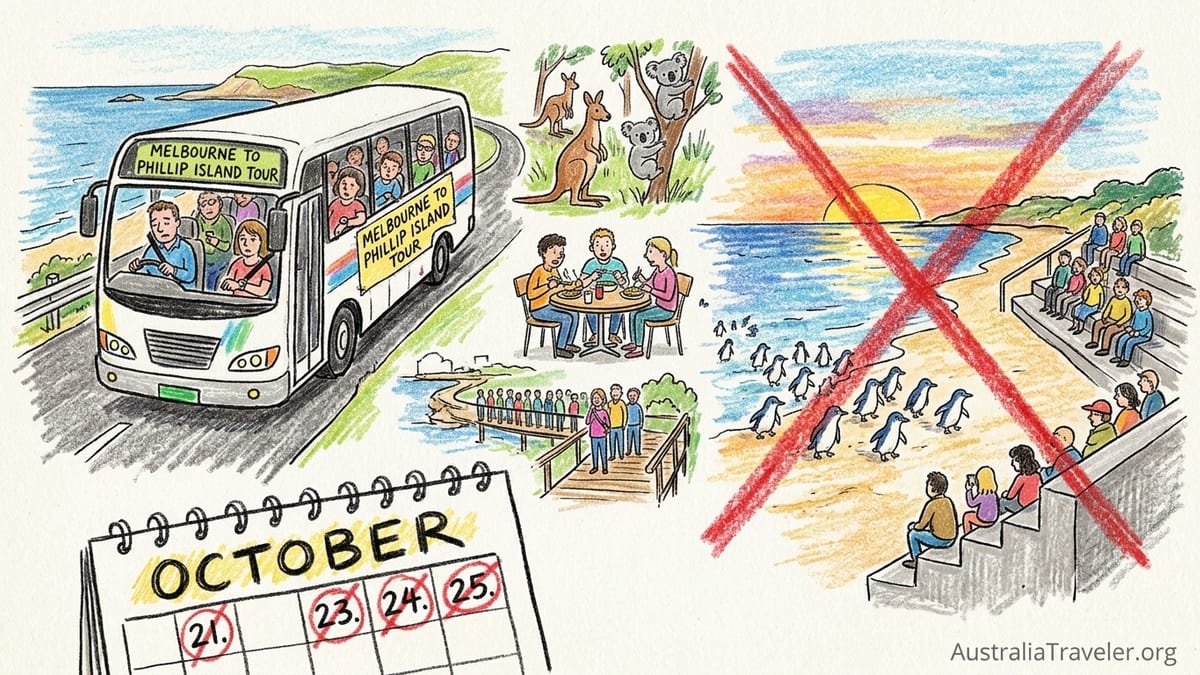
The Tour I Actually Took: Promises Versus Reality
The tour I chose was a common template sold all over Melbourne’s CBD: a one day Phillip Island Penguin Parade trip on a shared coach. The company I booked with charged about A$139 per adult for a full-day itinerary that promised hotel pickup, a stop at a wildlife park to see kangaroos and koalas, free time in Cowes for dinner, and general viewing admission at the Penguin Parade. Departure was billed as an early afternoon pick-up, with a “comfortable return to Melbourne late evening.” On paper it sounded efficient and well paced.
The reality began with a rolling series of hotel collections. My ticket said 1:10 p.m. pickup from a central hotel on Little Bourke Street. The bus arrived closer to 1:30 p.m., already half full, and then spent another 40 minutes threading through city traffic to collect more passengers. We did not properly leave Melbourne’s urban sprawl for the Monash Freeway until close to 2:15 p.m. That sluggish start framed the rest of the day: there was always another delay built into a timetable that simply tried to do too much.
By the time we reached the outskirts of Phillip Island, we had already been on the road for around two hours, with a quick comfort stop at a service station. Only then did the “wildlife experiences” begin. Our coach pulled into a small wildlife park for an hour, which was enough time to queue for kangaroo feeding and koala viewing platforms, but not enough to feel like a real nature immersion. It was closer to ticking a box than experiencing Victoria’s ecosystems in any depth.
We rolled into Cowes, the island’s main town, just after 5 p.m. The driver announced that we had a tightly timed dinner break and should be back on the bus by 6 p.m. so we could reach the Penguin Parade visitor centre ahead of the main crowds. That gave us perhaps 45 minutes of actual eating time once you allowed for disembarking, finding a café that could serve quickly, and paying. This was my first strong sense that the ratio of transit and queueing to actual island time was badly skewed.
How the Day Really Breaks Down
When I reconstructed the timeline afterwards, the imbalance became stark. From a little after 1 p.m. to about 3:45 p.m. was largely consumed by hotel pick-ups and freeway driving. We spent maybe 60 rushed minutes at the wildlife park, followed by another 30 to 40 minutes driving to Cowes. Dinner in Cowes consumed less than an hour, then it was roughly a 20-minute drive to the Penguin Parade at Summerland Beach.
Doors for the Penguin Parade visitor centre generally open well before dusk, but the penguins only begin to arrive at sunset. In October and November, that means sometime after 7:30 p.m. and progressively later as summer approaches. The tour insisted on getting us into the stands early. We were told bluntly that if we did not head down to the viewing area immediately after arriving, we might not get good seats in general viewing. I found myself sitting on cold concrete benches almost an hour before the first penguin appeared, guarding a patch of space while the wind whipped in from Bass Strait.
The actual time with penguins on the beach, from the first group emerging from the surf to the last stragglers making their way up the dunes, was around 50 to 60 minutes. After that, the rangers ushered people gently back toward the boardwalks and visitor centre. Our coach departed the car park a little after 9:30 p.m., and we did not pull back into central Melbourne until close to midnight, after multiple CBD drop-offs. In total, I had spent almost ten and a half hours away from my hotel, with only about one concentrated hour of truly distinctive penguin viewing and very brief snatches of other island experiences.
If you run those numbers, less than 15 percent of the day felt like meaningful time with Phillip Island’s landscapes and wildlife. The rest was spent in buses, queues, souvenir areas and hurried meal breaks. That may sound like a harsh verdict, but it aligns with how these coach itineraries must operate: they are trying to thread sunset, a two-hour drive each way and multiple commercial stops into a single afternoon and evening from Melbourne.
An Exhausting Schedule for Families
The late return to Melbourne is not just inconvenient; it is genuinely punishing for families with younger children. On my coach, there were several primary-school-age kids who were flagging badly by the time we reached Cowes. By the time we were sitting in the stands at the Penguin Parade, many of them were wrapped in hired blankets, half asleep, fighting the windy cold and the long wait for the penguins to appear. When the main parade began, a few were simply too tired to care.
Because sunset dictates the timing, the day cannot be easily shortened. In mid-summer, sunset can slide toward 9 p.m., which means coaches do not leave the car park until very late. With a two-hour journey back to Melbourne and then staggered hotel drop-offs, it is not unusual for families to get back to city hotels at 12:30 a.m. or later. For young children who are not used to being upright and shivering on a coastal headland at that hour, the schedule can feel like a marathon.
The cumulative fatigue also erodes the quality of the wildlife experience. Adults who have been on a bus since early afternoon, shuffled through a wildlife park, herded into food outlets, then parked on concrete waiting for the main event are not in the most receptive mood for quiet observation. That is a pity, because Phillip Island Nature Parks is genuinely serious about conservation and interpretation. The visitor centre has thoughtful exhibits on penguin biology and the broader ecosystem, but on my tour, hardly anyone engaged with them deeply. People grabbed a quick coffee, pushed through the crowds and made a beeline for the stands, too mentally and physically tired to explore.
I came away feeling that the very coach format which makes the Penguin Parade accessible for many also makes it harder to appreciate the subtleties of the place. Instead of a slow-burn introduction to the peninsula’s wetlands, bluffs and birdlife, you get a compressed highlight reel at a time of day when everyone is running on empty.
The Viewing Experience: Crowds, Cold and Questionable “Premium” Upgrades
The viewing experience itself is a mix of world-class wildlife and very human frustrations. The basic general viewing stands are large tiered terraces overlooking Summerland Beach. General viewing is the category bundled into most Melbourne day tours. The current published price for a stand-alone general admission ticket starts around A$34 per adult, depending on season and promotions. That is a fair price for direct support of a conservation-focused attraction, but on a busy night the value can feel diluted by sheer crowd density.
General viewing is first-come, first-served. On my tour, by the time we reached the stands, corporate groups and earlier-arriving independent travelers had already claimed many of the central seats. Families were spreading out bags and jackets to hold space. Rangers did their best to keep aisles clear, but the result was still a tight squeeze. Once seated, you must stay relatively still; getting up for the bathroom or to adjust your position risks losing your spot entirely. When the first penguin rafts broke the surf, there were audible gasps. The magic of seeing hundreds of little penguins wobbling up the beach in the fading light is real. Yet I found myself peering between other visitors’ shoulders, aware that if I had paid for a premium category I might have had a clearer line of sight.
Phillip Island Nature Parks currently offers several upgraded experiences beyond general viewing. Penguins Plus is a smaller platform in a more intimate location that channels one of the main penguin pathways. Recent published prices list Penguins Plus at roughly A$93 per adult. Underground Viewing, where you watch the penguins at eye level through glass as they waddle along their “penguin highway,” is priced higher again, often around A$103 per adult. There are also premium stands and guided small-group options that climb even further up the pricing ladder. While those prices can shift and are always subject to official updates, the pattern is consistent: you pay significantly more for smaller numbers, more shelter and better sight lines.
Do these upgrades genuinely transform the experience? From what I observed and later discussed with other travelers, the answer is mixed. Penguins Plus and Underground Viewing clearly reduce crowding and shield you from the worst of the coastal wind. On a night like mine, when gusts came hard off Bass Strait and temperatures on the exposed terraces sank sharply after sunset, that extra comfort would have been welcome. But they do not change the basic constraint that you are still on a fixed timetable dictated by a coach schedule. Passengers in premium categories on my bus still had to be back at the vehicle at the same time as everyone else. They also spent much of the pre-parade period waiting, simply in a different seating area.
No Photos Allowed: The Conservation Argument and Visitor Frustration
One of the most contentious rules at the Penguin Parade is the strict prohibition on photography and filming after sunset in the viewing areas. Phillip Island Nature Parks is unequivocal about this. There is no photography or filming allowed once the light drops and the penguins are coming ashore. Rangers reinforce this in multiple languages and patrol the stands and boardwalks, asking people to put cameras and phones away. The same policy applies on the boardwalks behind the beach as you watch penguins passing close to the path.
The reasoning is soundly rooted in wildlife welfare. Little penguins have sensitive eyes, and sudden flashes, bright screens or beams of light can startle or disorient them as they navigate from the surf back to their burrows. Management notes that recurring flashes and unusual light patterns can alter penguin behavior and potentially impact breeding success. To reduce that risk, they have adopted a zero-tolerance position for recreational photography during the nightly parade, with rare exceptions only for controlled professional filming under permit and with low-light equipment.
As a traveler accustomed to documenting experiences, I found this emotionally conflicted. On one hand, I respect the science-based approach and the priority given to the birds. On the other, many visitors around me were quietly frustrated to learn that they could not take any close-up images. Some had clearly imagined capturing their children with penguins in the background or a line of penguins marching past in the dusk. The visitor centre does offer professionally captured images and footage for download, and there are photo panels and exhibits where you can take selfies beforehand. Still, that is not quite the same as creating your own photographs of a once-in-a-lifetime encounter.
This is where the rushed tour format grates particularly hard. If you have committed an entire afternoon and late night, wrestled children through an exhausting schedule and paid for premium seating, it can feel like one more compromise to leave without any personal penguin photos. The rule is justified and necessary. Yet coach companies’ marketing rarely foregrounds it. Brochures emphasize “up-close encounters” without clearly spelling out that those encounters exist only in memory, not in camera rolls.
Why Public Transport Is Not an Easy Evening Alternative
After my tour, I considered returning independently another time to do things at my own pace. On paper, public transport seems tempting. V/Line coaches run from Melbourne’s Southern Cross Station to Phillip Island, with connections to the main township of Cowes. However, Phillip Island Nature Parks itself cautions that this is not a viable way to attend the Penguin Parade in the evening. The bus reaches Cowes, not the Summerland Peninsula where the parade takes place, and there is no reliable late-night public transport from the penguin site back to Cowes or from Cowes back to Melbourne after the event.
The nature parks’ official frequently asked questions make this explicit: the coach service that travels between Melbourne and Phillip Island does not operate after the Penguin Parade. Taxis and on-demand rideshare are limited on the island, and even if you could arrange one, the cost would be high, especially if you needed to return all the way to Melbourne at night. There is also no island-wide evening shuttle linking attractions. In practice, without your own car, you are either dependent on an organized tour or restricted to daytime visits.
This gap in public transport is a problem for independent-minded travelers who might otherwise design a calmer schedule. If there was a late-return bus timed to the parade, it would immediately open up more flexible options. As things stand, the choice on a short Melbourne stay is often between taking a shared coach or not seeing the penguins at all, unless you are comfortable hiring a car and driving back to the city in the dark.
Shared Tours, Self-Driving and Staying Overnight
Having now experienced a classic coach tour, I see three main ways to approach the Penguin Parade, each with distinct trade-offs. Shared tours are the simplest to book, bundle admission and transport, and remove the stress of night driving on regional roads. For solo travelers and people who strongly dislike driving, this is still a rational option, provided you go in clear-eyed about the long hours, limited island time and late return.
Self-driving gives you the most control over your schedule. Phillip Island is about 140 kilometers from central Melbourne, mostly along major freeways and well-signed roads, although the final stretches involve some country driving and the weather can change quickly. With a rental car, you can leave Melbourne mid-morning, explore Churchill Island, the Nobbies Centre or the Koala Conservation Reserve at your own pace, have an early dinner somewhere like Cowes or Rhyll, then arrive at the Penguin Parade visitor centre in time for sunset without being herded by a timetable. After the parade, you can depart as soon as you are ready, without waiting for dozens of other passengers.
The drawback is that someone in your group must stay fresh to drive back to Melbourne, potentially starting a two-hour journey close to 10 p.m. or later. For nervous drivers, that is a significant burden. It is also more complicated for visitors unused to Australian road rules or right-hand drive. On the other hand, the cost of car hire, fuel and independent tickets can compare reasonably with four or more premium coach tour seats, particularly for families.
The option that made the most sense once I had dissected my rushed tour was to stay overnight on Phillip Island. Even a single night in Cowes or nearby Newhaven transforms the experience. You can arrive on the island earlier in the day, explore beaches, boardwalks and wetlands, check into your accommodation, then head to the Penguin Parade in the evening with only a short drive back to your bed afterwards. The next morning, you are already in place to walk coastal tracks or visit additional nature parks without another long coach journey.
Accommodation ranges from simple motels and holiday parks to apartments and boutique stays. Prices fluctuate by season and event calendar, especially around major race weekends and school holidays, but by visiting outside peak times you can often find reasonable midweek rates. With an overnight base, the penguins become one highlight within a broader encounter with the island, not the sole, exhausting objective.
The Tour Format I Would Avoid and a Better Way to See the Penguins
Having picked apart my own experience and cross-checked it against current schedules, prices and access information, there is one format I would personally avoid in future: the tightly scheduled afternoon-and-evening coach tour from Melbourne that promises “everything in one easy day.” Too many hours vanish into hotel pick-ups, freeway driving, compulsory stops and early seating, while the most special part of the day, the penguin parade itself, ends up feeling wedged into a small, tired window.
If I were advising a friend or planning a return trip, I would propose two stronger alternatives. The first is to rent a car, leave Melbourne late morning or midday, and treat Phillip Island as a full-day coastal escape. Spend the early afternoon walking a headland track, watching seabirds at the Nobbies, or visiting the Koala Conservation Reserve. Have an unhurried early dinner in Cowes, then arrive at the Penguin Parade visitor centre about an hour before the stated session time. Select your preferred viewing category based on your budget and tolerance for cold and crowds. General viewing around A$34 per adult is defensible if you are prepared to arrive early and carry warm clothing. If you value comfort and closer views, paying extra for Penguins Plus or Underground Viewing can be worthwhile, especially on a windy night.
The second, better still, is to commit to at least one night on the island. Take a lunchtime V/Line coach to Cowes while services are running, check into a local stay, and either join a short local shuttle or hire a small car to reach the Penguin Parade and other attractions. This splits the fatigue across two days and gives you breathing room to enjoy Phillip Island beyond a single spectacle. Even if you still rely on an evening tour for transport to the penguins, starting from Cowes rather than Melbourne slashes your bus time and allows children to rest in a nearby room before and after.
What I would not do again is sign up, uncritically, for a generic “Phillip Island and Penguin Parade” coach tour that squeezes wildlife parks, dinner, souvenir shopping and sunset penguin viewing into an afternoon departure from Melbourne and a midnight return. For travelers with only a couple of days in the city, it is tempting to treat this as a must-do, but you pay for that box-ticking with weariness and superficial engagement. The little penguins of Phillip Island deserve better than being reduced to the final act of an overstuffed excursion, and so do the people making the journey to see them.
FAQ
Q1. Is the classic afternoon and evening coach tour from Melbourne worth it for the Penguin Parade?
The value depends on your priorities. If you strongly dislike driving and have only one free day, the tour can still be a straightforward way to see the penguins. However, be prepared for a long afternoon and late night with relatively little unhurried time on Phillip Island itself. You may spend nine to ten hours away from your hotel for only about an hour of focused penguin viewing.
Q2. How much does general viewing at the Penguin Parade cost compared with premium options?
Recent published prices put basic Penguin Parade general viewing at around A$34 per adult, though exact figures vary by date and ticket type. Upgrade experiences such as Penguins Plus are typically priced close to three times that amount, while Underground Viewing can cost even more per adult. Always check the official site close to your visit, as prices are regularly reviewed.
Q3. Do premium categories like Penguins Plus or Underground Viewing really improve the experience?
They generally provide smaller crowds, better views and greater shelter from wind and cold, which many visitors appreciate, especially in winter. However, they do not change the overall timing of your evening. If you arrive on a packed coach, you will still be operating on the same rushed schedule as general viewing passengers, just in a different seating area.
Q4. Why is photography and filming banned during the Penguin Parade?
Phillip Island Nature Parks prohibits photography and filming after sunset in the viewing areas to protect the penguins. Sudden flashes and bright screens can startle or disorient the birds as they cross the beach and navigate back to their burrows. To minimize disturbance and support long-term conservation, the park applies a strict no-photography rule, with only tightly controlled exceptions for approved professional media.
Q5. Can I use public transport to visit the Penguin Parade in the evening?
Public transport is not a practical evening option. V/Line coach services from Melbourne will get you as far as Cowes during the day, but they do not run late enough after the Penguin Parade to bring you back to Melbourne. There is also no regular island-wide night bus from the penguin viewing area to Cowes after the event.
Q6. Is the Penguin Parade suitable for young children on a standard day tour?
The spectacle itself is enchanting for many children, but the timetable is demanding. Expect several hours of bus travel, late-night returns to Melbourne and long periods of waiting in cold, windy conditions before the penguins arrive. Very young children may struggle to stay engaged and comfortable, especially in the cooler months.
Q7. How cold and windy does it get at the viewing stands?
The viewing area faces Bass Strait and is exposed. Even in summer, temperatures can drop sharply after sunset and the wind can be strong. Warm layers, hats, gloves and windproof jackets are essential, and some visitors bring blankets. Premium and underground viewing areas offer better shelter but you should still dress for cold conditions.
Q8. Would you recommend self-driving instead of a coach tour?
If you are comfortable driving in Australia, self-driving is often the most flexible and rewarding option. It allows you to arrive on Phillip Island earlier in the day, explore other attractions at your own pace, choose where to eat and leave the Penguin Parade when it suits you. The trade-off is shouldering a late-night drive back to Melbourne.
Q9. Is it worth staying overnight on Phillip Island?
Yes, staying overnight transforms the experience. With a local base, you can visit beaches, wetlands and other nature parks without rushing, attend the Penguin Parade without a long return journey the same night and enjoy a slower, more connected sense of the island. It also reduces the stress of tight schedules and late finishes, especially for families.
Q10. If I only have one evening free in Melbourne, should I still try to see the Penguin Parade?
If seeing the little penguins is a lifelong dream and you accept the long travel and late return, a coach tour can still make sense. If you are more ambivalent or traveling with small children, you might instead spend that evening exploring closer-to-city experiences and save Phillip Island for a trip when you can devote at least a full day, ideally with an overnight stay, to do it justice.