


I did not fly to Melbourne dreaming of beaches. I came for flat whites, laneway murals, and the ritual of arguing about which coffee roastery was best. Yet after a few days in the city, the blue strip of Port Phillip Bay on the tram map tempted me. Could a city so obsessed with culture and food also deliver a memorable day at the beach? To find out, I gave myself two very different outings: a full afternoon and evening in St Kilda, and a slower, more curated escape to Brighton’s famous bathing boxes on Dendy Street Beach.
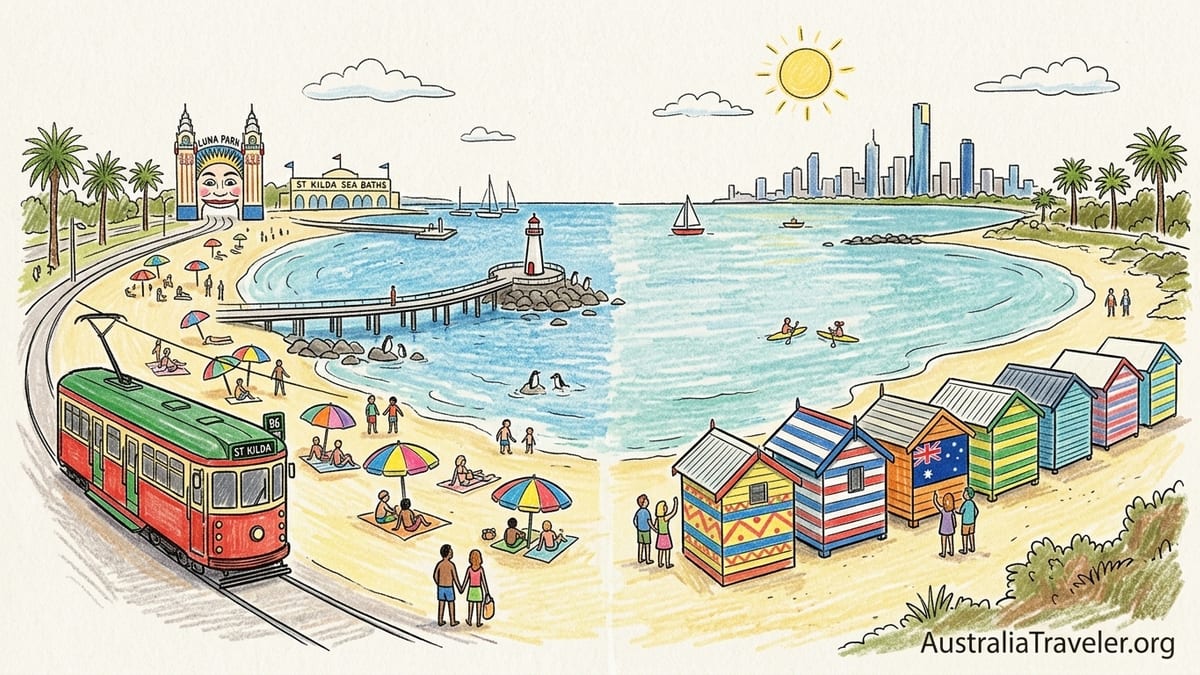
First Impressions: Culture City Meets Bay Water
My Melbourne mental picture was always more cobblestones than sand. Friends who lived here talked about the National Gallery of Victoria, laneway bars off Flinders Lane, and long lunches on Lygon Street. When I said I was thinking of a beach day, more than one local shrugged and said, “Well, they are bay beaches, not real surf.” That became my starting point. Port Phillip Bay is a broad, sheltered inlet, not an open ocean coastline. The water here is usually far calmer than the waves that pound places like Bells Beach or the surf coast along the Great Ocean Road. Think lapping edges of an enormous salt lake rather than thundering surf.
With that caveat in mind, I decided to lean into the city’s strengths. For St Kilda, I planned a whole afternoon around food, people-watching and sunset, plus a walk along the pier. For Brighton, my focus was on the iconic bathing boxes, the photographic potential and a more low-key swim. Both outings started in the CBD, so I could directly compare transport time, cost and effort.
From central Melbourne, St Kilda felt like an easy extension of the city. I caught the Route 96 tram from Bourke Street and in roughly 25 to 30 minutes rolled straight down to the St Kilda Beach terminus opposite the foreshore. For Brighton, I walked to Flinders Street Station and took a suburban train on the Sandringham line to Brighton Beach. The ride took just under half an hour before I stepped out to a quieter, more residential feel. Same city, same bay, completely different mood.
The contrast started before I even saw the water. At St Kilda, the closer the tram came to the beach, the more the carriage filled with a grab-bag of characters: families juggling prams and buckets, backpackers in sunhats, locals in gym gear, and a few people dressed for cocktail hour long before sunset. The Brighton train carriage was almost the opposite. Commuters peeled off at earlier stops, leaving a mix of locals heading home and a handful of tourists clearly bound for the bathing boxes with cameras already around their necks.
My Day at St Kilda: Sand, Pier and Acland Street Sugar
Stepping off the tram at St Kilda Beach felt like walking straight into a postcard. There was the broad sweep of pale sand, a row of green lawns and palms, the curve of St Kilda Pier stretching out into the bay, and behind it all a strip of cafes and bars facing the water. I arrived in mid-afternoon on a warm Sunday, and the beach was busy without being unbearable. Towels and umbrellas dotted the sand, but there were still pockets of space if you were willing to walk a little further from the main tram stop.
I waded in cautiously at first. Port Phillip Bay does not offer crystal-clear turquoise on every visit. The water that day was mildly cloudy close to the shore, with small bits of seaweed rolling in and out, but no obvious rubbish floating around. I had checked the Environmental Protection Authority’s online beach report in the morning, which forecasted acceptable water quality for St Kilda that day, so I felt comfortable going for a proper swim. The waves were gentle, knee to waist height where I was, which made it easy for casual swimmers and kids. If you are used to powerful surf, it might feel a little tame, but for floating and chatting it was ideal.
On the sand, the atmosphere was urban and energetic. Bluetooth speakers competed with the sound of gulls, and the crowd skewed younger: groups of friends with takeaway pizza boxes, couples with picnic blankets, and tourists attempting drone shots near the waterline. The upside was a certain buzz. The downside was the inevitable cigarette smoke here and there and the occasional abandoned drink can. Overall, though, the council’s bins and regular patrols seemed to keep the worst of it under control, and I saw staff collecting litter as they walked the promenade.
After swimming I dried off and headed for the pier. The redeveloped St Kilda Pier now curves gently out from the shore, with seating along the way and sweeping views back to the city skyline. Walking to the end, I could see kite surfers carving up the water further down the bay and ferries moving in and out. Even without penguins, the pier itself felt worth the stroll, especially in late afternoon light when the skyscrapers glowed and the water reflected strips of gold.
Esplanade Vibes, Cafés and Acland Street Cake Decisions
Leaving the sand, I crossed to the Esplanade, the tree-lined road that runs parallel to the beach. Here, St Kilda shows its personality. There were buskers playing guitar, cyclists cruising along the shared path and a steady trickle of people moving between the beach and the bars. In summer, the Esplanade often hosts events and markets, which can be worth checking on the City of Port Phillip’s listings because they affect both atmosphere and parking availability. On my visit, the only “event” was an informal parade of dogs and their owners heading towards the off-leash area at St Kilda West.
For a late lunch, I cut inland a few blocks to Acland Street, one of St Kilda’s classic commercial strips. It is famous for old-school cake shops with elaborately layered slices in the windows. I ended up at a long-running bakery-cafe where I ordered a slice of continental cheesecake and a flat white. Prices were very much inner-Melbourne: the cake and coffee together came to a little under 15 Australian dollars, not a bargain but fair for a generous slice and a well-made coffee. Sitting outside, I watched a mix of locals and visitors line up for gelato next door, while a busker worked through acoustic covers of 1990s favourites.
Acland Street is also full of casual dining options, from burgers and pizza to vegetarian cafes and contemporary bistros. It meant I did not feel locked into expensive waterfront menus. After coffee I wandered back towards the sea along Fitzroy Street, another major strip, and ducked into a smaller café for a cold drink later in the afternoon. St Kilda’s food scene genuinely enhances the beach experience. You are rarely more than a few minutes’ walk from decent coffee or a meal, which is not always true for more isolated Victorian beaches.
There were attractions I researched but consciously skipped this time. Luna Park, with its famous smiling entrance, sits just beside the Esplanade and is a nostalgic funfair option for families or anyone who loves old-school roller coasters. Similarly, the nearby St Kilda Botanical Gardens inland offer a quieter green escape with ornamental lakes and lawns. Both are easy to add if you want a broader St Kilda day, but my priority on this visit was to stick close to the water and the foreshore precinct.
St Kilda Penguins: Why I Did Not Join the Nightly Viewing
As sunset approached, I faced a decision about the little penguins that live in the breakwater at the end of St Kilda Pier. For years, people would simply wander out at dusk and wait on the rocks to see them come ashore. That uncontrolled approach is gone. After the pier’s redevelopment, penguin viewing is now managed through a free ticketed system operated by Phillip Island Nature Parks on behalf of Parks Victoria. Tickets are released online and are required for the structured nightly sessions on the new boardwalk at the breakwater.
I had not secured a ticket in advance. When I checked the booking page the week before, sessions for my travel dates were already fully allocated. Local news coverage and recent visitor reports suggested that during the reopening phase, tickets were often snapped up weeks or even months ahead, especially in peak seasons and on weekends. Some travellers reported occasional last-minute releases due to cancellations, but relying on that felt risky for my short stay.
Because I did not have a ticket, I chose not to head out at dusk and try to improvise. Staff on-site now direct ticket holders to the viewing area and manage access to protect the colony. The message is clear: if you want to see St Kilda’s penguins, treat it like a limited-capacity wildlife experience rather than an informal stroll. Book as early as possible, be prepared for structured timing, and understand that free does not mean unlimited access.
Even without the penguins, my St Kilda evening was pleasant. I grabbed a takeaway fish and chips pack from a shop near the sea baths, found a spot on the seawall and watched the sun sink behind silhouetted yachts. Streetlights flicked on along the pier, and the nightlife on Fitzroy and Acland Streets began to build. The trade-off was that by early evening the area felt crowded and heavily commercialised. Bars were advertising drink specials through loudspeakers, ride-share cars kept pulling over in bus zones, and small groups hovered around looking for a party. If your ideal beach day ends in relaxed quiet, St Kilda after dark can feel more like an entertainment district than a gentle bayside village.
Brighton and Dendy Street Beach: Chasing the Bathing Box Shot
My Brighton outing began in a much calmer way. From Flinders Street Station, I tapped on with my myki card and boarded a Sandringham line train. About 25 minutes later I stepped off at Brighton Beach station into a world of leafy streets and subdued traffic. No carnival atmosphere here, just the faint smell of sea air and the distant sound of waves against the seawall. There is a small café outside the station where I paused for a quick takeaway coffee before walking downhill towards the coast.
The route to Dendy Street Beach from the station is straightforward. I followed Beach Road south, keeping the water on my right, until I reached the signposted turn-off for Dendy Street. From there, a short path led down to the sand, and the line of famous bathing boxes came into view. Painted in bold stripes, patterns and occasionally national flags, the boxes stretched in a neat row along the beach, with the city skyline hovering on the horizon behind them. Even if you have seen a hundred photos online, the first real-life sight is striking.
The bathing boxes are the main reason many visitors come to Brighton. They are simple timber structures sitting directly on the sand, built in the late nineteenth and early twentieth centuries as private changing huts. Today there are around ninety to one hundred boxes, and they remain privately owned under strict council regulations. This is crucial to understand. These are not public changing rooms or accommodation. You cannot legally enter them, store belongings, or use them like cabanas unless you own one or are a guest of someone who does. The doors stay locked, and there are clear rules around alterations, colours and maintenance.
On the day I visited, several owners were sitting on their steps reading or chatting, using the boxes as front porches with million-dollar views. A few had small flags or decorative details that expressed personality, but overall the row felt remarkably uniform. This consistency, combined with the backdrop of Melbourne’s skyline, is part of what makes Dendy Street Beach so photogenic and so heavily featured in tourism campaigns.
Swimming and Photography at Brighton: Calm Bay, Big Lens Energy
Swimming at Dendy Street Beach felt similar in some ways to St Kilda and quite different in others. The water was again that gentle Port Phillip Bay lap, more like a lake than surf. On my visit, the water near shore was clear enough that I could see my toes once I waded to about knee depth, with less visible seaweed than St Kilda earlier in the week. Small waves broke against the sand, but there were no strong rips or dumps. Many parents felt comfortable letting their children paddle close to the edge under supervision.
The beach itself was noticeably less crowded than St Kilda, especially further from the densest cluster of people near the middle of the bathing boxes. There were still plenty of visitors, but the vibe was quieter and more contained. I saw more families with small children, older couples on gentle strolls and a noticeable number of photographers with tripods and telephoto lenses. The crowd periodically shifted as people arrived, snapped their shots with the most colourful boxes, and then moved on.
As a photography experience, Brighton delivered. I spent at least an hour walking up and down the row of boxes, experimenting with angles. Shooting towards the city in late afternoon, I captured the painted doors in the foreground with distant skyscrapers softened by haze in the background. Looking the other way, I used the curvature of the shoreline to lead the eye along the line of boxes disappearing into the distance. The best light came in the final hour before sunset, when the low sun warmed the colours without blowing out the highlights.
The practical downside was how quickly the outing began to feel like a box-ticking exercise. Once I had my shots and a short swim, there was surprisingly little else to do right on Dendy Street Beach itself. There are basic amenities toilets, outdoor showers and bins but no strip of cafes immediately behind the sand like at St Kilda. To find a proper sit-down meal or more interesting people-watching, you either walk back towards Brighton Beach station where there are a few options, or head inland to Bay Street or Church Street precincts. Both are pleasant, but they turn the visit into a two-part outing rather than a self-contained beachfront experience.
Facilities, Food and Getting There: The Practical Comparison
On simple logistics, St Kilda wins for convenience. Multiple tram routes including the 96, 16 and 12 connect the CBD directly with the foreshore, and the ride is covered by the standard metropolitan fare. You step off almost on the sand, and everything you need is within a ten-minute walk: ATMs, supermarkets, pharmacies, takeaway shops and more formal dining. The promenade has showers, toilets and shaded seating areas, and there are life savers on patrol in peak periods. Parking is available in paid council lots along the foreshore, but it fills quickly on warm weekends and comes with hourly fees that add up over a full day.
Brighton requires a little more planning. The Sandringham line train from central Melbourne is straightforward, but from Brighton Beach station you have a walk of ten to fifteen minutes to reach the bathing boxes on Dendy Street Beach. The path is pleasant, but if you are carrying heavy gear or managing small kids, you will feel the distance on the way back uphill. There is a paid car park closer to the bathing boxes, accessed from the Dendy Street side, but spaces are limited and fees again can be significant over several hours. Facilities on the beach are adequate but minimal: toilets, showers and bins, with no dense wall of shops immediately behind you.
Food is where the difference truly shows. St Kilda offers everything from casual fish and chips at the Sea Baths complex to gelato parlours on Acland Street and hip cafes serving modern Australian brunch. You can grab a 6 to 8 dollar takeaway coffee or settle into a sit-down meal that could easily climb past 30 dollars per person with drinks. It feels like an extension of Melbourne’s inner-city dining scene. Brighton, by contrast, asks you to separate beach time from food time. You can bring a picnic and eat on the sand, or walk or drive to nearby shopping streets where smart cafes and bakeries line the footpaths. Prices there are comparable to other affluent Melbourne suburbs, and the atmosphere is more local than touristy.
In terms of overall value, St Kilda provides more “stuff” per hour. With a single tram fare you gain access to a beach, pier, amusement park, penguin boardwalk if you secure a free ticket, live music pubs, cake shops and leafy gardens within a relatively compact area. Brighton offers a calmer, more curated experience that revolves around one internationally recognisable visual icon and a quieter patch of sand. Neither is expensive in admission terms, since both beaches are free to access, but you will likely spend more impulsively on food and drinks in St Kilda because temptation is everywhere.
Crowds, Character and That Bay vs Ocean Reality
Both beaches sit on the edge of Port Phillip Bay, and that has a few practical implications. First, wave action is generally mild compared with ocean beaches further along Victoria’s coast. Swimmers who want to body surf or tackle larger waves will not find much excitement here, even on windy days. Second, the water can at times look less pristine than isolated coastal spots. After heavy rain, stormwater run-off affects clarity, and authorities advise checking the bay’s water quality forecast if you are concerned. Third, tides play a subtler role; the beaches are usable for swimming for most of the day, without the dramatic tidal swings that can transform an exposed surf beach.
When you compare this to open ocean stretches like those near Torquay or along the Mornington Peninsula’s back beaches, Melbourne’s bay shores feel gentler but also more urban. At St Kilda especially, you are rarely unaware of the city. Trams rumble behind you, planes cross overhead and the skyline looms just across the water. Brighton offers more of an escape, but you still see the high-rises on the horizon and the regular pattern of container ships moving in and out of the port further up the bay.
In terms of crowds and character, St Kilda is the extrovert. On my visit, the beach felt almost like an outdoor living room for half the inner city. People were playing beach volleyball near the pier, teenagers were jumping off the breakwater structures where permitted, and music drifted from foam party events advertised along the promenade. It was lively and, at times, verging on chaotic. If you dislike noise or find large social crowds draining, you may tire of St Kilda by late afternoon.
Brighton is more reserved. The number of visitors around the bathing boxes is still significant, especially in peak season and at golden hour for photographers, but the behaviour is typically more subdued. There were no portable speakers, less visible alcohol and fewer groups obviously in party mode. The main annoyance was the occasional cluster of tour groups queuing to take turns in front of the same handful of particularly bold-coloured huts. If St Kilda sometimes feels over-commercialised, Brighton risks feeling underwhelming once the Instagram shot is secured.
Who Should Go Where: My Personal Verdicts
After separate days at each beach, I sat down to decide which one I would return to first and for what kind of outing. For swimming alone, my pick slightly leans towards Brighton. The water on my visits felt a touch clearer, the sand marginally cleaner and the atmosphere more relaxed. Without the constant soundtrack of bars and events, I found it easier to unwind between dips. For confident swimmers who want calm water and space to float without being kicked accidentally by a stranger, Brighton delivered a more restful experience.
For sightseeing and general atmosphere, however, St Kilda wins comfortably. The combination of pier, promenade, historic attractions and dining means you can easily fill a whole day without getting bored. You can start with brunch on Acland Street, spend the hottest hours under beach umbrellas, wander the pier at sunset and finish with dinner or live music. Even if you do not join the penguin viewing sessions, the area offers more variation and serendipity than Brighton’s linear strip of boxes.
For families, the choice depends on your children and your tolerance for crowds. If your kids love rides and bright lights, you could combine St Kilda Beach with a visit to Luna Park and a stroll through the nearby gardens, creating a full-on day of activities in one compact area. Just be aware that weekends and holidays bring dense crowds, more traffic and a louder, more adult nightlife later in the evening. Families seeking a gentler, picnic-style day with sandcastles and intermittent swims might appreciate Brighton’s quieter feel, provided you are happy to bring your own snacks or walk to nearby shops.
For couples, I would split the recommendation. For a lively date that moves from beach time to cocktails and possibly a gig, St Kilda is ideal. You can share cakes on Acland Street, watch sunset from the pier and then stroll hand-in-hand through a choice of wine bars and restaurants. For a slower, more contemplative afternoon where conversation and the view matter more than entertainment, Brighton is the better fit. Bring a picnic blanket, situate yourselves a comfortable distance from the densest photo traffic near the most famous boxes, and you have a simple but romantic setting.
The Takeaway
For photography, Brighton is my clear winner. The bathing boxes at Dendy Street Beach provide a ready-made foreground interest that works in almost any light, and the alignment with Melbourne’s skyline gives you multiple compositional options. St Kilda has good views, especially back towards the city from the pier, but it lacks a single distinctive visual anchor to rival Brighton’s colourful huts. If you have limited time and your main goal is to come home with classic “Melbourne beach” images, Brighton will feel like the more productive choice.
In the end, if I had an extra free afternoon in Melbourne tomorrow and could pick only one beach to revisit, I would choose St Kilda. Despite the crowds, occasional litter and heavily commercialised strip, it felt more like a complete day out. I liked being able to jump between swimming, people-watching, café-hopping and sunset strolling without ever having to check a timetable or hike far from the shoreline. I would plan better, try to secure a free penguin viewing ticket well in advance, and perhaps avoid the busiest weekend peaks, but the mix of city and sea suited the way I travel.
Brighton, for me, is an excellent half-day excursion rather than a full-destination beach. I am glad I went, I would recommend it to photographers and to anyone curious about Melbourne’s coastal history, and I could imagine returning on a crisp winter day just to walk and shoot. But on a return trip, I would likely pair it with something else in the same part of the city, such as a café crawl on Church Street or a visit to nearby coastal suburbs, rather than expecting the beach itself to occupy me from morning to night.
Melbourne will probably never dethrone Australia’s classic surf coasts in the minds of beach purists, and that is fine. What it does offer within easy reach of the tram and train grid are two distinct bayside personalities: St Kilda the extrovert and Brighton the reserved beauty. Know what you want from your beach day, accept the bay for what it is rather than wishing for open ocean, and you can have a genuinely rewarding seaside experience in a city better known for its coffee than its coastline.
FAQ
Q1. Is St Kilda or Brighton better for swimming?
For relaxed bay swimming, I found Brighton slightly better thanks to clearer water and a calmer atmosphere, but both are gentle, sheltered Port Phillip Bay beaches.
Q2. How do I get to St Kilda Beach and Brighton Beach from Melbourne CBD on public transport?
To St Kilda, take a tram such as Route 96 directly to the foreshore. To Brighton, catch a Sandringham line train to Brighton Beach station and walk 10 to 15 minutes to Dendy Street Beach.
Q3. Can I use the Brighton bathing boxes as changing rooms or sit inside them?
No. The Brighton bathing boxes on Dendy Street Beach are privately owned timber huts. They are not public facilities, and you cannot legally enter or use them unless invited by an owner.
Q4. Is the penguin viewing at St Kilda Pier free and how do I book?
Yes, the structured St Kilda Penguin Viewing Experience on the pier’s boardwalk is free, but capacity is limited and you must secure tickets in advance through the official booking system.
Q5. Which beach is better for families with young children?
Families wanting rides and a busy atmosphere may prefer St Kilda, especially if they combine the beach with Luna Park. Those seeking a quieter picnic-and-paddling day may find Brighton more restful.
Q6. Are there good food options right by each beach?
St Kilda has extensive cafes, bakeries and restaurants along Acland Street, Fitzroy Street and the Esplanade. Brighton’s Dendy Street Beach has basic amenities, with most dining a short walk or drive away.
Q7. Do I need to worry about strong waves or rips at these beaches?
Both beaches face Port Phillip Bay, not open ocean, so wave action is usually mild. Conditions can change, but they are generally gentler than Victoria’s surf beaches.
Q8. Is parking easier at St Kilda or Brighton?
Both have paid parking that fills up on warm days. St Kilda offers more total spaces near the foreshore but also draws bigger crowds. Brighton’s car park is closer to the bathing boxes but more limited.
Q9. Which beach offers the best views of Melbourne’s skyline?
Both have skyline views, but Brighton’s Dendy Street Beach is especially photogenic, with the colourful bathing boxes in the foreground and the city on the horizon.
Q10. If I only have time for one Melbourne beach, which should I choose?
If you want a full day with varied activities, food and nightlife, choose St Kilda. If your priority is photography and a quieter swim, choose Brighton and Dendy Street Beach.