


My clearest memory of Australia is a single day that split in two. In the morning I was on a Sydney ferry, wind in my face as we curved past the Opera House and under the Harbour Bridge, the water glittering and the skyline stacked in glass. That evening I was in Melbourne, squeezed into a tiny bar off a graffiti-covered laneway, sipping a local pinot while a jazz trio tried to make themselves heard over the murmur of after-work conversations. That contrast between Sydney’s big, natural stage and Melbourne’s close-up, neighborhood energy has shaped every visit since, and it is exactly what makes choosing a favorite between the two so complicated.
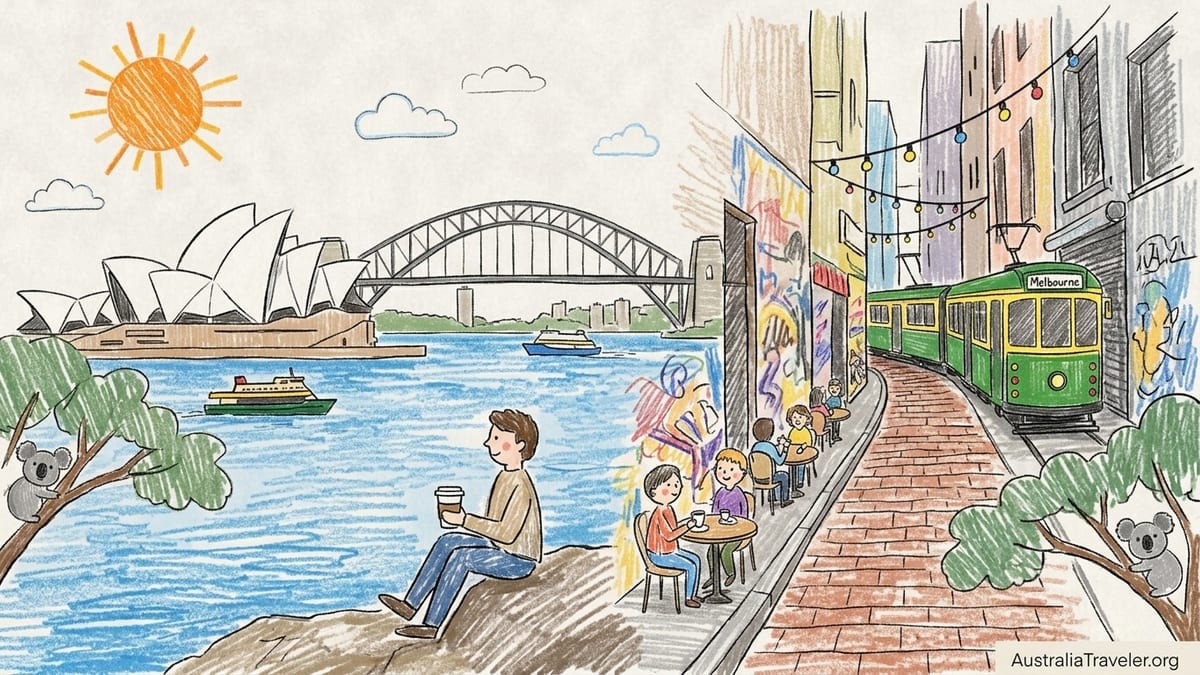
First Impressions: Harbor Spectacle vs Laneway Mystery
Landing in Sydney for the first time, I went straight to Circular Quay, slightly jet-lagged and clutching a takeaway flat white from a kiosk on the wharf. Within minutes I was staring at the Opera House on one side and the Harbour Bridge on the other, with ferries gliding in and out like clockwork. It felt immediately legible: water, icons, promenades, a city built around a view. My first couple of hours were spent simply walking from Circular Quay around to the Royal Botanic Garden, watching locals jog past in office gear and tourists angle for the perfect photo. It was an extroverted city from the very first step.
My first arrival in Melbourne could not have been more different. I checked into a small hotel on the edge of the CBD and walked straight into a tangle of laneways near Flinders Street Station. There was no single postcard view competing for attention. Instead there were layered murals on brick walls, narrow alleys like Centre Place and Degraves Street packed with tiny cafes, and people lingering at sidewalk tables even on a cool evening. It took me longer to grasp the structure of the city, but I felt myself relax in that slower reveal. Melbourne asked to be explored one block at a time, not in a single sweeping glance.
Those first hours set the tone for how I still see both places. Sydney is about open skies and sharp silhouettes against the water, a city that shows you its best side immediately. Melbourne is about what hides behind the main streets, the ducking into an anonymous-looking arcade and finding a jazz bar or a hole-in-the-wall dumpling spot two floors up. When I think about where I enjoyed myself more, I keep coming back to that difference in how quickly you feel you “get” the city.
Over several trips, that first impression has held steady. Sydney always greets me with light and drama, especially around the harbor, while Melbourne wins me over more slowly through conversations with baristas, nights in Fitzroy, and afternoons that start with one gallery and somehow end in a late dinner in a neighborhood I had not planned to visit.
Sydney Days: Harbor Icons, Coastal Walks and Big Views
Most of my time in Sydney has revolved around the water. I have walked from Circular Quay through The Rocks, climbed the steps beneath the Harbour Bridge for views back to the Opera House, and then cut through to Barangaroo to see how the city is pushing its waterfront further west. The Circular Quay area itself can feel crowded and touristy, but the payoff is constant. On one visit I spent an entire afternoon just watching ferries fan out toward Manly, Watsons Bay and Parramatta, noting how many commuters used them as everyday transport rather than scenic outings.
The ferry ride to Manly has become a staple of my Sydney stays. Using an Opal card or a contactless credit card, I simply tapped on at Circular Quay Wharf 3 and treated the public ferry as a budget harbor cruise. On a clear morning, sitting on the outdoor deck, the ride gave me a front-row view of the Opera House and the towering pylons of the Harbour Bridge before we slipped past headlands and arrived in a compact beach town. I usually walked the Corso from the ferry to Manly Beach, grabbed fish and chips from a takeaway shop behind the sand, and then continued on the path toward Shelly Beach. It felt like a full day out for little more than the cost of a standard commuter fare.
Bondi was a more intense version of Sydney’s beach personality. I based myself once in a small guesthouse about ten minutes’ walk from Bondi Beach, which meant most mornings started with a coffee from a busy corner cafe and a stroll down to the promenade. The people-watching was relentless: surfers jogging down in wetsuits, personal trainers barking encouragement, and families trying to negotiate sandcastles and sunscreen. The Bondi to Coogee coastal walk, which I have now done in both bright sun and blustery wind, is one of the most beautiful urban hikes I have taken anywhere. Cliffs, rock pools and a string of smaller beaches like Tamarama and Bronte made me feel like I was far from a major city, even though I could be back in the CBD in under an hour by bus and train.
When I wanted a calmer side of Sydney, I kept returning to the Royal Botanic Garden. Entering from the Opera House side, I would wander along the waterfront paths, passing wedding parties posing under fig trees and office workers picnicking on the grass. The path around Mrs Macquarie’s Chair provided one of my favorite city views, with the Opera House and Bridge perfectly framed across the water. It was one of the only places in Sydney where I felt I could be still and contemplative without leaving the central city, and it balanced the high-energy feel of places like Darling Harbour, which I visited for its waterfront restaurants and nighttime light shows but rarely lingered in during the day.
Melbourne Days: Laneways, Markets and Neighborhood Energy
My Melbourne days usually started not with a view but with a coffee decision. The CBD and inner neighborhoods are saturated with cafes, and I found that simply picking a different one each morning became a sort of citywide treasure hunt. In the heart of the city, I often gravitated toward the laneways between Collins Street and Flinders Lane, ducking into Degraves Street for a quick espresso at a rickety outdoor table or following my nose into one of the arcades where baristas seemed to know every regular by name. Compared with Sydney, where standout cafes felt more scattered, Melbourne made specialty coffee feel like the default rather than the exception.
Queen Victoria Market was another regular stop. I visited on different days and times, each with its own energy. In the fresh produce halls, I watched locals load up on vegetables, seafood and cured meats, while the deli section tempted me with cheeses and smallgoods for impromptu picnics. On one visit, I assembled a simple lunch of fresh bread, olives and a wedge of local cheese and walked it back to a patch of grass near Flagstaff Gardens. The night markets were a different experience, with food stalls selling everything from paella to dumplings and live music playing under strings of lights. It felt less like a tourist market and more like a gathering spot for the city.
Federation Square, just opposite Flinders Street Station, became my main orientation point. I would cut across its open plaza on my way to the National Gallery of Victoria or the Australian Centre for the Moving Image, both of which I have visited multiple times. On one rainy afternoon I spent several hours in the NGV International, moving from Indigenous Australian art to European paintings, then sat in the courtyard listening to the echo of the water feature against the glass. It was the kind of cultural immersion I struggled to replicate in Sydney without planning a specific museum day.
Outside the CBD, Fitzroy quickly became my favorite Melbourne neighborhood. I walked up Brunswick Street and Gertrude Street, browsing independent bookstores and vintage shops, and stopped at small wine bars that felt like living rooms. In the evening, the side streets filled with people heading to low-lit restaurants serving everything from modern Australian tasting menus to casual Greek and Vietnamese. St Kilda offered a different flavor, with its bayside promenade, palm trees and the slightly faded charm of Luna Park. I walked the pier at sunset, watching the city lights shimmer across the bay, then ate simple fish and chips on Acland Street before catching a late tram back to the CBD.
Walking, Architecture and Getting Around Without a Car
On foot, Sydney and Melbourne felt markedly different. Sydney’s CBD is walkable, but the terrain quickly reminds you that this is a city built around coves and headlands. Streets rise and fall, and while I enjoyed exploring The Rocks’ sandstone lanes and staircases, I also found that many of the most interesting coastal areas required a mix of trains, buses and ferries. I rarely felt comfortable just setting off in a random direction from my hotel, because I would often hit a motorway, a steep hill or a dead end at the water. Instead, my walks tended to be specific: Bondi to Coogee, Manly to Shelly Beach, or the loop through the Botanic Garden.
Melbourne by contrast encouraged aimless wandering. The CBD’s grid and laneway system made it easy to drift without checking a map constantly. Once I learned that trams within the central Free Tram Zone did not require a ticket, I grew more confident about hopping on and off whenever my feet got tired. I could walk from the top of Swanston Street down to the Yarra River, detour through a few arcades, then catch a tram to Fitzroy or down to St Kilda Road with very little planning. The relative flatness of the inner suburbs helped, and I often finished days here having walked much further than in Sydney without really noticing.
In terms of public transport, both cities were easy enough without a car, but I found Melbourne slightly more intuitive for a visitor. In Sydney I used an Opal card on my first trip, then switched to tapping my contactless bank card on later visits once that option was fully rolled out. It worked seamlessly across trains, buses, light rail and ferries, and the daily caps meant my spending never spiraled beyond a predictable amount. Still, I had to pay attention to peak and off-peak differences and occasionally navigate complex bus routes to reach coastal neighborhoods.
In Melbourne, I bought a myki card from a machine at the airport bus terminal and topped it up as needed. The card worked on trains, trams and buses, and I quickly learned that within the inner zones my daily spend would only go so high before capping out. The key perk was the Free Tram Zone in the CBD, which let me zip between places like Southern Cross, Parliament and Docklands without worrying about my balance. Outside that zone I still had to tap on and off, but the system felt cohesive, and I rarely waited long for a tram along the main routes. For a visitor without a car, both cities are workable, but Melbourne rewarded spontaneity a bit more.
Food, Cafés, Nightlife and General Atmosphere
On paper, both cities are strong food destinations, but my actual meals gave Melbourne the edge. In Sydney I enjoyed particular restaurants around Surry Hills and Potts Point, from casual Thai and Italian to more polished modern Australian spots. One night in Surry Hills, I ate a shared-plates dinner in a converted terrace house, with natural wines and small dishes built around local seafood and vegetables. It was excellent, but it also felt like it could have existed in many affluent global cities. In Melbourne, my dinners in Fitzroy and the CBD had a more distinct local flavor, from a tiny spot serving imaginative vegetarian dishes with a playlist curated by the chef, to a relaxed wine bar where the staff recommended small producers from the Yarra Valley and beyond.
The everyday cafe culture in Melbourne was what really stood out. Even a random cafe in a quiet side street seemed to take its espresso and filter coffee seriously, and latte art was so common it barely registered. I found myself planning my days around which neighborhood I wanted to drink coffee in, using it as an excuse to visit new streets. Sydney absolutely has standout cafes, especially in inner suburbs like Surry Hills and Newtown, but outside a few concentrated pockets I felt I had to seek them out more deliberately. In Melbourne, good coffee seemed to find me.
Nightlife told a similar story. Sydney’s waterfront bars around Circular Quay, The Rocks and Darling Harbour give you dramatic backdrops and an undeniably glamorous feel. I spent one evening at a rooftop bar overlooking the harbor, watching cruise ships depart while nursing an expensive cocktail. It was spectacular, but it also came with a price tag that made lingering for a second drink a considered choice. Melbourne’s nightlife, especially around Fitzroy, Collingwood and the CBD laneways, felt more casual and layered. I moved from a small bar dedicated to local gins to a live music venue with a modest cover charge, then ended the night in a late-opening dumpling restaurant. It was less about a single view and more about the sequence of places.
In terms of overall atmosphere, Sydney struck me as more outwardly energetic and fitness-focused, with a strong beach and outdoor culture, while Melbourne projected a quieter confidence built on arts, food and conversation. Sydney days often revolved around sun, surf and views, with evenings leaning toward waterfront drinks. Melbourne days were more likely to include galleries, bookstores, markets and long conversations over coffee, with nights spilling into intimate bars and live music. Where I enjoyed myself more depended on my mood, but across multiple trips I found myself more consistently satisfied by Melbourne’s everyday rhythm.
Costs, Accommodation Areas and Where I Felt the Value
In both cities, I stayed across a range of neighborhoods and price points, but my wallet noticed a difference. Nightly rates for comparable midrange hotels or serviced apartments in central Sydney generally ran higher than in Melbourne, especially in peak periods or when major events were on. Eating out in Sydney often felt slightly more expensive as well, particularly in harborside areas where mains and drinks could nudge the total well above what I paid for similar meals in inner Melbourne. While I cannot give exact figures that apply year-round, I consistently found that my daily spend in Sydney ran higher without me doing anything particularly extravagant.
In Sydney I divided my stays between the CBD near Wynyard, Surry Hills and once in Bondi. The CBD location gave me unbeatable access to Circular Quay, The Rocks and the Harbor Bridge, and I loved being able to walk down to the water within ten minutes. However, the area emptied out at night away from the restaurant and bar clusters, and prices for centrally located hotels reflected the convenience. Surry Hills was my favorite compromise: close enough to walk into the CBD in about twenty minutes or grab a short train ride, but with a dense concentration of cafes, bars and restaurants that made evenings feel local rather than touristy. Bondi was the most atmospheric place I stayed, with early-morning walks on the beach built into my routine, but it required more time and planning to get into the city center for museums or harbor activities.
In Melbourne I have stayed in the CBD, Southbank and Fitzroy. A CBD hotel put me within easy walking distance of Federation Square, the major laneways and the Free Tram Zone, which made it ideal for a first visit. Southbank offered a slightly more polished riverside environment with big hotels and apartment buildings lining the Yarra, and it was an easy stroll across the pedestrian bridges into the heart of the city. Fitzroy was my favorite long-stay base. Accommodation there skewed more toward boutique hotels and apartments, and while the tram ride into the CBD added a few minutes, I appreciated stepping out each morning into a neighborhood full of independent shops, cafes and street art rather than office towers.
When I weighed cost against experience, Melbourne generally felt like better value. I could find comfortable, well-located accommodation at a slightly lower rate, spend less on meals without feeling like I was cutting corners, and move around easily on public transport. Sydney gave me some incomparable moments, especially around the harbor and along the coast, but achieving those often involved higher hotel rates and pricier harborside meals if I wanted to pair the view with dinner or drinks.
Beaches, Culture and Day Trips: How I Spent My Time
For beaches, Sydney was impossible to beat. Bondi, Manly, Bronte and Coogee each offered a distinct experience, from the slightly glossy, see-and-be-seen atmosphere of Bondi to the more relaxed family feel of Manly. I loved walking the coastal paths, swimming at ocean pools like Icebergs at Bondi or the rock pools at Coogee, and taking in the contrast between the deep blue water and the cliff faces. These were not just places to sunbathe; they were integral to the city’s identity, used by commuters for a morning surf and by families for weekend gatherings. Melbourne’s bayside St Kilda offered pleasant walks and sunsets, but the water felt calmer and the overall experience more subdued compared with Sydney’s dramatic oceanfront.
On the cultural front, Melbourne pulled ahead. My visits to the National Gallery of Victoria, both the International and Australian sites, left me with a stronger sense of connection to Australian art and design. The city’s smaller galleries and street art alleys, like Hosier Lane near Federation Square, made it easy to encounter creativity without buying a ticket. I attended a theater performance in the Arts Centre precinct on one trip, surrounded by locals discussing the production over drinks afterwards. Sydney has significant cultural institutions as well, including the Museum of Contemporary Art near Circular Quay and performances at the Opera House, but I found myself planning those as special outings, whereas in Melbourne, culture seemed to be interwoven with my daily wanderings.
For day trips, both cities offered standouts that shaped my overall impression. From Sydney, I took a full-day train and bus trip to the Blue Mountains. Leaving Central Station in the morning, I reached Katoomba in about two hours, then rode local buses to Echo Point to see the Three Sisters and hiked sections of the cliff-top trails. The sheer drop of the valleys, the eucalyptus haze and the views from lookouts like Govetts Leap made it one of the most memorable excursions of my travels. On another trip, I joined a small-group tour to the Hunter Valley, spending the day visiting wineries, tasting semillon and shiraz, and eating a long lunch overlooking vineyards. Both trips reinforced Sydney’s strength in natural scenery.
From Melbourne, my two most impactful excursions were along the Great Ocean Road and into the Yarra Valley. The Great Ocean Road trip required an early start, but watching the coastline unfold from surf beaches to the limestone stacks of the Twelve Apostles was worth every minute. I walked down to the sand at Loch Ard Gorge, feeling the wind whip off the Southern Ocean, and stopped at small towns along the way for coffee and bakery lunches. The Yarra Valley offered a different mood, all rolling vineyards, cellar doors and long, relaxed tastings. I joined a tour that included a small cheese producer and a winery lunch, which tied together nicely with the local wines I had been seeing on menus back in Fitzroy. While both cities offered excellent day trips, Melbourne’s combination of ocean road, wine country and wildlife-focused outings like Phillip Island made it particularly rewarding for longer stays.
Where I Would Spend More Time and Who Each City Suits
After multiple visits, if I were planning a short first-time trip to Australia, I would still start in Sydney. The harbor alone justifies a few days, and taking a public ferry under the Harbour Bridge remains one of the defining experiences of the country for me. With three or four nights, I could stay in the CBD or Surry Hills, visit the Opera House precinct, walk the Bondi to Coogee coastal path, spend a day in Manly, and perhaps squeeze in a Blue Mountains day trip. Sydney excels at concentrated impact, and it is hard to imagine someone leaving indifferent after watching the sun set behind the skyline from a harborside lookout.
For a longer stay of a week or more, or for a return trip where I wanted to settle into a city’s everyday life, I would choose Melbourne. The ease of exploring without a car, the depth of the cafe and bar scene, and the range of cultural activities meant that I could fill ten days without ever feeling like I was repeating myself. I would base myself in Fitzroy or the CBD, alternate museum days with market visits and neighborhood walks, and slot in day trips to the Great Ocean Road and Yarra Valley. The city supports slow travel particularly well, rewarding curiosity about side streets and local institutions rather than just headline attractions.
If I imagine myself living in one city for a few months, Melbourne wins by a clear margin. The combination of walkability, tram access, housing options in characterful inner suburbs and a thriving food and arts scene aligns more closely with how I like to spend my time. Sydney would tempt me with its beaches and harbor views, but I suspect I would feel more often that I needed to actively plan my days around transport and higher costs to access my favorite places. Melbourne, by contrast, seems to invite an unhurried routine of work, coffee, galleries and neighborhood dinners that could stretch on indefinitely.
That said, the choice is not purely either or. Many travelers wisely split their time between the two, using Sydney as a dramatic introduction to Australia’s coastal beauty and Melbourne as a deeper dive into its urban culture. Having done that myself in different sequences, I have come to think of Sydney as the city that takes my breath away and Melbourne as the city that keeps my attention.
Rankings and Final Recommendation
To make sense of my own preferences, I started informally ranking the two cities across a few categories that matter most to me as a traveler. For scenery, Sydney is the clear winner. The combination of harbor, headlands, ocean beaches and inland mountains is unmatched in my experience of urban destinations. There are moments in Sydney, whether on the Manly ferry or standing at a Bondi lookout, that feel almost unreal in their beauty. Melbourne has its own charms along the Yarra River and in the rolling landscapes beyond the city, but it cannot compete with Sydney’s immediate natural drama.
For food, Melbourne takes the top spot. While I have had excellent meals in both cities, the density of standout cafes, casual eateries and inventive restaurants in Melbourne means that I eat better with less effort there. Coffee culture in particular is more consistent and more deeply embedded in everyday life. For culture, including galleries, live music, theater and street art, Melbourne again comes out ahead. I spend more time in museums, linger longer at markets like Queen Victoria Market and feel more spontaneously drawn into performances and exhibitions.
When I consider beaches, Sydney dominates with its oceanfront and coastal walks, while Melbourne’s St Kilda and nearby bay beaches feel more like pleasant complements rather than destinations in their own right. On affordability, Melbourne edges ahead for me in terms of hotel rates, everyday eating and drinking, and the value of public transport, especially with the Free Tram Zone reducing costs in the core. Sydney’s higher costs are not prohibitive, but they do shape how many nights I feel comfortable staying and how often I opt for that second waterfront cocktail.
Overall enjoyment is the most subjective category, but if I tally my experiences across multiple trips, Melbourne narrowly wins. I simply feel more at ease there day to day, more connected to the local rhythm, and more engaged by the small discoveries that come with each walk. Sydney has provided some of my highest-impact travel memories, but Melbourne has given me more of the quietly satisfying days that, added together, define a place I want to return to again and again.
For a first-time visitor choosing between the two with limited time, my decisive recommendation is to start with Sydney if you are drawn to big views, beaches and iconic landmarks, and to choose Melbourne if you prioritize food, culture and a walkable, neighborhood-based city experience. If you have the time and budget, visiting both is ideal, but if I personally had to pick one city in which to spend an extra week, I would choose Melbourne.
The Takeaway
Looking back across my trips, Sydney is the city that dazzled me on arrival, while Melbourne is the one that made me feel at home. Sydney’s harbor, beaches and day trips like the Blue Mountains and Hunter Valley delivered scenes I still scroll back to on my phone when I need a hit of faraway beauty. Melbourne’s laneways, markets, galleries and neighborhoods like Fitzroy and St Kilda built up a different kind of affection, one based on repetition, small rituals and conversations with locals who saw me more than once.
If your time in Australia is short and you want the country’s greatest hits in a compact package, Sydney will give you exactly that, from standing beneath the Opera House sails to swimming in an ocean pool with the Pacific crashing behind you. If you have a little longer and want a city that rewards unstructured days, long coffees and evenings that start with “we will just see where we end up,” Melbourne is likely to resonate more deeply.
For my own travels, I now plan around that distinction. Sydney is where I go when I crave sun, salt and spectacle. Melbourne is where I return when I want to live, even temporarily, the kind of everyday life that makes me consider staying much longer than my ticket allows.
FAQ
Q1. Which city did you personally enjoy more overall, Sydney or Melbourne?
Over multiple trips I have enjoyed both, but Melbourne edges ahead overall. I find its mix of neighborhoods, cafes, galleries and walkable streets creates more consistently satisfying days. Sydney has higher individual peaks, especially around the harbor and beaches, but Melbourne wins on everyday livability and depth.
Q2. If I only have three or four days, should I choose Sydney or Melbourne?
For a short first-time visit of three or four days, I would recommend Sydney. You can see the Opera House and Harbour Bridge, take a ferry to Manly, walk the Bondi to Coogee coastal path and get a strong sense of Australia’s coastal identity in a compact timeframe.
Q3. Which city felt more expensive during your stays?
In my experience, Sydney felt more expensive overall. Comparable central hotels tended to be pricier, and eating and drinking in harborside areas added up quickly. Melbourne was not cheap, but I consistently found slightly better value in accommodation, everyday meals and nights out.
Q4. How easy is it to get around Sydney and Melbourne without a car?
I managed well in both cities without a car. In Sydney I relied on trains, buses, light rail and ferries using an Opal card or contactless bank card, and in Melbourne I used a myki card for trains, trams and buses, taking advantage of the Free Tram Zone in the CBD. Melbourne felt a bit more intuitive for spontaneous tram hopping, while Sydney’s ferries added a scenic dimension to otherwise practical journeys.
Q5. Where did you prefer staying in each city?
In Sydney my favorite base was Surry Hills, which balanced proximity to the CBD with a strong local food and bar scene. Staying in Bondi was wonderful for beach access but less convenient for city sights. In Melbourne I most enjoyed staying in Fitzroy for its neighborhood character and easy tram access, though a CBD base was ideal on my first visit for quick access to major sights and the Free Tram Zone.
Q6. Which city has better beaches for a visitor without a car?
Sydney clearly wins for beaches. Bondi, Manly, Bronte and Coogee are all reachable by public transport, and the coastal walks between them are among the best urban hikes I have done. Melbourne’s St Kilda offers pleasant bay swimming and sunsets, but it lacks the dramatic ocean setting that makes Sydney’s beaches so memorable.
Q7. Which city did you find stronger for food and coffee?
While I ate and drank well in both, Melbourne felt stronger overall. Its cafe culture is exceptionally deep, with high-quality coffee and breakfasts almost everywhere I went, especially in the CBD laneways and inner suburbs like Fitzroy. Sydney has excellent options too, particularly in Surry Hills and other inner neighborhoods, but I had to seek them out more deliberately.
Q8. What were your favorite day trips from each city?
From Sydney, my standout day trips were to the Blue Mountains for cliff-top hikes and valley views, and to the Hunter Valley for wine tasting. From Melbourne, the Great Ocean Road with its coastal scenery and the Yarra Valley for vineyards and long lunches were the most rewarding. All four are worth considering if you have time.
Q9. Which city would you choose for a longer stay or remote work base?
For a longer stay or remote work base, I would choose Melbourne. Its walkability, tram network, choice of characterful inner suburbs and depth of food and cultural options make it easier for me to settle into a routine. Sydney would be tempting for its beaches, but I would expect higher living costs and more planning to reach my favorite spots.
Q10. Is it worth visiting both cities on the same trip to Australia?
Yes, if your time and budget allow, visiting both is very worthwhile. Sydney offers iconic scenery and beaches that define many people’s image of Australia, while Melbourne provides a richer sense of its urban culture and everyday life. Experiencing both gives a more balanced picture of the country than either one alone.