


The wheels touched down at Ayers Rock Airport just after noon, and the heat hit me the moment the aircraft door opened. The light was blinding and oddly flat, the way it can be in the desert, with a pale blue sky stretched tight above a horizon the color of rust. Between the runway and the low terminal building, everything felt stripped back to essentials: red earth, tough little shrubs, and the faint outline of Uluru itself in the far distance. After years of wondering whether the cost and remoteness could possibly be justified by a single rock and its companion domes at Kata Tjuta, I was finally here to find out.
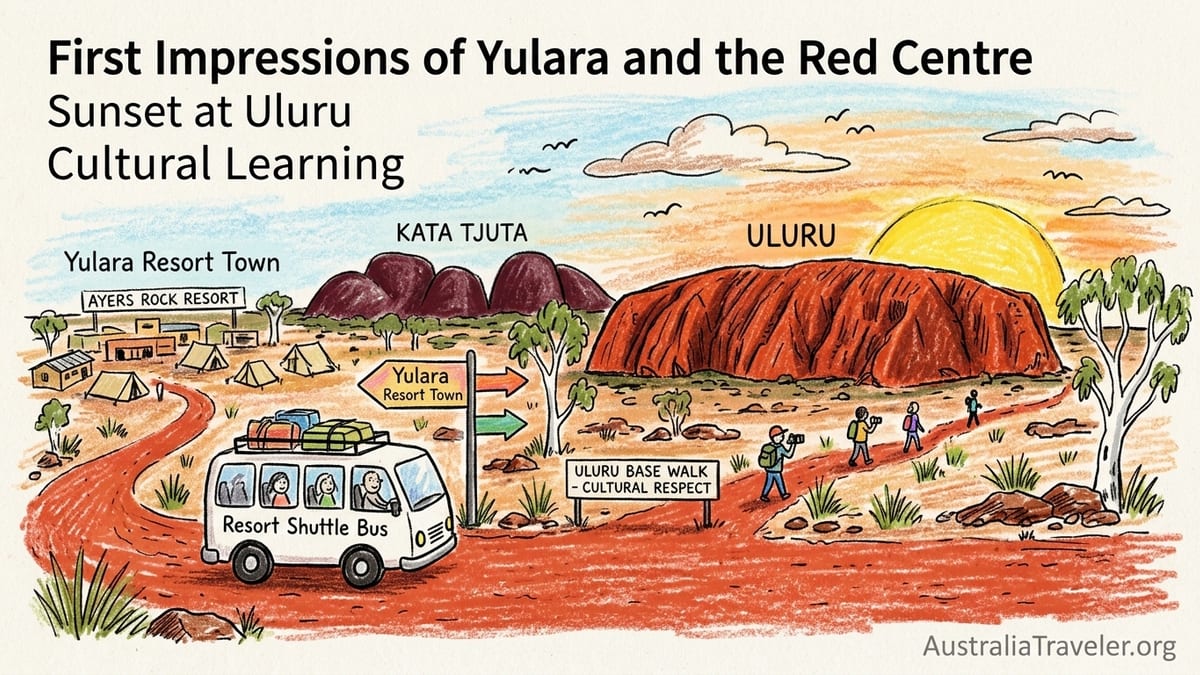
First Impressions of Yulara and the Red Centre
The shuttle bus from the airport rolled the short distance to Yulara, the purpose-built resort town that services Uluru-Kata Tjuta National Park. The drive is barely ten minutes, but in that time the landscape asserted itself in a way no photograph had ever quite managed for me. The soil really is that deeply red, and against it the white trunks of ghost gums looked almost theatrical. Out the left-hand window, Uluru sat on the horizon, still surprisingly small, while to the west the soft humps of Kata Tjuta were just discernible as a darker band.
Yulara itself felt like a self-contained island in the desert. All accommodation here is managed under the umbrella of Ayers Rock Resort, from dorm beds at the Outback Lodge and campsites at Ayers Rock Campground to mid-range hotels and the five-star Sails in the Desert. Budget dorms in October 2026 were listed around 40 to 60 Australian dollars per night, while hotel rooms in the more comfortable properties commonly started somewhere in the 350 to 500 dollar range and rose quickly from there, especially in peak periods. The monopoly and freight costs are real, and they are reflected in every menu and booking screen.
I checked into a mid-range hotel room with standard air conditioning and desert-plain views for just under 400 dollars per night, pre-booked months earlier. For that price in a city you might expect designer interiors, but here the value equation is different. You are paying for access to what lies outside the window, not for thread count or a rooftop bar. It was a framing I found myself returning to repeatedly over the next three days.
By the time I dropped my bags and walked to the small town square, the sun had softened slightly, the thermometer hovering around 30 degrees Celsius. A compact supermarket, a bottle shop, a few cafes and takeaway counters, and an art gallery clustered around a dusty plaza. Prices for basics were noticeably higher than in coastal cities: a simple sandwich or burger often reached 18 to 25 dollars, and a modest pub meal easily nudged past 30. It was already obvious that the Red Centre would not be a cheap experience, but I had come precisely to see whether it could be a meaningful one.
My First Entry into Uluru-Kata Tjuta National Park
That first afternoon I collected a small rental car from the airport depot. For many visitors this is the most flexible option despite the extra cost. Daily hire rates in 2026 commonly ranged from around 130 to over 200 dollars per day once one-way fees, compulsory insurance, and remote-location surcharges were added. The alternative would have been to rely on resort shuttles and guided tours at 90 to 250 dollars per person per tour for sunrise, sunset, or Kata Tjuta excursions. With two or more people, a rental quickly becomes more economical and allows you to escape the timetables of large groups.
At the park entrance, around a twenty-minute drive from Yulara, I stopped to purchase a park pass. Since 2021, visitors are required to buy passes in advance or on arrival, with a standard adult three-day pass priced at roughly 38 Australian dollars. Multi-day passes and concessions exist, but either way, entry is controlled and revenue is shared in a joint management framework between Parks Australia and Aṉangu Traditional Owners.
Crossing the threshold into Uluru-Kata Tjuta National Park felt significant, even from the driver’s seat. The asphalt ribbon of road led straight toward Uluru, which now began to dominate the field of view. The rock seemed to swell with every kilometer, its surface shifting from ochre to deep red as the angle of the light changed. The day was clear and hot, about 32 degrees, with a strong dry wind that picked up low dust. I had imagined the desert as a quiet place, but the wind made a constant low roar against the car.
My expectations were unavoidably high. Years of Instagram sunsets and coffee-table books had built Uluru into something monumental in my mind. I was prepared to be moved and slightly suspicious of my own romanticism at the same time. I parked at the main sunset viewing area on the western side of the rock, joining rows of vehicles and a few tour coaches that had already claimed their spaces.
Sunset at Uluru: Crowds, Color and Compromise
That first sunset was both everything I had been promised and a little less. The official sunset viewing area is designed to handle large crowds, and by an hour before sunset most car bays were full. People set up camp chairs and folding tables, unpacking cheese and crackers, beers and binoculars. Several coach groups parked together, their guides circling with clipboards while passengers queued for sparkling wine. It felt more like a festival car park than a hushed spiritual gathering.
From this position, the view is straight across low scrub to the western face of Uluru. As the sun dropped behind us, the color of the rock deepened through a slow, theatrical shift: ochre to terracotta to a bruised maroon. The light picked out fine textures and flaking surfaces, and if you ignored the chatter and clinking glasses around you, it could feel otherworldly. Still, the viewing area was undeniably busy. If you crave solitude, this might jar. On my visit in the shoulder season, I estimated several hundred people were present, and in peak school holiday periods reports suggest the area can be very crowded.
The disappointment, if there was one, came less from the number of people than from the narrowness of the experience. By sticking to the main sunset area, you see a postcard Uluru, framed much as every marketing image has already shown you. There is a reason for this: some alternative angles and sections of the rock are culturally sensitive and closed to general photography at the request of Aṉangu Traditional Owners. These restrictions are clearly explained in park literature and at certain lookouts. Visitors are asked not to photograph specific segments that reveal sacred stories, and commercial film crews must adhere to strict guidelines.
After sunset, the air cooled quickly, and the sky transformed into a dome of intense stars. Driving back to Yulara in the near-dark, I felt both awe and a creeping worry. Was I simply paying a premium to replicate an image I had seen a thousand times? I knew the answer would depend on what happened the next morning.
Walking with Uluru: Base Sections and Cultural Learning
The most meaningful day of my visit began in the half-light before dawn. I drove back into the park along the same road, but this time turned toward the Mala carpark at the north-western foot of Uluru. The plan was to walk sections of the Uluru Base Walk, a loop of about 10.6 kilometers that encircles the rock. Official maps grade it as a moderate undertaking for most people, largely flat but exposed, taking around 3 to 4 hours at a steady pace.
Recent flooding in early 2026 had damaged parts of the track, and works were ongoing around sections such as Lungkaṯa and the link between Kuniya carpark and Kuniya Piti. Some sections were diverted or supported by temporary signage, and the park had run courtesy shuttles during earlier repair windows to help people navigate closures. When I visited, the main loop was open but with occasional rougher patches where washouts had been filled. It was a reminder that this is living country, not a controlled theme park.
I chose to walk the western and southern sections of the base, starting from Mala and continuing past Kantju Gorge toward the water-worn caves on the southern side. This section alone covered roughly 6 to 7 kilometers of gently undulating path on compacted dirt and boardwalks. In the cool of early morning, with temperatures around 18 degrees, it felt easy, but every information board and ranger would tell you to carry more water than you think you need. By late morning, the same walk would sit in full sun and feel far more punishing.
Up close, Uluru is not a smooth monolith but a mass of folds, cavities and streaks. Some caves are clearly signposted as sacred places where photography is not permitted, and it felt important to respect those requests, even when the shapes and colors were visually irresistible. Anangu stories, known as Tjukurpa, are tied to particular features of the rock, and the park’s interpretive signs hint at some of these connections in careful, partial ways. They make it explicit that many stories are not for public sharing.
Midway through the morning, I retreated from the rising heat to the Cultural Centre near the base of Uluru. This low, curved building, constructed from rammed earth and steel, is operated jointly with Anangu and focuses on Tjukurpa, land management, and the history of the handback of the park to its Traditional Owners in 1985. Here I learned that Anangu have been living in the region for tens of thousands of years, and that the park is leased back to Parks Australia under a joint management arrangement that places Anangu law and knowledge at its core.
The Cultural Centre was also where the significance of the permanent closure of the Uluru climb crystallised for me. In 2017 the park’s Board of Management, which includes Anangu representatives, voted unanimously to end climbing, and on 26 October 2019 the route to the summit was closed for good. Long before that date, elders had asked visitors not to climb out of respect for Tjukurpa and for the many people who were injured or died attempting the steep ascent. Seeing old photographs of lines of people on the chain route felt, in hindsight, jarringly out of step with the values the park now articulates.
Walpa Gorge and Valley of the Winds at Kata Tjuta
No visit to the Red Centre feels complete without crossing the 40 or so kilometers from Uluru to Kata Tjuta, the cluster of 36 domes to the west. Where Uluru is all about a single massive presence, Kata Tjuta feels like entering among giants. The road bends toward them through gently rising country, and as you approach, the domes separate into individual rounded forms with deep creases between them.
On my second morning, under a milky sky and a forecast high of 28 degrees, I chose the Walpa Gorge walk. Official maps describe it as an approximate 2.6 kilometer return track that threads into a narrow valley between two towering domes. It is rated as moderate, with some uneven rocky surfaces and a gradual climb. The carpark was busy but not overwhelmed, and once on the track people naturally spaced out. Within five minutes the soundscape changed from voices and car doors to wind and the occasional clatter of loose stones underfoot.
The gorge itself is cool and shaded compared with the open plains. Walls rise steeply on either side, revealing layers and fractures in the conglomerate rock. Small hardy plants cling to cracks where water collects after rare rain. There is a formal lookout at the end of the maintained path, but the experience is less about a single viewpoint and more about the feeling of being enveloped by rock. There are also cultural sensitivities at Kata Tjuta, and as at Uluru, visitors are asked to avoid photography in certain directions or of particular formations to protect stories that are not for public dissemination.
On another morning I tackled the Valley of the Winds walk, a longer, more demanding circuit that official materials list at around 7.4 kilometers. I did not complete the full loop but walked to the second main lookout and back, covering roughly 5 kilometers. The path is steeper in places than the Walpa Gorge trail, with rock steps and sections that would be challenging in hotter temperatures. Leaving just after sunrise with two liters of water and a hat felt prudent. Several signs warn that parts of the walk close from late morning to the late afternoon when temperatures exceed safe thresholds, typically around 36 degrees, which is a genuine consideration in the summer months.
Standing at the second lookout, wind strong enough to tug at clothing, I felt more physically engaged than anywhere near Uluru. The view took in a tumbling maze of domes and gullies stretching to the horizon, and for a few minutes there were no other hikers in sight. Here, at least, the Red Centre felt expansive rather than curated. If Uluru is a single sentence in the story of this landscape, Kata Tjuta is an entire paragraph.
Logistics, Costs and the Reality of Remote Travel
Practicalities shape every experience at Uluru-Kata Tjuta, and they deserve clear-eyed acknowledgment. Reaching Yulara from the east coast of Australia often involves expensive flights to the small Ayers Rock Airport. In October 2026, return fares from Sydney or Melbourne regularly sat in the 500 to 900 Australian dollar range, particularly around school holidays, and could be higher at short notice. Some travelers choose to fly into Alice Springs and drive five hours each way, trading time and hire car kilometres for lower airfare.
Once in Yulara, accommodation is the next major cost. The resort’s range is broad but rarely cheap. Backpacker-style dorm beds at the Outback Lodge sometimes appear under 60 dollars per night, especially outside peak seasons. Basic motel-style rooms at properties such as Outback Hotel or The Lost Camel typically fall in the 300 to 450 dollar range per night. Self-contained Emu Walk Apartments or premium rooms at Sails in the Desert often start around 500 to 700 dollars per night and can climb well beyond that when demand spikes. Campground sites can be more affordable but still reflect the cost of providing facilities in a remote environment.
Food and drink add another substantial layer. Because everything is flown or trucked in, even simple meals command a premium. A takeaway pizza or curry might run 25 to 35 dollars, while sit-down restaurant mains often land between 40 and 60 dollars. Special dinners, such as starlit outdoor experiences that combine a buffet or degustation with astronomical talks or sound-and-light installations on a dune, can cost upwards of 250 to 400 dollars per person, depending on inclusions and the operator.
Transport within the resort can be managed via free shuttle buses between accommodation and the central square, but trips into the national park require either a private vehicle, privately booked airport transfers, or guided tours. Organized sunrise or sunset tours to Uluru and Kata Tjuta, including guide commentary and transfers, typically cost around 90 to 200 dollars per adult per outing, with more elaborate packages surpassing that. Over three days, it is easy to spend well over a thousand dollars per person on logistics alone, before counting park passes or optional activities.
All of this is not to suggest that the prices are unjustified. Supplying a remote desert resort, maintaining sealed roads and walking tracks, and funding joint management and cultural programs comes with significant expense. Still, any honest assessment of whether Uluru is worth it has to begin by acknowledging that the Red Centre is one of the most expensive short trips many travelers will ever undertake.
Heat, Crowds and the Emotional Texture of the Place
Beyond money, there is the physical reality of being in the desert. Even in what locals describe as the shoulder seasons, daytime temperatures often push into the low to mid-30s Celsius, and the sun feels fierce. Shade on many walks is limited, and the light can be relentless. I found my energy levels dropping more quickly than anticipated, even though I am used to hiking. Early starts and long midday breaks in air-conditioned spaces were not a luxury but a necessity.
Crowds ebb and flow in predictable patterns. The key sunrise and sunset viewing areas are usually the busiest, as are short walks like the early sections of the base track and the first lookouts on popular trails. Yet even on my relatively busy October visit, it was possible to find quieter moments by choosing less popular times or lingering where others rushed. Arriving at Uluru’s eastern face in the late afternoon, for instance, I sat alone on a bench near Mutitjulu Waterhole for several minutes, listening to zebra finches and watching tiny insects sparkle in the slanting light.
Emotionally, my experience of Uluru changed over the days. At first it felt remote but oddly familiar, filtered through years of external imagery. Walking close, learning about Tjukurpa and the handback of the park, and seeing how Aṉangu leaders speak about their ongoing custodianship shifted something. The place began to feel less like a tourist destination and more like a living cultural landscape into which visitors are granted partial, conditional access.
Still, there were occasional jarring notes. Hearing loud conversations about bucket lists and social media angles in front of sacred caves was confronting. Watching a few people ignore signs about photography restrictions in sensitive areas was disheartening. Those moments did not negate the power of the place, but they did remind me that meaningful experiences in popular destinations require not only infrastructure and interpretation but also personal restraint and respect.
Cultural Significance and Responsible Presence
Uluru-Kata Tjuta National Park is inscribed on the World Heritage list for both its natural and cultural values. For Aṉangu, the land is inseparable from Tjukurpa, the law and creation stories that guide every aspect of life. The rock formations are not mere geology but the physical evidence of ancestral beings whose actions shaped the world. Traditional burning practices, seasonal movements, and sacred ceremonies have been carried out here for countless generations.
The joint management model gives Aṉangu a formal role in decisions about park operations, guiding everything from trail closures to interpretive content. The statement of significance written for the park highlights it as an outstanding example of an ancient cultural landscape where Aboriginal law and cosmology remain strong. The park’s Board of Management, which includes Aṉangu representatives, balances visitor access with cultural responsibilities, leading to decisions such as the permanent closure of the climb and periodic respectful closures of the entire park following the passing of senior Traditional Owners.
For visitors, participating in this framework means adjusting expectations. You are asked not to stray from marked tracks, to observe photography restrictions, and to accept that some places will be forever out of public reach. Commercial filming and drone operations are controlled through permits, and even ordinary visitors are encouraged to think carefully about where they point a lens. This is not about secrecy for its own sake but about maintaining the integrity of stories and sites that hold immense spiritual weight.
Some of the most valuable hours of my trip were spent in the Cultural Centre and on guided ranger walks near the base of Uluru. Listening to explanations of how Tjukurpa governs relationships between people, animals and the land, or how traditional knowledge informs modern fire management, made the surrounding landscape feel layered and precise. It also reframed the question of worth. The journey began to feel less about whether I had seen a famous rock and more about how I was choosing to be present on someone else’s Country.
The Takeaway
In the end, my Red Centre itinerary comprised three nights at Yulara and two full days plus two half days in the park. This felt like a good minimum. With fewer nights, you risk cramming everything into a blur of sunrises and shuttle buses. With three, I could revisit Uluru at different times of day, experience both Walpa Gorge and a substantial section of the Valley of the Winds at Kata Tjuta, and spend unhurried time at the Cultural Centre without feeling as if every hour had to be optimized.
Of all the experiences, the ones that added the most cultural value were not the classic sunset shots but the slower, quieter engagements. Walking sections of the Uluru base in the cool of early morning, reading interpretive panels, and simply sitting in the shadow of the rock allowed a more nuanced appreciation than any single panoramic viewpoint. Time at the Cultural Centre, and any opportunity to hear from Aṉangu voices, shifted my understanding most profoundly.
So was it worth it? Financially, my own trip was undeniably expensive: several hundred dollars for flights, well over a thousand for accommodation and car rental over three nights, plus park passes, fuel, and food. That is a significant outlay for what is, in raw numbers, only a handful of days and a small geographic area. There were moments, standing in a crowded viewing carpark or paying 30 dollars for a basic meal, when I questioned the return.
Yet on balance, I would say yes, the journey to Uluru and Kata Tjuta was worth it, with conditions. It is worth it if you are prepared to approach the place as a cultural landscape first and a photographic backdrop second. It is worth it if you accept the heat, the high prices and the occasional crowd as part of the cost of visiting a fragile, remote environment under Indigenous custodianship. And it is worth it, most of all, if you give yourself enough time: for most travelers I would recommend at least three nights on the ground, so the Red Centre has space to move from the surface of your camera sensor into something quieter and more enduring.
FAQ
Q1. How many nights should I spend at Uluru and Kata Tjuta?
Most travelers find that three nights in Yulara provides enough time for at least one sunrise and one sunset at Uluru, a base walk section, visits to the Cultural Centre, and a full or partial day at Kata Tjuta for Walpa Gorge or Valley of the Winds, without feeling rushed.
Q2. Is the Uluru climb still open?
No. The climb has been permanently closed since 26 October 2019 following a unanimous decision by the park’s Board of Management, made in consultation with Aṉangu Traditional Owners. Visitors are asked to respect this closure as an important cultural request.
Q3. How difficult is the Uluru Base Walk?
The full base walk is about 10.6 kilometers on mostly flat, well-formed tracks, but it is exposed to sun and heat. With plenty of water and an early start it is manageable for most people with moderate fitness. Shorter sections from carparks, such as between Mala and Kantju Gorge, allow you to experience parts of the base without committing to the entire loop.
Q4. What are the main walks at Kata Tjuta?
Walpa Gorge is an approximately 2.6 kilometer return walk into a shaded valley between two domes, considered moderate due to uneven rocky surfaces. Valley of the Winds is a longer, steeper walk of around 7.4 kilometers for the full loop, with lookouts that can be reached on shorter out-and-back sections. Heat-related closures can affect Valley of the Winds later in the day during hotter months.
Q5. Are there photography restrictions at Uluru and Kata Tjuta?
Yes. Certain areas of both Uluru and Kata Tjuta are culturally sensitive and visitors are requested not to photograph or film them. Signs and park information indicate where restrictions apply. These rules protect sacred sites and stories that are not for public sharing, and visitors are expected to follow them.
Q6. How much does it cost to enter Uluru-Kata Tjuta National Park?
As of 2026, a standard adult three-day park pass costs around 38 Australian dollars, with options for longer passes and concessions. Passes can be purchased online in advance or at the park entry station, and revenue supports joint management with Aṉangu Traditional Owners.
Q7. Is a rental car necessary, or can I rely on tours?
You can experience Uluru and Kata Tjuta either way. A rental car, often 130 to over 200 dollars per day in this remote location, offers maximum flexibility to visit sunrise and sunset areas and trails on your own schedule. Organized tours, usually between about 90 and 200 dollars per person per outing, bundle transport and guide commentary, which can be ideal if you prefer not to drive.
Q8. How expensive is accommodation at Yulara?
Accommodation spans dorm beds around 40 to 60 dollars per night at the budget end to several hundred dollars per night for hotel rooms and apartments, with premium properties often over 500 dollars per night in busy periods. Campground sites are usually cheaper but still cost more than equivalent options in less remote parts of Australia.
Q9. When is the best time of year to visit considering heat and crowds?
The cooler months from roughly April to September generally offer more pleasant daytime temperatures for walking, especially in the middle of the year. These months can also be busier and more expensive around school holidays. The hotter months from October to March bring higher temperatures, potential walk closures in extreme heat, and often slightly lower accommodation rates outside peak periods.
Q10. How can I make my visit more culturally respectful?
Plan time at the Cultural Centre, read and follow all guidance from Aṉangu and park staff, stick to marked tracks, observe photography restrictions, and choose tours and experiences that are run or endorsed by Traditional Owners where possible. Listening carefully, asking thoughtful questions in appropriate settings, and accepting that some aspects of the culture are not for visitors to access are all part of being a respectful guest on Aṉangu Country.