


By the time my flight dropped through the cloud and Hobart appeared below, a compact city tucked between a dark river and a hulking mountain, Tasmania already felt like a different Australia. Cooler air fogged the window, the hills were deep green instead of dusty brown, and the scale was smaller, older, more intimate. I had come chasing that difference: a week on the road to see if seven days between Hobart, the east coast and Cradle Mountain could show me a wilder, slower version of the country I thought I knew.
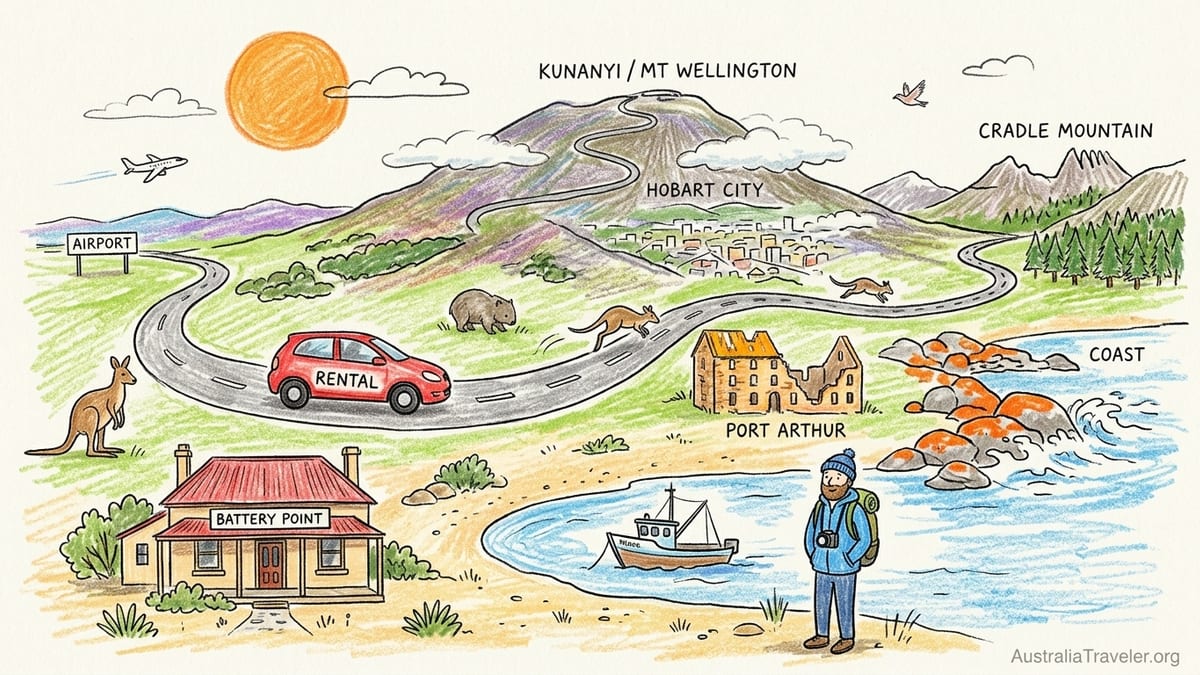
Why I Chose Tasmania and Started in Hobart
I chose to start in Hobart for a practical reason. From many mainland cities it has some of the cheapest direct flights into Tasmania, and the airport is small enough that you can be on the road within 20 or 30 minutes of landing. I wanted cooler weather than the mainland, landscapes that felt closer to New Zealand than to the Outback, and a chance to mix short hikes with food and history rather than driving huge distances across flat plains.
At the car rental desk in Hobart Airport I faced the first real decision of the trip. I had prebooked a compact petrol hatchback with basic insurance at a daily rate that was significantly lower than guided tour packages I had researched. At the same time, the agent warned me about wildlife on the roads at dawn and dusk and the extra cost of a single vehicle accident, which is the type most likely in Tasmania if you hit a wallaby or swerve off a wet corner. Guided tours were tempting for that reason, but they came with tight schedules and limited time on the trails. I chose independence and accepted the risk, upgrading only my insurance to reduce the excess.
Leaving the airport, the first lesson came quickly. Distances on the map are short but the roads rarely feel fast. The highway from the airport into Hobart is simple enough, yet as soon as you leave the city for coastal or mountain routes the speed limit drops regularly, the tarmac winds and there are long stretches with no overtaking lanes. I adjusted my rule of thumb from mainland driving to expect an average of 60 to 70 kilometres per hour once off the main highway, and that proved accurate for much of the week.
My first night was in a small guesthouse in Battery Point, a historic waterfront neighbourhood where old sandstone cottages sit behind roses and picket fences. I walked down to the harbour with a jacket zipped to my chin even in late summer, something that would be unthinkable in many mainland capitals at the same time of year. Dinner was local fish and chips eaten on a bench near Salamanca Place, watching a fishing boat unload, and it set the tone for the week. Tasmania would be about simple food done well and days that ended earlier than I expected, because the combination of cool air, long walks and concentrated driving made me sleepier than other Australian road trips.
Kunanyi / Mount Wellington and Hobart’s Slow Start
I could have rushed straight to the east coast, but I wanted to see Hobart from above before committing to days on the road. The drive from central Hobart to the summit of kunanyi / Mount Wellington looks trivial on paper, roughly 20 kilometres, yet it took almost 40 minutes of steady climbing, hairpins and photo stops. The weather shifted three times on the way up. I left a bright harbour, drove into mist and drizzle through the forest band, then emerged on a bare, rocky plateau under broken cloud with gusting wind strong enough that opening the car door took effort.
On the summit boardwalk I layered everything I had, including a beanie and gloves from my daypack, grateful I had ignored the blue sky over Hobart when packing. The wind chill sat close to freezing, ice crusted the puddles, and a line of cloud was moving in fast from the west. On a calm day you can see far up the Derwent River and out to the Tasman Sea, but on my visit the city below appeared and disappeared in moving gaps of grey. It was a dramatic welcome to Tasmanian weather and a reminder that even short detours off the coast deserved proper layers.
Back in the city I wandered through the Salamanca Market area, which on weekend mornings is full of stalls selling local cheese, honey, timber craft and second hand books. When I visited it was a quieter weekday, but several artisan bakeries and cafes nearby were open. I grabbed a pastry and coffee and realised how easy it would be to linger in Hobart and lose road time. With only seven days, that temptation had consequences, so around midday I turned the car northeast towards the Tasman Peninsula and Port Arthur.
The driving change from city to rural happened much faster than expected. Within 20 minutes I was on narrower two lane roads lined with forest, sharing the way with logging trucks and caravans. Average speed dropped again, and it became clear I would arrive at Port Arthur later in the afternoon than planned. That meant less time in the historic site but a more realistic taste of how long Tasmania’s apparently short hops can take in practice.
Port Arthur, Slow Roads and a Chilly Night
Port Arthur Historic Site, the former penal settlement on the Tasman Peninsula, was one of the few places I had booked in advance. A day entry ticket provided access to the grounds, a short introductory walking tour and a harbour cruise. While prices and inclusions change over time, on my visit it was clear that the ticket system encouraged visitors to spend at least half a day, ideally more. Arriving mid afternoon after a slower than expected drive meant I had to prioritise.
I focused on the ruined Penitentiary, the Separate Prison and the church, moving through sandstone buildings softened by grass and English style trees. Interpretive signs described lives that were wet, cold and harsh, and they were easier to imagine because the weather had turned again. The wind picked up across the cove, drizzle came in sideways, and even with a waterproof jacket I felt chilled after an hour. It was a stark contrast to the sunny tourist photos I had seen, and it altered the emotional impact. Instead of picturesque ruins, Port Arthur felt like a place built on punishment in a landscape that offered little comfort.
By closing time the car park was almost empty and the temperature dropping faster than I liked. My budget cabin for the night was a ten minute drive away, basic but heated, and I was grateful for the short distance. If I had planned to continue to the east coast that evening it would have meant driving in failing light on unfamiliar, winding rural roads with a high chance of wildlife on the verge. That first night taught me a rule I followed for the rest of the week. In Tasmania it is wise to plan to be off the road by dusk, not just for safety but to avoid the stress of scanning for movement in the headlights every few seconds.
Dinner that night was at a nearby tavern serving hearty pub food. I watched other travellers arrive later than me, shoulders tight, the red eyes and forward slump of people who had driven longer than they wanted. A couple at the next table mentioned an almost collision with a pademelon that jumped out from the grass. I had yet to see my first roadkill of the trip, but their story stayed with me. In mainland Australia it is common to warn people about kangaroos at dusk in the Outback. In Tasmania the risk feels more concentrated because the roads thread through forest and pasture with far less open verge.
Along the East Coast to Freycinet and Wineglass Bay
The next morning began with low cloud over the Tasman Sea and wet tarmac as I retraced part of the route back towards Sorell, then turned north up the east coast. The distance to Coles Bay, gateway to Freycinet National Park and Wineglass Bay, was around three and a half hours on paper via the coast road. In practice it was closer to four with fuel and photo stops. The road rolled through small towns with simple service stations and general stores, then opened occasionally to views of long pale beaches and a restless grey ocean.
Arriving at the entrance road to Freycinet, I stopped at a supermarket style grocer in Coles Bay to pick up basic supplies. Prices reflected the remoteness, a little higher than in Hobart, and the shelves leaned heavily on pantry staples and simple fresh produce. It reinforced how important it is on a short road trip to think about self-catering. Having muesli, fruit and simple dinner options in the cabin meant I did not need to drive again after a hike just to find a meal.
Entry to Freycinet National Park required a valid Tasmanian Parks pass, which can be bought as a holiday pass covering multiple days across the state. Exact prices change regularly, but the structure made multi day exploration better value than buying individual day passes. I already had a pass from an online purchase before the trip, so at the visitor car park I only needed to display it on the dashboard. Rangers at the information shelter were happy to talk about current trail conditions and weather. On the day of my visit they warned of strong wind on exposed saddles and suggested carrying extra layers even for shorter walks.
The classic walk here is to the Wineglass Bay lookout. It is described as a moderate climb on a well formed gravel and granite path, and that was accurate, but two details guidebooks sometimes gloss over stood out. First, the track can be crowded in peak season, which means you may spend parts of the ascent stepping aside on narrow sections to let descending walkers pass. Second, the granite steps are uneven in height and can be hard on knees when damp. The lookout itself, when the cloud lifts, is as photogenic as any image search suggests, a perfect crescent of pale sand wrapped around calm blue water with darker forest behind. On my climb low cloud shredded and reformed across the Hazards Range, revealing Wineglass Bay in shifting pieces rather than a single postcard moment.
Bicheno, Bay of Fires and the Reality of Limited Daylight
From Coles Bay, my original plan had been ambitious. I wanted to see Bicheno, a small coastal town known for little penguins and a blowhole, then continue all the way to the Bay of Fires near St Helens in the same afternoon. On a map, the sequence looks logical. In real time, lane by lane behind caravans and logging trucks, it was too much. I reached Bicheno close to midday after a relaxed morning detour and realised that if I continued to the Bay of Fires and still wanted to reach my accommodation near St Helens before dark, there would be almost no margin for photo stops, a beach walk or the inevitable slow driver.
I compromised. In Bicheno I bought fresh fish and a coffee from a modest shop opposite the water, then walked the short coastal path to the blowhole. Waves rolled in under a slab of orange lichen covered granite and shot sprays of white water through the gap. It was a simple attraction, more about the sound and the smell of salt than any dramatic height, and that was part of its charm. Families clambered over rocks; an older couple watched from a bench with jackets zipped tight against the wind. It felt domestic and small, the opposite of blockbuster coastal scenery, and a gentle pause in the trip.
In the end I did push on to the Bay of Fires, but I trimmed my expectations. Instead of trying to see multiple beaches I chose one easy access spot near Binalong Bay and walked the curve of sand until the next headland. The famous orange rock lichen glowed even under a flat grey sky, and the water carried that distinct Tasmanian mix of clarity and cold. I could have stayed longer, but daylight was slipping. The drive from there to my cabin outside St Helens took less than an hour, yet by the time I arrived mist was forming in the hollows and the forest felt very close. It confirmed another quiet truth about Tasmanian road trips. Limited daylight, especially outside high summer, shapes almost every decision. You either accept shorter driving days and fewer sights or you push into twilight and increase both stress and risk.
That evening, hearing wallabies thump around the cabin and possums scratch on the veranda, I understood why wildlife collision statistics here are taken seriously. I had already seen a sobering amount of roadkill along the verges, from small marsupials to larger bodies pulled to the side. It was a reminder that many native animals are nocturnal and that their patterns clash directly with human desire to squeeze more kilometres into the day.
Across the Island to Launceston and Cradle Mountain
From St Helens my route turned inland, crossing the island towards Launceston as a staging point for Cradle Mountain. This leg can be done in a single push via winding inland roads, but I chose to break the drive in Launceston for a night. It provided a chance to swap seafood and coastal walks for Victorian architecture and a different kind of river view. Launceston’s compact centre has heritage facades, a central park that feels distinctly English, and the short walk into Cataract Gorge, where a river squeezes between steep hills and walking tracks cling to the slope.
Compared to Hobart, Launceston felt quieter and more workaday. My motel sat on a slight hill above the river with a functional room, free parking and a simple continental breakfast. It was not a highlight in itself, but it kept costs down. When I compared the overall budget later, the difference between staying in comfortable motels and more character filled boutique lodgings came close to the price of a guided day tour in some regions. It confirmed that self driving with modest accommodation can compete well with tour packages when cost is a concern, provided you are willing to do the planning work.
The next morning’s drive from Launceston to Cradle Mountain revealed again how Tasmanian distances hide effort. The route is around two and a half hours on main and secondary roads, but the last stretch into Cradle Mountain-Lake St Clair National Park narrows, with more curves, changing weather and frequent reasons to slow. By the time I reached the visitor centre late morning a steady drizzle had set in, low cloud sat on the ridges and the temperature was several degrees lower than in Launceston.
At Cradle Mountain, private vehicles are generally not allowed to drive the narrow park road all the way to Dove Lake during the day in busy periods. Instead, visitors park at the large visitor centre and use a shuttle bus system. I purchased a national parks pass that covered both entry and shuttle usage. The shuttles were running frequently, roughly every 15 minutes, and each one carried hikers to key trailheads along the road, with Dove Lake at the end. The arrangement kept car traffic low and reduced parking chaos, but it also meant watching the clock. The last shuttle back in the afternoon is finite. Missing it can turn a long day into a complicated one.
Dove Lake, Weather Swings and Hiking Realities
When I stepped off the shuttle at Dove Lake, Cradle Mountain itself was invisible. The famous jagged skyline sat inside a bowl of cloud, and drizzle ticked on my rain jacket. Yet even half hidden the place felt raw and compelling. The boardwalk section of the Dove Lake Circuit, a loop walk around the shore, was slick underfoot, and the buttongrass and low shrubs beaded with water. Small groups of walkers moved in both directions, some underprepared in cotton hoodies, others in full waterproof shells with trekking poles.
The Dove Lake Circuit is often described in promotional material as an easy to moderate walk, but weather can shift that firmly into the moderate category. On my visit a cold wind blew across the more exposed sections, and the rocky parts of the track required attention. Puddles disguised deeper holes and some timber steps were greasy. I was glad of waterproof boots rather than trainers, and of packing a mid layer fleece. Timewise, the loop took me noticeably longer than the signboard estimates because I stopped often to photograph sudden partings in the cloud when Cradle Mountain’s outline appeared briefly before vanishing again.
Wildlife encounters here were subtle rather than dramatic. On the walk back towards the shuttle stop I saw a wombat grazing in low heath, unbothered by human presence, and later that afternoon a currawong hopped confidently around the outdoor tables at the visitor centre cafe hoping for unattended crumbs. More sobering were the discussions on the shuttle bus about walkers who occasionally underestimate the conditions on longer tracks. The combination of fast moving weather, cold, and limited phone coverage means that what looks like a casual half day outing on a summer brochure can be quite different in shoulder seasons.
Accommodation near Cradle Mountain ranged from lodge style rooms with fireplaces to basic cabins and camping. I had prebooked a simple cabin with shared facilities a short drive from the park boundary, heated and dry but without luxury. Prices in this area reflect the isolation and popularity. Even budget beds can cost as much as comfortable hotel rooms in mainland cities, particularly in peak season. That is one place where a guided multi day tour can sometimes compete on value, rolling accommodation and transport into a single per night rate. For me, for this trip, the trade off was worth it. I could set my own walking pace and change plans quickly if weather or energy levels shifted.
Back to Hobart, Missed Stops and What I Would Change
The final leg of my loop took me from Cradle Mountain back to Hobart in a long day that I would not repeat in the same way. It is possible to do this drive in one push via the Midlands Highway with short breaks, and that is what I attempted. It was efficient in terms of nights and bookings, but it made the day feel like a transport stage, not part of the holiday. I left early to maximise daylight and still arrived in Hobart late in the afternoon with stiff shoulders and a head full of white lines and tail lights rather than scenery.
Along the way I bypassed towns I would have liked to explore, such as Ross and Oatlands with their historic sandstone buildings and bakeries. The lesson was simple. On a seven day trip, crossing from the east coast to Cradle Mountain and back to Hobart or Launceston is technically possible, but every extra destination compresses the experience. If I had my time again, I would choose either the east coast and Cradle Mountain loop or the Tasman Peninsula and the central highlands, not all three, unless I could add extra days.
The comparison between self driving and guided tours also looked different in hindsight. Renting a small car with full insurance, buying national park passes, paying for fuel on long rural stretches, and booking accommodation night by night added flexibility but also admin. A guided seven day circuit would likely have used small buses or minibuses, with a driver who knew where wildlife tended to appear and how to time arrival at popular lookouts to dodge some crowds. For solo travellers nervous about mountain driving or night wildlife, that structure could feel safer and less tiring, even if it costs more upfront.
On the other hand, self driving allowed small, personal pauses and unplanned stops that no tour could match. Pulling over at an unsigned layby because the light on the water looked interesting, choosing to spend an extra 20 minutes with a wombat near a boardwalk, or detouring to a quiet bakery when hunger struck all added texture to the trip. For me, that ability to listen to the day instead of a timetable was the main reason I would rent a car again, although I might combine it with a single guided day hike in one region to deepen understanding of local ecology.
The Takeaway
Looking back, the shape of my seven days in Tasmania felt less like a perfect loop and more like an honest sketch. There were rushed sections, missed opportunities and weather that refused to match the glossy images that tempted me there. Yet in between were vividly real moments that only seem to happen when travel pushes gently against comfort. Standing on kunanyi / Mount Wellington in sleet while Hobart shone briefly below. Watching wind tear cloud from Cradle Mountain’s shoulders for a few seconds at Dove Lake. Eating hot chips in Bicheno with salt drying on my face. Hearing wallabies move in the dark outside a thin cabin wall on the east coast.
Tasmania gave me a very different Australian experience not because it was dramatic at every turn, but because its scale, climate and roads forced me to slow down. Limited daylight set the rhythm. Rapidly changing weather turned simple walks into small expeditions. Wildlife on and near the roads demanded respect and changed my daily driving window. The towns felt older, closer to the colonial edge, and the food leaned on short supply chains, from coastal fish and shellfish to cheese and berries in inland valleys.
If I were to design a realistic seven day itinerary from what I actually did, for someone who wants a similar mix of coast, mountain and history, it would look like this. Day one and two based in Hobart with a half day on kunanyi / Mount Wellington and a full day to the Tasman Peninsula and Port Arthur, returning to the city at night. Day three and four driving slowly up the east coast, with at least one full day in Freycinet for Wineglass Bay and a second night that allows unhurried time in Bicheno or further north towards the Bay of Fires. Day five driving across the island to a night in Launceston, with time for Cataract Gorge. Day six and an overnight at Cradle Mountain for the Dove Lake Circuit and, if conditions allow, a shorter second walk. Day seven returning to Hobart or Launceston at a comfortable pace, accepting that it is mainly a travel day.
On a second trip I would change two things. I would add at least one more night near Cradle Mountain to allow for bad weather and a rest day, and I would avoid long cross island drives at the start or end of the trip. Instead, I might fly into Hobart and out of Launceston, or the reverse, to cut repetition. Whether you choose a rental car or a guided tour, the most important adjustment is mental. Treat every distance as longer than it appears, every easy walk as weather dependent, and every dusk as a time to be already parked somewhere warm, listening for the rustle of wildlife outside instead of watching for it in your headlights.
FAQ
Q1. Is seven days enough for a Tasmania road trip that includes Cradle Mountain and the east coast?
Seven days is enough to sample Hobart, one or two east coast locations and Cradle Mountain, but it will feel full. You will need to accept that some days are mostly driving and that you cannot see every town or beach along the way. Adding extra nights, especially near Cradle Mountain or Freycinet, makes the trip feel more balanced.
Q2. How difficult is the Wineglass Bay lookout walk for an average traveler?
The Wineglass Bay lookout track is a steady climb on a well formed path with many granite steps. Most reasonably fit travelers can complete it in around 60 to 90 minutes return, but it can feel demanding on knees and lungs, especially in warm or humid conditions. Good footwear and taking breaks at the granite platforms help a lot.
Q3. What should I know about the Cradle Mountain shuttle and access to Dove Lake?
During busy periods, private cars are generally not allowed to drive all the way to Dove Lake. Instead, you park at the visitor centre, hold a valid parks pass and use the shuttle buses that run throughout the day. It is important to check the current timetable on arrival and plan walks so that you are back at a shuttle stop before the last bus in the afternoon.
Q4. Is it safe to drive in Tasmania at night with all the wildlife?
Night driving in Tasmania carries a higher risk of animal collisions because many species are most active around dusk and after dark. While it is legal to drive at night, locals and regular visitors often recommend planning your days so that you are off rural roads by sunset whenever possible. If you must drive after dark, reducing speed and scanning the road edges constantly is essential.
Q5. Do I really need a rental car, or can I rely on guided tours and public transport?
A rental car gives the most flexibility for stopping at viewpoints, walking at your own pace and staying in smaller towns. Guided tours, often in minibuses, are a good alternative if you prefer not to drive on narrow, winding roads or worry about wildlife. Public transport between key centres exists but is limited in frequency and does not serve national parks or trailheads as directly as a car or organised tour.
Q6. What kind of weather should I pack for, even in summer?
Tasmania’s weather is changeable, and even in summer you can experience cold wind, rain and strong sun in a single day. For a road trip that includes coastal areas and mountains, you should pack a waterproof jacket, warm mid layers, a beanie and gloves, along with lighter clothing for milder days. Layering is more important than heavy single garments.
Q7. How do national park passes work for a trip that visits several parks?
Tasmania offers holiday style park passes that cover entry to multiple national parks over a set number of days. These passes are generally better value than buying single day tickets for each park if you plan to visit places like Freycinet and Cradle Mountain in one trip. You can purchase passes online in advance or at major visitor centres, and they are typically displayed on your dashboard.
Q8. What kind of accommodation can I expect on a mid range budget?
On a mid range budget you can mix simple motels in cities like Hobart and Launceston with cabins or lodge rooms near coastal towns and national parks. Near popular spots such as Cradle Mountain and Freycinet, even basic cabins can be relatively expensive due to demand and isolation, so booking well ahead is wise. Self catering facilities can help keep food costs down.
Q9. Are the roads in Tasmania suitable for nervous drivers?
The main highways are generally straightforward, but many scenic routes are narrow, winding and have limited overtaking opportunities. Nervous drivers may find the combination of curves, changing weather and occasional heavy vehicles challenging. Taking extra time, avoiding ambitious daily distances and stopping regularly can make it more manageable. Alternatively, joining a small group tour removes that stress entirely.
Q10. What would you skip or change if you did this seven day route again?
If I repeated this trip, I would avoid trying to combine the Tasman Peninsula, a full east coast run and Cradle Mountain all in one week. Instead, I would drop at least one region or add extra days. I would also split the long return drive from Cradle Mountain with an additional night in a Midlands town, both to rest and to enjoy the historic villages that I rushed past the first time.