


On my second trip up Australia’s East Coast, I made the classic mistake I now spend entire hostel common room conversations warning people about. Faced with fourteen precious days off work, I sat in front of a booking screen and tried to cram in everything: Sydney, Byron Bay, Gold Coast, Brisbane, Noosa, K'gari, Airlie Beach, Whitsundays, Magnetic Island and Cairns, plus a Great Barrier Reef trip and at least one big night out in every stop. On paper, it looked efficient. In reality, I remember one particularly grim day that started with a 5.30 a.m. hostel checkout in Airlie Beach, a sleepy shuffle to a coach, a ten hour road journey broken only by servo pies, a frantic Townsville supermarket dash, then a race to catch the last ferry to Magnetic Island. By sunset I was watching wallabies in the carpark with half-closed eyes, too exhausted to enjoy a place I had wanted to visit for years. That was the moment I realised the standard two week East Coast itinerary is not ambitious. It is broken.
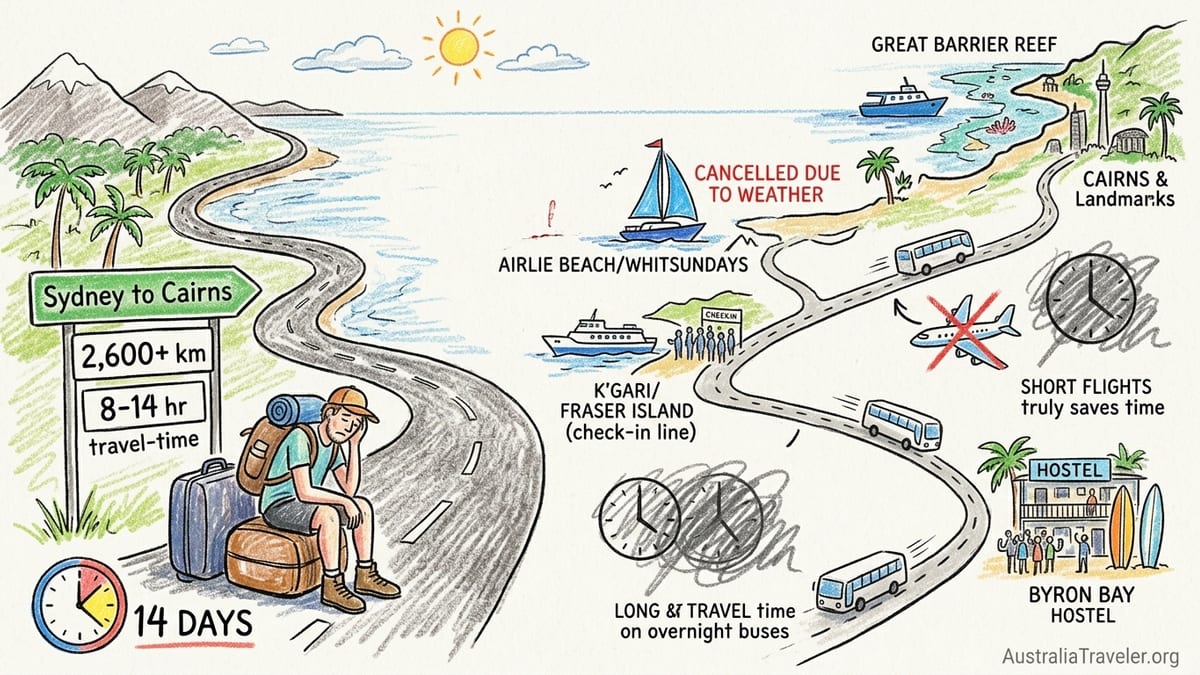
How the Classic Sydney to Cairns Itinerary Actually Plays Out
The glossy backpacker version of the East Coast sells a dream. Start in Sydney, maybe detour to the Blue Mountains, then up to Byron Bay, Gold Coast, Brisbane, Noosa, K'gari, Airlie Beach and the Whitsundays, Magnetic Island, and finally Cairns for the Great Barrier Reef. Travel agencies cluster along Sydney’s George Street and in backpacker hubs like Byron, Brisbane and Cairns, with whiteboards full of package names that promise all of this in ten to fourteen days. On the wall it looks like a neat staircase of beaches and palm trees. Once you overlay the map with actual distances and timetables, it becomes something else entirely.
To understand the scale, you need rough driving distances. Sydney to Byron Bay is about 750 kilometres by road. Byron to Brisbane adds another 165 kilometres. Brisbane to Noosa is about 140 kilometres. Noosa to Rainbow Beach or Hervey Bay, the main K'gari departure points, is around 135 to 190 kilometres. From there to Airlie Beach is roughly 900 kilometres, then another 275 kilometres to Townsville for Magnetic Island, and finally around 350 kilometres to Cairns. Strung together, Sydney to Cairns by road is in the region of 2,400 to 2,600 kilometres. On a map, it is a colourful dotted line. On a bus timetable, it is a repeating pattern of 8 to 14 hour travel days.
Most backpackers lower the psychological pain by relying heavily on overnight coaches between long sections. Greyhound and Premier coach routes typically turn Noosa to Airlie Beach into an overnight trip of about 14 hours, and Airlie Beach to Townsville into about 4 to 5 hours. A direct coach from Sydney to Byron Bay usually takes around 13 to 14 hours, depending on stops and traffic. These numbers fluctuate with schedules, but the reality does not: on a two week itinerary that tries to hit every major stop, a huge chunk of your precious days is spent sitting upright, half asleep, in artificial air conditioning, staring at the Pacific Highway.
When you plan at a laptop in London, Toronto or Berlin, it all sounds fine. You tell yourself overnight buses will “save on accommodation” and create more time for actual travel. What I discovered the hard way is that when you add early ferry departures, 7 a.m. sailing check-ins, and the simple mental load of constant checkouts and check-ins, your supposed days “in” each destination become thin slivers of real time. You arrive somewhere you have dreamed of, like Byron Bay or Airlie Beach, and realise you effectively have an afternoon and a rushed morning before you pack up again.
Time Math: What Two Weeks Really Buys You
Let us be generous and say you have fourteen full days. Take a typical overpacked route starting in Sydney and ending in Cairns: Sydney 3 nights, Byron Bay 2 nights, Gold Coast 1 night, Brisbane 1 night, Noosa 2 nights, K'gari 2 day / 1 night tagalong tour, overnight bus to Airlie, 2 nights in Airlie Beach with a 2 day / 1 night Whitsundays sailing, Magnetic Island 2 nights, then Cairns 3 nights with one full day for the Great Barrier Reef. It sounds extravagant. You have, after all, just ticked nearly every iconic box on the East Coast. The problem is that when you map it against actual transport and tour timings, it collapses.
Start with Sydney. Three nights in theory means you arrive, get two full days, then leave. Except your bus to Byron might leave early morning or late evening. If you arrive in Sydney on a late flight, that first night barely counts. If you take an overnight bus to Byron, you lose the last evening and the following morning to packing, transit, and groggy arrival. Byron Bay fares no better. With two nights, you effectively have one full day. Yet some people try to squeeze in surf lessons, the Cape Byron lighthouse walk, a night at the famous Beach Hotel, plus recovery from the Sydney nightlife they are still shaking off. The town starts to feel like a checklist, not a place.
The compression gets worse north of Brisbane. A K'gari tagalong tour usually departs early in the morning from Hervey Bay or Rainbow Beach and returns late afternoon on day two or three, depending on whether you booked a 2 day / 1 night or 3 day / 2 night option. Check-in briefings and safety talks often happen the afternoon before departure. That means a “2 day tour” effectively occupies at least three calendar days. Add a late night gear return and you are in no state to catch an overnight bus immediately after. Many do it anyway. I met travellers in Airlie who had stepped off a ferry from K'gari, had a hurried shower, thrown their sandy bags on a bus, and woken up in Proserpine feeling like they had dreamt the entire island.
Then come the Whitsundays. Common backpacker sailing trips from Airlie Beach run on 2 day / 1 night or 3 day / 2 night schedules, with boarding usually in the late morning or early afternoon and disembarkation around late morning on the final day. Again, pre-departure briefings and check-ins can easily claim another half day. If your plan has you boarding a Whitsunday boat within 24 hours of arriving in Airlie, and climbing onto an overnight bus the evening you get back, you will technically have “done” the Whitsundays without ever really being in Airlie Beach itself. Restaurants, bars, the relaxed lagoon, even a simple beach walk fall through the cracks.
Buses, Flights, Campervans and Packaged Tours: None Are Magic Fixes
A lot of people justify the two week dash by pointing at different modes of transport. “It is fine,” they say, “I will fly the really long bits.” Domestic flights can help, but they do not perform miracles. A flight from Sydney to Brisbane or Sydney to the Whitsunday Coast can be under two hours in the air, but airport transfers, security, and the dead zones of waiting time still turn it into a half day exercise. You also lay another layer of planning over an already complicated jigsaw: aligning flights with tour start dates, hostel check-in times and bus or ferry connections.
Greyhound’s hop on hop off passes, including flexible options between Sydney and Cairns, look sensible at first. You see nice straight lines on the network map and read marketing copy about the freedom to “travel at your own pace.” In theory, yes. In practice, on a strict two week itinerary most people end up using those passes like fixed tickets, because there is no slack. Miss the Noosa to Hervey Bay bus and your K'gari tour booking unravels, which affects your overnight bus to Airlie, which squeezes your Whitsundays window, and the whole thing shifts like a house of cards. It starts to feel less like freedom and more like a tight escorted tour.
Campervans promise a different kind of flexibility. Hire a van with one of the major operators, split the cost between friends, and you can sleep where you park, right? Except the reality of Australian road rules, distances and fatigue bites here too. Long driving days still eat your time. Caravan parks and campgrounds require check-ins. One person usually ends up as the designated driver and accumulates a special kind of exhaustion. If you are trying to push from Noosa to Airlie Beach in two days in a campervan, you are still committing to serious hours on the highway, just with slightly more control over your roadside coffee stops.
Packaged backpacker tours might be the most deceptive of all. Companies bundle together overnight bus segments, hostel nights and tour slots for K'gari, Whitsundays and the reef, sometimes with headline prices that look very enticing. What often sits underneath those headline prices, however, are optional extras and upgrade costs that you only fully understand after you have paid a deposit. Want a reef trip on a faster boat with fewer people. That is an upgrade. Want a better class of sailing trip that includes all meals of reasonable quality, or a reef experience with a reputable operator and a marine biologist talk. Those can be upgrades too. Item by item, the real cost of cramming the coast into two weeks creeps toward what you might have spent over three weeks anyway, just with less stress and more actual beach time.
Big Experiences Need Big Time, and the Weather Does Not Care About Your Spreadsheet
The most persuasive argument against the hyper compressed itinerary is not about comfort. It is about risk. The biggest experiences on the East Coast are tied closely to weather and sea conditions. K'gari tagalong tours will not run in unsafe conditions. Whitsundays sailing trips can be cancelled or heavily altered in strong winds or storms. Great Barrier Reef day boats will move to more sheltered sites or, occasionally, not depart at all. If you have given each of these experiences a single locked-in day inside a two week chain of bookings, your buffer is essentially zero.
I learned this on a December trip when a tropical low rolled across the Whitsundays. Friends who had booked a 2 day / 1 night party boat found their trip shortened, their route changed and their snorkelling stops abandoned altogether. One of them showed me photos from the deck: grey water, horizontal rain, everyone in wet hoodies. It counted as “doing” the Whitsundays, but none of them felt like they had actually seen those famous turquoise shallows and white sand curves from the brochures. With a looser three or four week schedule, you can push a sailing date back a day, or sit out a storm in Airlie’s cafes instead of being forced onto an overnight bus.
On K'gari, access depends on tides, track conditions and safety regulations. High rainfall can close inland sand tracks. Strong winds and rough seas can disrupt barge crossings from Inskip Point or River Heads. I met backpackers in Rainbow Beach who had their 3 day / 2 night tour cut to 2 days, losing major sites like Eli Creek or Indian Head. When your wider itinerary is already a tight chain from Brisbane to Cairns, this kind of change is not just disappointing. It means you spent one of your few East Coast nights in a gateway town like Rainbow Beach essentially waiting for a non event.
The reef is no different. Operators out of Cairns and Port Douglas do their best to run trips in marginal conditions, but strong winds can make outer reef journeys rough or unpleasant, and occasionally they are cancelled outright. If your entire Cairns stay is two nights with a single day earmarked for the reef, a cancelled boat can turn your northern highlight into a damp evening staring at your phone trying to rebook flights. Give yourself four or five nights in Cairns instead, and a cancelled day simply becomes a pool day before you try again.
The Hollow Victory of the One Night Stop
One of the strangest artefacts of the rushed East Coast itinerary is the one night stop that exists almost solely for bragging rights. I have done it. You get talked into one night on the Gold Coast so that you can say you “saw Surfers Paradise,” or a single night in Brisbane so you can pin it on your map. It looks efficient from afar. Up close, it is wasteful. By the time you have checked in, found a locker, had a shower and looked around for something to eat, it is already late. If you go out, you risk missing your early bus. If you go to bed early, you have essentially turned a whole city into a glorified layover.
The Gold Coast is a textbook example. Buses from Byron might get you into town around midday or mid afternoon if you are lucky with timing. Check-in at most budget hostels typically starts in the early afternoon. By the time you are settled, the full heat of the day is already easing off the beach. If you are aiming for an early morning bus to Brisbane, you cannot stay out late without cutting into sleep. I still remember standing under the neon in Surfers Paradise, half enjoying the absurd skyline, half aware that I would see nothing of the hinterland, the quieter southern beaches or the cafes locals actually love. I had ticked “Gold Coast” but barely touched it.
Brisbane suffers a similar fate on many itineraries. I have met travellers who arrived late one evening, stored their bags, and had time for little more than a walk along South Bank and a quick drink in Fortitude Valley before they had to sleep and catch a morning bus to Noosa. A city of over two million people was compressed into a handful of hurried impressions. When you ask them later what Brisbane was like, they shrug and say something vague about “nice river views.” The rushed route does not just steal rest. It flattens complex, interesting places into generic postcard captions.
Short stays in gateway towns like Rainbow Beach or Hervey Bay can be just as unsatisfying. These places are worth more than being staging posts for K'gari, especially if you enjoy quiet beaches or cycling. Yet at busy times of year, I have watched people arrive on a late bus, dart between hostels and tour offices for mandatory briefings, sleep one short night, then vanish onto the barge the next morning. They later describe Rainbow Beach as a car park with sand. The problem is not the town. It is the absurdly tight schedule.
Cost: Why Slower Travel Is Not Always Much More Expensive
At first glance, there is a clear argument for speed. Nights in Australia are not cheap. Stretching a route from two to three or four weeks means paying for extra hostel beds and more meals. When you look closer, however, the economics are more complicated. Overnight buses that save you one night’s hostel also wreck the following day. Scattered one night stays and last minute changes are where your budget quietly leaks away on luggage storage, rush meals and Uber rides when you are too tired to drag your pack twenty minutes through humidity.
Many Sydney to Cairns packages advertise enticing base prices that bundle buses, a few nights of accommodation, K'gari and Whitsundays tours, and sometimes a reef day. Then come the extras. Equipment levies for reef trips, environmental management charges, compulsory insurance top ups for 4WD tours, stinger suit hire in jellyfish season, snorkel gear, sleeping bag rental, luggage storage for the days you are on tour, photo packages and bar tabs onboard boats. Individually, each add-on might be small. By the time you finish a two week sprint, your real cost often lands much closer to what you would have paid doing the same route at a more relaxed pace, simply without the panic.
There is also the question of value per day. Suppose you extend your East Coast trip from two to three weeks and add an extra seven nights of accommodation and food. You might spend a few hundred extra Australian dollars, depending on your style. What you buy with that money is not just rest. It is backup days for bad weather. It is the ability to skip an overnight bus and take a daytime coach with actual views. It is room in your itinerary for lazy afternoons in Noosa’s national park instead of rushing straight from hostel to tour briefing to barge.
When I did my overly compressed loop, I arrived home with a spreadsheet that technically looked efficient. I had done everything. K'gari, Whitsundays, reef, Byron, Magnetic Island, even that silly Gold Coast night. What nagged me was how many of those experiences felt blurry and interchangeable. Later, on a slower trip that cut out entire segments, I spent extra nights in just a handful of places and felt I had got much better value for money, even though the total cost was slightly higher. Instead of three exhausted days where I barely remember who I met, I had one long slow week in Noosa and Airlie that I still talk about years later.
Side by Side: Unrealistic Two Week Route vs Stronger Alternatives
To put this in concrete terms, let us line up one typical ambitious fourteen day route against a more sensible alternative. First, the overstuffed version starting in Sydney and ending in Cairns. Imagine: Sydney 3 nights, overnight bus to Byron; Byron Bay 2 nights, late bus to Gold Coast; Gold Coast 1 night, morning bus to Brisbane; Brisbane 1 night, bus to Noosa; Noosa 2 nights, transfer to Rainbow Beach and K'gari briefing; K'gari 2 day / 1 night tour, return and board overnight bus to Airlie; Airlie Beach 2 nights including 2 day / 1 night Whitsundays tour; bus to Townsville; Magnetic Island 2 nights; final bus to Cairns and 2 or 3 nights with one day on the reef.
Count the real days. Of your fourteen, at least four are swallowed almost entirely by long bus legs and transfers. Three more are dominated by timetabled tours. Check-in and briefing requirements nibble away at the edges of the rest. You may have one fairly relaxed day in Sydney and maybe one in Byron, Noosa and Magnetic Island. The rest is an intricate dance of alarms, baggage tags and departure lounges. Any disruption from weather, illness or simple overwhelm can ripple down the line and make you miss either K'gari, Whitsundays or the reef, which were probably the things you cared about most in the first place.
Now contrast this with a slower but still straightforward Sydney to Brisbane itinerary over roughly the same two weeks. For example: Sydney 4 to 5 nights, including a Blue Mountains day trip; overnight or daytime bus to Byron Bay for 4 nights; Gold Coast or Brisbane for 3 nights combined, allowing at least one full day in Brisbane itself; then Noosa for 3 to 4 nights, with a relaxed day trip or longer K'gari tour depending on your interest and budget. Suddenly, all your journeys are shorter. Your body is not constantly slammed by overnight travel. You can wait out a rainy day in Byron instead of frantically watching the surf report while you pack. You leave with actual memories of specific cafes and swims and conversations, not just ticket stubs.
Alternatively, if your heart is set on the tropical north, flip the logic and focus on Brisbane to Cairns in two weeks. Fly into Brisbane, give yourself 2 to 3 nights, then head to Noosa for 3 nights and a K'gari experience, followed by an overnight or split bus leg up to Airlie for 4 to 5 nights that include your Whitsundays sailing but also real time in town. From there, go to Magnetic Island for 3 nights, then finish with at least 4 nights in Cairns or Port Douglas, including a reef trip and maybe a waterfall circuit or Daintree day tour. Notice what is missing. Byron and Sydney are absent, yes. But your remaining stops breathe.
What matters here is not the exact numbers. It is the deliberate choice to omit entire sections of coastline, rather than shaving every stop down to a token one or two nights. You choose depth over breadth. Instead of being the person in the hostel kitchen saying you “did the entire East Coast” in two weeks, you become the one giving specific, grounded recommendations about sunrise at the Cape Byron lighthouse or late afternoon swims in Noosa National Park because you were actually there long enough to notice them.
The Takeaway
Looking back on my own rushed Sydney to Cairns attempt, what embarrasses me now is not just how tired I was but how proud I felt telling people what I had “managed” to squeeze in. It took a second, slower trip for me to realise that the East Coast is not a collection of logos to be stamped on an internal loyalty card. It is a vast and varied part of a vast country, and two weeks is a very short time. Every choice to add another famous stop is, in practice, a choice to subtract real time and flexibility somewhere else.
If you only have fourteen days, I would bluntly say this: do not try to connect Sydney or Melbourne with Cairns while collecting nearly every famous stop on the way. Pick one half and do it well. A rich two week journey from Sydney to Brisbane, or from Brisbane to Cairns, will leave you with stories, restaurants you remember, swimming spots you can describe and people whose names stuck. The end to end sprint often leaves you with little more than bus memories and vague impressions of harbours and palm trees that blur together.
When it comes to deliberate omissions, I would personally skip at least one of the following if I were limited to two weeks: the Gold Coast as a one night stop, Brisbane as a rushed layover, or Magnetic Island as an afterthought squeezed between the Whitsundays and Cairns. Each of these places deserves more than one exhausted night. I would also seriously consider flying one major leg, such as Sydney to Brisbane or Brisbane to Proserpine or Cairns, if it allows you to shift time from highways to actual holiday. The extra cost can be justified when it replaces a brutal overnight bus and gives you an entire functioning day in a place you care about.
The itineraries sold in hostel travel shops are not inherently malicious. Many people have fun on them. But they are built around the idea that seeing more automatically means experiencing more. On Australia’s East Coast, that logic breaks down. The distances are too big, the key experiences too dependent on weather, and the gateway towns too interesting to be treated as mere bus stops. If you allow yourself to plan less and stay longer, you may technically “see” fewer dots on the map, but day by day, conversation by conversation, you will almost certainly gain more.
FAQ
Q1. Is it really impossible to travel from Sydney to Cairns in two weeks as a backpacker?
It is certainly possible to travel from Sydney to Cairns in two weeks, and many travellers do exactly that, but it usually involves multiple overnight buses, very short stays in several stops and little flexibility if tours are cancelled or weather is poor. The issue is not feasibility but quality of experience, especially if you try to include nearly every major coastal destination.
Q2. If I only have fourteen days, which half of the East Coast should I prioritise?
If it is your first time in Australia and you value cities and surf culture, a two week Sydney to Brisbane itinerary can work very well, with time for the Blue Mountains, Byron Bay, the Gold Coast or Brisbane and Noosa, plus a K'gari trip. If tropical islands and the Great Barrier Reef are your main goals, focus instead on Brisbane to Cairns, spending proper time in Noosa, Airlie Beach, Magnetic Island and Cairns or Port Douglas.
Q3. When is paying for a domestic flight worth it on the East Coast?
A flight begins to make clear sense when it replaces a very long overnight bus leg and genuinely gives you a usable extra day on the ground. Examples include flying from Sydney to Brisbane instead of taking a full day or overnight coach, or flying into the Whitsunday Coast or Cairns to avoid back to back long bus journeys. It is most worthwhile when that extra day is earmarked for a major experience such as a reef trip or Whitsundays sailing rather than simply adding another rushed city stop.
Q4. Are the flexible bus passes still good value if I travel more slowly?
Flexible passes from companies like Greyhound can become much better value on a three or four week itinerary because you actually use the flexibility they are designed for. With more time, you can adjust your route around weather, extend stays in places you love and avoid stacking overnight buses. On a very tight two week schedule, most people end up treating a flexible pass like a fixed set of tickets and lose much of the benefit.
Q5. How many nights should I allow for K'gari, the Whitsundays and the Great Barrier Reef?
As a rough guide, plan at least three calendar days around each major experience. For K'gari, that might mean arriving in Rainbow Beach or Hervey Bay the day before your tour briefing, doing a 2 or 3 day trip, then having the evening to rest before moving on. For the Whitsundays, allow time in Airlie Beach both before and after your sailing. In Cairns, aim for several nights so you can move your reef day if the weather turns or add a second reef or rainforest trip.
Q6. Are packaged East Coast backpacker tours bad value compared with planning it myself?
Packaged tours can be convenient and occasionally save money, especially if you book during promotions, but you should read the inclusions carefully. Many headline prices exclude optional extras, gear hire and local fees that add up quickly. Planning the trip yourself with individual bus tickets and separate tour bookings can give you more control over timings and the ability to spend longer in your favourite places, though it takes more effort in the planning stage.
Q7. What are the biggest risks of relying heavily on overnight buses?
The main risks are cumulative fatigue, lost days and inflexibility. Each overnight bus might save you one night’s hostel cost, but it often ruins the following day because you are too tired to enjoy a hike, surf lesson or sailing trip. If a bus is delayed or you sleep badly and miss a connection, a tight itinerary can unravel quickly, especially when tours have fixed departure times.
Q8. Can I visit both K'gari and the Whitsundays on a two week trip without feeling rushed?
You can include both K'gari and the Whitsundays in two weeks, but you will need to make sacrifices elsewhere. That usually means dropping some minor stops, spending less time in big cities, and avoiding extra one night stays. If you keep both islands, try to build at least one buffer day between them so that if poor weather affects one tour you have some room to adjust.
Q9. How far in advance should I book tours and transport for the East Coast?
During Australian school holidays and peak backpacker season, which often runs from around June to September and again around December and January, popular K'gari and Whitsundays tours can book out days or weeks ahead. In those windows, it is sensible to secure the big pieces of your itinerary in advance, especially if you have limited time. Outside peak periods you can leave more room for spontaneity, as long as you remain aware of tour departure days and bus schedules.
Q10. If I insist on doing Sydney to Cairns in fourteen days, what is one change that would help most?
If you are committed to the full Sydney to Cairns stretch in two weeks, the single most helpful change is to remove some one night stops and add those nights to your key experiences. That might mean skipping the Gold Coast entirely, giving Brisbane an extra night so it does not feel like a layover, or dropping Magnetic Island so you can spend longer in Airlie Beach and Cairns. Reducing the number of checkouts and long transfers will do more for your enjoyment than almost any other adjustment.