


I arrived on the outer Great Barrier Reef with a head full of brochure images: neon coral gardens, water so clear you could count fish from the boat, and a sense of drifting through an untouched wilderness. Instead, when I slid off the snorkel platform beside a large day-boat pontoon, my first impression was not colour but beige. Patches of vivid life were still there if you looked closely, but the sweeping, cinematic reef I thought I had booked in Cairns felt fragmented, stressed and crowded, both above and below the surface.
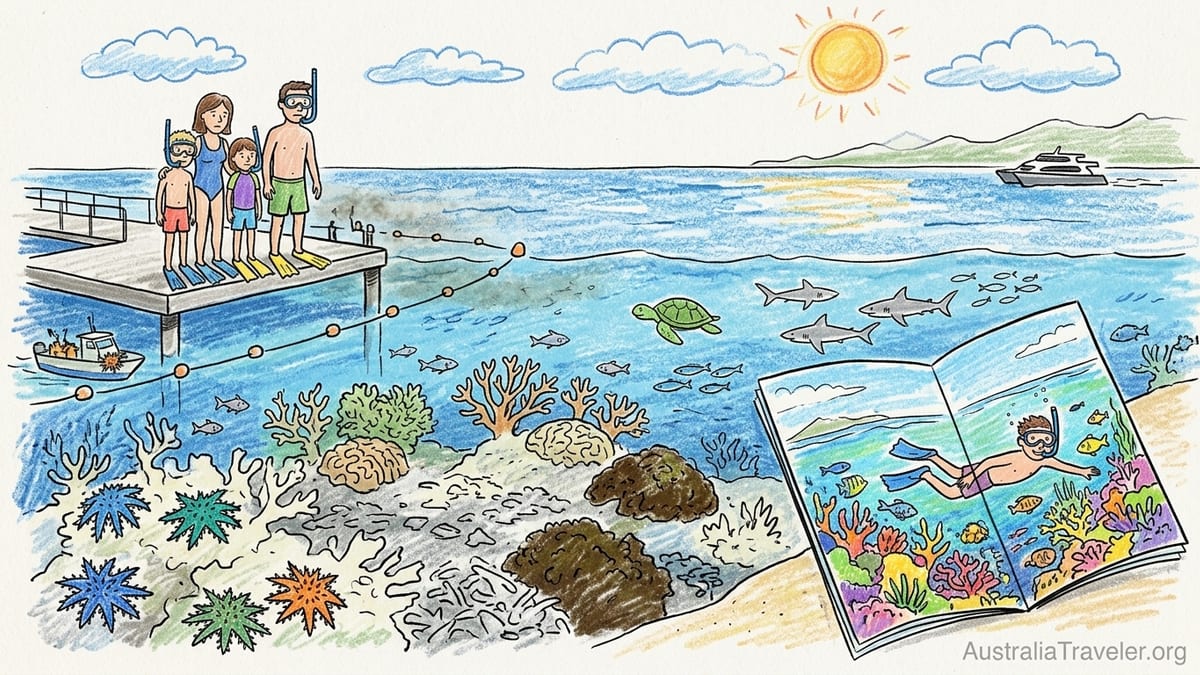
What I Actually Saw Underwater Versus the Brochures
The day had started perfectly: blue skies over Cairns, a smooth two-hour ride on a high-speed catamaran, and staff reassuring everyone that we were heading to "one of our best outer-reef sites today." On board, the marketing loop played a familiar reel of drone shots over turquoise lagoons and snorkellers hovering above luminous bommies. No one showed footage from a bad-visibility day or a site that had recently bleached. By the time we tied up at the pontoon, most people were expecting a guaranteed postcard.
Mask on, I followed the rope line out from the platform and dropped my head into the water. Visibility was roughly 8 to 10 metres: good enough to navigate, but milky compared with the crystal-clear scenes on screen. The first ten metres of reef slope were dominated by pale plates and rubble fields, with isolated patches of healthy branching corals. Some colonies glowed with life, sheltering damselfish and parrotfish, but others were stark white skeletons dusted in algae. It was not a graveyard, but it was certainly not the uniform, high-cover coral garden in the advertising.
Marine life, too, felt thinner than promised. We did see a green turtle, a handful of reef sharks and occasional schools of fusiliers, yet long stretches of the snorkel trail were surprisingly quiet. The staff-directed circuit kept several dozen people clustered into the same channel, kicking silt into the water. As the morning went on and more groups entered, the water clouded and the reef felt more like a busy swimming pool perched above a damaged ecosystem than a wilderness experience.
What struck me most was not that the reef was dead, which it is not, but that the gap between promotional imagery and real conditions was so rarely acknowledged. On board, no one mentioned that this region had been hit hard by recent bleaching and cyclones. There was no explanation of why some coral heads were bleached, or why others had simply disappeared. The message was simple: this is the Great Barrier Reef you have seen in pictures. Underwater, the story was far more complicated.
What the Science Actually Says in 2026
The Australian Institute of Marine Science (AIMS) has been tracking the condition of the Great Barrier Reef for decades, and its findings in 2025 and 2026 paint a picture that is both more encouraging and more precarious than the sound bites suggest. In an August 2026 summary, AIMS reported that average hard coral cover across the northern, central and southern regions of the reef had either increased slightly or held steady compared with 2025, despite a serious mass bleaching event in 2024 and further regional bleaching in early 2026. Coral cover in the northern region was estimated at roughly the mid-thirties in percentage terms, with the central and southern regions around the high twenties to low thirties, broadly in line with or slightly above long-term averages.
On its face, this sounds like a comeback story. Some Australian media outlets seized on the data to argue that reports of the reef’s decline had been exaggerated. AIMS scientists pushed back, stressing that while parts of the reef are in reasonable shape by global standards, the system has become more volatile. Reefs can shift quickly from high to low coral cover after marine heatwaves, cyclones or outbreaks of crown-of-thorns starfish. The Institute’s own reporting describes a sixth mass bleaching event since 2016 and documents that in 2024 some northern reefs lost between roughly a fifth and well over half of their hard coral cover in a single year.
Critically for travellers, AIMS surveys use regional averages derived from more than 190 reefs across a marine park the size of Italy. Those averages do not guarantee that the one or two commercial sites your boat visits on a short trip will be in good condition. A reef platform north of Cairns, for example, can be sitting in a corridor that suffered heavy bleaching or cyclone damage even while the broader region still reports “average” coral cover. Conversely, a site off Port Douglas might escape the worst effects and look far healthier than you would expect from a headline about mass bleaching.
It is also important to understand what “coral cover” does not capture. A reef can have similar total cover in two different years, yet the species mix, structural complexity and colour may be radically different. Fast-growing branching corals that have recolonised a disturbed site can push cover figures upward, but they may be relatively fragile and more vulnerable to the next heatwave. From a snorkeller’s perspective, that might translate as a reef that looks busy but still quite uniform and lacks the diversity seen in older photographs and documentaries.
Why Your Day-trip Site May Not Match the Data
Most visitors see the Great Barrier Reef from a handful of highly developed tourism locations off Cairns, Port Douglas, the Whitsundays and, to a lesser extent, Townsville and Gladstone. Operators typically use a small portfolio of specific reefs where they hold long-term moorings and platform permits. Those sites are chosen for a mix of reasons: depth suitable for large vessels, navigation safety, proximity to sheltered waters, and historical coral quality. They are not a random or representative sample of the entire marine park.
When conditions change, companies can sometimes rotate to different bommies or neighbouring reefs, but most are constrained by licenses, fuel costs and travel time. A large pontoon operation from Port Douglas might advertise “our certified divers can visit different sites around Agincourt Reef,” yet day-trippers on a fixed schedule will still spend almost all their time on the same small radius around the platform. If bleaching, flood plumes or cyclones have recently affected that area, there may not be a pristine backup option within a realistic cruising range.
Weather narrows choices further. In strong wind or swell, skippers often abandon the most visually spectacular outer-reef walls because they are too exposed, reverting to more sheltered but sometimes less colourful lagoons. Passengers are rarely told, in concrete terms, that a switch has just taken them from the operator’s best site to a backup that has known damage. The briefing might simply mention “an alternative reef today due to conditions,” leaving you to assume that the quality is equivalent.
This is where the gap between data and experience becomes sharpest. In 2026, both AIMS and the Great Barrier Reef Marine Park Authority have highlighted that while average coral cover is currently moderate to good across much of the system, repeated disturbances and localized outbreaks of crown-of-thorns starfish continue to strip individual reefs. Crown-of-thorns control vessels have even been redeployed northward to respond to a fresh wave of outbreaks. Yet a traveller stepping off a crowded snorkel platform is not given a map of outbreaks or a candid summary of recent bleaching history at that precise location. You are simply told you are on “the Great Barrier Reef.”
How Honestly Do Operators Talk About Reef Condition?
During my own trip, the on-board commentary leaned heavily on two messages: the reef is not dead, and you should feel good about supporting tourism jobs. Both points are valid, but they also served as a shield against harder questions. When I asked staff if the coral here had bleached badly in 2024, the response was a vague “the reef has its ups and downs” and a quick pivot to pointing out a nearby clam. I heard no mention of the specific AIMS results that showed sharp losses on some northern reefs, or of the fact that bleaching has become more frequent in the last decade.
Behind the scenes, the picture is more complex. Under the federal government’s Tourism Reef Protection Initiative, twenty-three operators receive funding to monitor and help manage 26 high-use sites, collecting fine-scale data and taking actions such as crown-of-thorns removal and coral gardening. That means many companies are acutely aware of how their particular patch is faring in any given year. They often know, with some precision, whether coral cover has dropped, whether certain species have disappeared, and whether juvenile corals are returning.
Public messaging, however, still tends to flatten this nuance into generic reassurance. Marketing copy for major operators speaks of “pristine outer reefs,” “vibrant coral gardens” and “the most spectacular snorkelling on the planet,” even in years following well-documented bleaching events. The scientific caveats about volatility and increasing risk rarely make it onto booking pages or promotional videos. You may find a short paragraph about climate change or a line noting that “the reef remains resilient,” but you will search in vain for current, site-specific condition summaries written in plain language.
There are exceptions. Some smaller, conservation-focused operators and liveaboards now post seasonal updates through social channels, noting when visibility is poor after floods or when a particular site has suffered bleaching. They are also more likely to frame the experience as witnessing a threatened ecosystem instead of visiting an untouched paradise. Yet these voices are still a minority in a market where glossy imagery and positive messaging sell high-priced seats.
Pontoons, Day Boats and Liveaboards: What You Really Get for the Price
Outer-reef tourism in 2026 is not cheap. Recent price comparisons for Cairns-based operators show that a full-day outer-reef trip typically starts around 255 to 280 Australian dollars per adult for large day boats that visit two sites, with about five hours in the water. Pontoon-based trips that anchor at a fixed platform over a single reef site sit higher, often in the low to mid-300 dollar range. Fare pages for well-known names list adult prices around 312 to 338 dollars for outer-reef platforms from Cairns or Port Douglas during the 2026–27 season.
Those figures usually include a basic snorkel set and lunch, but they rarely include everything. Many tickets exclude hotel transfers, which can add another 20 to 45 dollars per adult return depending on whether you are staying in central Cairns, the northern beaches or Port Douglas. On top of that, some companies apply fuel surcharges introduced in 2026 due to higher fuel prices. These add-ons might not sound huge individually, but for a family of four they quickly push a "from 325 dollars" advertised price closer to or beyond 1400 dollars for a single day, before any optional dives or guided tours.
Liveaboards occupy a different tier. A budget two-day, one-night trip with four to six dives can begin around the mid-600s per person, while more comfortable three-day itineraries often run into four figures. These vessels access a wider range of sites and, crucially, allow you to be in the water at dawn and dusk when marine life is more active and day boats are far away. When I compared my crowded pontoon experience with speaking to divers returning from a three-day liveaboard, the contrasts were stark. They reported more sharks, healthier coral on selected offshore walls, and the psychological benefit of not having several hundred people using the same snorkel platform at once.
For those who cannot stomach open-ocean crossings, island-fringing reefs like Green Island or Fitzroy Island cost slightly less, but the trade-off is shallower, more heavily visited coral that has endured decades of stress. Some travellers leaving island trips in 2026 have described visibility as poor and coral as patchy, especially after rain or wind. In value terms, paying almost as much as an outer-reef day to snorkel over degraded nearshore coral can feel like a particularly sharp mismatch between promise and reality.
Weather, Timing and the Lottery of Reef Conditions
One hard truth most booking engines gloss over is how much your experience depends on weather you cannot control. Coral colour, fish activity and visibility can all look very different from one week to the next. After heavy rain on the Queensland coast, river runoff carries sediment and freshwater plumes well offshore, creating green-brown layers that sit over the reef and cut underwater visibility dramatically. Even on days with blue skies above, a snorkeller may find themselves staring through a murky filter.
The summers of 2024 and 2025 brought extreme heat and bleaching to many parts of the Great Barrier Reef. By early 2026, a late monsoon cooled sea surface temperatures, easing thermal stress and allowing some recovery. Yet those same storms and associated cyclones also damaged coral and created flooding that affected nearshore visibility. Agencies such as the Reef Authority now issue regular reef health updates noting where bleaching, flood plumes and crown-of-thorns starfish are active. Tourists, however, rarely consult these bulletins or even know they exist.
Most operators maintain some flexibility to adjust their daily plan, choosing slightly clearer spots or sites that have retained more colour. What they do not do, in my experience, is recalibrate the promise of the day according to conditions. You will hear that visibility is "pretty good today" or that "we have chosen the best option for the weather," which may both be true, without hearing that you are still unlikely to experience the Technicolor scenes you saw in a 10-year-old marketing video filmed at the very edge of the continental shelf in unusually calm conditions.
If you are sensitive to crowds, timing matters too. High season school holidays and calm winter days draw the largest boats and the most passengers. My pontoon visit fell in a busy window and the water felt crowded within minutes, with lifejackets bumping and fins clipping coral despite staff reminders. Shoulder-season days, and mid-week departures, can offer a noticeably calmer experience, but that is rarely highlighted at the point of sale.
Confronting the Marketing Myths
There is nothing inherently wrong with tourism boards and companies using their best photographs to sell trips. The problem arises when the gap between those images and present-day conditions grows so wide that it misleads. In 2026, much of the official imagery still leans on footage captured in years before the recent spike in bleaching events. It foregrounds reefs that are now partly damaged and fails to show the variability that AIMS and the Reef Authority are at pains to describe.
One common myth is that a day on "the outer reef" guarantees vivid coral regardless of which operator you choose. In reality, outer-reef sites vary enormously. Some walls still show layered, thriving coral communities, while others feature long stretches of rubble interspersed with isolated bommies. Another myth is that booking a premium platform, with glass-bottom boats and semi-submersibles, automatically provides a better reef than a cheaper small-boat tour. Sometimes the opposite is true. A small, slower vessel operating to a more distant or less-crowded site can offer richer coral and more relaxed wildlife encounters than the heavily marketed platforms closest to fuel-efficient shipping lanes.
Marketing also tends to flatten the emotional experience. On my trip, a short reef ecology talk focused on inspiring people to care, but said little about grief or the shock many visitors feel when they first see bleached patches or storm-broken coral heads. Several fellow passengers expressed disappointment in hushed tones, clearly unsure whether it was acceptable to admit that the reef did not look as good as expected. Their feedback forms, if completed, would go back into internal reporting loops that rarely become part of public advertising.
To be clear, the alternative is not to declare the Great Barrier Reef "dead" and discourage visitation altogether. Scientists, including those at AIMS, caution strongly against this oversimplified narrative. Many reefs remain in relatively good condition, and tourism revenue funds both regional economies and some conservation work. But an honest tourism industry needs to sit in the uncomfortable space between these extremes, telling visitors both that there is still extraordinary life to see and that it exists under acute and accelerating pressure.
The Takeaway
After several days of talking with operators, reading current science and getting back in the water at different locations, my verdict is more conflicted than either the "reef is dead" headlines or the glossy brochures allow. There are still parts of the Great Barrier Reef that are intensely beautiful, where healthy coral gardens, schooling fish and occasional megafauna encounters add up to a world-class experience. On a calmer day at a smaller site away from pontoons, I snorkelled over bommies pulsing with anthias and soft corals that matched, if not exceeded, my expectations.
Yet the odds that a casual visitor on a single day trip will see that best-case version are lower than marketing suggests. Between weather, recent disturbance history and the constraints of mass tourism, many people will instead encounter a reef that is visibly stressed and a little sad, especially if they have internalised older images as their benchmark. When you add in the complete cost of tickets, levies, transfers and extras, that mismatch can leave travellers feeling short-changed and confused about what their money is supporting.
So is the Great Barrier Reef still worth visiting in 2026? If you are prepared for nuance, yes. Go with the understanding that you are visiting a living system under strain, not a timeless theme park. Expect variability, not perfection. Budget and plan as if you are paying not just for colourful coral but also for the chance to witness a global climate frontline. If that framing feels meaningful rather than depressing, a carefully chosen trip can still be worth both the cost and the long journey.
Personally, I would now avoid large, crowded pontoons and high-season weekends. I would favour smaller operators that share candid updates, allow unhurried water time and acknowledge the realities of bleaching. I would also treat any exceptional day with clear water and vibrant coral as a privilege, not an entitlement. The reef is not gone, but it is changed, and visiting it responsibly in 2026 means seeing both its remaining splendour and its fragility with open eyes.
FAQ
Q1. Is the Great Barrier Reef really dying, or is that an exaggeration?
Scientists are clear that the reef is under serious and escalating pressure from marine heatwaves, bleaching, cyclones and crown-of-thorns starfish, but it is not uniformly dead. Many individual reefs still have moderate to high coral cover, while others have been heavily damaged. Overall, the system is more volatile and has less recovery time between impacts than in the past.
Q2. How likely am I to see colourful, healthy coral on a single day trip?
You may see pockets of vibrant coral, especially at well-managed outer-reef sites, but you should also expect areas of damage, pale or bleached colonies and algae-covered rubble. Weather, recent bleaching history and which specific reef your operator visits all play a big role in what you actually see underwater.
Q3. Are expensive pontoon trips from Cairns or Port Douglas worth the higher price?
Pontoons offer stability, stairs, lifeguards and extra activities like semi-submersibles, which can be good for non-swimmers. However, the reef below is not guaranteed to be better than that visited by cheaper boats, and the platforms can feel crowded. You are paying as much for infrastructure and convenience as for superior coral.
Q4. Will a liveaboard give me a noticeably better reef experience?
Usually yes, if you are comfortable on boats and can afford it. Liveaboards reach a wider range of reefs, visit sites at quieter times of day and allow multiple dives or snorkels, which increases your chances of seeing healthier coral and more wildlife. They are, however, significantly more expensive than single day trips.
Q5. How much should I realistically budget for a quality outer-reef day from Cairns in 2026?
For a standard outer-reef cruise, expect an advertised adult fare in roughly the mid-200s to low-300s in Australian dollars, plus potential fuel surcharges, transfers and optional extras like introductory dives or guided snorkel tours. A family of four can easily spend around a thousand dollars or more for a single day once everything is included.
Q6. Can I choose which specific reef site my boat will visit?
Generally no. Skippers decide on the day based on wind, swell, currents and operational constraints. Operators may have a small set of preferred reefs, but passengers are rarely guaranteed a particular site at the time of booking, and substitution clauses in the fine print give companies broad flexibility to change plans without compensation.
Q7. How can I find out current reef conditions before I book?
Check recent reef health summaries from official agencies, read up-to-date traveller reports, and pay attention to operators that post honest condition updates rather than generic marketing. You can also email or call companies directly and ask specific questions about visibility, bleaching and recent weather impacts at the sites they currently use.
Q8. Are nearshore island trips like Green Island a good alternative to the outer reef?
They can be a gentler option for those prone to seasickness and are sometimes cheaper, but the coral is often more degraded due to decades of use, warmer inshore waters and flood impacts. You may get a pleasant beach day with some fish and seagrass, but the snorkelling usually does not match the best outer-reef sites in terms of coral diversity or colour.
Q9. Does my ticket price meaningfully support reef conservation?
Part of what you pay includes mandatory environmental management charges that help fund marine park management, and some operators contribute additional monitoring and crown-of-thorns control at their sites. However, most of your fare goes to running the tourism business. If conservation impact is a priority, consider supporting reputable reef charities in addition to choosing responsible operators.
Q10. If I care about climate change, should I skip flying to the reef altogether?
Only you can weigh the emissions from long-haul travel against the personal value of seeing the reef. Some travellers choose to combine a visit with carbon reduction efforts at home and use the experience to deepen their engagement with climate issues. Others decide that the climate cost outweighs the benefit. Being honest about the reef’s condition and your reasons for going is an important part of that decision.