


Australia does not have a single best month to visit. The country spans tropical reefs, snow-capped mountains, wine regions, deserts and cool island wilderness, so the ideal time depends entirely on where you go and what you want to do. This guide explains Australia’s seasons from a Southern Hemisphere perspective, breaks down the major climate zones and then walks month by month through conditions in Sydney, Melbourne, Brisbane, Cairns, Darwin, Uluṟu, Perth, Adelaide and Hobart, using Bureau of Meteorology climate averages alongside real-world considerations like holiday surges, road access and tour seasons.
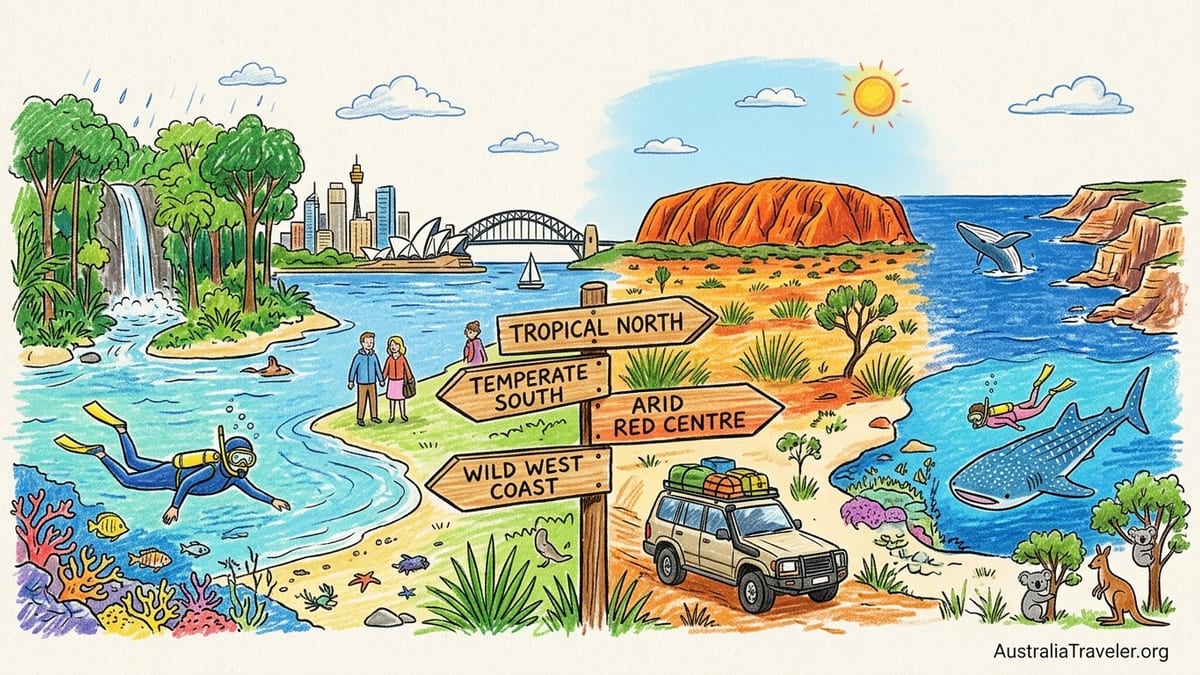
Understanding Australia’s Seasons and Climate Regions
Australia sits in the Southern Hemisphere, so the seasons run opposite to Europe and North America. Summer is December to February, autumn is March to May, winter is June to August and spring is September to November. Within these broad seasons, the country splits into distinct climate zones. The tropical north, including Cairns and Darwin, has a wet and a dry season instead of four traditional seasons. Southeastern cities such as Sydney, Melbourne and Hobart are temperate, with mild to hot summers and cool winters. The interior Red Centre around Uluṟu and Alice Springs is arid with very hot days and often cold nights. Western Australia combines Mediterranean-style climate around Perth with tropical conditions further north. Tasmania is the coolest state, with crisp air even in summer and regular snow in higher areas during winter.
The Bureau of Meteorology’s climate averages show how different these regions are. Sydney’s long-term daytime maximums hover around the mid 20s Celsius in summer and mid-teens in winter, with rainfall fairly evenly spread through the year. In contrast, Darwin’s average daytime highs sit around 31 to 33 degrees Celsius all year, but rainfall jumps from very low totals in the dry season middle of the year to heavy downpours and frequent storms between roughly November and April. Melbourne, Hobart and Adelaide see more pronounced seasonal swings in temperature and are cooler overall, while inland locations like Alice Springs and Uluṟu regularly exceed 35 degrees in summer with very low humidity, then drop near or below freezing overnight in winter.
These contrasts explain why one month can be perfect for a Great Barrier Reef snorkeling trip but unpleasantly hot and stormy in the Top End, or why a winter visit that feels chilly in Melbourne can be prime beach weather on Queensland’s Sunshine Coast. The key to timing your trip is to match each month’s conditions with the region that is at its best, rather than trying to force a single nationwide itinerary into a single set of dates.
North vs South: Wet and Dry Seasons, Cyclones and Stingers
Northern Australia, especially around Cairns, the Whitsundays, Darwin and Kakadu, operates on a wet and dry rhythm. The dry season, roughly May to October, brings blue skies, lower humidity, and cooler nights. In Darwin during June and July, average daytime temperatures are typically around 30 degrees Celsius with low rainfall, ideal for outdoor markets and crocodile-spotting cruises in Kakadu or on the Adelaide River. Many unsealed roads in Kakadu, Arnhem Land and the Kimberley that are impassable in the wet season become accessible, so guided 4WD tours into gorges and waterfalls cluster in these months. Tour operators in Darwin and Kakadu often build their high season around this cooler, dry stretch.
In the wet season from about November to April, the same northern areas shift to heavy tropical downpours, humidity and heat. Bureau of Meteorology data shows that Darwin’s wettest months, typically January and February, can record several hundred millimetres of rain. These months bring impressive afternoon storms but also risks. Tropical cyclones can develop over the warm seas off northern Queensland and the Northern Territory, particularly between December and March. Even systems that stay offshore can cause intense rainfall, temporary flooding and rough seas that disrupt boat tours. Kakadu National Park often closes some roads and walking tracks during peak wet months because of flooding or crocodile risks, and remote lodges may only be reachable by air.
Marine stingers are another seasonal hazard in tropical Queensland and the Northern Territory. Box jellyfish and related species tend to be most problematic in the warmer months, usually from around November or December through to about May. During this period, lifeguards along beaches in Cairns and the Whitsundays may install stinger nets and strongly advise wearing full-length stinger suits for swimming and snorkeling. Reef tour operators near Cairns routinely provide these suits as part of the tour price in summer. In contrast, southern summer beach destinations such as Sydney, the Gold Coast and Perth do not experience the same stinger season and remain popular for casual swimming without special gear beyond normal sun protection and swimwear.
Month-by-Month: Summer (December to February)
December marks the beginning of the Australian summer and is also when domestic travel demand starts to climb sharply. In Sydney and Melbourne, average daytime temperatures in December are usually in the low to high 20s Celsius, warm enough for Bondi Beach or St Kilda but not yet at peak heat. In Brisbane, Cairns and Perth, daytime highs are warmer, often edging into the high 20s or low 30s. Humidity is rising in the tropical north and showers become more frequent. Around Uluṟu and the Red Centre, December brings very hot days that often exceed 35 degrees Celsius, so guided walks at Uluṟu or Kings Canyon typically depart at dawn to avoid the midday heat.
Christmas and New Year fall in the middle of the southern summer, and school holidays run from roughly mid December until late January. Beach towns along the New South Wales and Victorian coasts, the Gold Coast and Sunshine Coast in Queensland, and popular city centres like Sydney’s Circular Quay often see hotel prices jump significantly during the last two weeks of December and the first half of January. It is common for central hotels in Sydney to charge several times their off-season rates for New Year’s Eve stays with a harbour view, and many properties require multi-night minimums. Budget travellers at this time gravitate towards suburban motels, holiday parks and hostel dorms, all of which book out far in advance.
January remains peak holiday season. In Sydney, Bureau of Meteorology averages show daytime maxima in the mid to high 20s Celsius and warm nights, with occasional heatwaves pushing temperatures much higher for a few days at a time. Melbourne and Adelaide can swing from mild days in the low 20s to heat spikes around 40 degrees, sometimes with total fire bans across regional areas. Bushfire risk in the southeast is a real consideration for self-drive itineraries, especially for those planning to drive the Great Ocean Road or visit wine regions; travellers should check current warnings before leaving cities. Cairns, Darwin and northern Western Australia sit deeply in the wet season, with hot, humid weather, heavy thunderstorms and a higher chance of tropical cyclones affecting sea conditions and flight schedules.
By February, domestic school holidays are mostly over but heat and humidity remain. Sydney and Brisbane continue to be strong for beaches and city exploration, while Melbourne’s festival calendar starts to ramp up ahead of March, with cricket, tennis and cultural events bringing in visitors. In the north, February tends to be one of the wettest months of the year in Darwin and around Cairns. Flooding can close some outback highways and remote tracks, which makes this a challenging time for long outback road trips to Kakadu or Cape York. Budget travellers willing to accept steamy conditions, afternoon downpours and the possibility of disrupted tours may find very competitive hotel rates in Cairns and Darwin during February, compared with the higher dry-season tariffs.
Month-by-Month: Autumn (March to May)
March is a shoulder month that begins to balance comfortable temperatures in the south with improving conditions in some northern areas. In Sydney, Melbourne and Adelaide, daytime temperatures usually settle into the low to mid 20s Celsius with lower humidity. This makes March a strong choice for city sightseeing and for driving the Great Ocean Road, where coastal lookouts and short walks are more pleasant than in the heat of January. In Tasmania, March offers mild days ideal for hiking around Cradle Mountain or Wineglass Bay, with fewer biting winds than winter and less of the changeable summer crowds. Accommodation in Hobart and Launceston is still reasonably in demand, but prices may be lower than during the peak of summer festivals.
In the tropical north, the wet season often continues in March, though rainfall may gradually start to ease. Cairns can still see heavy showers and storms, and some remote tracks around the Daintree or Cape Tribulation remain muddy or closed. Darwin’s humidity is usually still high and Kakadu National Park retains wet-season water levels. However, waterholes near sealed roads can be spectacular at this time, with strong waterfalls in places like Litchfield National Park. Because it is not yet the main dry season, hotel prices in Darwin and Cairns can offer good value in March, especially for travellers who prioritise lush landscapes and dramatic skies over guaranteed clear days.
April is often one of the best all-round months to visit Australia for a multi-region trip. In Sydney and Melbourne, daytime temperatures are frequently in the high teens to low 20s Celsius, ideal for walking neighbourhoods like Newtown or Fitzroy, visiting wineries in the Hunter or Yarra Valleys, or combining city stays with a few days in the Blue Mountains or Grampians. Autumn foliage appears in cool-climate regions such as Bright in Victoria. In Brisbane and the Gold Coast, the sea remains warm enough for easy swimming without the intense summer humidity.
April also overlaps with the early-to-peak period for key northern and western experiences. Whale shark tour operators at Ningaloo Reef in Western Australia typically begin their season in March and report the highest chance of sightings between roughly April and June, with licensed companies running full-day tours from Exmouth and Coral Bay and often guaranteeing repeat trips if no sharks are seen during certain weeks. Kakadu and the Top End are transitioning towards the dry season by late April, with some seasonal roads opening. Easter holidays can fall anywhere between late March and late April, compressing demand into a long weekend or short school break; coastal cabins, holiday parks and flights between major cities and tourist areas often sell out weeks in advance around these dates.
By May, the southern cities feel more like late spring in northern-hemisphere terms. Sydney and Brisbane usually offer clear, cool to mild days that suit outdoor dining and harbour cruises without summer’s glare. Melbourne, Adelaide and Hobart become cooler, and snow may start to dust the highest peaks in Tasmania’s central highlands. In the north, May is fully into the dry season pattern around Darwin, with daytime temperatures around 30 degrees Celsius, low humidity and minimal rainfall. Many travellers time visits to Kakadu, Nitmiluk and Litchfield for this month because waterfalls still have good flow from the preceding wet, but most of the major tracks and 4WD routes have reopened.
Month-by-Month: Winter (June to August)
June ushers in winter in the temperate south and peak season in much of the tropical north and interior. Bureau of Meteorology data shows Sydney’s average daytime maximum in June around the mid-teens Celsius, cool but still comfortable for walking the harbour foreshore in a light jacket. Melbourne and Hobart are colder, often seeing daytime highs around the low teens and frequent frosts in inland areas overnight. Alpine resorts in New South Wales and Victoria such as Thredbo and Falls Creek aim to have ski lifts running by this time, supported by natural snowfalls and snow-making. Accommodation in these ski villages sells at premium winter rates and long weekend dates book out early.
At the same time, June is one of the prime months for the Top End, Great Barrier Reef and Red Centre. In Cairns, average daytime maxima in winter are typically mid to high 20s Celsius with much lower rainfall than in summer, creating excellent conditions for reef day trips, overnight liveaboards and sailing expeditions around the Whitsunday Islands. Stinger risk is lower in winter, though some operators continue to recommend full-coverage suits as protection against sunburn and any lingering stingers. In Darwin, the dry season is fully established with outdoor night markets, open-air cinemas and comfortable evenings. Kakadu’s floodplains are accessible, and popular cruise operators run regular boat safaris to view wildlife on the Yellow Water Billabong.
June, July and August are also popular for outback touring. Daytime temperatures at Uluṟu, Alice Springs and along long-distance drives such as the Stuart Highway fall into a manageable range that usually sits between the high teens and mid 20s Celsius, though nights can approach freezing. Tour companies schedule sunrise and sunset trips around the rock, often including hot drinks and simple breakfasts for guests braving the cold pre-dawn air. Because winter aligns with European and North American summer holidays, this period sees a surge in international visitors, which pushes up prices in gateway cities and at iconic sites like Uluṟu, Kakadu and the Whitsundays. Travellers on a budget can respond by booking basic motels along highways, unpowered camping in caravan parks where allowed, or travelling in early June or late August to skirt the very peak dates.
July is mid-winter in the south. In Melbourne, overcast days and showers are common, and locals retreat indoors to cafes, galleries and sporting events. Hobart can feel particularly crisp, with snow visible on Mount Wellington and frequent frosts in rural Tasmania. This is not an obvious beach month for southern Australia, but it is excellent for hiking in many parts of Tasmania and for road trips like the Great Ocean Road if you value moody scenery, empty lookouts and lower non-holiday accommodation prices. In Western Australia, Perth’s Mediterranean climate brings its wetter season around this time, with cool, rainy days, while much of northern WA, including Broome and Ningaloo, remains dry, sunny and warm. Whale shark swims at Ningaloo generally remain strong through July, and humpback whale migrations pass along the coast.
August keeps similar patterns. Alpine snow fields are usually at or close to their best depth, and ski packages, lift passes and lodge stays remain in high demand. Sydney gradually sees more sunny days and slightly rising temperatures, making it a good time to combine urban sightseeing with short hikes in the Blue Mountains or Royal National Park. In Queensland, Brisbane and the Gold Coast enjoy mild, bright days, convenient for family trips on the last of the winter school holidays. In Cairns and the Whitsundays, conditions remain favourable for snorkeling and sailing, with many European visitors timing their trips for these months to escape northern-hemisphere heatwaves.
Month-by-Month: Spring (September to November)
September signals the start of spring and another shoulder season. In Sydney and Melbourne, daytime temperatures usually climb into the high teens and low 20s Celsius, flowers bloom in parks and the beach season tentatively resumes on warmer days. Great Ocean Road trips work well in September, with fewer caravans on the road than in January and often clear coastal views. In the interior, Uluṟu remains quite comfortable, though daytime temperatures start to rise. Many overland tours through the Red Centre schedule their final departures for early to mid spring before the full force of summer returns.
In the north, the dry season is still in place in early September but with increasing heat towards October. Darwin continues to host outdoor events and waterfront dining, yet humidity gradually rises. Cairns and the Whitsundays stay relatively dry and warm, making September one of the most popular months for reef trips and island stays; accommodation on Hamilton Island and Airlie Beach often fills with families and couples capitalising on shoulder-season airfares from southern cities. Ningaloo’s core whale shark season may be tapering, but tours based in Exmouth and Coral Bay still report regular sightings during this period, and humpback whale watching becomes a major focus for operators in Western Australia.
October leans fully into warm-weather travel. Sydney’s beaches come alive, with surf schools resuming beginner lessons at Bondi and Manly. Brisbane and Perth also shift into consistent beach weather, and coastal camping grounds see an upswing in demand. In Tasmania, October can still bring cool winds and frost in alpine areas, but lower-level hiking trails in Freycinet National Park and along the Tasman Peninsula often enjoy crisp, clear days. This month is strong for wildlife trips too; for example, Tasmania’s spring brings active wombats and wallabies in open grasslands at dusk, while southern right whales can be spotted off parts of the southern coastline in several states.
By November, conditions across much of southern and eastern Australia resemble late spring or early summer in northern-hemisphere terms. Sydney, Melbourne, Adelaide and Hobart experience multiple warm days without school-holiday crowds, making this one of the most appealing months for city breaks. Many vineyards in regions such as the Barossa, Margaret River and the Hunter host spring festivals and tasting events. On the downside, the build-up to the wet season starts in earnest in the Top End. Around Darwin, humidity climbs, thunderstorms become more numerous and some outback travellers find the conditions oppressive. Marine stinger season also starts to ramp up in northern Queensland, so reef and beach visitors in Cairns and the Whitsundays will be offered or required to use stinger suits again for safety.
Best Timing for Iconic Australian Experiences
Several of Australia’s headline experiences depend heavily on timing. For Great Barrier Reef snorkeling and Whitsundays sailing, the drier, cooler months from roughly June to October are usually recommended, especially for first-time visitors who want calmer seas and clearer visibility. During this window, day boats from Cairns and Port Douglas focus on outer reef sites with good clarity, and overnight sailings out of Airlie Beach run on regular schedules with relatively low cyclone risk. Families often choose the June or September school holidays for these trips, accepting higher prices in exchange for good conditions and predictable departures.
Ningaloo’s whale shark season in Western Australia typically begins in March and continues through winter, with many operators indicating that April to June offers the highest probability of reliable encounters. During those months, companies based in Exmouth and Coral Bay run full-day tours that include reef snorkeling, spotter planes and snorkel gear. Some operators publish approximate success rates on their marketing material and may offer repeat tours if no sharks are seen within a particular part of the season, especially in April and May. Accommodation in Exmouth and nearby campgrounds can be tight when domestic school holidays overlap with this peak period, so travellers aiming for budget cabins or powered campsites should reserve spots several months ahead.
The Red Centre around Uluṟu, Kata Tjuṯa and Kings Canyon is most comfortable from around May to September, when clear days and cool nights make walking more pleasant. Many travellers pair a Uluṟu visit in winter with a drive on paved highways between Alice Springs and Yulara in a rental vehicle or campervan. Summer visits in December or January are still possible, and sunrise at Uluṟu is spectacular at any time of year, but the midday heat can limit the number of walks you feel comfortable doing, and some operators may shorten or adjust itineraries for safety on very hot days.
For classic southern road trips such as the Great Ocean Road, the best compromise between mild weather and manageable crowds tends to be March to May and again in September to early November. During these shoulder seasons, car rental and motel prices along the route are usually lower than in the summer school holidays. Coastal camping grounds near towns like Lorne, Apollo Bay and Port Campbell still recommend advance bookings over long weekends, but midweek nights can remain flexible. Tasmanian hiking, including multi-day tracks such as the Overland Track, is generally strongest from around December to March, when days are longer and highland snow is least likely to block trails, although strong walkers with proper gear also enjoy late spring and early autumn for quieter tracks.
Matching Activities to Seasons and Budgets
Beach holidays vary widely by region. For warm-water swimming at places such as the Gold Coast, Sunshine Coast and north Queensland islands, the best windows are late spring through autumn, roughly October to May, keeping in mind stinger season and beach safety advice in the tropics. For temperate-city beaches around Sydney, Perth and Adelaide, late spring and summer from around November to March suit most travellers. However, crowds and prices peak from mid December through January, when apartment rentals along popular strips like Surfers Paradise or Bondi attract premium nightly rates. Budget-conscious travellers often shift beach trips into November, early December or late February, when water temperatures remain pleasant but holiday surcharges are lower.
Camping and outback road trips are at their best when extreme heat or heavy rains are least likely. In the southern states, that usually means late spring to early autumn avoiding only the hottest inland weeks. In the far north and interior, the core window is roughly May to September, when unsealed tracks have dried after the wet season and daytime temperatures are tolerable. Many 4WD hire contracts specify restrictions for deep river crossings or certain remote roads outside this period, and some national parks close internal routes in the wet to protect visitors and the environment. Travellers planning long drives such as Darwin to Broome or the Gibb River Road should check seasonal opening dates for fuel roadhouses and campsites, as some only trade in the dry.
Wildlife viewing opportunities also have seasonal rhythms. In winter, humpback whales migrate along much of Australia’s east and west coasts, and dedicated cruises operate from ports like Sydney, Hervey Bay and Fremantle. Kangaroos, wallabies and wombats are usually more active at dawn and dusk year-round, but cooler months can make spotlighting and short hikes more comfortable, especially in Tasmania and highland areas. Birdwatchers often aim for spring when breeding plumage is at its most vivid and many species are vocal. For those interested in marine life beyond the Great Barrier Reef, Ningaloo offers manta rays, turtles and reef sharks throughout much of the year, with humpback whale swims concentrated mainly in the winter humpback migration.
Surfing is available in some form year-round, but the best windows shift by coast. New South Wales and Queensland’s east coast points and beaches, including Byron Bay and Snapper Rocks, see consistent swells through autumn and winter. Victoria’s Surf Coast and Western Australia’s Margaret River region are renowned for powerful winter waves that attract experienced surfers in thick wetsuits. Summer months are friendlier for learners, with gentler waves and surf schools operating at many patrolled beaches. Budget travellers can often save money by taking group lessons rather than private sessions and by targeting shoulder-season weekdays when equipment hire is cheaper and the water is less crowded.
From a cost perspective, domestic school holidays and major events are the most important drivers of price spikes. Christmas and New Year, the summer school break, Easter and state-based winter school holidays all push up prices for flights, car rentals and accommodation. Major city events, such as Sydney’s New Year fireworks, the Australian Open tennis in Melbourne each January and arts festivals in cities like Adelaide and Hobart, also tighten availability. Budget travellers can respond by travelling just before or after these peaks, using regional airports instead of the busiest hubs where possible, and booking flexible motels, cabins in holiday parks and hostel privates rather than central business district hotels.
The Takeaway
The idea of a single best month to visit Australia does not hold up once you look at the country’s huge range of climates and experiences. Instead, each month of the year highlights different regions. Dry-season winter months from June to August are ideal for Cairns, Darwin, Kakadu, the Whitsundays and Uluṟu, but bring cool, sometimes rainy weather to Melbourne, Hobart and Perth. Summer and early autumn from December through March favour city beaches in Sydney and Brisbane, festival-going in Melbourne and wine touring in many regions, but also coincide with wet-season heat, humidity and cyclones in the far north.
The most balanced choices for many visitors, especially those hoping to combine several regions in one trip, are the shoulder months of April, May, September and November. April and May pair comfortable southern weather with the start of Ningaloo’s whale shark season and the onset of the northern dry, while September and November offer warming conditions in the south and lingering dry-season advantages in many northern areas. Inside these windows, your own priorities will determine when you should come. Divers and snorkelers might anchor plans around whale shark or humpback migrations, hikers around the Tasmanian summer, and budget-conscious travellers around the weeks just outside Australian school holidays.
The following decision table summarises the relative strengths of each month for different Australian regions and highlights a few times when specific areas can be poor value or face limited activities because of weather or seasonal closures. It is based on long-term Bureau of Meteorology climate averages and typical tourism-season patterns, not on any single year’s forecast. Conditions in a particular year can vary, so travellers should always check up-to-date weather outlooks and local advice as their departure date approaches.
January: Strong for southern and eastern beaches including Sydney, Melbourne’s bay suburbs, Adelaide and Perth, but hot, humid and stormy in Darwin and Cairns with higher cyclone and stinger risk and some Kakadu access limits. February: Good for uncrowded city breaks in Sydney and Melbourne once school holidays end, but still deep wet season in the Top End and far north Queensland, so reef trips and remote road journeys are more weather-dependent. March: Excellent for Great Ocean Road drives, Tasmanian touring and early autumn city visits, moderate for tropical north as rains gradually ease, and the beginning of whale shark season at Ningaloo. April: One of the best all-round months, combining mild southern weather, rising reliability in the north, strong conditions for reef trips and Ningaloo, but with Easter and school breaks lifting prices. May: Ideal for Darwin, Kakadu, Cairns, Whitsundays and Uluṟu, still comfortable in most southern cities, and busy but rewarding at Ningaloo during peak whale shark months.
June: Peak for Top End, Red Centre, Great Barrier Reef sailing and Ningaloo marine life, as well as the start of snow season in the southeast, while southern coastal cities turn cool and occasionally wet. July: Strong for tropical north, Ningaloo, whales along east and west coasts and Tasmanian hiking if appropriately dressed, but mid-winter chill and shorter days in Melbourne, Hobart and Adelaide. August: Continued strength in northern Australia, strong for skiing and cool-climate touring, with Perth and Adelaide experiencing more rain but still attractive for city-focused trips. September: Excellent for Whitsundays sailing, Great Barrier Reef snorkeling, Great Ocean Road driving and early spring festivals, while the far north grows hotter but remains mostly dry. October: Very good for beaches in Sydney, Brisbane and Perth, shoulder-season deals in inland regions and lively spring wildlife, while Ningaloo begins to shift from whale sharks towards humpback-focused tours. November: One of the best months for southern cities, wine regions and coastal drives, but the build-up period of rising humidity and storminess around Darwin and renewed stinger concerns in tropical Queensland. December: Highly appealing for Sydney and Brisbane beaches and big-city events, especially around Christmas and New Year, but very hot in the Red Centre and firmly back into the wet season for Cairns, Darwin and parts of northern Western Australia.
FAQ
Q1. What is the single best month to visit Australia?
There is no single best month because Australia’s climates are so varied. Winter is best for the tropical north and interior, summer suits southern beaches and festivals, and shoulder seasons balance multiple regions.
Q2. When is the best time for the Great Barrier Reef and Whitsundays?
Most visitors find June to October ideal, when Cairns and the Whitsundays are dry, warm and less humid, and stinger risk is lower, though operators may still recommend protective suits.
Q3. When should I visit Ningaloo to swim with whale sharks?
Licensed tour operators typically run whale shark trips from around March to late winter, with April to June often regarded as the core season when sightings are most reliable.
Q4. What months are best for visiting Darwin and Kakadu?
The main dry season from about May to September is best, when roads are open, humidity is lower and outdoor activities like billabong cruises and 4WD waterfall trips operate on regular schedules.
Q5. Is summer a bad time to visit Uluṟu and the Red Centre?
Summer in the Red Centre can be extremely hot during the day, which limits comfortable walking hours, but sunrise and sunset visits still work. Many travellers prefer May to September for milder temperatures.
Q6. When does marine stinger season affect Cairns and the Whitsundays?
Stinger season generally runs from around November or December through to about May. During this time, beaches may use stinger nets and reef tour boats provide stinger suits for swimming and snorkeling.
Q7. What is the best time for a Great Ocean Road or Tasmanian road trip?
Shoulder seasons in autumn and spring, especially March to May and September to early November, usually offer mild weather, fewer crowds and more flexible accommodation options.
Q8. When is surfing best in Australia?
Autumn and winter bring the most consistent swells on both the east and west coasts for experienced surfers, while summer offers gentler waves and warmer water that suit beginners.
Q9. How do school holidays affect prices and availability?
Australian school holidays over Christmas and New Year, Easter and winter sharply increase demand, especially for beach towns and family resorts, so prices rise and accommodation often sells out.
Q10. If I want mild weather and good value, which months should I target?
April, May, September and November usually provide a strong balance of comfortable temperatures, active tour seasons and better-value airfares and hotels than the peak holiday periods.