


I still remember the first time I rolled off a Great Barrier Reef boat into water so blue it looked unreal. For a few suspended seconds there was only the muffled rush of bubbles, a flicker of silver fish and the slow reveal of coral bommies rising out of the depths like a drowned city. Years later, finning out from a quiet Ningaloo beach with my mask already fogging from excitement, I felt that same catch in my throat as a turtle cruised past in barely three metres of water. Both reefs delivered those breath-stealing underwater moments, but the way you reach them and experience them could not be more different.
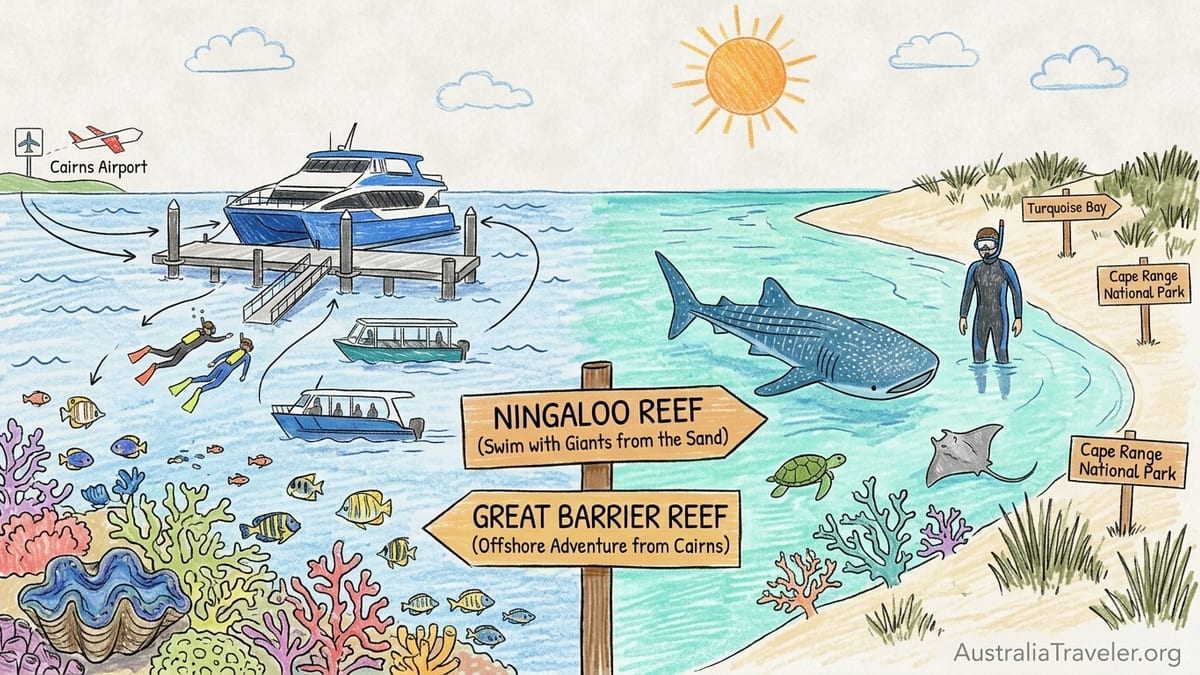
Stepping Into Two Very Different Reef Worlds
My Great Barrier Reef trips started in the dark, humid air of Cairns and Port Douglas, queuing at busy marinas with several hundred other hopeful snorkellers. After safety forms and seasickness tablets, we motored for roughly 90 minutes to two hours to reach the outer reef, watching the coastline shrink to a faint blur. On a typical full day outer reef trip from Cairns, like those advertised in late 2026 for around 255 to 330 Australian dollars per adult, that offshore commute is simply part of the deal, trading time and cost for access to clear water and robust coral gardens out beyond the continental shelf.
Ningaloo felt almost like the opposite. My first snorkel there was not from a big catamaran but from the sand at Turquoise Bay in Cape Range National Park, near Exmouth. I parked in a dusty lot, zipped up my own shorty wetsuit, and walked ten or fifteen steps into water that already held branching coral, clouds of damsels and a grazing green turtle. No compressors humming in the background, no loudspeaker instructions, just shore break, wind and the faint clink of someone else’s fin buckles. The simplicity of walking straight into a World Heritage reef is Ningaloo’s defining magic.
These contrasting first entries into the water set the tone for everything that followed. The Great Barrier Reef, at least from Cairns and Port Douglas, is an offshore production with big boats, pontoons and tightly timed schedules. Ningaloo, especially around Exmouth and Coral Bay, is a fringing reef system where parts of the reef come almost to the beach, and most of your day is spent either on a smaller boat close to shore or snorkelling from the sand.
Neither model is inherently better. They create different experiences, different kinds of wildlife encounters and, as I discovered, very different costs and practical trade-offs once you factor in flights, accommodation and car hire.
Reaching the Reefs: Airports, Drives and First Logistics
Getting to the Great Barrier Reef tourism hubs is straightforward. I flew into Cairns Airport, which has frequent connections from Sydney, Melbourne and Brisbane, then took a short shuttle into the city. For Port Douglas, the transfer is roughly an hour by road along a scenic coastal highway, with shuttle buses meeting most domestic flights. From either town you can walk or take a brief taxi ride to the marina in the morning, and for a classic outer reef day you do not need a rental car at all. This ease of access is a significant advantage, especially if the reef is just one part of a broader Queensland itinerary.
Reaching Ningaloo required a different mindset and more planning. I flew into Learmonth Airport, the small gateway for both Exmouth and Coral Bay on Western Australia’s mid-north coast. From there it was about a 35 kilometre drive to Exmouth township along a mostly empty road, with rental cars in relatively high demand during peak whale shark months. Operators like Sail Ningaloo even note in their planning information that they can help arrange transfers from Learmonth because public transport is limited. Accommodation is spread between Exmouth town, the marina side developments and a handful of caravan parks and eco-camps closer to the national park, so a car made my stay vastly more flexible.
In practical terms, that meant the Great Barrier Reef slots more easily into a first Australian trip or a family holiday where you want to avoid hiring a car. Cairns in particular works well for travellers who want to stay in a hotel, stroll to the marina, join a big-boat reef cruise one day and perhaps a rainforest trip to Kuranda or the Daintree the next. Ningaloo, by contrast, rewards those who are willing to travel further, stay in more remote-feeling towns and accept that supermarket runs, fuel stops and tide charts become part of the daily rhythm.
The reward for that extra effort at Ningaloo is immediacy once you are there. In Exmouth I could finish breakfast, throw my mask and fins in the car, and twenty-five minutes later be drifting along Turquoise Bay’s famous drift snorkel. In Coral Bay, most motels and holiday parks are within a short walk of the beach, where the shallow lagoon reef begins only a few fin kicks from shore.
Boat Transfers, Briefings and Time Actually in the Water
On the Great Barrier Reef, my standard day began with a big catamaran boarding in Cairns shortly after 8 am. After the safety video and initial briefing on mask fitting and fin use, we chugged through occasionally choppy seas to the outer reef. Travel times varied between about 70 minutes on some faster boats to almost two hours on more budget-friendly options. A recent price breakdown of Cairns reef trips in 2026 lists many full day outer reef tours in the 255 to 330 dollar range per adult, often including up to five hours at two or three reef sites but still anchoring the experience around that offshore transit window.
Seasickness is a real consideration here. On rougher days I watched several passengers retreat to the back deck clutching paper bags, and crew were very proactive with ginger tablets and advice to stay outside in the fresh air. The large boats are stable, but there is no avoiding the low, rolling swell once you leave the shelter of the coast. If you are prone to motion sickness, planning your Great Barrier Reef trip for the calmer winter months from June to August can make a big difference.
Once moored, the operation runs like clockwork. There are separate briefings for certified divers, intro divers and snorkellers, with clear explanations of currents, “no go” areas and how to signal to surface watchers. Snorkel sessions often last 45 to 60 minutes at each site, and some operators add optional guided snorkel tours with a marine biologist. At a pontoon on Agincourt Reef out of Port Douglas, I appreciated having a fixed platform with freshwater showers, shaded seating and semi-submersible reef viewing for non-swimmers, but it also meant sharing the water with a large number of people, all entering and exiting from the same snorkel platform.
Ningaloo felt less regimented but more intimate. Shore snorkels from Turquoise Bay or Oyster Stacks relied on reading the tide board in the car park and timing entries for mid to high tide. There were no loudspeaker briefings, only simple warning signs about currents and the reminder not to stand on the coral. On a whale shark tour out of Exmouth, the boat carried a much smaller group than any Cairns catamaran I had boarded. Prices for full day whale shark trips in 2026 cluster around the high 400s to mid 500s in dollars per adult, reflecting the use of dedicated spotter planes and strict interaction licences, but the water time is generous. My day included one or two reef snorkels, a series of whale shark swims, and time left to watch humpbacks breaching in the distance during the cruise back to the marina.
Marine Life Encounters: From Reef Fish to Whale Sharks and Mantas
In raw coral diversity and the sheer scale of the system, the Great Barrier Reef is extraordinary. On my outer reef days from Cairns and Port Douglas, I drifted above hard coral gardens dotted with giant clams, watched anemonefish darting through fluorescent tentacles and followed schools of fusiliers flashing like coins in the light. Turtles were reasonably common, and on one memorable dive at a site near Norman Reef I hovered beside a reef wall where a whitetip reef shark rested under a ledge. The overall impression was of a vast mosaic of habitats, with each mooring offering slightly different topography and resident creatures.
Ningaloo’s calling card is not greater species diversity but its concentration of headline encounters close to shore. The reef runs almost parallel to the coast for more than 250 kilometres along Western Australia’s Ningaloo Coast, and during the austral autumn and winter months it becomes a magnet for megafauna. Local operators and recent season summaries emphasize that whale shark tours out of Exmouth typically run from early March through at least July, with some companies continuing to see sharks into October in recent years. March through August is widely publicised as the most reliable window to swim with them, when the world’s biggest fish gather to feed in the plankton-rich waters.
Stepping off the transom behind my guide and finning towards the gangly outline of a whale shark at Ningaloo was unlike anything I experienced on the Great Barrier Reef. The shark’s spotted back seemed to fill my field of view, and as I kicked gently to stay alongside its gill line, remoras and trevally cruised in its slipstream. The strict interaction rules mean small groups, no touching and time-limited swims, but over multiple entries everyone on our boat had several close, unhurried passes.
Manta rays were another Ningaloo highlight. Around Coral Bay, tours focus not just on whale sharks in season but also on cleaning stations where mantas circle above coral bommies while cleaner fish pick at their skin. My manta encounter involved drifting above a sandy patch as a ray with a three metre wingspan glided loops beneath me like a slow-moving ghost. While mantas and whale sharks have been spotted on the Great Barrier Reef as well, Ningaloo’s combination of shore-accessible coral, high turtle densities and predictable seasonal aggregations of giants makes it feel more like a marine safari that plays out within a compact, manageable area.
Seasons, Stingers and Sea Conditions
Timing matters a great deal for both reefs. For Tropical North Queensland, several local authorities and tourism bodies describe a higher-risk marine stinger season that generally runs from around November through to May, with dangerous box jellyfish and Irukandji more likely in coastal waters during the warmer months. Stinger nets on popular beaches and the widespread use of full-body stinger suits on reef tours are the response to this reality. Operators in Cairns and Port Douglas supplied stinger suits as standard on my summer visits and strongly encouraged everyone to wear them in the water.
Out at the outer reef during this season, crew often note that stingers are less common than along the mainland beaches, but the precaution remains. In the cooler winter months from June to August, the risk drops and many passengers switch from thin stinger suits to thicker wetsuits mainly for warmth. Water visibility on the Great Barrier Reef can be very good year-round, but my clearest days tended to be in the drier winter period when rainfall and river runoff from the coast were minimal.
Ningaloo, being farther south and with a different jellyfish profile, does not have the same level of box jellyfish concern, and stinger suits on my tours were offered more for sun and general jellyfish protection than for a specific deadly species. Instead, the seasonal focus is on wildlife. Whale shark tours out of Exmouth commonly run from March through July or August, supported by both operator season calendars and recent marine science work at Ningaloo. Humpback whales migrate along the reef corridor in winter, and manta ray sightings are good across much of the year, with notable peaks that individual operators can advise on.
Sea conditions also shape the experience. The Great Barrier Reef crossings from Cairns and Port Douglas can be rougher during the summer wet season with stronger trade winds, which is worth keeping in mind if you are prone to seasickness. Ningaloo’s nearshore fringing reef provides a degree of shelter, and many snorkel sites are in shallow, relatively protected lagoons, but strong afternoon winds can kick up surface chop and reduce visibility. On one December return visit to Exmouth, outside the whale shark season, I still enjoyed shore snorkelling but noticed more sediment in the water and more days lost to strong south-westerlies.
Boats, Group Sizes, Gear and Photography Packages
The industrial scale of Cairns and Port Douglas reef tourism has both advantages and drawbacks. On a popular outer reef catamaran, it is not unusual to share the day with 100 to 200 other passengers. This supports lower starting prices for standard snorkel trips, more departure choices and extensive onboard facilities such as spacious saloons, multiple decks, air-conditioned interior cabins and even onboard photographers. Many operators offer professional photo packages, with staff circulating in the water taking images of guests against the coral backdrop, later sold as bundled digital galleries or printed keepsakes.
Equipment quality on the Great Barrier Reef boats I joined was solid, with silicon masks, adjustable fins and buoyancy vests included in the fare. Stinger suits or short wetsuits were usually provided as part of the ticket during high-risk or cooler seasons. Guided snorkel tours and introductory dives were add-ons. The briefings were polished and easy to follow, and there were dedicated crew in the water whose only job was to watch snorkellers and respond quickly to anyone looking uncomfortable.
Ningaloo boats felt more like small-group expeditions. My Exmouth whale shark trip carried a few dozen passengers at most, and Coral Bay snorkel tours often operate at similarly modest capacities. That intimacy translated into more personalised guidance. When I mentioned that I was a confident snorkeller but a slow swimmer, the guide on my whale shark trip suggested I join the second group rotation so I could watch how the first group positioned themselves before my turn. The photographer on board focused less on posed surface shots and more on trying to capture genuine interactions, then offered a fairly priced digital package that covered the whole boat, rather than per-person posed images.
Gear at Ningaloo was comparable in quality to Cairns, with well maintained masks and fins included. Wetsuits were standard on full day trips, and stinger suits were available mainly as sun protection. The smaller group sizes made conservation talks feel more conversational and less like a scripted lecture. On one late afternoon Coral Bay tour, the skipper cut the engine to point out a loggerhead turtle surfacing nearby, using the moment to discuss the pressures on nesting beaches from coastal development and artificial lighting along other parts of Australia’s shore.
Costs, Accommodation and Overall Value
Purely on day-tour ticket prices, the Great Barrier Reef from Cairns or Port Douglas often appears more affordable. Recent price checks in 2026 show many full-day outer reef snorkel trips in the mid 200s to low 300s per adult, with some Green Island or Fitzroy Island options under 200 dollars that combine reef and beach time. Families can sometimes access reduced child fares and family bundles. Accommodation in Cairns spans backpacker hostels, mid-range hotels and upscale waterfront properties, and competition helps keep rates reasonable outside school holiday peaks.
Ningaloo day tours, particularly whale shark and manta ray interactions, sit in a higher bracket. Whale shark operators out of Exmouth currently list adult prices in roughly the 480 to 600 dollar range, with child fares somewhat lower but still substantial. These tours include spotter aircraft, onboard meals, high guide ratios and often guarantees that offer discounted or free repeat tours if no whale sharks are seen on your day, which adds to operational cost. Standard reef snorkel and manta tours out of Coral Bay are less, often closer to outer reef prices in Queensland, but the marquee whale shark experience remains a premium product.
Accommodation and logistics tilt the value equation in complicated ways. Ningaloo’s remoteness means flights to Learmonth are generally more expensive than to Cairns, and car hire in Exmouth can be costly and books out early in peak months. On the other hand, once based in Coral Bay or with a campsite near Turquoise Bay, you can enjoy excellent shore snorkelling at essentially no daily cost beyond park entry fees and fuel. I spent several Ningaloo days where my only expense was a packed lunch and an ice cream in town after an afternoon drift.
On the Great Barrier Reef, lower airfares and frequent deals on accommodation make it attractive for shorter, budget-conscious trips. However, much of the good snorkelling requires a paid boat tour, and if you add extra-cost activities like introductory scuba dives, helmet walks or scenic flights, the spend per day can rise quickly. Overall, I found that the Great Barrier Reef offered better value for travellers who want a single spectacular reef day wrapped into a broader holiday, while Ningaloo offered exceptional value to wildlife enthusiasts willing to invest more upfront in getting there and then maximise its shore-accessible reef over several days.
Conservation, Crowds and Choosing Specific Reef Sites
It is tempting to ask which reef is “better,” but that question ignores how much your experience depends on exactly where you go. On the Great Barrier Reef, the difference between a shallow, slightly tired inner reef patch and a carefully chosen outer reef wall can be vast. Some of my most vivid coral memories are from smaller boats that visited less frequented sites or that moored on the edge of drop-offs where plate corals still stacked like terraces. Talking with staff, it was clear that operators keep a close eye on bleaching events, cyclone impacts and reef health monitoring reports to select sites that are both resilient and suitable for novice snorkellers.
Ningaloo’s site choice is just as crucial, especially with shore snorkels. At Oyster Stacks, for example, local advice is to go only at mid to high tide to avoid both current risks and the risk of damaging corals in very shallow water. At Turquoise Bay, the famous drift snorkel delivers a magical ride along the reef crest if you enter at the right point and exit before the current funnels around the point, but can be disorienting if you misjudge that exit. Engaging with rangers, reading current park guidance in Exmouth and heeding operator recommendations were key to making my Ningaloo days safe and low impact.
In terms of conservation practice, both regions now operate under strict regulations. Great Barrier Reef pontoons and day boats follow zoning rules, limit anchoring by using fixed moorings and provide briefings on not touching or standing on coral, not harassing turtles and respecting “no take” zones. Many participate in citizen science programs where guides log coral health and species sightings for reef authorities. Ningaloo whale shark tours must follow interaction licences that govern how many people can be in the water with a shark at a time, minimum approach distances and how long any one shark can be interacted with, which helps reduce stress on the animals.
Crowding, though, feels different. Even on a busy day at Turquoise Bay, I never shared the water with more than a few dozen people, and on some morning snorkels I had entire sections of reef almost to myself. Pontoons on the Great Barrier Reef, in contrast, can feel hectic at peak times, with snorkellers, divers, semi-submersibles and helicopters all operating in the same footprint. If you prioritise a sense of solitude in the water, Ningaloo currently has an edge. If you are comforted by lifeguards everywhere, plentiful ladders and infrastructure, a Great Barrier Reef pontoon might feel more reassuring.
Who Each Reef Suits Best and My Personal Verdict
For beginners and nervous swimmers, my recommendation tilts slightly toward the Great Barrier Reef accessed via a reputable Cairns or Port Douglas operator. The combination of large, stable boats, extensive safety briefings, buoyancy vests, lifeguards in high-visibility shirts and sheltered coral lagoons around pontoons creates a controlled environment where you can get used to mask and snorkel at your own pace. Families with young children also benefit from the onboard facilities, shaded play areas, and the option for non-swimmers to enjoy semi-submersible tours or glass-bottom boats while others snorkel.
For experienced snorkellers and confident ocean swimmers, Ningaloo is hard to beat. The ability to fine-tune your entry points, linger as long as you want on a patch of reef, and explore less trafficked corners of Cape Range National Park or Coral Bay’s outer bommies rewards water skills and patience. Experienced divers may still gravitate toward the Great Barrier Reef’s liveaboard scene for multi-day trips to ribbon reefs and Osprey Reef, but strictly from a snorkel perspective, Ningaloo’s fringing layout and megafauna bonuses feel purpose-built for those who already love reading currents and reef structure.
Wildlife enthusiasts whose dream is to swim with whale sharks or mantas should seriously consider planning around Ningaloo’s key months from March through at least July, when operators schedule daily whale shark tours and the odds of encounters are highest. It is important to remember that wild animals are never guaranteed, but the combination of spotter planes, experienced crews and Ningaloo’s long history of seasonal aggregations means your chances are strong. By contrast, while both whale sharks and mantas do occasionally appear on the Great Barrier Reef, there is no equivalent, highly reliable seasonal aggregation tied into a mainstream tourist offering.
When I weigh my own memories, the Great Barrier Reef gave me the classic coral wonderland I had pictured since childhood. Floating above bommies teeming with parrotfish and hearing my own breathing boom in my head was everything I hoped for. Yet Ningaloo delivered the most intense, emotionally charged encounters. Locking eyes, or feeling as if I did, with a whale shark as we moved in parallel through clear blue water, or drifting silently above a manta as it looped below, remains some of the most powerful time I have ever spent in the ocean. In terms of pure awe, Ningaloo edges ahead for me.
On value, my verdict is more nuanced. For a first-time visitor to Australia, especially one on a one or two week trip, the Great Barrier Reef from Cairns or Port Douglas offers better overall value and simplicity. Flights are easier, accommodation is varied, and a single well chosen full-day outer reef tour delivers a world-class experience without the need for rental cars or long regional flights. For those who are willing to invest more time and money to reach a remote corner of Western Australia, Ningaloo offers better value over several days, especially if you mix one premium whale shark trip with numerous essentially free shore snorkels that would be difficult to replicate on the Great Barrier Reef’s more distant reef edge.
The Takeaway
Comparing the Great Barrier Reef and Ningaloo Reef is a little like comparing two very different national parks. One is vast, iconic and accessible via polished, large-scale tourism infrastructure that makes it achievable for almost anyone who can swim. The other is smaller in footprint but brimming with concentrated wildlife and a sense of remoteness that appeals to travellers who like a little edge in their adventures. My own journey through both has convinced me that the smarter question is not which reef is better, but which reef is better for you, right now, given your experience, budget and appetite for travel.
If you are a first-time snorkeller, travelling with young children, or fitting the reef into a broader east coast itinerary, I would start with the Great Barrier Reef. Base yourself in Cairns or Port Douglas, pick an established operator with good safety records and small guided snorkel groups, and aim for the drier, cooler months to minimise both stinger risk and seasickness. Treat a pontoon or outer reef cruise as a one or two day highlight alongside rainforest, Indigenous culture and island time.
If you have already ticked the Great Barrier Reef off your list, or if your heart is set on swimming alongside the world’s largest fish, then Ningaloo deserves to be moved to the top of your plans. Accept the higher upfront cost of getting to Learmonth and possibly renting a car, schedule your visit for the whale shark season from March into mid winter if that is your priority, and leave yourself enough unscheduled days to simply wander down to Turquoise Bay or the Coral Bay foreshore with a mask in hand. As I floated there with only the reef and a few distant snorkellers for company, I realised that what I valued most was time in the water without a clock constantly ticking down to the last tender back to the boat.
Pressed to choose, my personal verdict is this: the Great Barrier Reef delivered my most complete, user friendly reef holiday and still feels like an essential Australian experience. Ningaloo, though, delivered my most unforgettable individual moments and, over a week that mixed one expensive whale shark day with many shore snorkels, offered better experiential value for me as an independent snorkeller. If circumstances allowed me to return to only one reef tomorrow, I would board a small Ningaloo boat, scan the surface for the tell-tale shadow of a whale shark, and be back in that clear, desert-framed water in a heartbeat.
FAQ
Q1. Is the Great Barrier Reef or Ningaloo Reef better for first-time snorkellers?
For first-time snorkellers I generally recommend the Great Barrier Reef from Cairns or Port Douglas, where large boats, pontoons, buoyancy vests and in-water guides create a very supported environment that feels reassuring if you are still gaining confidence in the ocean.
Q2. When is the best time of year to swim with whale sharks at Ningaloo?
The most reliable whale shark season at Ningaloo runs from around March through at least July, with many operators starting tours on 1 March and scheduling them daily through the southern winter when plankton blooms attract the sharks close to the reef.
Q3. How much does a typical Great Barrier Reef day trip cost compared with a Ningaloo whale shark tour?
Recent pricing in 2026 shows full-day outer reef snorkel trips from Cairns and Port Douglas commonly in the 255 to 330 Australian dollar range per adult, whereas full-day whale shark tours from Exmouth often sit in the high 400s to around 600 dollars per adult, reflecting the use of planes and stricter wildlife interaction logistics.
Q4. Do I need to worry about dangerous jellyfish at both reefs?
In Tropical North Queensland, box jellyfish and Irukandji are a concern in coastal waters from roughly November to May, so reef operators provide full-body stinger suits and emphasise precautions, while Ningaloo does not have the same high-risk box jellyfish profile and focuses more on general sun and marine life safety.
Q5. Can I snorkel directly from the beach at the Great Barrier Reef like I can at Ningaloo?
Most of the classic Great Barrier Reef snorkelling from Cairns and Port Douglas requires an offshore boat, although island fringes such as Green Island or Fitzroy Island do offer nearshore coral, whereas Ningaloo’s hallmark is being able to walk into the water from beaches like Turquoise Bay and find living reef within a few fin kicks.
Q6. Which reef is better for families with young children?
Families with young children often find the Great Barrier Reef easier because of the big-boat facilities, shaded areas, kids’ equipment, lifeguards and non-snorkelling options like semi-submersible rides, which help keep different ages happy on the same day out.
Q7. Is a rental car essential for visiting Ningaloo Reef?
While some tours provide transfers, having a rental car around Exmouth or Coral Bay makes a huge difference because public transport is minimal and many of the best shore snorkel sites and national park beaches are spread along the coast.
Q8. How bad is seasickness on Great Barrier Reef and Ningaloo tours?
Outer reef trips from Cairns and Port Douglas can feel quite bumpy on windy or wet season days, so those prone to motion sickness should plan for medication and choose larger vessels, whereas Ningaloo tours usually operate closer to shore but can still be choppy in strong afternoon winds.
Q9. Which reef offers better photography opportunities for snorkellers?
Both reefs are photogenic, but the Great Barrier Reef’s big operators often include professional photographers and structured photo packages, while Ningaloo offers more chances for close encounters with large animals like whale sharks and mantas in clear water, which can be especially rewarding for confident underwater photographers.
Q10. If I can only choose one reef for my Australia trip, which should it be?
If it is your first visit and you want an iconic, straightforward experience, I would lean toward the Great Barrier Reef via Cairns or Port Douglas, but if you are comfortable travelling further, prioritise swimming with megafauna and like small-group or shore-based snorkelling, Ningaloo may offer a more memorable and personally rewarding trip.