


Australia is vast, and most visitors underestimate its scale until they start planning how to fit Sydney, Melbourne, the Great Ocean Road and the Great Barrier Reef into a two or three week holiday. Driving everything is rarely realistic. Instead, the smartest itineraries for first-time international visitors use a mix of city bases, day trips and strategic domestic flights to cover large distances quickly without feeling rushed. The following two sample routes, one for 14 days and one for 21 days, are designed as practical, bookable blueprints built around real flight times, current baggage rules and on-the-ground travel logistics in late 2026.
Understanding Distances, Seasons and Flight Logistics
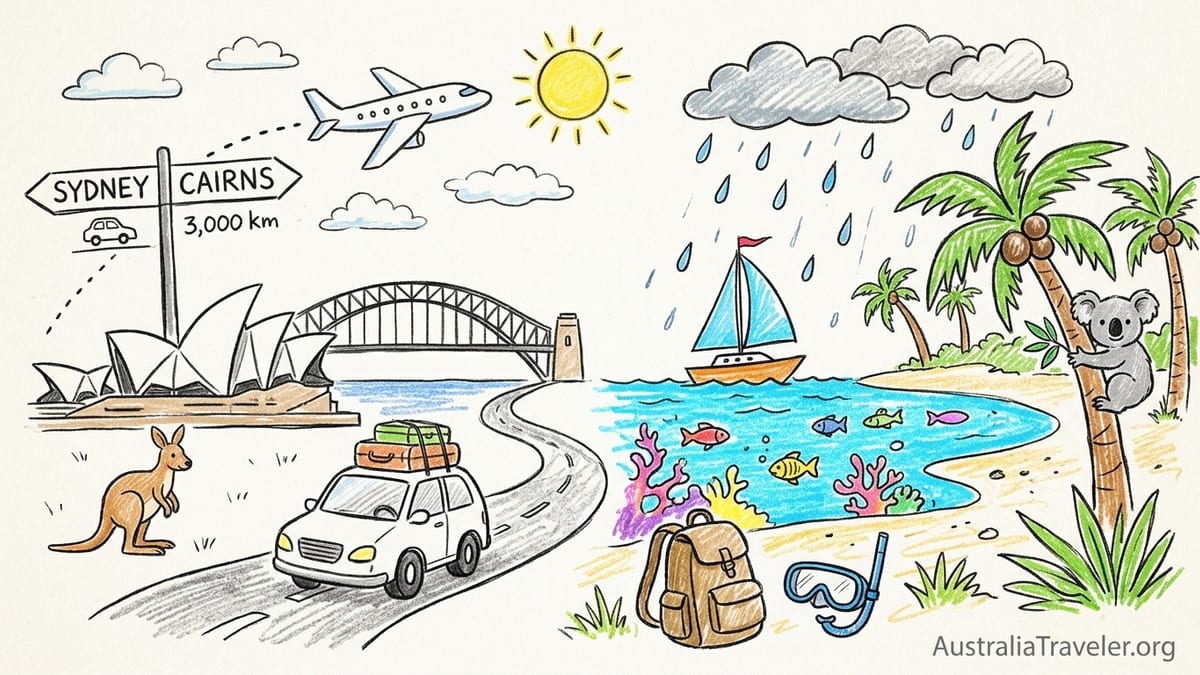
The first surprise for many visitors is how far apart Australia’s headline destinations really are. The road distance between Melbourne and Cairns is close to 3,000 kilometres, and typical driving time without major detours or long stops is well over 30 hours of actual time behind the wheel. That equates to at least four to five full days once you factor in fuel, rest and overnight breaks, which is a large chunk of a two or three week holiday to spend in the car.
By contrast, non-stop flights between Sydney and Cairns generally take around four hours, and Sydney to Melbourne around one and a half hours. Several daily services on Qantas, Virgin Australia and Jetstar link Sydney, Melbourne, Brisbane and Cairns, and these trunk routes are often competitive on price. Flying allows you to treat each city or coastal hub as a base for regional day trips and short drives instead of turning the entire holiday into a long-haul road journey.
Seasonality is another key factor. Tropical North Queensland, including Cairns, Port Douglas, the Daintree and the Whitsunday Islands, has a wet season roughly from November to April, with higher humidity, more rain and risk of cyclones. Many travellers prefer the drier months from June to September for reef trips and rainforest walks, although that is also peak tourism season with higher prices. In southern cities such as Sydney and Melbourne, summer from December to February is warm to hot, while winters are mild but can be cool and wet. If you travel in July or August, you are likely to enjoy crisp, clear days in the south while escaping to warm, dry conditions up north.
From a budget perspective, domestic airfares fluctuate widely. Advance purchase sales between Sydney and Cairns can occasionally dip below 200 Australian dollars one way on low-cost carriers, while last-minute peak holiday seats might rise above 400 Australian dollars. Checked baggage is usually included on Qantas domestic fares. Virgin Australia typically includes at least one checked bag on many economy fares, while Jetstar sells checked baggage and now overhead carry-on access as add-ons for a fee. These pricing structures make a difference when comparing a cheaper base fare plus luggage fees with a higher all-inclusive fare on a full-service airline.
Itinerary One: Efficient 14 Day Route From Sydney to the Reef
This two week plan connects Sydney, Melbourne, the Great Ocean Road and Tropical North Queensland using three main domestic flights and a single rental car segment. It assumes an open-jaw international arrival into Sydney and departure from Cairns, although it can be reversed. Per-day spending estimates are approximate and based on late 2026 prices in Australian dollars, excluding international flights.
Day 1: Arrive in Sydney. After clearing immigration and baggage, take either the airport train into the city or a pre-booked shuttle or rideshare to your hotel in the central business district or harbourside areas such as The Rocks or Darling Harbour. Travel time from airport to city is usually under 30 minutes. Spend the afternoon stretching your legs with an easy circular walk taking in the Sydney Opera House and Harbour Bridge viewpoints. A realistic daily budget for a central hotel, meals in mid-range restaurants and local transport would be around 350 to 450 Australian dollars for two people, with budget travellers able to reduce this by choosing guesthouses and using public transport more heavily.
Day 2: Full sightseeing day in Sydney. Use ferries and light rail to explore Circular Quay, the Royal Botanic Garden and Bondi Beach. Many visitors enjoy joining a guided Opera House tour or climbing the Harbour Bridge with advance reservations. A day using public transport, casual cafes and one paid attraction might be around 250 to 350 Australian dollars for two, depending on tour choices.
Day 3: Second full day in Sydney. Consider a ferry day trip to Manly for coastal walks and ocean swimming, or a small-group tour into the Blue Mountains that includes scenic lookouts, short bushwalks and wildlife spotting. A guided Blue Mountains excursion with hotel pickup typically pushes the daily spend closer to 350 to 500 Australian dollars for two, though self-guided train-based visits are cheaper.
Day 4: Morning in Sydney, then fly to Melbourne. The Sydney to Melbourne flight takes roughly one and a half hours in the air, but you should allow three to four hours door to door including airport transfers, check-in and baggage claim. Base yourself around the central business district, Southbank or Fitzroy depending on your dining and nightlife preferences. With a mid-range hotel and typical meals out, expect about 350 to 450 Australian dollars for the day including the domestic airfare if purchased in advance during a sale.
Day 5: Explore Melbourne’s laneways, galleries and riverfront. Walk or take trams around Federation Square, the National Gallery of Victoria and the cafe-filled lanes between Flinders and Bourke streets. Many travellers enjoy a half-day street art or food tour to orient themselves. Daily spending including central accommodation, trams and a couple of paid attractions generally sits between 250 and 400 Australian dollars for two.
Day 6: Collect a rental car in the morning and drive from Melbourne to the Great Ocean Road, staying in a base such as Lorne or Apollo Bay. The first driving stint can take around three hours with breaks. Spend the afternoon enjoying short coastal walks near your chosen town. Car rental, fuel, a comfortable motel and meals can bring the daily total to 350 to 450 Australian dollars, though budget travellers can trim this with simpler lodgings and self-catering.
Day 7: Full Great Ocean Road sightseeing day. Drive from your base to highlights such as the Twelve Apostles, Loch Ard Gorge and nearby lookouts, allowing several short walks to viewpoints. Expect many brief drives of 10 to 30 minutes between stops. Return to your base in the late afternoon. Without any long paid tours, this can be a relatively economical day, around 250 to 350 Australian dollars for two including petrol and meals, assuming the car is already rented.
Day 8: Drive back to Melbourne in the morning, allowing three to four hours with rest stops, then fly to Cairns in the afternoon or evening. The flight from Melbourne to Cairns is around three and a half hours in the air; door to door, plan on at least five to six hours. Upon arrival, transfer to your hotel in central Cairns or a resort area such as the northern beaches. Combined car drop fee, fuel, domestic flight, transfers and a mid-range hotel can bring this day close to 500 to 650 Australian dollars for two.
Day 9: Great Barrier Reef day trip from Cairns. Many reef operators depart from the Cairns Marlin Marina, offering full-day cruises that include snorkelling, lunch and equipment. Prices for quality operators often range from roughly 250 to 350 Australian dollars per person, so a couple’s daily spend, including dinner in town and one night in a mid-range hotel, often totals 700 to 900 Australian dollars.
Day 10: Explore the Cairns hinterland or rainforest. Popular options include a day trip to Kuranda using the heritage railway and Skyrail gondola, or a small-group tour into the Atherton Tablelands for waterfalls and local food. These experiences, including transport and park fees, can result in a daily spend of 400 to 600 Australian dollars for two including accommodation.
Day 11: Travel to Port Douglas, around one hour north of Cairns by shuttle or rental car along a scenic coastal road. Settle into a beachfront resort or apartment, then stroll Macrossan Street for dinner. Transfers or car hire plus accommodation and meals generally amount to 350 to 500 Australian dollars for two, depending on property choice.
Day 12: Explore the Daintree region. Many travellers book a guided day tour from Port Douglas that includes Mossman Gorge, a Daintree River crocodile cruise and a visit to Cape Tribulation, combining rainforest walks with time on the beach. Guided tours often range from approximately 220 to 300 Australian dollars per person, so total daily spend for two with an evening meal and accommodation may reach 600 to 800 Australian dollars.
Day 13: Free day around Port Douglas. Relax on Four Mile Beach, join an additional half-day reef trip, or simply enjoy resort facilities. With casual dining and no major tours, a couple might spend 300 to 450 Australian dollars for the day including accommodation.
Day 14: Travel home from Cairns. Return by shuttle or private transfer from Port Douglas to Cairns Airport, allowing at least one and a half to two hours before check in and extra time for any international flight. Daily costs will centre on transfers, final meals and any late check-out fees, typically between 200 and 400 Australian dollars for two, excluding long-haul flights.
Itinerary Two: Deeper 21 Day Route With Whitsundays and the Red Centre
The three week version keeps the Sydney, Melbourne and Port Douglas elements but builds in more time on the reef, a Whitsundays segment for island and sailing experiences, plus a side trip to Uluṟu in the Red Centre. This makes it more immersive, but also highlights why something usually needs to be removed if you add central Australia. Travel days increase and additional domestic flights affect budget and energy levels.
Days 1 to 6: Follow the earlier 14 day plan from arrival in Sydney through to your full day on the Great Ocean Road. Use the same city bases and transport choices, keeping daily spending estimates similar. By Day 6 you have reached the Twelve Apostles area with a rental car.
Day 7: Return to Melbourne and stay overnight rather than flying north immediately. This cushion day helps absorb any delays on the road and allows an evening in one of Melbourne’s restaurant districts such as Flinders Lane or Carlton. Expect around 350 to 450 Australian dollars for car fuel, hotel and meals.
Day 8: Fly from Melbourne to Uluṟu. Direct services from Melbourne to Ayers Rock Airport are not daily, so this leg must be planned around current airline schedules. Flying via Sydney is sometimes required. Overall journey time is typically four to six hours including connections. On arrival, check into a property at Yulara, the resort township near Uluṟu. Accommodation at the base ranges widely from simple outback hotels to high-end luxury lodges. Daily costs including airfare, a standard room and meals are often in the range of 600 to above 1,200 Australian dollars per couple depending on comfort level.
Day 9: Full day at Uluṟu and Kata Tjuṯa. Many visitors choose to book guided sunrise or sunset tours that include walks at the base of the rock and visits to Kata Tjuṯa’s domes. Park entry fees apply and are usually handled via advance purchase or through tour operators. With guided experiences, meals and accommodation, a realistic daily spend for two can easily sit between 700 and 1,000 Australian dollars.
Day 10: Morning at leisure in the Red Centre, then fly to Cairns, often routing via Alice Springs or a major east coast city. This will likely be a full travel day, with door to door times of five to seven hours or more. Plan to stay overnight in Cairns, close to the marina. Once flights, transfers, a mid-range hotel and meals are added, this day can reach 600 to 900 Australian dollars for two.
Day 11: Great Barrier Reef trip from Cairns as described in the two week itinerary. Spending for a quality full-day reef excursion plus accommodation and dining is again likely to fall around 700 to 900 Australian dollars for a couple. Staying in central Cairns keeps marina transfers quick and inexpensive, usually a short walk or a brief taxi ride.
Day 12: Travel north to Port Douglas, using a shared shuttle, private transfer or rental car. Enjoy a relaxed afternoon on Four Mile Beach and dinner in the main village. Base budgeting and experience expectations on the earlier itinerary, around 350 to 500 Australian dollars for two.
Day 13: Daintree day tour ex Port Douglas, focusing on rainforest boardwalks, freshwater swimming holes where conditions allow, and wildlife cruises. Costs for guided tours, meals and accommodation remain similar, typically 600 to 800 Australian dollars for two on an active day.
Day 14: Free day in Port Douglas. With three nights here in total, you have more time to rest after a string of flights and tours. Use this buffer to adjust if weather affects scheduled reef or rainforest trips. A more relaxed day without large paid tours might sit around 300 to 450 Australian dollars.
Day 15: Fly from Cairns to Proserpine or Hamilton Island to access the Whitsundays. Flight times are usually around one and a half to two hours, but connections and transfers to Airlie Beach or an island resort extend the door to door journey closer to four or five hours. Stay in Airlie Beach for access to a range of reef and island cruises, or select a resort island for a more self-contained stay. With flight, ground transfer, accommodation and meals, daily costs for two are often between 500 and 800 Australian dollars.
Day 16: Whitsundays sailing or island day. Popular experiences include day cruises to Whitehaven Beach and Hill Inlet lookout, or short sailing trips visiting multiple islands. Tours can range from smaller group catamarans to larger day boats, with approximate prices often between 250 and 350 Australian dollars per person. Together with accommodation and meals, the daily total can reach 700 to 1,000 Australian dollars for a couple.
Day 17: Additional Whitsundays time, perhaps focusing on snorkelling or a scenic flight over Heart Reef and the outer barrier. Scenic flights add to the budget, potentially pushing the day above 900 Australian dollars for two including lodging and dining. Alternatively, a quieter beach day keeps spending closer to 400 to 600 Australian dollars.
Day 18: Fly from the Whitsundays region back to Sydney, usually via Brisbane or directly to Sydney depending on current schedules. Travel will take most of the day once check-in and transfers are included. Plan to stay around Circular Quay, Surry Hills or another central neighbourhood. With flights, accommodation and meals, daily spending levels between 500 and 800 Australian dollars for two are realistic.
Day 19: Full day in Sydney for any missed highlights, shopping or coastal walks, using similar cost expectations to the earlier Sydney days. This is also a good contingency buffer for any previous weather-related disruptions in Queensland.
Day 20: Final Sydney day or optional side trip, such as a wine tasting excursion to the Hunter Valley. A day trip with transport and tastings increases the daily budget toward 400 to 600 Australian dollars for two, while a relaxed city day can be kept under that level.
Day 21: Departure from Sydney. With an afternoon or evening international flight, allow extra time at the airport. Final local costs are likely to consist of airport train or taxi fares, meals and incidentals, usually in the range of 200 to 350 Australian dollars for two.
Why You Cannot Simply “Squeeze In” Uluṟu
Adding Uluṟu to an already full two week Sydney to reef itinerary looks simple on a map, but it introduces several extra flights, higher daily costs and a need for flexible buffer days. Services into Ayers Rock Airport are less frequent than on the busy coastal routes, and many flights operate only on certain days of the week. Missing a tight connection due to weather or delays can have a knock-on effect for reef trips and onward flights.
Typical visitors benefit most from at least two nights in the Red Centre to experience both sunrise and sunset at Uluṟu and to visit Kata Tjuṯa. With travel days on each side, that sequence often consumes four calendar days. To maintain a balanced, enjoyable schedule, something usually needs to be removed, such as one city stop or the Whitsundays. Trying to keep every other element and simply compress nights can lead to a holiday dominated by airports and early wake-ups.
The three week itinerary described above illustrates this trade-off. Uluṟu fits comfortably when you have 21 days, but you can feel the increase in flight days and transport costs, especially when compared with a simpler route that focuses only on the east coast and southern cities. For travellers who have a deep interest in First Nations culture, desert landscapes and geology, the extra expense and time are justified. Others may prefer to save Uluṟu for a future trip built around central and western Australia.
Pragmatically, central Australian accommodation also skews more expensive because of remoteness and limited supply. While budget rooms exist, they book out early in peak periods. This makes careful advance planning important if Uluṟu is a priority, and it is another reason why last-minute attempts to add the Red Centre often come at a high financial and logistical cost.
Flights, Baggage, Transfers and Why Driving Melbourne to Cairns Is Inefficient
On the coastal routes between Sydney, Melbourne, Brisbane and Cairns, Qantas generally includes at least one piece of checked baggage on domestic economy tickets, subject to evolving weight and piece limits. Virgin Australia provides varying checked baggage allowances depending on fare type and loyalty status, while Jetstar treats checked luggage as a paid extra, and from 2027 is moving to a model where basic fares include only a small under-seat item as carry-on, with overhead locker use sold separately. These policies mean the apparent cheapest fare on a low-cost carrier may become more expensive than a mid-range fare on a full-service airline once bags are added.
Airport transfers are relatively straightforward in major Australian cities. Sydney and Melbourne both have airport rail links reaching the central city in under 30 minutes, supplemented by taxis, rideshares and shuttle buses. In Cairns and the Whitsundays, dedicated shuttle companies and resort transfers are common. Typical per-person costs for shared shuttles on short airport runs might fall roughly between 20 and 40 Australian dollars each way, while private transfers or rideshares for two to four people can be more or less cost-effective depending on distance and time of day.
Rental cars are most useful on focused segments such as the Great Ocean Road or the coastal strip from Cairns to Port Douglas. Daily rental rates fluctuate widely based on vehicle type and season, but compact cars often start around 70 to 100 Australian dollars per day before fuel and optional excess reduction cover. For city-to-city travel between Melbourne and Cairns, hiring a vehicle for a one-way drive adds considerable cost in rental days and one-way relocation fees, in addition to fuel, accommodation and meals in multiple overnight stops.
Continuous driving from Melbourne to Cairns is generally a poor substitute for flying on a short holiday. Beyond the distance of nearly 3,000 kilometres, the most direct inland route is not the same scenic coastal drive many visitors imagine from postcards. To see the classic east coast beaches and towns, you would need to detour to the shore repeatedly, further extending time and distance. Even if you attempted to split the journey into four or five long driving days, you would spend most of your limited holiday time on highways, arriving at the Great Barrier Reef already tired, with fewer days left to enjoy reef trips and rainforest walks.
By choosing flights on high-traffic sectors and reserving driving for compact, scenic stretches, you maximise time at the destinations rather than in transit. This approach also makes it easier to lock in timed reservations such as reef cruises, Daintree tours or Whitsundays sailings, since your arrival windows are more predictable when not subject to multi-day road conditions.
Budget, Midrange and Luxury Ways To Follow These Routes
The 14 and 21 day itineraries can both be tailored to very different budgets. A cost-conscious couple staying in budget hotels or hostels, cooking some meals and prioritising a small number of paid tours might complete the two week route for an average of around 350 to 450 Australian dollars per day excluding long-haul airfares. This would involve using airport trains where available, travelling mostly on low-cost carriers with prepaid checked baggage, and selecting one major reef trip and one or two key guided tours.
A midrange approach, using comfortable city hotels, occasional splurge dinners and a larger selection of guided activities, often lands closer to 500 to 750 Australian dollars per day for two on the 14 day trip and slightly higher on the 21 day version. This bracket suits many international visitors, providing reliable comfort and a good balance between independent exploration and organised excursions.
At the luxury end, five-star harbour and resort hotels, premium reef excursions, helicopter scenic flights and private touring can raise average daily spending above 1,000 Australian dollars for a couple in popular areas such as Sydney, the Whitsundays or Uluṟu. High-end properties in remote locations, particularly around the Red Centre or on island resorts, command elevated nightly rates, and fine dining can add significantly to the total. These travellers often benefit from working with a specialist travel advisor who can secure waitlisted rooms or special experiences.
Seasonality influences not only weather but also price. During school holidays, major events or the Australian summer, accommodation and tours can cost more and book out earlier, particularly in coastal destinations. Travelling in shoulder seasons, such as late April or October, may offer a middle ground with milder temperatures and somewhat lower demand, though in Tropical North Queensland this period also overlaps with transitions into or out of the wet season, so flexible planning is important.
Map-Ready Routes, Booking Timeline and Theme Variations
For mapping purposes, the 14 day route traces a clear shape. It begins in Sydney, hops by air to Melbourne, sweeps along the Great Ocean Road to the Twelve Apostles and back, then leaps north by air to Cairns before continuing by road transfer to Port Douglas and returning to Cairns for departure. Visualised on a map, it resembles a southern city loop joined to a northern reef arc. The 21 day version adds a central Australian leg to Uluṟu between Melbourne and Cairns, plus a Whitsundays loop between Cairns and the final return to Sydney, forming a broad triangle linking the southeast, the tropics and the Red Centre.
When planning, a staged booking timeline is helpful. Six to nine months before travel, focus on locking in international flights and key domestic sectors that connect with those long-haul arrivals and departures. At the same time, secure scarce accommodation such as Uluṟu lodgings or popular island resorts. Three to six months out, book major day tours and reef trips, aiming for earlier days in each location to allow for weather adjustments. One to two months before departure, confirm airport transfers, rental cars and any restaurant reservations in highly sought-after dining districts in Sydney or Melbourne.
Travellers with a strong beach focus might adapt these routes by trimming city days and extending time in Port Douglas or the Whitsundays. For example, a beach-focused 14 day variation could reduce Sydney and Melbourne by one night each and allocate those days to an island resort. City-centric visitors may drop the Great Ocean Road in favour of extra time in Melbourne neighbourhoods and an additional day trip from Sydney, such as the Hunter Valley. Nature enthusiasts could spend more time in the Daintree and Atherton Tablelands, or, on the three week itinerary, add an extra night at Uluṟu while reducing urban stays.
The wet season in Queensland shapes these choices. During the peak of the rains, some inland tracks and certain reef sites may be affected, and stinger season along the northern beaches requires the use of protective stinger suits and attention to local warnings. If your priority is beaches and reef, a dry season visit from June to September generally provides the most reliable conditions, though popular tours must be booked well in advance. If your interests lean more toward cities and culture, visiting in shoulder seasons or the southern spring can be very rewarding, with more moderate temperatures in Sydney and Melbourne and somewhat lower demand on domestic flights.
FAQ
Q1: Is it better to book an open-jaw international ticket for these itineraries?
For the 14 day route that starts in Sydney and ends in Cairns, an open-jaw ticket that flies into Sydney and out of Cairns can save backtracking time and domestic airfare costs. On the 21 day itinerary, an open-jaw that arrives in Sydney and departs from either Cairns or Sydney works well depending on how you sequence your Queensland and Red Centre segments.
Q2: How far in advance should I book Great Barrier Reef tours?
For peak periods such as Australian school holidays and the June to September dry season in North Queensland, booking reef trips at least two to three months ahead is sensible, especially for smaller boats or premium operators. Outside peak times, a few weeks’ notice is often sufficient, but last-minute travellers may find limited choice on exact dates.
Q3: Do I need to rent a car in Sydney or Melbourne?
In both Sydney and Melbourne, most visitors rely on public transport and walking, since central areas are congested and parking is expensive. A car is far more useful on focused segments like the Great Ocean Road or the drive between Cairns and Port Douglas. Renting a car just for those periods reduces hassle and costs.
Q4: Is it safe to swim at the beaches near Cairns and Port Douglas?
Swimming conditions vary by season. During the tropical wet and marine stinger season, enclosures and stinger suits are widely used and beachfront signage provides up-to-date advice. Many visitors choose resort pools or patrolled sections of beach where lifesavers monitor conditions. Local operators and accommodation staff are good sources of current safety information.
Q5: How strict are airlines about domestic checked baggage?
Qantas generally includes checked bags on domestic fares, subject to size and weight rules, while Virgin Australia allowances depend on the fare purchased. Jetstar requires most passengers to pay for checked luggage and is increasingly enforcing both carry-on and overhead locker limits. At check-in counters, overweight or extra bags can attract substantial fees, so pre-purchasing the correct allowance is recommended.
Q6: Can I visit the Great Ocean Road as a long day trip from Melbourne?
It is technically possible to see some highlights on a very long day tour from Melbourne, but this involves significant time on the bus and limited stops. Staying one or two nights along the route at towns like Lorne, Apollo Bay or Port Campbell offers a more relaxed experience with the chance to see coastal lookouts in different light and avoid peak bus tour times.
Q7: Is driving between Melbourne and Cairns ever a good idea for visitors?
For travellers with several weeks dedicated specifically to an overland journey and a strong interest in regional towns, an extended road trip can be rewarding. For first-time visitors trying to fit city sightseeing and reef time into two or three weeks, the long drive is usually too time-consuming and often means sacrificing experiences at the key destinations.
Q8: Which month balances weather in both the south and Tropical North Queensland?
June, July and August are popular because Sydney and Melbourne enjoy clear, cool to mild days while Cairns and the reef regions are in their drier, more stable season. These months are also busy, so travellers should expect higher demand and plan bookings well in advance.
Q9: Are there vegetarian and vegan dining options on these routes?
Sydney and Melbourne both have extensive vegetarian and vegan offerings across all price ranges, from casual cafes to fine dining. In Cairns, Port Douglas and the Whitsundays, plant-based options are increasingly common, particularly in tourist-oriented restaurants, though menus can be more limited than in the big cities. Advising tour operators of dietary needs when booking reef or sailing trips is important.
Q10: Can I use public transport to reach the Daintree Rainforest?
The Daintree region is not directly served by regular public buses, so most visitors join guided tours from Cairns or Port Douglas or use rental cars to reach Mossman Gorge, the Daintree River and Cape Tribulation. Road conditions are generally good on the main routes, but distances and limited mobile coverage in sections make organised tours attractive for many travellers.