


Australia is vast, diverse and far more than its famous harbor cities. From the red heart of Uluṟu and the tropical rainforests of the Daintree to the vineyards of Margaret River and the wild coasts of Tasmania, planning a trip here means making smart choices. Distances are huge, daily budgets are closer to a high-cost destination than a bargain break, and you will almost certainly need at least one domestic flight. This guide focuses on 20 of the country’s most rewarding destinations, what genuinely makes each special, how long to stay, what it costs in real terms, and how to combine them into realistic itineraries.
Understanding Australia’s Scale, Costs and Seasons
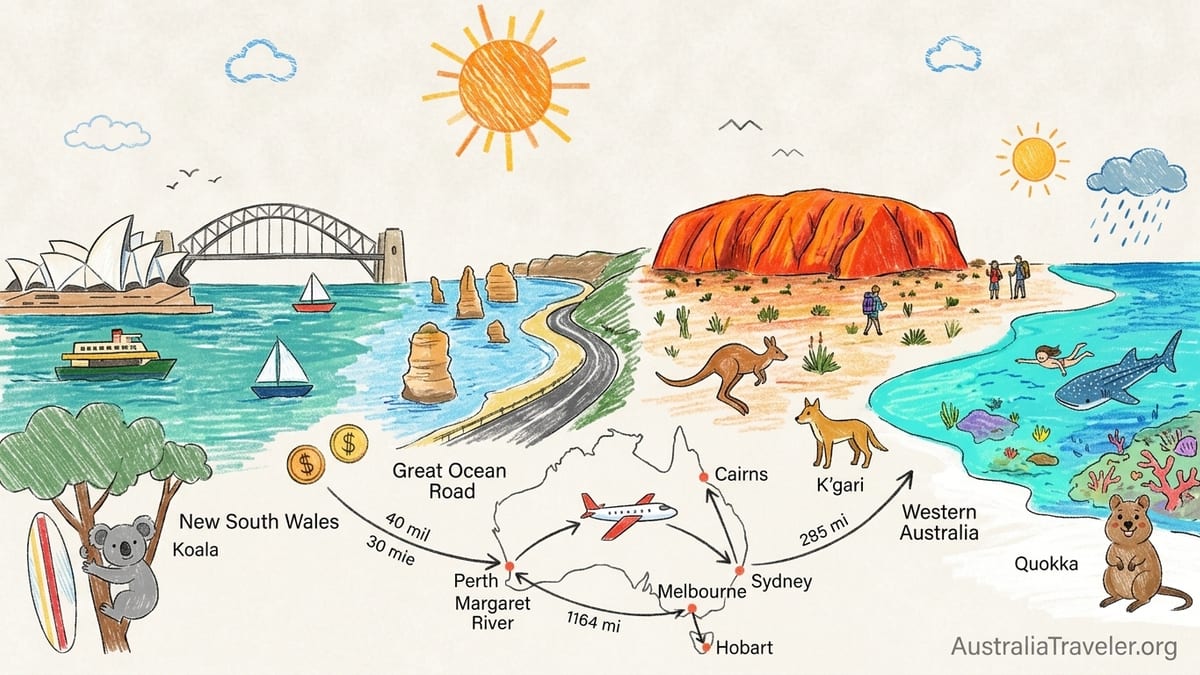
Australia is almost as wide as the continental United States, and about the size of mainland Europe. Flying from Sydney to Perth takes around five hours, similar to New York to Los Angeles. Driving distances that look manageable on a map can mean ten or more hours on the road. As a rule of thumb, combine destinations within the same state or region by car, such as Sydney and the Blue Mountains or Melbourne and the Great Ocean Road, and use domestic flights for longer jumps, for example between Sydney and Cairns or Melbourne and Hobart.
Costs have risen in recent years, and travelers regularly report that an Australian holiday now feels closer in price to destinations like New Zealand or Western Europe. Recent analyses of on-the-ground expenses suggest that a hostel-style budget often sits around the equivalent of 80 to 100 US dollars per person per day, while a comfortable mid-range style usually falls around 160 to 230 US dollars per person per day when sharing a hotel room, including meals, local transport and sightseeing. These ballpark figures match what many visitors now see in real bookings, such as central Sydney hotel nights that often start around 250 Australian dollars for standard properties and simple breakfasts commonly priced from 15 to 25 Australian dollars in major cities.
Seasonality is critical. The northern tropics, including Cairns, Port Douglas and Darwin, have a distinct dry season from roughly May to October with lower humidity and fewer storms, making it the prime time for reef trips and national park touring. Southern cities and regions such as Sydney, Melbourne, Perth, Tasmania and South Australia are most pleasant from October to April, with beach-friendly summers and cool but often clear winters. The red centre around Alice Springs and Uluṟu is at its best in the cooler months from April to September, when daytime temperatures are milder and walking is more comfortable.
For national parks and signature experiences, factor in mandatory passes and tour costs. For example, entry to Uluṟu-Kata Tjuṯa National Park currently costs just under 40 Australian dollars per adult for a three-day pass bought online, while seven-day Kakadu National Park passes for adults are usually priced in the tens of dollars, sometimes discounted in the dry season. A full-day whale shark tour on Ningaloo Reef can easily start from around 700 to 800 Australian dollars per person, including multiple snorkels and meals on board. These concrete figures help explain why even short itineraries can add up quickly and why advance budgeting matters.
New South Wales: Sydney, Blue Mountains and the Gold Coast
Sydney remains Australia’s most recognisable city, but it earns its place on more than name alone. The harbor, framed by the Sydney Opera House and Harbour Bridge, offers world-class coastal walks between Bondi and Coogee, inner-city beaches like Balmoral and Manly, and ferry rides that function as inexpensive harbor cruises. Three to four full days let first-time visitors explore The Rocks, take a harbor cruise or public ferry, spend a beach day and perhaps add a day trip out of town. Sydney Airport sits about 20 minutes by train from the city center, and accommodation ranges from well-located hostels from roughly 50 to 70 Australian dollars per night in shared dorms to mid-range hotels often above 250 Australian dollars per room in peak periods.
Two hours inland, the Blue Mountains offer dramatic cliffs, eucalyptus forests scented with oil in warm weather, and accessible hiking near Katoomba and Leura. Iconic viewpoints like the Three Sisters and Govetts Leap are paired with day walks that range from short cliff-top strolls to half-day descents into the valleys. One or two nights allow time to see lookouts in quieter early morning or late afternoon light. Many visitors travel by train from Sydney’s Central Station to Katoomba, then use local buses, or hire a car for maximum flexibility. Lodging runs from simple motels around 150 Australian dollars per night to boutique guesthouses and cottages aimed at couples.
South of the Queensland border but firmly within the same coastal tourism belt, the Gold Coast combines long surf beaches with a skyline of high-rise apartments and family-friendly theme parks. It works best as a base for beach days, whale-watching cruises in season and hinterland drives into Lamington or Springbrook National Parks for rainforest walks and waterfalls. Two to four days suit most travelers. Gold Coast Airport handles direct flights from major Australian cities and some international services, while Brisbane is roughly an hour north by train. Bedrooms in self-catering apartments, which are popular with families, can start around 200 Australian dollars per night outside school holidays, though prices climb significantly during peak Australian vacation periods.
Across these three destinations, wildlife and outdoor activities dominate. Sydney’s coastal paths often deliver wild parrot sightings and southern right or humpback whales offshore in winter, the Blue Mountains reward walkers with lyrebirds and occasional wallabies, and the Gold Coast’s hinterland brings glow-worm caves and bird-rich subtropical forest. None are top snorkeling spots, so most travelers pair them with a separate tropical or west coast reef destination.
Victoria and South Australia: Melbourne, Great Ocean Road, Kangaroo Island and Flinders Ranges
Melbourne’s appeal lies in culture and atmosphere as much as in sights. The central laneways are packed with coffee bars, street art and small boutiques, while neighborhoods like Fitzroy, Collingwood and St Kilda each offer their own dining and nightlife scenes. Sports fans time visits around Australian Football League matches or international cricket, and food lovers plan restaurant bookings weeks ahead. Spend at least three nights to explore the central city, take a street art or food tour, and fit in an evening at the theatre or a live music venue. Melbourne Airport sits to the northwest, with a dedicated bus link to the center and taxis or rideshares costing around 60 Australian dollars into town.
The Great Ocean Road west of Melbourne ranks among Australia’s classic coastal drives. Its sandstone stacks, including the famous Twelve Apostles, combine with rainforest pockets, koala sightings near Kennett River and surf towns like Torquay and Lorne. Allow two to three days with an overnight stop around Apollo Bay or Port Campbell to avoid rushed one-day bus trips, and to see sunset and sunrise at the major lookouts when crowds are thinner. Fuel, accommodation and meals along the route tend to cost slightly more than inland, with basic motel rooms commonly starting from around 180 to 220 Australian dollars per night.
Across the border in South Australia, Kangaroo Island functions as an open-air wildlife park. Wild kangaroos, tame-feeling sea lions at Seal Bay and often visible echidnas make it a standout for families and animal lovers, while Remarkable Rocks and Admirals Arch in Flinders Chase National Park create a rugged coastal backdrop. Reaching the island involves either a short regional flight from Adelaide to Kingscote or a ferry from Cape Jervis after a roughly 90-minute drive from Adelaide. Given the ferry cost and logistics, two to three nights are ideal, enabling time for guided nocturnal tours and visits to family-run farms and honey producers. Many visitors rent a house or cabin with a kitchen, both to manage costs and because dining options are scattered.
Further inland, the Flinders Ranges offer classic outback scenery without the longer journey into the Northern Territory. The amphitheatre-like walls of Wilpena Pound, ridgeline trails and historic sheep stations converted into lodges draw hikers and photographers. Autumn and spring are best for walking, although winter days can also be clear and cool. Travelers usually fly into Adelaide and then either join a multi-day tour or drive around five hours north. Some historic homestead stays start around 250 Australian dollars per night including dinner and breakfast, while simple camping remains an option for those with gear. Compared to Melbourne’s urban energy, the Flinders emphasise stargazing, Aboriginal rock art sites and quiet, long hikes.
Queensland Tropics: Cairns, Port Douglas, Daintree, Whitsundays, K’gari and Beyond
Far North Queensland is the country’s flagship reef and rainforest destination, anchored by Cairns and Port Douglas. Cairns works as the main flight gateway, with daily services from Sydney, Melbourne and Brisbane. Two to four days in the area suit most visitors, combining a full-day Great Barrier Reef cruise with a day in Kuranda via the scenic railway and cableway or an excursion to nearby waterfalls on the Atherton Tablelands. Central hotels and hostels in Cairns are relatively compact around the Esplanade, where a public lagoon serves as the town’s swimming spot instead of a beach.
Port Douglas, an hour north by coastal highway, feels more resort-like, with palm-lined Four Mile Beach, shaded streets and easy access to both Outer Reef trips and Daintree Rainforest tours. It is a strong base for couples and families who prefer a quieter setting. Daintree and Cape Tribulation lie another hour or two beyond, reached by a small cable ferry over the Daintree River. Here, lowland rainforest meets the sea, with boardwalks, night walks and guided Indigenous experiences focused on traditional plant uses and coastal foraging. Three to five nights between Port Douglas and the Daintree region allow time for at least one reef day, one rainforest day and some unstructured beach time.
Farther south, the Whitsunday Islands in central Queensland deliver the country’s postcard-perfect white-sand beaches and turquoise water. Airlie Beach on the mainland acts as the main jumping-off point, with Whitsunday Coast Airport nearby and additional connections via Proserpine or Hamilton Island airports. Many visitors book overnight sailing trips through the islands or day cruises to Whitehaven Beach. Prices vary widely, but shared cabin sailing trips commonly start in the low hundreds of Australian dollars per day including meals, while resort stays on Hamilton Island regularly exceed 400 Australian dollars per night in high season. Four to five days in the region let you balance boat days with time by the pool.
K’gari, formerly Fraser Island, rounds out Queensland’s coastal highlights. As the world’s largest sand island, it features perched freshwater lakes like Lake McKenzie, a long surf beach that doubles as a four-wheel-drive highway, and dingoes that remain genuinely wild. Access usually involves a ferry from the Hervey Bay or Rainbow Beach areas, combined with a guided 4WD tour or a rented 4WD for experienced sand drivers. Two or three days are enough for most itineraries. Compared with Cairns and the Whitsundays, K’gari focuses more on off-road adventure and wildlife than snorkeling, although some trips include shallow-water swims and snorkeling in sheltered bays.
Northern Territory Icons: Uluṟu, Kata Tjuṯa, Alice Springs, Kakadu and Darwin
The central Australian desert delivers some of the country’s most powerful experiences. Uluṟu and neighbouring Kata Tjuṯa rise from a red sand plain, glowing orange at sunrise and sunset and associated with complex Anangu creation stories. Travelers typically fly into Ayers Rock Airport near the resort town of Yulara, which sits just outside Uluṟu-Kata Tjuṯa National Park. A three-day park pass costs a little under 40 Australian dollars per adult bought online, giving access to both the Uluṟu base walk and Kata Tjuṯa’s Valley of the Winds. Two to three nights allow you to see multiple dawn and dusk viewpoints, join a guided Mala walk with rangers or local guides, and attend cultural presentations at Yulara’s town square.
Alice Springs lies about 450 kilometers away, usually reached by a five-hour drive or a short regional flight. The town offers access to the West MacDonnell Ranges, with waterholes such as Ormiston Gorge and Simpsons Gap, and multi-day trails for experienced hikers. Spending at least two nights allows for a full day exploring the nearby gorges and historic sites like the old telegraph station. Mid-range hotels and motels in Alice Springs often price rooms in the 180 to 260 Australian dollar range, slightly less than the resort properties at Yulara where demand is more concentrated.
In the Top End, Kakadu National Park combines wetlands, sandstone escarpments, prolific birdlife and some of the country’s most renowned Aboriginal rock art sites at Ubirr and Burrungkuy. Travelers usually approach from Darwin, around three hours’ drive away. A seven-day park pass for adults recently sat in the band of 25 to 40 Australian dollars, with temporary reductions during certain months, and helps fund ranger programs and boardwalk maintenance. Allow three days to visit rock art sites, take a Yellow Water billabong cruise for crocodile and bird viewing, and explore Nourlangie’s walks. Overnight options range from simple campsites and basic motels to lodge-style rooms priced similarly to regional highway motels elsewhere in the country.
Darwin itself is a relaxed tropical city that works as a gateway more than a standalone destination, though its waterfront precinct, sunset markets at Mindil Beach during the dry season and World War II history justify at least two nights. It is also the staging point for Litchfield National Park day trips, where short walks lead to plunge pools and waterfalls. Darwin International Airport accommodates domestic and some international flights, and car rental is common for those planning to continue into Kakadu or Katherine. Compared with the red centre, the Top End sees far more humidity and dramatic storms outside the May to October dry season, so timing matters more here than in many southern regions.
Western Australia Wonders: Perth, Rottnest Island, Margaret River, Ningaloo and Esperance
Western Australia feels like a country within a country, with its own time zone and vast distances between highlights. Perth, the capital, offers a riverfront setting, urban beaches at Cottesloe and Scarborough, and easy access to the Swan Valley and Fremantle. Two to three days are enough for most visitors to explore Kings Park, spend time at the beach and join a Swan River cruise or wine-tasting excursion. Perth Airport sits close to the city, with a direct rail link operating between the CBD and some terminals and frequent rideshares and taxis.
Just offshore, Rottnest Island is popular for day trips focused on cycling between bays and meeting the resident quokkas. Ferries depart from Fremantle, Hillarys and central Perth, taking 25 to 90 minutes depending on route, and many packages bundle bike hire. The island has car-free roads for visitors, so expect to move on foot or by bicycle. While many travelers visit as a day trip, staying overnight in simple cabins, holiday houses or a handful of hotels opens up quieter evenings and early mornings when birdlife and soft light make the beaches even more appealing.
South of Perth, the Margaret River region is known for its combination of wineries, surf breaks and karst caves. Travelers usually drive the three or so hours from Perth, then base themselves around Margaret River township, Dunsborough or Yallingup. Two to four days are ideal, giving enough time for wine tastings at cellar doors, beach walks and perhaps a half-day cave tour. Accommodation ranges from holiday parks and farm stays from roughly 150 to 200 Australian dollars per night to design-focused lodges and vineyard cottages well above 400 Australian dollars.
Farther north, Ningaloo Reef provides an alternative to the Great Barrier Reef with easier access to coral gardens directly from the beach. Towns like Exmouth and Coral Bay function as gateways. Swimming with whale sharks is the marquee experience between roughly March and July, with day tours that commonly start from around 700 to 800 Australian dollars per person including multiple snorkels, meals and spotter plane support. Outside whale shark season, snorkeling from shore at Turquoise Bay or Oyster Stacks still rewards visitors with turtles, reef sharks and a dense fish population. Expect at least three days in Exmouth or Coral Bay to fit in a whale shark or humpback whale tour, a self-guided snorkeling day and some rest time.
On the south coast, Esperance is famous for its powdery white beaches and, at certain times, scenes of kangaroos resting on the sand at Lucky Bay. Reaching it involves either a short flight from Perth or a long, roughly eight-hour drive, so most travelers plan at least three nights. Cape Le Grand National Park provides numerous lookouts and hiking opportunities, and the town itself offers modest cafes and a relaxed atmosphere. Within Western Australia as a whole, snorkeling shines at Ningaloo, road trips between Perth and Margaret River are notably easy, and wildlife encounters range from quokkas on Rottnest to kangaroos and emus on rural roads, reminding drivers to stay cautious at dawn and dusk.
Tasmania: Hobart, Freycinet and Cradle Mountain
Tasmania feels distinct from mainland Australia, with a cooler climate, compact distances and a strong focus on wilderness and produce. Hobart, reached via direct flights from major Australian cities, blends a small working harbor with historical sandstone warehouses and a contemporary art scene anchored by its headline-grabbing private museum outside town. Two to three nights support a visit to the city’s markets, the museum, and nearby Mount Wellington for sweeping views and alpine walking trails.
On the east coast, Freycinet Peninsula and Wineglass Bay feature curved white-sand beaches, granite mountains and clear water. Visitors often drive from Hobart in about two and a half hours, then stay in the nearby village of Coles Bay or in lodge-style accommodation at the national park boundary. At least two nights are advisable to complete the Wineglass Bay lookout walk, explore longer trails into the Hazards Range, and enjoy beach time. Although the water here is clear, temperatures are considerably cooler than in Queensland or Western Australia, so snorkeling appeals most to confident swimmers with wetsuits.
Cradle Mountain-Lake St Clair National Park in the island’s northwest is Tasmania’s premier alpine hiking area. Day walks like Dove Lake Circuit are accessible to most visitors, while the multi-day Overland Track requires advance bookings and suitable gear. Cradle Mountain is roughly a four to five-hour drive from Hobart or Launceston, and given the winding roads, at least two nights are recommended to allow for weather changes. Lodging spans from simple cabins and hostels to high-end wilderness lodges where rooms with dinner and breakfast included can easily exceed 500 Australian dollars per night in peak season.
Compared with mainland destinations, Tasmania stands out for its concentration of national parks and the ease of stringing several together in a one or two-week loop. Wildlife feels close at hand, with common encounters involving wallabies, pademelons and wombats near dusk. For travelers more interested in hiking, cool-climate vineyards and unhurried drives than in tropical snorkeling, Tasmania can competently replace northern Queensland or Western Australia in a first-time itinerary.
Itinerary Ideas: 7, 14 and 21 Days
Seven days in Australia forces hard choices, and almost always requires at least one domestic flight. A classic first-time one-week trip focuses on Sydney and the red centre. You might spend four nights in Sydney to explore the harbor, Bondi and the Blue Mountains on a day trip, then fly to Ayers Rock Airport for three nights at Uluṟu-Kata Tjuṯa, with guided base walks, a field-of-light-style art installation in the desert if budgets permit, and one sunrise and one sunset at different viewpoints. This combination mixes city, coast and desert while limiting long drives.
With two weeks, you can add a tropical or cool-climate component. One popular 14-day routing combines Sydney, Cairns or Port Douglas, and Melbourne with the Great Ocean Road. For example, spend three nights in Sydney, fly to Cairns for five nights split between Port Douglas and the Daintree, then fly to Melbourne for three nights plus a three-day Great Ocean Road loop by rental car. Expect at least three domestic flights on such an itinerary. Another two-week option focuses on the south, blending Melbourne, Kangaroo Island and Tasmania for travelers less interested in reef snorkeling and more interested in wildlife and hiking.
A 21-day trip allows time to reach Western Australia or to slow down and reduce flight count. One month-like three-week plan could link Melbourne and the Great Ocean Road, Adelaide with Kangaroo Island and the Flinders Ranges, then fly to Perth for a week split between the city, Rottnest Island and Margaret River. Another three-week route aimed at nature travelers might loop through Brisbane and the Gold Coast, continue to the Whitsundays and K’gari by domestic flights and hire cars, then end in the red centre and Darwin with Kakadu. Because each extra flight can add hundreds of dollars to the budget, some travelers intentionally choose two main hubs and explore them deeply instead of racing around the continent.
Whichever duration you choose, build in at least one slower day every four or five days, especially in hot or humid regions. Heat, long flights and jet lag combine to sap energy. A simple day by the pool in Port Douglas, a cafe day in Melbourne or a quiet afternoon wine tasting in Margaret River can help you enjoy the headline experiences more.
The Takeaway
Seen on a map, Australia looks like a single destination. Travel on the ground reveals a patchwork of distinct regions that feel, in climate and culture, almost like separate countries linked by language. The 20 destinations highlighted here are not a checklist to race through in one trip but a menu to mix and match based on your time, budget and interests. Those who love snorkeling and marine life gravitate to Cairns and Port Douglas, the Whitsundays or Ningaloo, while hikers and cool-weather fans often prioritise Tasmania, the Flinders Ranges and the Blue Mountains. Couples might choose vineyard stays in Margaret River or the Yarra Valley near Melbourne, and families often look to the Gold Coast, Kangaroo Island or K’gari for wildlife and beach time.
Realistically, first-time visitors with one to two weeks should plan on seeing at most three major hubs, linked by one or two domestic flights. Families may find it easier to focus on a single coast, such as combining Sydney, the Gold Coast and Cairns in the east, or Perth, Rottnest and Margaret River in the west. Couples might build an itinerary around fewer bases with longer stays, for example a week divided between Port Douglas and the Daintree, then a week split between Hobart and Freycinet. Nature-focused travelers might allocate more days to national parks like Uluṟu-Kata Tjuṯa, Kakadu, Cradle Mountain and the Flinders, using nearby towns merely as staging posts.
Budget-conscious visitors have several levers to pull. Traveling outside Australian school holidays, choosing apartments with kitchens in places like the Gold Coast, Port Douglas, Margaret River and Hobart, and using long-distance buses or occasional overnight buses instead of short flights on certain corridors can all trim costs. Picking one high-ticket experience, such as a whale shark tour at Ningaloo or a scenic flight over the Great Barrier Reef, and balancing it with free hikes and national-park days elsewhere keeps the trip special without breaking the bank. For all traveler types, the key is accepting Australia’s scale, allowing adequate time in each region, and embracing the mix of coast, desert, forest and city that makes the country distinct.
FAQ
Q1. How many domestic flights should I plan for a two-week trip to Australia?
For a typical two-week trip that includes both a major city and at least one remote region, most visitors end up taking two to three domestic flights. For example, a Sydney, Cairns and Uluṟu itinerary will usually involve flying between each hub rather than driving because the distances are comparable to crossing large parts of the United States.
Q2. What is a realistic daily budget for mid-range travel in Australia?
Recent price data and traveler reports suggest that a mid-range traveler sharing hotel rooms should expect to spend roughly 230 to 325 Australian dollars per person per day. This figure usually covers a central three-star or four-star hotel, meals at casual restaurants or cafes, local transport and one paid activity most days, such as a guided walk, museum entry or boat trip.
Q3. Is it better to visit the Great Barrier Reef from Cairns or the Whitsundays?
Cairns and Port Douglas provide access to both outer reefs and nearby rainforest, making them a strong choice if you want reef plus Daintree in a single stop. The Whitsundays focus more on island scenery and beaches, with reef experiences often paired with sailing and resort stays. If snorkeling quality is your top priority and time is short, basing yourself in Cairns or Port Douglas usually offers more varied reef day trips.
Q4. When is the best time to visit Uluṟu and central Australia?
The most comfortable period for Uluṟu, Kata Tjuṯa and Alice Springs is from about April to September, when daytime temperatures are milder and walking long trails is more pleasant. Summer months can bring extreme heat that makes midday hiking unsafe, and many visitors then shift to sunrise and sunset activities or choose cooler destinations instead.
Q5. Do I need a car to explore Australia’s main destinations?
You can visit most major hubs such as Sydney, Melbourne, Cairns, Hobart and Perth without a car by relying on public transport and organised tours. However, renting a car becomes very useful for areas like the Great Ocean Road, Tasmania outside Hobart, Margaret River, the Flinders Ranges and parts of the Queensland coast. Always factor fuel costs, one-way drop fees and long driving distances into your planning.
Q6. How far in advance should I book popular tours like Ningaloo whale shark trips?
For seasonal, high-demand experiences such as swimming with whale sharks at Ningaloo Reef between roughly March and July, it is wise to book at least several months in advance, especially if you have fixed dates. Boats have limited capacity and small towns like Exmouth and Coral Bay also have limited accommodation, so securing both lodging and your chosen tour early reduces the risk of missing out or facing only the most expensive options.
Q7. Are Australian national park fees expensive?
Park entry fees vary by state and park but are generally modest compared with overall trip costs. Multi-day passes for parks like Uluṟu-Kata Tjuṯa and Kakadu typically sit in the tens of dollars per adult, sometimes with discounts or seasonal pricing. Fee revenue helps maintain walking tracks, visitor centres and cultural programs, so factoring these passes into your budget is both practical and supportive of conservation.
Q8. Which Australian destinations are best for families with children?
Families often enjoy the Gold Coast for its theme parks and patrolled beaches, Port Douglas and Cairns for easy-going reef trips and resort pools, and Kangaroo Island or K’gari for close wildlife encounters. Apartment-style accommodation is common in these areas, making it easier to self-cater and keep costs manageable. Many tours in these regions also welcome school-age children and offer shorter, child-friendly excursions.
Q9. Where should couples go for a romantic Australian trip?
Couples frequently choose Margaret River for its wineries and coastal scenery, Port Douglas for palm-fringed resorts, or Tasmania’s east coast for quiet lodges near Freycinet. Staying in a vineyard cottage, an adults-only eco-lodge or a small design hotel often adds a romantic feel without needing an extensive list of activities. Combining one coastal region with a few nights in the red centre around Uluṟu creates a memorable mix of landscapes.
Q10. How can budget-conscious travelers keep costs down in Australia?
Travelers watching their spending can save money by visiting outside peak school-holiday periods, choosing hostel private rooms or basic motels, and focusing on regions with strong free offerings such as national parks and beaches. Cooking some meals in hostel or apartment kitchens, using public transport in major cities and selecting just one or two big-ticket tours such as a reef day or scenic flight all help stretch a limited budget while still delivering a satisfying Australian experience.