


Planning a trip to Australia in 2026 means facing one big question early: how much is this really going to cost? Sticker shock is common, especially in big cities like Sydney and Melbourne or at remote icons such as Uluṟu and the Great Barrier Reef. There is no single “average” daily budget that works for both a Sydney hostel-hopper and a family on a Whitsundays cruise. Instead, real costs depend heavily on your travel style, pace, destinations and how often you splash out on big-ticket experiences.
Why One “Average” Australian Daily Cost Is Misleading
Many guidebooks still quote a single daily figure for Australia, as if a backpacker in an eight-bed dorm in inner Sydney spends anything like a family of four driving the Great Ocean Road and flying to Cairns. In reality, the same country can feel moderately priced in cities where competition keeps hotel and tour prices in check, and eye-wateringly expensive in the outback or on small resort islands where there may only be one or two places to stay. Looking at realistic scenarios for budget, midrange and higher-end trips is far more useful than chasing an impossible average.
Costs also fluctuate sharply between regions. A hostel bed in central Sydney might cost around 70 to 80 Australian dollars per night if you book close to arrival in peak months, whereas a simple room in an outback roadhouse between Alice Springs and Uluṟu can be similar money for a far lower standard. In Cairns you can find good-value accommodation and tours backed by strong competition, but move to a one-resort island in the Whitsundays and you may pay city-hotel prices for very ordinary rooms simply because there are no alternatives.
Seasonality matters. School holidays, Christmas and New Year, and popular event periods send rates up in major cities and coastal hotspots. Tour operators on the Great Barrier Reef and in the Whitsundays publish peak and shoulder rates that can differ by 10 to 20 percent for the same product. Remote destinations where everything arrives by truck or barge, such as Uluṟu or Kangaroo Island, embed high transport and staffing costs into every hotel night and restaurant meal, so the gap with city pricing widens further during busy periods.
Instead of focusing on a single number, it is more helpful to think in ranges. For 2026, a lean but realistic backpacker budget in cities might land around 120 to 170 Australian dollars per person per day once you factor in accommodation, food, public transport and the occasional tour. A comfortable midrange trip runs more like 250 to 400 dollars per person per day depending on how often you fly and how many paid activities you include. Top-end trips with premium resorts, private tours and business-class domestic flights easily reach 600 dollars per person per day or more.
Accommodation: Hostels, Hotels, Apartments and Remote Premium Prices
Accommodation is usually the largest single expense. In October 2026, median hotel asking prices in Sydney sit around 180 to a little over 200 Australian dollars per night for standard rooms, with many central business district and harbour-view properties at 300 to 400 dollars on busy dates. Simple private rooms or studios in budget city hotels and serviced apartments may still hover around 150 to 220 dollars if booked ahead, which becomes good value for couples who can share the cost.
Hostels help solo travelers most. In Sydney and Melbourne, dorm beds commonly list around 60 to 80 Australian dollars per night in well-reviewed properties when booked within a few weeks of travel in high season. Some budget-focused travelers find deals closer to 40 to 50 dollars by choosing larger dorms, less central neighbourhoods or midweek stays, but cheapest beds often sell out first. Across Brisbane, Cairns and Perth, dorm prices can be a little lower outside peak events, with typical online listings in the 45 to 70 dollar range. Private hostel rooms with shared bathrooms often land between 110 and 180 dollars per night, again making most sense for couples.
Standard three to four star hotels in Melbourne, Brisbane and Perth typically fall slightly below Sydney’s levels, often in the 160 to 260 dollar nightly range for central locations if you avoid major events. Self-contained apartments in city centres or inner suburbs might cost 200 to 280 dollars per night for a one-bedroom unit sleeping two or three, and 260 to 350 dollars for two-bedroom apartments that can accommodate families of four. Splitting these costs across several people usually compares favourably to booking multiple hotel rooms, particularly for longer stays where in-room laundry and kitchen facilities reduce restaurant spending.
At remote natural icons, price structures change entirely. Accommodation at Uluṟu is concentrated in a single integrated resort area with several brands from simple hotel-style rooms up to luxury lodges. In practice, even the more modest hotel options often price from roughly 350 to 500 Australian dollars per night for a standard room in midseason, and premium suites or high-end desert lodges can run into four figures per night. On Kangaroo Island, wildlife lodges and quality guesthouses often charge from about 300 to 700 dollars per night, while Whitsunday islands with a single resort, such as Daydream or Hamilton, routinely price standard rooms at 350 dollars and upwards. These locations have minimal hostel infrastructure and little competition, so trying to apply a city-style backpacker budget usually fails.
Transport: Flights, Trains, Buses, Cars and Campervans
Australia’s distances are vast. Flying between major cities is often the most time-efficient option but can become a major line item. On key routes such as Sydney to Melbourne or Brisbane to Cairns, sale fares with low-cost carriers can drop under 120 Australian dollars one way if booked well ahead, but flexible, luggage-inclusive fares on full-service airlines often sit in the 220 to 350 dollar range. Flying from Sydney or Melbourne to Alice Springs or Uluṟu for a Red Centre visit commonly costs more again, with many dates showing one-way fares in the 350 to 550 dollar band in 2026.
Long-distance buses serve parts of the east coast, for example Sydney to Byron Bay or Brisbane to Airlie Beach, and can cost less in pure dollars than flights, especially on routes with direct competition. However, you must factor lost travel time. A budget overnight bus from Brisbane to Airlie Beach might cost somewhere in the low hundreds, which looks appealing beside a 250 dollar flight, but you trade a one-hour flight for a 12 to 15 hour road journey, arrive tired and potentially spend more on extra nights in transit stops. For travelers with only two weeks, the opportunity cost of bus travel is substantial.
Car rental gives flexibility for coastal drives and regional explorations such as the Great Ocean Road from Melbourne or loops around Tasmania. In 2026, compact hire cars from major brands typically start around 70 to 110 Australian dollars per day in low season, rising to 140 or more at peak times and in smaller markets with fewer operators. You then add fuel, which often hovers around 1.80 to 2.20 dollars per litre in cities and can be significantly higher in remote roadhouses. One-way relocation fees between cities such as Cairns and Brisbane or Adelaide and Alice Springs can easily add several hundred dollars to the bill if you do not return the car to the same depot.
Campervans combine transport and accommodation, widely used along the east coast between Sydney, Brisbane and Cairns. A basic two-berth van rented in shoulder season might cost in the region of 120 to 180 dollars per day before insurance, while family-sized four-berth vehicles can range from about 200 to 350 dollars or more. Insurance add-ons, liability reductions, one-way drop fees and optional extras such as camp chairs or child seats often add 20 to 40 percent to the advertised daily price. Camping is not free in most popular areas. Powered sites in commercial caravan parks commonly charge 40 to 80 dollars per night, and national park campgrounds with basic facilities often charge modest overnight fees plus separate park entry. Once you add campground charges, fuel and insurance, campervans are rarely the absolute cheapest option, but they can be appealing when split between three or four people who value flexibility and the ability to stay close to beaches and national parks.
Food, City Transport and Everyday Costs
Daily living costs are another area where city and remote budgets diverge. In central Sydney or Melbourne, a casual cafe breakfast like eggs on toast with coffee often runs 20 to 28 Australian dollars, and simple lunches such as a sandwich or takeaway Asian noodles usually cost 12 to 20 dollars. Standard pub mains and simple restaurant dinners commonly fall into the 25 to 40 dollar range, with midrange two-course dinners with a drink sitting between 45 and 70 dollars per person depending on venue and location. In touristy waterfront areas such as Sydney’s Circular Quay or Brisbane’s South Bank, expect to be at the upper end of these bands.
Self-catering helps control spending. Supermarket prices in cities and regional centres are high by global standards but still cheaper than eating out for every meal. A basic basket with bread, cereal, milk, fruit, pasta, vegetables and simple proteins before any alcohol might cost 80 to 120 Australian dollars for several days for a couple, particularly if you shop at large chain supermarkets instead of small convenience stores. In remote areas such as Yulara near Uluṟu, travellers regularly report supermarket prices at several times city levels for fresh produce and packaged goods because of long supply chains and limited competition.
Public transport in major cities is efficient and relatively good value compared with taxis or rideshares. In Sydney, tap-on card systems mean most single metro and train rides in the central area cost in the mid single digits, with daily caps that limit total spending even if you ride frequently. Melbourne’s tram and train network uses a similar card-based system, with free trams in the core city grid helping reduce costs if you choose central accommodation. Brisbane and Perth also operate contactless smartcard systems with similar per-ride costs. Airport rail or bus links, however, tend to be pricier, so budget extra for those transfers or consider rideshares when traveling as a pair or family.
Alcohol is a discretionary but often underestimated cost. A beer in a city pub commonly costs around 10 to 13 Australian dollars for a pint, while glasses of wine start around 10 to 15 dollars in many venues. Bottles of wine from bottle shops can be far better value at 10 to 25 dollars for midrange labels. Limiting bar visits, choosing happy hours and buying wine or beer at bottle shops to enjoy in your accommodation significantly reduces daily spending without cutting out the experience entirely.
Big Experiences: Reef, Whitsundays, Great Ocean Road, Uluṟu and Kangaroo Island
Many travellers come to Australia specifically for a handful of marquee experiences. These are not cheap but they are often the highlights that people remember for decades. For the Great Barrier Reef, full-day outer reef trips from Cairns in 2026 typically cost in the ballpark of 275 to 330 Australian dollars per adult, including snorkel gear and lunch, with many well-regarded operators listing adult fares around 280 to just over 300 dollars. Some all-inclusive packages that bundle guided snorkel tours or dives list higher headline prices but reduce add-on stress once you are on the water. Half-day reef or island trips can start closer to 180 to 210 dollars for adults, but give you less time on the reef.
Whitsundays day cruises that include a visit to Whitehaven Beach, snorkelling over fringing reef and a scenic cruise through the islands generally price in the low to mid hundreds. It is common to see adult fares in the vicinity of 250 to 320 Australian dollars for full-day outings in 2026, with family tickets for two adults and two children often nudging or surpassing 800 dollars on premium vessels. Overnight sailing trips with smaller group sizes quickly climb above 500 dollars per person. These fares usually include lunch and snorkel equipment but may exclude stinger suit hire or national park fees.
From Melbourne, organised Great Ocean Road day tours remain one of the most popular excursions. Shared-bus day trips that include stops at the Twelve Apostles, Loch Ard Gorge and coastal lookouts frequently advertise adult rates in the range of 150 to 220 Australian dollars, with smaller group or premium food-inclusive options costing more. Multi-day tours that extend to overnight stays in coastal towns or add wildlife experiences naturally push overall budgets higher but reduce the pace, which can be valuable for families.
At Uluṟu, accommodation, park fees and tours stack up quickly. The mandatory entry fee to Uluṟu-Kata Tjuṯa National Park itself is around 25 Australian dollars per adult for a three-day pass, which is relatively modest. However, sunrise and sunset tours, guided base walks and field-of-light style art experiences each add another 100 to 300 dollars per person depending on inclusions and group size. With hotel rates often above 350 dollars per night, a three-night stay for a couple including two or three guided experiences can easily reach several thousand dollars even before flights.
Kangaroo Island off the coast of South Australia offers close-up wildlife viewing, rugged coastlines and local food. Access either involves a short regional flight from Adelaide or a combination of drive and passenger or vehicle ferry. Full-day small-group wildlife tours that combine seal colonies, koalas and coastal scenery frequently sit somewhere between 250 and 400 Australian dollars per adult. Premium multi-day packages that bundle accommodation on the island, meals and touring cost substantially more. Given ferry fares for vehicles and people, plus the relatively limited room inventory on the island, Kangaroo Island itineraries often surprise travellers with their total cost despite the modest distances involved.
Sample Budgets for 7, 14 and 21 Days
To bring these numbers together, it helps to sketch rough budgets for different travel styles. Figures below use Australian dollars and treat flights to and from Australia as separate. They assume a mix of Sydney, Melbourne and Brisbane plus at least one major nature highlight such as Cairns for the reef, the Whitsundays, Uluṟu or Kangaroo Island. These are not precise quotes but realistic 2026 ranges built from current prices.
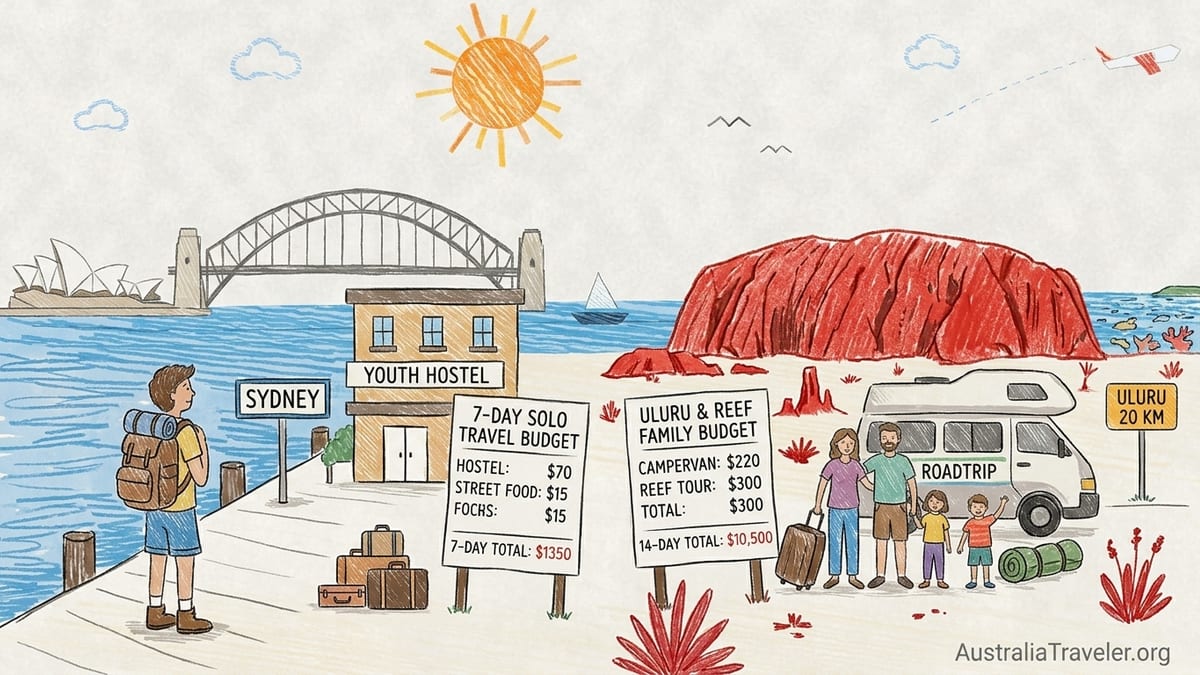
For a budget solo traveler spending a week in Australia with hostel dorms at about 70 dollars per night, supermarket breakfasts and simple takeaway meals, local public transport, and one major day tour such as a Great Ocean Road or reef trip at around 280 dollars, a realistic seven-day budget often lands around 1,200 to 1,600 dollars. Stretch that to a fortnight and 21 days, including two or three big-ticket day tours and perhaps one domestic flight bought early, and you are looking at roughly 2,300 to 3,200 dollars for two weeks and 3,300 to 4,500 dollars for three weeks if you keep nightlife and bar spending modest.
For a midrange couple staying in three to four star hotels or central apartments at an average of 220 to 260 dollars per night, eating a mix of cafe and casual restaurant meals with some self-catered breakfasts, using a combination of public transport and a couple of domestic flights at around 250 to 350 dollars each, and including two or three headline tours such as a Cairns reef day, a Whitsundays cruise and a Great Ocean Road trip, a seven-day budget often sits somewhere around 3,000 to 4,200 dollars for two. For 14 days, that rises into the 5,500 to 8,000 dollar band, and for 21 days a realistic range is roughly 8,000 to 11,000 dollars for the couple, especially if you include a short Uluṟu stay or a side trip to Kangaroo Island.
Families of four see accommodation efficiency but higher activity costs. Assume a two-bedroom apartment or family hotel room averaging 260 to 350 dollars per night, mostly self-catered breakfasts and some dinners, simple lunches when out and occasional restaurant dinners, plus public transport passes and a few car rental days. Add at least two major full-day tours charging adult fares of 250 to 320 dollars and child fares around half to two-thirds of that. In this scenario, a seven-day Australian holiday for a family might reasonably cost 4,500 to 6,500 dollars, a 14-day trip perhaps 8,000 to 12,000 dollars and a 21-day adventure 11,000 to 16,000 dollars depending on the mix of cities and high-cost nature destinations. Choosing a remote island resort or multi-night Uluṟu stay pushes the top end of these ranges higher very quickly.
At the top end, a luxury-focused couple choosing harbour-view suites in Sydney, premium lodges near Uluṟu or in the Whitsundays, business-class domestic flights and mostly private or very small group tours could easily see costs above 10,000 dollars for a single week. Three-week itineraries that string together multiple high-end properties, a liveaboard Great Barrier Reef trip and curated winery or wildlife experiences may reach 25,000 dollars or more. While this level of spending is far from necessary to experience Australia, it highlights why planning around your own comfort threshold from the start is essential.
Why City Backpacker Budgets Break in the Outback and on Islands
It is tempting to take a daily budget that works in Sydney or Melbourne and assume it will stretch just as far in the Red Centre or on a coral cay. Unfortunately, supply constraints and logistics change the equation. In cities, hundreds of hotels, hostels and apartments compete for guests. Tour operators share marketing platforms and adjust their prices frequently, and cheap eats line most busy streets. In this environment, budget travellers can play operators off against each other, hunt sales and keep daily spending under tight control without much sacrifice.
In remote areas, a single integrated resort, roadhouse or campground may be the only viable option within hundreds of kilometres. At Uluṟu, for example, all formal accommodation sits within one resort precinct under unified management. This creates a baseline of relatively high prices for even the simplest rooms, taking previously workable hostel-style budgets and blowing them out. Likewise on small islands such as those in the Whitsundays or on Kangaroo Island, transporting food, linen, maintenance crew and staff involves ferries or small planes, which inflates every underlying cost. Even basic pub meals or groceries can feel steep compared with the mainland.
Transport access compounds the challenge. Reaching Uluṟu, Kangaroo Island or some Whitsunday islands usually requires a flight on a limited-route carrier or a ferry with set departure times. Fares cannot drop to the ultra-low levels sometimes seen on competitive trunk routes such as Sydney to Melbourne because there are fewer airlines and passengers. If you only have a short overall itinerary, you may have little choice about which days to travel, reducing your ability to chase midweek or off-peak fares. All of this means that backpacker-friendly tricks like last-minute booking and not planning ahead tend to backfire in remote or island environments.
Finally, the very reason people visit these places is the paid experience itself. You go to Cairns for the reef, to the Whitsundays for island cruises, to Uluṟu for guided walks and sunrise or sunset viewings, to Kangaroo Island for wildlife touring. Trying to maintain an ultra-low daily budget by cutting out these activities leads to an unsatisfying trip. It is usually better to trim days elsewhere or travel slightly shorter overall so you can allocate extra to each high-cost nature destination and enjoy the once-in-a-lifetime highlights properly.
Seasonality, Travel Pace and How They Shape Your Budget
Seasons in Australia affect more than just weather. Peak travel times such as Christmas and New Year, Easter, and local school holidays see accommodation rates rise sharply in coastal destinations, popular cities and island resorts. In Cairns and the Whitsundays, some reef and cruise operators levy short-term surcharges or simply increase headline fares during the busiest months, particularly June to August for southern visitors chasing winter sun and December to January for local holiday-makers. Uluṟu and Red Centre experiences, by contrast, often see their highest demand in the cooler, drier months from around May to September, when walking and cycling are more comfortable.
Travel pace also drives cost dynamics. Fast itineraries that cram Sydney, Melbourne, the Great Ocean Road, Cairns for the reef and Uluṟu into 10 or 11 days require several one-way flights. Even with smart booking, four or five domestic flights at 250 to 400 dollars each rapidly push the transport line of your budget well into four figures per person. Slower travel that clusters experiences geographically, such as spending a full week between Brisbane and Cairns using a mix of flights and short road trips, can reduce total transport spending. However, adding nights naturally increases accommodation and day-to-day living costs, so the savings are not linear.
Weather and sea conditions should also inform your planning. Cheaper low-season deals in North Queensland often coincide with the wettest months and marine stinger season, when protective suits are mandatory in the water and some activities are less pleasant. Similarly, discounted winter prices in Melbourne or Tasmania bring colder, wetter days and shorter daylight hours, which may limit outdoor experiences even as they stretch your budget. Balancing savings against experience quality is important, especially if you are unlikely to return soon.
One effective strategy is to build your trip around one or two “anchor” experiences with relatively fixed dates, such as a liveaboard reef departure or a time-specific event, and then keep the rest of your itinerary flexible enough to chase midweek accommodation deals and cheaper flight days. Booking cancellable rates for some nights also lets you pivot if you see a significantly better fare on another route, although you may pay slightly more upfront for that flexibility.
Practical Ways to Save Without Skipping the Best Bits
The goal with Australian budgeting is not to strip out everything that makes the country special, but to spend deliberately. One of the easiest wins is to self-cater at least some meals. Booking apartments or hostel rooms with kitchen access in cities like Sydney, Melbourne, Brisbane and Cairns allows you to buy groceries, cook simple dinners and assemble breakfast before heading out. Saving even 20 dollars per person per day on food over a two or three-week trip frees up hundreds of dollars that can go directly into reef tours, island cruises or wildlife experiences.
Another tactic is to cluster premium experiences rather than scatter them. Instead of booking separate snorkel trips in both Cairns and the Whitsundays, many travellers pick the location that best fits their route and invest in one excellent full-day tour there. Similarly, you might decide between Kangaroo Island and a multi-day Great Ocean Road and Grampians loop rather than trying to do both on a short trip from Adelaide or Melbourne. Focusing your spend often yields better memories than paying for many similar but slightly compromised activities.
Leveraging city passes and public transport caps can also help. In Sydney and Melbourne, using smartcard fare caps to your advantage means you can pack your inner-city sightseeing into a couple of days where you take numerous buses, trains and trams, then slow down or walk more on other days. Free or low-cost experiences such as coastal walks around Bondi and Coogee, exploring Melbourne’s laneways and galleries, or enjoying Brisbane’s riverfront parklands do not add much to your daily budget but give a sense of place between more expensive tours.
Finally, be strategic about where you accept higher costs. If Uluṟu has been on your list for years, it can make sense to cut one city from your itinerary, travel for 14 days instead of 21 or choose midrange hotels instead of top-end ones elsewhere so that you can afford three nights in the desert plus a sunrise base walk and a field-of-light style experience. Likewise, if a Great Barrier Reef snorkelling day is a non-negotiable, budget that 275 to 320 dollars early, then make conscious choices elsewhere: share airport transfers, cook dinner for a few nights, or substitute one domestic flight with a daytime train or road leg where it genuinely saves money without compressing your schedule too much.
The Takeaway
Answering “how much does a trip to Australia cost?” in 2026 requires moving beyond any single daily number. A one-week hostel-based city break with a single big tour might cost a solo traveler around 1,200 to 1,600 Australian dollars, while a three-week, multi-stop adventure with reef, outback and island highlights can easily reach five figures for couples and families, especially once domestic flights and premium activities are included. The same country offers both strong-value city experiences and some of the world’s priciest remote stays, often within one itinerary.
The most successful trips start with honest priorities. Decide early which marquee experiences matter most: perhaps a full-day Great Barrier Reef snorkel trip from Cairns, a Whitsundays cruise to Whitehaven Beach, a day on the Great Ocean Road, a sunrise at Uluṟu or close-up wildlife time on Kangaroo Island. Then shape your route and pace to support those goals, using city apartments, public transport, self-catering and selective touring to keep basic costs under control. Treat remote icons and islands as splurges that you plan around rather than spontaneous add-ons.
Australia rewards this deliberate approach. With clear-eyed expectations about accommodation, transport and tour prices, plus a willingness to slow down a little, you can both respect your budget and still come home with the reef colours, desert silhouettes and city skylines you came for. The country may be expensive, but with thoughtful planning it does not have to be out of reach.
FAQ
Q1. How much should I budget per day as a backpacker in Australia in 2026?
For a city-based backpacker staying in hostel dorms, cooking some meals and using public transport, a realistic range is roughly 120 to 170 Australian dollars per person per day, including one or two major paid activities per week.
Q2. Is it cheaper to fly or take the bus between Australian cities?
On very long routes such as Brisbane to Cairns or Sydney to Airlie Beach, low-cost flights booked early are often similar in price to long-distance buses and save many hours of travel, but buses can still work out cheaper if you have more time than money.
Q3. How much does a full-day Great Barrier Reef snorkelling trip from Cairns cost?
In 2026, most reputable full-day outer reef snorkelling trips from Cairns charge in the region of 275 to just over 300 Australian dollars per adult, including gear and lunch, with family tickets discounted from the combined adult and child fares.
Q4. What does a week in Australia cost for a midrange couple?
A couple staying in three to four star hotels or apartments, eating a mix of restaurant and self-catered meals, taking one or two domestic flights and joining one major day tour can expect to spend around 3,000 to 4,200 Australian dollars over seven days.
Q5. Why is Uluṟu more expensive than other parts of Australia?
Uluṟu is remote, with all accommodation concentrated in one resort precinct and all supplies brought in over long distances, which pushes up hotel, tour and food prices even before you factor in flights and guided experiences.
Q6. Are campervans a money saver in Australia?
Campervans can be good value for small groups who fill the vehicle and enjoy camping, but once you add insurance, fuel, campground fees and possible one-way charges they are often similar in total cost to a small hire car plus modest motels or apartments.
Q7. How much should a family of four budget for two weeks in Australia?
For a mix of city stays in apartments, some self-catering, public transport and car hire, plus a couple of major tours such as a reef day and a coastal excursion, a family of four should expect to spend roughly 8,000 to 12,000 Australian dollars over 14 days, excluding international flights.
Q8. When is the cheapest time of year to visit Australia?
Shoulder seasons, such as late February to April and October to early December, often bring lower airfares and accommodation rates outside key holiday periods, though exact savings depend on region and local events.
Q9. Can I visit the Great Barrier Reef on a tight budget?
Yes, but you should plan for at least one quality reef day as a deliberate splurge, then save elsewhere through hostel stays, self-catering and using public transport so the 275 to 320 Australian dollars for a full-day snorkel trip does not break your overall budget.
Q10. How far in advance should I book to get good prices in 2026?
For peak periods and high-demand destinations such as Uluṟu, Kangaroo Island and the Whitsundays, booking accommodation and key tours several months ahead usually secures better prices and availability, while domestic flights between major cities often reward booking at least six to eight weeks before travel.