


I thought I was being clever when I booked a Great Ocean Road day trip from Melbourne. Twelve hours, the brochure promised, with Torquay, Lorne, Apollo Bay, the Otways, the Twelve Apostles and Loch Ard Gorge all wrapped into one efficient loop. It looked like the perfect solution for a tight itinerary. Instead, it became one of the most rushed, exhausting days I have ever spent on the road, and it fundamentally changed how I recommend other travellers approach Australia’s most famous coastal drive.
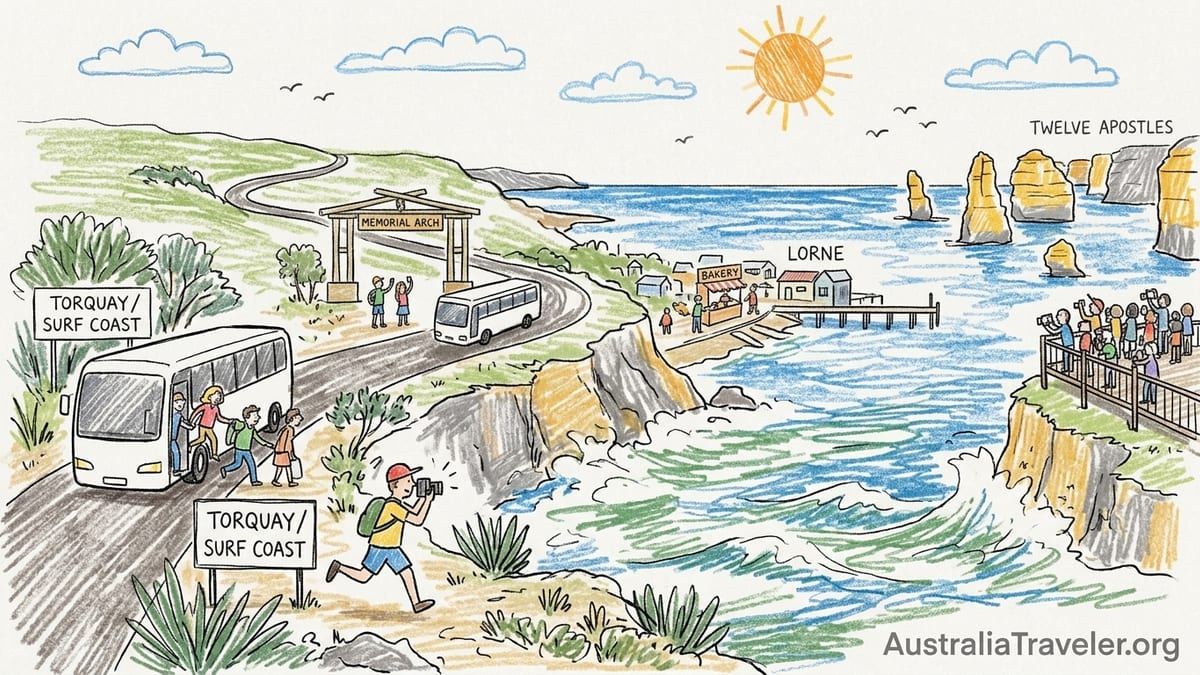
The Day I Tried to Squeeze the Great Ocean Road into 13 Hours
My alarm went off at 5.30 am in a Melbourne CBD hotel. By 6.45 am I was on a coach creeping through early traffic to collect the rest of the group, coffee in one hand and camera in the other. This is standard for most one-day Great Ocean Road tours, which usually advertise a 6.30 to 7.30 am pickup and a 7.45 am departure from the city. By the time we finally rolled onto the West Gate Freeway, 45 minutes of our advertised “tour time” had already gone on urban logistics, not ocean views.
We reached the Surf Coast near Torquay after about 90 minutes on the freeway, roughly 100 kilometres from central Melbourne. The official start of the Great Ocean Road sits just beyond here, but on my tour Torquay itself was reduced to a quick roadside pull-in near a surf beach car park. The guide gave us exactly 15 minutes. Half the bus lined up for the toilet. The rest of us jogged to the sand, took two hurried photos of grey morning surf and jogged back. It was my first glimpse of how little time you actually spend out of the vehicle on a one-day loop.
By the time we reached the Memorial Arch and then Lorne, the schedule had started to feel relentless. We stopped at the famous arch, piled off, took the classic “Great Ocean Road” sign photo, and piled back on all within 10 minutes. Lorne, a town that warrants at least an afternoon, became a 20-minute coffee and bakery stop. The sea was just across the road, the pier a short drive away, and the Erskine Falls walking track only 15 minutes inland, but there was no question of exploring. We were already watching the clock, with the guide reminding us that if we did not leave Lorne on time we risked losing minutes later at the Twelve Apostles.
Doing the Maths: Distance versus Real Time on the Road
The brutal truth of a one-day Great Ocean Road trip lies in the numbers. From Melbourne CBD to Torquay is about 100 kilometres, to Lorne about 145 kilometres, Apollo Bay about 190 kilometres and the Twelve Apostles roughly 275 kilometres along the coastal route. On paper, that does not sound too extreme, but coastal sections are slow, winding and often reduced-speed, especially between Lorne and Apollo Bay. Local touring guides estimate that if you follow the coast both ways and continue past Apollo Bay to the Shipwreck Coast, the actual driving time alone can reach eight hours in a single long day.
My bus tour followed the classic route: Melbourne to Torquay and the Memorial Arch, along the road through Lorne and Apollo Bay, then out to the Otways and the Twelve Apostles before an inland return along the Princes Highway. That loop comes in at around 500 to 550 kilometres. Even with the faster inland shortcut back to the city, most operators advertise 12 to 13.5 hours door-to-door. When you strip out eight hours of driving and at least an hour lost to pickups, drop-offs and refuelling, you are left with perhaps three short hours of meaningful time outside the vehicle, spread across half a dozen stops.
This reality explains why so many advertised “inclusions” are technically accurate but practically thin. An itinerary might list Torquay, a Surf Coast lookout, Lorne, Kennett River for wild koalas, Apollo Bay for lunch, an Otways rainforest walk, the Twelve Apostles and Loch Ard Gorge. On the page, that looks comprehensive. On the ground, it often means 10 to 20 minutes at the minor stops, 30 to 40 minutes for lunch and no more than an hour at the Twelve Apostles precinct. It is not that guides are rushing for the sake of it. They are racing a timetable and Melbourne’s return-traffic window.
Twelve Apostles and the New Keerray Woorroong Visitor Centre Reality
The Twelve Apostles are the headline act. They sit near Port Campbell in Port Campbell National Park, about 4.5 hours from Melbourne by the coastal route even on a smooth run. On my trip we arrived mid-afternoon, in solid crowds, with the guide announcing that we had “about 50 minutes” before we needed to meet back at the bus. That 50 minutes had to cover walking from the car park to the clifftop viewpoints, navigating the boardwalks, taking photos, queueing for the toilets and grabbing a drink from the kiosk. I remember standing at the main lookout, shoulder to shoulder with other tour groups, thinking that I had just spent most of the day to earn a viewpoint I could not linger at.
This pinch point is becoming even more important from late 2026. The new Keerray Woorroong Visitor Centre is being developed as the main gateway to the Twelve Apostles viewing area. The Great Ocean Road Coast and Parks Authority has confirmed that from mid-October 2026 access to the new visitor precinct and viewing areas will move to a pre-booked arrival model, with specified arrival windows for group operators. In parallel, the Victorian Government has signalled that a booking and fee model will operate once the full visitor centre opens later in 2026, designed to fund conservation and management of the site.
For one-day coach tours, this means the schedule will be even less flexible than it already is. Operators will need to hit their allocated arrival windows for the Twelve Apostles or risk losing their slot. For travellers, a foggy afternoon, a squall of horizontal rain or a sudden drop in visibility will not be something you can simply work around by waiting an hour. If the bus has 50 minutes allocated before it must turn inland for Colac and Melbourne, then 20 minutes of that lost to heavy rain is time you will not get back. Self-drivers will retain a little more leeway, but as booking systems and caps settle in, independent travellers will also need timed reservations instead of simply turning up at sunset.
Do Day Tours Really Deliver Loch Ard Gorge, Rainforest Walks and Wildlife Stops?
One of the big selling points of Great Ocean Road day tours is the promise of diversity: not only the Twelve Apostles, but also Loch Ard Gorge, an Otways rainforest walk and wildlife encounters. The marketing language is often broad. A brochure might promise “a guided walk through ancient rainforest,” “time to discover the hidden beach of Loch Ard Gorge” and “the chance to see koalas in the wild.” These descriptions are not false, but the clock shapes them in ways that many first-time visitors do not grasp when they book.
On my own tour, the wildlife stop was at Kennett River. This is a small settlement known for koalas that rest in the gum trees near the caravan park. We had about 20 minutes to stretch our legs, scan the trees and take photos. I saw three koalas and a flock of loud cockatoos. It was genuinely enjoyable. It was also hurried. The guide herded everyone back on the bus just as some people had found their first koala, anxious not to lose precious minutes off the rest of the schedule.
The rainforest walk, in our case, was a loop on a well-maintained trail in Great Otway National Park. Many tours use short, easily accessed sections such as Maits Rest, because coach parking is available and the loop can be completed in 20 to 30 minutes. That time usually includes a safety briefing and a dash to the toilets. The result is that what gets billed as “immersion in ancient rainforest” is, realistically, a brisk stroll along a boardwalk where you rarely have time to stop, listen to the dripping ferns or read more than one interpretive sign.
Loch Ard Gorge, part of Port Campbell National Park, deserves at least an hour on its own. It has multiple vantage points, short walks out to the headlands and a side track down to the beach. Our tour allotted just under 40 minutes. By the time we had walked to the two main lookouts, listened to a quick version of the Loch Ard shipwreck story and queued for photos, we had no time left to descend to the sand. Back at the bus, several of us exchanged the same disappointed look. Yes, we had “done” Loch Ard Gorge in the technical sense. No, we had not truly experienced it.
Self-Drive vs Organised Day Tour vs Overnight: Comfort, Fatigue and Flexibility
Before my trip I debated whether to rent a car and self-drive, or join an organised day tour. Tour prices at the time started at around 120 to 150 Australian dollars per person for a 12 to 13.5-hour coach tour from Melbourne that followed the classic route and included the Twelve Apostles and Loch Ard Gorge. Small-group and premium tours cost more, often in the 180 to 250 dollar range, with more spacious vehicles, meals included and sometimes a sunset focus. Self-driving in a rental car for the day looked cheaper at first glance, particularly for two people sharing costs.
Once I added everything up, the value equation became more complicated. A one-day self-drive from Melbourne that includes fuel for 500 kilometres, car hire, tolls and parking easily reaches 200 to 250 dollars or more for two adults in 2026, depending on vehicle type and fuel prices. That does not factor in the human cost of eight hours of concentrated driving on a winding coastal road, then another three hours on inland highways in the dark. Several Australian travellers I later spoke with described returning from a self-driven day trip so tired they barely remembered the final two hours back into the city.
Organised tours spare you that fatigue. You can nap on the return journey, look out of the window and learn from a guide. What you surrender is flexibility. On a bus, you will stop where the operator has agreements or predictable parking, not necessarily at the quietest lookout or the beach that happens to look perfect in that day’s light. You cannot linger in Lorne for an extra coffee, or decide that Apollo Bay feels so good you would rather skip the Otways and check into a guesthouse for the night. A self-driver can. An overnight traveller can do it without worrying about driving tired.
That is where overnight trips, even simple two-day loops, change everything. A recent two-day Great Ocean Road itinerary costed from Apollo Bay tourism sources suggests that for two adults in mid-range accommodation, a weekend away might involve roughly 200 to 380 dollars for a night in Apollo Bay, 60 to 90 dollars in fuel, and 120 to 200 dollars for meals, plus any entry fees or optional extras such as a helicopter flight over the Apostles. When you compare those numbers to two seats on a 150 dollar tour, the difference is real but not as huge as many assume, particularly when split between two people.
Crowds, Weather Whiplash and Unsafe Roadside Stops
Beyond time pressure, a one-day schedule magnifies everything the coast throws at you. The Great Ocean Road is loved precisely because it is exposed and dramatic. It also sits in a part of Victoria where the weather can pivot from blue skies to thick mist and driving rain in a single afternoon. On my trip we left Melbourne under a clear early sun, drove through drizzle between Torquay and Lorne, enjoyed a sparkling lunch break in Apollo Bay, then reached the Apostles under a ceiling of low cloud and a biting ocean wind. The sea stacks were still visible, but muted and grey, not the honeyed limestone I had seen in photos.
With a rigid one-day timetable, bad timing is simply bad luck. I met another couple that day who had driven independently and stayed overnight in Port Campbell. They had seen the Apostles at sunset the night before and again at sunrise that morning. Their photos showed golden cliffs and long shadows. Mine captured crowded railings and flat light. An overnight stay gave them multiple chances to match their visit to good conditions. A day trip gave me exactly one window and no realistic way to wait it out.
Crowds are the other reality. The Twelve Apostles already receive large numbers of visitors, and reviews from recent years frequently describe peak periods where the viewing platforms feel like a festival. On a typical day, late morning to mid-afternoon sees a wave of coaches from Melbourne, regional Victoria and cruise ship port calls. My own group arrived at around 3 pm and joined a shoulder-to-shoulder mix of group tours from multiple companies. Guides tried to keep their flags visible. People edged forward to take photos, then were nudged aside by the next cluster of cameras.
Some self-drivers try to escape this by improvising. During my trip I saw rental cars pulled halfway off the shoulder of the Great Ocean Road near scenic bends, where drivers had clearly decided to jump out for a quick photo rather than wait for the next official turnout. Local authorities have been warning for years that this is dangerous. The road is narrow in many sections, with blind corners and limited places to pull over safely. When you feel that you must “get the photo” because you will not be coming back, temptation grows. Travelling over two or three days, when you know you can stop again on the return leg, relieves that urge.
What Rushing in One Day Really Costs You
None of this means that every traveller who takes a one-day tour is unhappy. On my bus there were visitors from Europe and Asia who were using Melbourne as a short stopover. They saw bouncing wallabies near the roadside, a koala in the Kennett River gums, a wedge of rugged coastline and the famous stone stacks. For them, ticking off the icons in one day was better than not seeing the Great Ocean Road at all, and several said they were satisfied. I do not doubt that their memories will be positive.
But it is important to be clear about what you sacrifice when you attempt the Great Ocean Road from Melbourne in a single day. You lose slow mornings in seaside towns like Lorne, where you might have walked the pier or followed a short waterfall trail. You miss the chance to settle into Apollo Bay with a real lunch, a swim in summer, or an early evening stroll along the curve of the bay before choosing a restaurant. You have no time to try a longer rainforest walk in the Otways, visit Cape Otway Lightstation, or take side trips to Aireys Inlet or the Great Ocean Walk trailheads.
You also give up control over the two most powerful elements on this coast: light and mood. A leisurely two or three days on the road allow you to experience the cliffs and beaches in different weather, at different times of day. The Apostles at sunrise or sunset look nothing like they do at 2.30 pm, when most day tours arrive. Loch Ard Gorge in bright sun is a postcard; in late-afternoon shade it feels enclosed and sombre. When you compress the trip into one day, you accept whatever the sky decides to serve during your one allocated hour at each viewpoint.
Finally, you risk ending the day so tired that the last hours become a blank. On my return journey the bus drove inland through Colac and Geelong. The guide turned off the microphone. Lights dimmed. Most of the group fell asleep or stared numbly at their phones. We reached the CBD after 8 pm. By the time I returned to my hotel it was almost 9. I had been out for over 14 hours, with only three or four brief bursts of movement on the ground. It did not feel like a day spent in nature. It felt like a long commute with spectacular but fleeting interruptions.
A Better Two-Day Itinerary and What I Would Do Differently
If I could redo my first Great Ocean Road experience, I would give it two full days and at least one overnight on the coast. The simplest version would look like this. On Day 1, I would leave Melbourne by 8 am and follow the coastal route through Geelong and Torquay. I would actually stop in Torquay for a walk on the beach and a look at the surf shops, then continue to Aireys Inlet to see Split Point Lighthouse. I would reach Lorne in time for lunch and a walk along the foreshore, maybe driving up to a nearby waterfall in the afternoon. From there I would continue at an unhurried pace through the curving cliffs towards Apollo Bay, stopping at a few signed lookouts simply because the light looked good.
I would make Apollo Bay my overnight base. Accommodation options range from motels and apartments to cottages and boutique stays. After checking in, I could wander along the beach, enjoy a relaxed dinner and actually feel the town slow down once the day-trip traffic had passed. If the weather looked promising, I might even drive a little way towards the Otways that evening to scout for glow worms or to feel the transition from coast to forest.
Day 2 would start with the short drive inland to Maits Rest or another rainforest loop, taking my time among the tree ferns instead of counting backward from a bus re-boarding time. From there I would continue to the Twelve Apostles, ideally aiming for a late-morning or, better, a late-afternoon visit depending on my reservation slot once the new visitor centre’s booking system is fully operational. With my own car I could wait out passing showers, return to the viewpoints when gaps in the crowd appeared, and then carry on to Loch Ard Gorge for as long as I liked, walking multiple tracks and perhaps climbing down to the beach.
If I felt energetic, I could push on to Port Campbell for a second night, using it as a base for London Bridge, The Grotto and the surrounding Shipwreck Coast formations, then return to Melbourne by the faster inland highway the next morning. Even without that extra night, a two-day loop with one overnight unlocks everything that felt impossible on my rushed tour: lingering in towns, trying side walks, watching the cliffs under soft evening light and waking up to the sound of the sea instead of an alarm in the city.
Financially, this approach is not dramatically more expensive once you add up the real costs of a day tour for two adults. Two seats on a mid-range coach tour might total 260 to 300 dollars. A two-day self-drive with an overnight in Apollo Bay could cost, very roughly, 200 to 380 dollars for accommodation, 60 to 90 dollars in fuel and 120 to 200 dollars for food, plus car hire and any optional entry fees. For couples or friends sharing a car, the per-person difference can be surprisingly small in exchange for turning a rushed sampler into a genuine coastal journey.
The Takeaway
Looking back, my biggest mistake was assuming that distance alone determines what is realistic in a day. On a straight inland highway, 500 kilometres with rest stops feels long but manageable. On a world-famous coastal road that invites you to stop at every bend, those same kilometres stretch and fragment. A one-day trip from Melbourne along the Great Ocean Road to the Twelve Apostles and back is physically doable and widely sold, but it compresses the experience into a string of short, crowded glimpses instead of allowing it to unfold.
I also underestimated how draining it is to be locked into a schedule built around a single fixed highlight. Everything about a day tour bends towards that narrow window at the Apostles. Towns on the Surf Coast, the mood shift into the Otways rainforest, the layered story of shipwrecks at Loch Ard Gorge, all become obstacles to be squeezed in around a non-negotiable deadline. For travellers with only one spare day in Melbourne, that compromise may still be worth it. You will see a great deal from a bus window, stretch your legs in beautiful places and come home with stories.
But if you can spare even one extra day, the character of the journey changes completely. Instead of counting minutes at each stop, you can watch the waves for as long as they hold your attention. You can return to a lookout when the light softens. You can check into a small coastal motel and fall asleep to the sound of the Southern Ocean. You can treat the Great Ocean Road not as a logistical problem to be solved in 13 hours, but as the slow, generous coastal landscape that it is.
There are still limited circumstances where a one-day trip makes sense. If you genuinely have only a single day in Victoria, cannot or do not wish to drive, and want to see the famous sea stacks with a guide handling every detail, an organised coach tour is the most practical option. Go into it with clear expectations: you will be in the vehicle for eight or nine hours, your time at each stop will be tightly rationed, and the Apostles may or may not appear under perfect skies. Accept that trade-off, and you may come away content. For everyone else, the regret of rushing this coast once is often what finally convinces them to return and give it the time it deserves.
FAQ
Q1. Is it really possible to drive the Great Ocean Road from Melbourne and back in one day?
Yes, it is physically possible to reach Torquay, Lorne, Apollo Bay, the Twelve Apostles and Loch Ard Gorge from Melbourne and return in one very long day, but you will spend around eight hours or more in the car or on a coach and only short periods at each stop.
Q2. How long does a typical Great Ocean Road day tour from Melbourne last?
Most organised tours advertise 12 to 13.5 hours door-to-door, with early pickups from about 6.30 to 7.30 am and a return to central Melbourne sometime between 8 and 9 pm, depending on traffic and season.
Q3. How much time do you usually get at the Twelve Apostles on a one-day tour?
Time at the Twelve Apostles on a standard day tour is often between 40 minutes and one hour, which has to cover walking from the car park, visiting several lookouts, using facilities and taking photos.
Q4. Do most one-day tours really include Loch Ard Gorge and a rainforest walk?
Many itineraries do visit both, but the stops are short, typically 20 to 40 minutes for a rainforest boardwalk and a similar period at Loch Ard Gorge, which means you will only sample each place rather than explore fully.
Q5. Will the new Keerray Woorroong Visitor Centre change how I visit the Twelve Apostles?
From late 2026 access to the main viewing area is shifting to a pre-booked model linked to the new visitor centre, so both tour groups and self-drivers will need to plan around timed arrival windows instead of simply turning up unannounced.
Q6. Is self-driving the Great Ocean Road in one day less tiring than joining a bus tour?
Self-driving gives you more control over stops but usually involves eight or more hours behind the wheel plus an inland return in the dark, which many travellers find more tiring than relaxing on a coach, especially if they are not used to long days on unfamiliar roads.
Q7. How does the cost of a one-day tour compare to a two-day self-drive trip?
A basic one-day tour from Melbourne might cost around 120 to 150 Australian dollars per person, while a two-day self-drive with one overnight on the coast can add up to several hundred dollars in accommodation, fuel, food and car hire, though shared costs often narrow the per-person difference.
Q8. Where is a good place to stay overnight if I extend my trip to two days?
Apollo Bay is a convenient halfway base with a wide range of motels, apartments and guesthouses, while Port Campbell works well for travellers who want to be close to the Twelve Apostles and Loch Ard Gorge for sunset or sunrise.
Q9. When does a one-day Great Ocean Road trip still make sense?
A one-day trip is most sensible if you only have a single free day in Melbourne, do not want to rent a car, and accept that you will get a fast-paced overview of the highlights rather than an in-depth experience.
Q10. What is the biggest mistake first-time visitors make when planning the Great Ocean Road?
The most common mistake is underestimating how long the coastal sections take to drive and trying to fit the full route to the Twelve Apostles and back into a single day, which leads to rushed stops and a very tiring return to Melbourne.