


The promotional photos had done their work long before I reached the Gold Coast. Humpbacks frozen mid-air against a neon-blue Pacific, passengers grinning on sunny decks, and Surfers Paradise skyscrapers hazy in the background. When I finally stepped aboard my own whale-watching cruise, the reality was more complicated: grey skies, a lumpy swell and a boat full of people who, like me, were quietly wondering if we would see anything at all, and whether the ticket price would justify spending a precious holiday morning rolling around on the open ocean.
Departure Day: Boat, Weather and Expectations
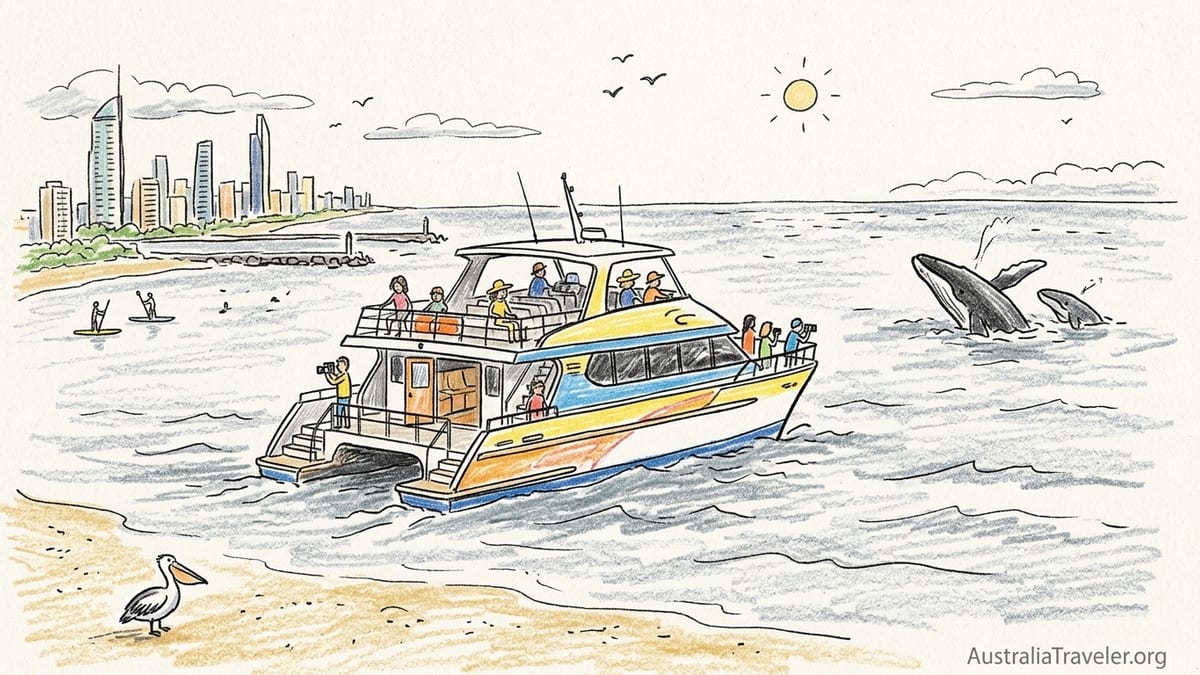
My cruise departed from the Sea World Cruises terminal at Main Beach, on the Broadwater side of the Gold Coast. It was a mid-season morning in August, right in the heart of the humpback migration window that typically runs from June to early November along this stretch of coast. The vessel was one of the company’s purpose-built whale-watching catamarans, with multiple outdoor decks, an indoor cabin, comfortable seating and a small café counter selling coffee and snacks. On paper it sounded luxurious. In person it felt solid and functional, which is exactly what you want when you are about to cross a river bar into the Pacific.
We had around 120 people on board, a near full load but not completely packed. Families claimed the bow, couples ringed the top deck, and a thicket of long camera lenses gathered at the railings. The crew encouraged everyone to move around once we reached the whale grounds, promising “plenty of rail space for all,” but it was clear that getting a front-row position would still require a bit of quiet determination.
The weather was not brochure-perfect. Low cloud smeared the skyline and a southerly wind pushed short, steep waves across the Seaway entrance. Inside the Broadwater, the ride out past Sea World, Southport Yacht Club and the sandbanks was calm and glassy, with pelicans skimming the surface and stand-up paddleboarders sliding by. It was only once we lined up with the Seaway that the movement changed, and with it, the mood on deck.
My expectations were high but I tried to hold them lightly. Humpback whales are abundant in this region now, yet no operator can truly guarantee what any one trip will see. I had come in late August hoping for southbound whales with calves, because mother and calf pairs often travel closer to shore at this stage of the migration. That was the dream. The crew were very clear as we left: while they had a sighting guarantee in the form of a free return voucher, nothing could be promised that exact morning.
From Sheltered Waterways to the Open Pacific
The transition from sheltered waterway to open ocean is the moment many visitors underestimate. For about twenty minutes we eased through the Broadwater, the skyline of Surfers Paradise off to the south, jet skis buzzing past and fishing boats anchored along the sandbanks. The commentary focused on local landmarks and basic whale biology, the sort of background that sounds like padding until you are actually scanning the horizon for a dark back or a faint blow.
As we approached the Seaway, the captain asked everyone to stay seated or hold railings. The swell outside was running at around one and a half to two metres, not a storm by any measure, but certainly enough to send the bow lifting and dropping in regular arcs. The first set of waves underlined how quickly conditions change once you leave the Broadwater. Coffee cups went down, and a few passengers retreated inside, already holding the complimentary sick bags that staff had quietly distributed.
I am not usually prone to seasickness, but even I felt that uncomfortable tipping point as we started to quarter the swell. The boat moved steadily, but it was a constant three-way motion: rocking from side to side, pitching over the swells and surging forward. A child near me went silent and glassy-eyed, then was quickly escorted inside by a parent. Within thirty minutes of clearing the bar, at least half a dozen people were leaning over the stern rail or sitting with their eyes closed, focusing on the horizon.
This is the part no glossy brochure ever highlights. Waiting for whales in a lumpy sea is not dramatic so much as grinding. You stand, you stare, your knees flex with the motion, and you realise that two and a half hours is a long time if the ocean does not deliver. I had remembered to take seasickness tablets an hour before departure, which turned out to be one of my better holiday decisions.
What I Actually Saw: Real Whale Encounters, Not Marketing Shots
Our first encounter was not the explosive breach the posters promise. About forty minutes offshore, someone on the upper deck called out, the crew shouted “eleven o’clock, about three hundred metres,” and everyone surged to the port side. What I saw at first was a faint vertical puff, a whale’s blow, hanging briefly in the cool air against the darker band of sea. It was surprisingly subtle, more like a small steam cloud than a geyser.
We edged closer, keeping what the crew described as a respectful distance. From our position, the humpback appeared as a low, dark back rolling through the water, with the small hook of its dorsal fin breaking the surface. It surfaced three or four times in a slow, predictable pattern, exhaled, arched, then on the final dive lifted its tail flukes clear in that classic, photographable moment before slipping under. It was beautiful, but still not close enough for the kind of frame-filling shot you see in advertising. My camera captured more grey water than whale.
As the morning went on we saw several different humpbacks, usually one or two animals at a time. There were more blows in the middle distance, perhaps five hundred metres away, and an occasional side fin slap. At one point we had two whales travelling vaguely parallel to the boat, surfacing every few minutes about two to three hundred metres away. You could see the bulk of their bodies more clearly then, the muscles along the back and the way the water streamed off them as they rose. Even so, they were not close enough to feel enormous, the way a breaching whale right next to the hull might.
The most memorable moment came roughly two hours into the cruise. A mother and calf pair were spotted slightly ahead of us, heading south at a leisurely pace. The captain slowed right down, giving them plenty of space. The calf surfaced more often, small and pale compared with its mother, blowing little puffs that seemed almost tentative. We never saw a full body breach or a series of repeated jumps. Instead we watched the pair travel, surface, dive and surface again, slowly making their way along a path that existed independent of our desire for spectacle. It was quieter than the marketing imagery, but in its own way more affecting.
Viewing Distance, Photography and Space on Deck
Before this trip, I had assumed that modern whale-watching boats and zoom lenses would make it easy to capture dramatic images. In practice, photography was the single most frustrating part of the experience. Regulations require boats to keep a minimum distance from whales unless the animals choose to approach on their own, which means you are typically viewing from at least a hundred metres away, often more. The ocean surface is uneven, the boat is moving, the whales spend most of their time underwater, and whenever they do surface it is brief and unpredictable.
From the top deck, with a 70-300mm lens, I was able to capture a handful of decent shots: a distant tail fluke silhouetted against a grey sea, a blow backlit by a break in the clouds, and the curved back of a mother with the calf just visible alongside. None of it resembled the iconic breach images on brochures, which are usually taken with longer lenses, in calmer seas or over many days on the water. If you are coming mainly for social media photography, it is important to understand that your results may be muted, especially on days when whales are traveling quietly rather than showing off.
Space on deck depended heavily on where you stood early in the trip. Once the first whales were spotted, people tended to cluster on one side, even as the crew encouraged passengers to move around and use all viewing areas. On our cruise, children were given priority along the bow rail at one point, which was a thoughtful touch, but it also meant that shorter adults and anyone who waited too long to move sometimes had to look over shoulders rather than along an unobstructed line to the water.
I was glad the vessel had multiple levels and both indoor and outdoor zones. Those who felt unwell could sit inside near the windows, still able to see some of the action when whales were closer. From outside, however, the combination of the boat’s constant motion, the swell and other passengers leaning out for a better look made any kind of tripod use impossible. Handheld photography with a fast shutter speed and image stabilisation was the only practical approach, and even then, my hit rate was low.
Crew Commentary, Facilities and The Question of Guarantees
The crew on my cruise struck a good balance between information and silence. As we left the Broadwater they delivered a structured talk about humpback migration, explaining that tens of thousands of whales pass this coastline between June and early November each year and that peak numbers tend to occur in July and August, with mothers and calves more common from late August through October. Once we were with the whales, the commentary shifted to simple, direct updates: where to look, which behaviour we were seeing, and when they expected the animals to surface again.
The vessel itself had enough facilities to make a few hours at sea comfortable, though not luxurious. There were several toilets, basic café options such as coffee, tea, soft drinks and packaged snacks, and a licensed bar that remained quiet on our somewhat queasy morning. Seating was a mix of padded benches inside and plastic seats outside. The crew circulated regularly with seasickness bags and gentle advice about watching the horizon and staying in the fresh air. Those who were clearly feeling unwell were checked on discretely rather than publicly fussed over.
Before departure, the check-in staff had explained the company’s whale guarantee in plain terms. If no whales were sighted on our cruise, every passenger would receive a complimentary return voucher, valid for another trip within the same or following season, subject to availability. What they did not offer was a cash refund. For visitors staying a week or more, a free second attempt is valuable. For those on a short, two or three-day stay, it is less useful. You cannot trade the voucher for money, and you cannot use it with another operator or transfer it to a different destination.
This distinction between a sighting guarantee and a refund policy is crucial on the Gold Coast, where several established operators, including Sea World Cruises, Whales in Paradise departing from Surfers Paradise, and Spirit of Gold Coast from the Southport area, use similar models. The guarantee sounds reassuring in marketing copy, but in practical terms it ties you to a repeat experience that you may not have time or stomach for. If seeing whales is a once-only priority on a tight schedule, it is worth reading the terms and conditions carefully and understanding you are accepting the risk that your only trip might be a non-event.
Comparing Major Gold Coast Operators and What You Get for the Price
Sea World Cruises, Whales in Paradise and Spirit of Gold Coast are three of the most visible whale-watching brands on the Gold Coast, and they share several common features. All run cruises between roughly early June and early November, target a duration of about two and a half to three hours, and advertise expert commentary and a whale sighting guarantee in the form of a return voucher rather than cash. Ticket prices for adults on standard whale-watching cruises are typically in the range of roughly 85 to just under 110 Australian dollars, depending on the operator, day of the week and occasional special offers.
Departure points do differ. Sea World Cruises departs from Main Beach on the Broadwater, near the Sea World theme park, which is convenient if you are staying in Main Beach or northern Surfers Paradise. Whales in Paradise usually departs from the Nerang River end of Cavill Avenue in central Surfers Paradise, an easy walk from many hotels and apartments clustered around the light rail stops. Spirit of Gold Coast operates from a marina area near Southport, requiring a short drive or rideshare for many visitors but offering a slightly different perspective as you exit the Broadwater.
Vessels also vary. Sea World’s boats are large, multi-deck catamarans with indoor cabins, several outdoor viewing areas, on-board cafes and in some cases features such as hydrophones for listening to whale song when conditions allow. Whales in Paradise tends to operate slightly smaller vessels that feel more intimate and allow passengers to be closer to the water surface, which can make sightings feel more immediate when whales are near. Spirit of Gold Coast’s main boat is typically described as a stable catamaran with both sun and shaded areas and a focus on educational commentary. All three offer basic amenities such as toilets and limited snacks, but none should be confused with full-scale cruise ships with seated dining.
Cancellation conditions have become more flexible in recent years but still require attention to detail. For example, it is common for operators to allow fee-free changes or cancellations up to 24 or 48 hours before departure, especially on direct bookings, while third-party platforms and package deals may have stricter rules. Weather-related cancellations are usually handled by rebooking passengers on another day or issuing a credit. Actual cash refunds are more likely when an operator cancels a cruise entirely, less so when whales simply do not cooperate on the day. Because policies can change from season to season, it is worth checking the latest wording at the time of booking rather than relying on outdated assumptions.
Premium Seats, Photography Packages, Food and Other Upgrades
On my cruise, the premium upgrades on offer were fairly restrained. There was an option for reserved seating in a preferred section of the upper deck at a higher price, which largely guaranteed a clear outward-facing spot for the duration of the trip. For travellers who are shorter, less comfortable jostling at railings or traveling with children, this could be attractive. I chose a standard ticket and managed to secure reasonable views by moving promptly when whales were called out, but there were definitely moments when a reserved rail space would have reduced the low-level stress of finding a sight line.
Photography packages were present but not intrusive. A staff photographer snapped boarding photos and circulated during the calmer parts of the cruise, offering printed or digital image bundles for an additional cost. These were mainly posed group shots with the skyline and boat rather than genuine wildlife photography. They are a nice souvenir if you value a guaranteed, well-framed family picture, but they do not replace the challenge of capturing whales yourself. No operator can legitimately promise close-up whale portraits, so treat any wildlife images in their promotional gallery as examples of what is sometimes possible, not what you will necessarily experience.
Food offerings tend to be minimal on dedicated whale-watching cruises. Expect coffee, tea, soft drinks, pre-packaged snacks and sometimes simple items like muffins or biscuits. On my trip, the bar was technically open but there were no elaborate cocktails or meals. This matched the mood of a morning spent scanning the sea through wind and salt spray rather than lounging on a scenic lunch cruise. If you are prone to low blood sugar or travelling with children, it is sensible to have a proper breakfast beforehand and carry a small snack that sits well on a moving stomach, such as plain crackers or ginger biscuits, within the operator’s rules.
In terms of value, I felt the base ticket price for my cruise was justified by the professional crew, the stability of the vessel and the chance to spend several hours on the water with at least some meaningful whale encounters. The upgrades, from premium seating to souvenir photos, struck me as situational rather than essential. For a once-off trip, I would direct most of my budget toward picking a date carefully within the core migration window and retaining a flexible backup day, rather than paying for add-ons that cannot influence the whales’ behaviour.
Practical Advice: Seasickness, Clothing and Timing Your Trip
Watching people’s colour drain away as we crossed the Seaway was a blunt reminder that seasickness can strip the joy from even a whale-filled morning. If you have any history of motion sickness, I strongly recommend taking over-the-counter medication at least an hour before departure, after checking it is appropriate for you. Eat a light, non-greasy meal beforehand, avoid alcohol, and choose a position near the centre of the vessel where movement is less amplified. Staying outside in the fresh air and fixing your gaze on the horizon usually helps more than retreating to an enclosed cabin.
Clothing on the Gold Coast in winter can be deceptive. The air temperature on my August cruise was mild, but the wind chill offshore made it feel significantly colder, especially when you are standing still on deck. I wore a light puffer jacket, a windproof shell, long pants and closed shoes, and I was still glad of a beanie when the breeze picked up. A waterproof outer layer is useful, not because of heavy rain but because of salt spray. Sunglasses help with both glare and wind, and a simple neck gaiter or scarf can make long periods on deck more comfortable.
From a timing perspective, choosing your date within the June to early November window matters almost as much as your choice of operator. Mid-season months such as July and August generally see higher numbers of northbound whales, giving operators a wider range of pods to work with. Late August through September and October often bring more mother and calf pairs traveling closer to shore, which can result in slower, more surface-oriented behaviour but not always in dramatic breaches. Early June and late October to early November can still deliver excellent days, but the density of passing animals may be lower, and you are trading the possibility of quieter boats against a slightly higher chance of long gaps between sightings.
If your itinerary allows it, build in a flexible backup day. Book your whale cruise for the first appropriate morning in your Gold Coast stay, not the last. That way if conditions deteriorate or, in the worst case, your trip is one of the rare outings with no sightings at all, you have the option of using any return voucher within the same visit. It also gives you a buffer for rescheduling if strong winds or large swells force operators to cancel, something that happens several times a season.
The Takeaway
When I stepped back onto the wharf at Main Beach, shoes coated in dried salt and camera card full of modest but meaningful images, I did a quick mental audit. I had paid roughly what most Gold Coast operators currently charge for a standard humpback cruise. In return I had spent two and a half hours at sea, seen multiple humpback whales including a mother and calf pair, heard thoughtful commentary, and experienced the real physicality of the migration route just off the high-rise strip. I had not seen the airborne, full-body breach I secretly hoped for, and several fellow passengers spent most of the trip too seasick to enjoy the whales we did find.
Was it worth it? For me, yes, with caveats. The moments of connection were brief but real: a tail fluke lifting cleanly against the horizon, the soft exhale of a calf near its mother, the realisation that these animals pass this coast in their tens of thousands each winter, regardless of whether anyone is there to watch. The discomfort of the crossing, the crowds at the railings and the unpredictability of the sightings felt like an honest part of engaging with wild animals in their own environment rather than at a theme park show.
I did, however, come away with a clearer sense of what I would do differently next time. I would still choose a reputable operator with a solid safety record and decent deck space, but I might lean toward a slightly smaller vessel that keeps fewer people closer to the water. I would avoid any assumption that a sighting guarantee equals a money-back promise, and I would only book when I had a spare day to use a return voucher if things did not work out. I would take seasickness more seriously than any brochure suggests, dress more for wind than for winter temperature, and bring a camera setup realistic for mid-distance encounters rather than magazine covers.
Most of all, I would adjust my expectations away from cinematic spectacle and toward quiet, cumulative observation. Whales breaching beside the bow do happen, just as the marketing images claim, but they are not the baseline experience. The baseline is more subtle: distant blows, slow rolling backs, an occasional tail and the knowledge that for a short window each year, the Gold Coast’s busy shoreline sits beside one of the world’s great marine migrations. Seen on those terms, my whale-watching cruise was not a disappointment but a reminder that the ocean sets the terms, and that accepting those terms is part of what makes the encounter feel earned.
FAQ
Q1. When is the best time of year to go whale watching on the Gold Coast?
The main humpback season on the Gold Coast runs from about June to early November, with peak numbers often in July and August and more mothers with calves commonly seen from late August through October.
Q2. How long do Gold Coast whale watching cruises usually last?
Most dedicated whale watching cruises from major operators such as Sea World Cruises, Whales in Paradise and Spirit of Gold Coast run for about two and a half to three hours from departure to return.
Q3. Are whale sightings guaranteed on these cruises?
Many operators offer a whale sighting guarantee, but it usually means a complimentary return trip if no whales are seen, not a cash refund, which may be less useful for short-stay visitors.
Q4. How rough does it get when leaving the Broadwater for the open ocean?
Conditions vary by day, but the crossing through the Seaway into the Pacific can feel significantly rougher than the calm waterways, with rolling and pitching that can trigger seasickness even in moderate swell.
Q5. What should I wear for a winter whale watching trip on the Gold Coast?
Dress for wind and spray rather than just air temperature: a warm base layer, windproof jacket, long pants, closed shoes, and optional hat and scarf make time on deck far more comfortable.
Q6. Is it easy to take good whale photos on these cruises?
Capturing strong photos is challenging because boats must keep their distance, whales surface briefly and the vessel moves constantly, so expect more distant record shots than dramatic close-ups.
Q7. Do the boats feel crowded during whale sightings?
On busy departures the railings can feel crowded when whales appear on one side of the boat, though multi-level decks and crew guidance usually help most passengers find at least some clear views.
Q8. Are there food and drinks available on board?
Most Gold Coast whale watching vessels offer basic refreshments such as coffee, tea, soft drinks and packaged snacks, but they are not full meal cruises, so it is best to eat beforehand.
Q9. What happens if my trip is cancelled due to bad weather?
If an operator cancels a cruise for safety or weather reasons, passengers are usually offered a choice of rescheduled dates or a credit, with cash refunds depending on each company’s current policy.
Q10. Which type of tour would you choose next time for whale watching on the Gold Coast?
Based on my experience, I would choose a reputable operator using a slightly smaller vessel with good outdoor space, travel within the mid-season window, plan a backup day and prioritise comfort and flexibility over optional upgrades.