


On a mild Tuesday in early October 2026, I paid full gate price to visit Warner Bros. Movie World on the Gold Coast. By the time the park closed, I had ridden just four attractions, discovered multiple headline rides offline and watched families pay hundreds more for “fast” access that still involved queuing. Walking back through the Hollywood-style main street at 5 pm, the uncomfortable question was not whether Movie World is fun. It was whether a full-price ticket had bought anything close to a full-value day.
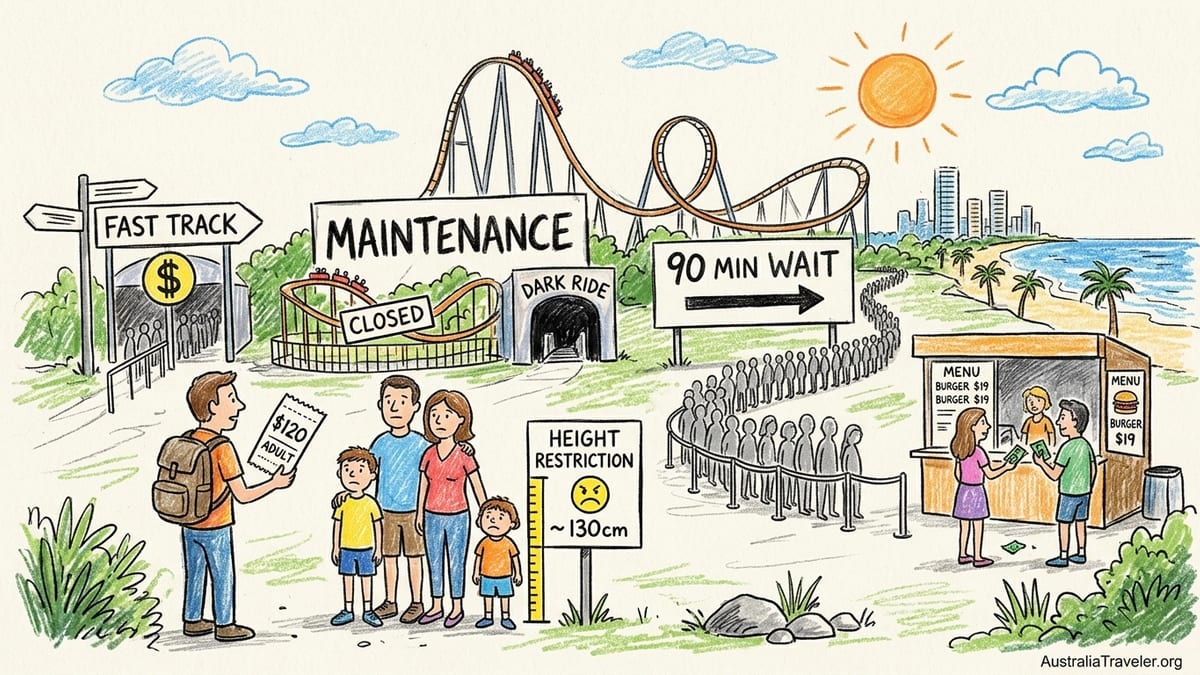
What I Paid For Versus What I Actually Got
I visited Movie World on a standard weekday in early October 2026, outside Queensland school holidays but squarely in shoulder season. Buying at the gate meant I paid around 10 Australian dollars more than the cheapest online rate. The official ticket menu listed single-day entry “from” about 99 dollars online, with flexible-dated tickets and gate purchases running higher. In practice, my adult ticket was about 120 dollars once the price difference was accounted for. For a family of four with two school-age children, that same day would have been close to 480 dollars before anyone bought a drink.
Going in, I expected access to the full roster of Movie World’s headline attractions: DC Rivals HyperCoaster, the Batwing Spaceshot, Superman Escape, Scooby-Doo Spooky Coaster, Justice League, the Wild West Falls log flume, plus shows and street entertainment. Village Roadshow’s marketing positions Movie World as the Gold Coast’s premier thrill park and leans heavily on the hypercoaster and the immersive dark rides. On paper, it looks like at least a dozen substantial attractions that could easily fill a day.
The reality, checked against the park’s own maintenance calendar the night before and confirmed on the official app once inside, was more modest. One family coaster was down for planned maintenance across October. A major effects-heavy dark ride was listed as unavailable for several weeks. On the day itself, another thrill ride failed to open until late morning due to a technical fault, and a children’s ride shut suddenly mid-afternoon. None of this was malicious. Rides are complex machines that need to be safe. But for anyone paying full price for a single day, the practical result was that a noticeable slice of the “headline” line-up simply did not exist.
For a solo journalist, losing two or three marquee attractions is frustrating but manageable. For a family of four who have saved and flown in, it represents a non-trivial percentage of the advertised experience dropping away without the ticket price budging a cent.
How Maintenance Calendars Quietly Shrink Your Park
Gold Coast parks publish maintenance updates, but they are usually framed as technical notices rather than value warnings. Village Roadshow Theme Parks, which owns Movie World, Sea World and Wet’n’Wild, runs a rolling online schedule that lists ride closures and refurbishment dates. Digging through the October 2026 entries, it was clear several attractions were slated for multi-week shutdowns across that period, especially outside peak holiday weeks when operators can least afford downtime.
On my Movie World day, at least one family ride in the kids’ area was under an extended maintenance block that ran from mid-October through mid-November. The information was public, but it was not surfaced front-and-centre during ticket purchase. The main ticket page still promoted the breadth of the park as if everything were operating. Only a separate maintenance tab, or a diligent check the night before, revealed the missing pieces. That subtle separation shifts the burden of research onto the visitor, even though the park already knows your date of visit when you pre-book.
Dreamworld on the northern Gold Coast does something similar. Its official ticketing site sells one-day admission products over 100 dollars for adults in October 2026, with optional bundles that add the SkyPoint Observation Deck or multi-day access. At the same time, the park cycles major rides through routine overhauls, especially after dark ride events, Halloween seasons or new attraction launches. Discount sellers and package operators often mention these prices, but the fine print frequently adds a bland instruction to “check park maintenance schedules,” as if that were a trivial footnote rather than a key part of the value equation.
Sea World, positioned as more of a marine park than a pure coaster destination, has an even sharper gap between marketing and on-the-day inventory. The park’s big coasters and water rides, such as Jet Rescue or Storm Coaster, are periodically offline for months at a time while the rest of the property leans on animal shows and exhibits. Visitors who purchase a single-day Sea World pass around 80 dollars on a wholesaler’s rate in 2026 discover only after arrival that one or two of the few genuine thrill rides are unavailable, but the dolphins and penguins are very much still included in the full gate price.
Weather, Faults and Short Hours: The Quiet Erosion of Value
Even if you pick a date with no red marks on the maintenance calendar, unplanned issues inevitably eat into what your ticket can realistically buy. On my Movie World visit, a crisp but dry Tuesday, the day’s operating hours were officially 10 am to 5 pm. In practice, some rides did not dispatch their first trains until after 10.15 am, and queues were cut off for the final ride cycle about 15 minutes before close. Theoretical seven hours of park time quickly turned into closer to six and a half, with three or four of those spent standing in switchbacks.
When a technical fault hit one of the major coasters around midday, operations halted for around 40 minutes. A recorded announcement blamed “temporary delays” and staff did their best to communicate, but the line barely moved. Those already in the queue could choose between wasting the time sunk or abandoning it. Those approaching the ride entrance were turned away, with no proactive push notification explaining the outage to anyone elsewhere in the park.
Weather can be even more brutal for perceived value, especially at Wet’n’Wild and ride-heavy corners of Sea World. Storm activity or high winds can shut slides, towers or chairlift-style attractions with little warning. Yet a full-price spring or summer ticket to Wet’n’Wild, which can run over 80 dollars per person through many resellers when not on sale, is rarely discounted because a storm front rolls through at lunchtime. Locals who hold annual or locals’ passes shrug and reschedule. Fly-in visitors who have locked a single date because of flights, hotels and rental cars do not have that luxury.
None of this means that every closure should equate to a refund. Australian safety regulations insist that rides be inspected, tested and stopped when conditions or machinery demand it. But from a traveller’s perspective, there is a meaningful gap between that safety reality and the glossy brochure impression of “unlimited thrills all day.” Gold Coast parks have not meaningfully closed that gap in their ticket pricing or communication.
Queues and the Real Cost of “Fast” Access
On the day I visited Movie World, wait times for the top three thrill coasters during peak hours consistently hovered somewhere between 45 and 90 minutes, according to the in-park signage and the official app. Regular day guests could expect to stand roughly an hour for DC Rivals HyperCoaster, about 40 to 60 minutes for Superman Escape, and 30 to 45 minutes for Wild West Falls when the weather warmed up. By contrast, smaller family rides and shows had shorter waits, sometimes under 20 minutes or even walk-on.
Movie World’s answer to this imbalance is Fast Track, a paid priority queue system that offers limited-use or unlimited line-skipping on selected rides. Prices vary by date and demand, but independent tracking and recent October observations put many Fast Track products somewhere around 70 to 150 dollars per person on top of entry, with higher prices more common on busy school holiday weekends. That means a family of four could easily add 300 to 600 dollars to an already expensive day simply to avoid standing in one-hour queues over and over.
Consider the effective cost per ride. If a family pays roughly 480 dollars for four standard Movie World tickets at the gate and manages to squeeze in eight major rides each across the day, their per-ride cost sits around 15 dollars per person once you ignore shows and wandering. Add a 100 dollar Fast Track upgrade for each of those four guests and the total spin on tickets alone reaches about 880 dollars. Even if Fast Track doubles the ride count to 16 headliners per person by cutting waits to 15 minutes, that still works out to over 13 dollars per ride. On a day where multiple headliners are already offline, that math becomes hard to justify.
Sea World and Wet’n’Wild offer similar queue-jumping products on peak dates, especially during summer, with prices for priority access bands often around 70 dollars or more based on October 2026 tracking. Third-party queue monitoring shows that Wet’n’Wild’s most popular slides can spike to 45 minute waits after midday on hot weekends. Paying 70 dollars to ride six extra slides might feel worthwhile for a thrill-chasing teenager. For younger kids who tire quickly or are nervous about big drops, the same product can amount to a 70 dollar wristband that delivers two extra turns before fatigue kicks in.
The Add-Ons: Food, Lockers, Parking and Souvenirs
Admission is only the beginning of a Gold Coast theme park bill. Once through the turnstiles at Movie World or Dreamworld, visitors face a series of quietly expensive decisions. At Movie World, car parking at the main lot adds around 30 dollars for the day if you are not staying at a partner hotel or holding a higher-tier pass that includes it. Dreamworld has historically charged a smaller but still noticeable parking fee for day guests arriving by car. Families taking ride share or transfers dodge those charges but pay instead in transport fares.
Food pricing across the parks follows a familiar pattern. Analyses of menu boards and promotions in mid-2026 showed standard burger-and-chips meals hovering near 19 dollars, with basic snacks like ice creams and mid-range treats up to about 6 dollars each. Soft drinks, coffee and bottled water multiply quickly when a family of four does a full day in warm Queensland weather. Dreamworld has experimented with an 89 dollar annual dining pass that folds a meal and snack into each visit for passholders, but that option is aimed squarely at locals and frequent visitors rather than one-off tourists.
Lockers are another often overlooked cost. At Wet’n’Wild, a day locker is practically non-optional if you have phones, wallets and dry clothes, and can run to tens of dollars depending on size and duration. Similar fees crop up at Dreamworld’s water park area and at Sea World’s more aquatic zones. Families hopping between parks on a multi-park pass might find themselves paying twice for storage in a single day if they do not plan transitions carefully.
Then come the impulse extras. Souvenir ride photos on the Gold Coast typically price around 20 to 30 dollars for a single printed or digital image, with “all-day” bundles reaching higher. Animal experiences at Sea World, such as dolphin encounters or behind-the-scenes sessions, can add well over 100 dollars per person to a day that already cost the family 300 to 400 dollars in admission. None of these add-ons are inherently unreasonable. But layered on top of tickets that already feel compromised by closures or queues, they tip many visits from “pricey but worth it” into “how did we just spend four figures on one park day.”
Multi-Park Passes and the Illusion of Low Marginal Cost
Gold Coast marketers are masters of the bundle. Village Roadshow sells multi-park passes that cover Movie World, Sea World and Wet’n’Wild for weeks or even a full year at prices only slightly above a two or three day ticket. Dreamworld’s own passes often include WhiteWater World and SkyPoint. For a tourist planning five days on the Coast, a product that appears to turn each extra day into a 10 or 20 dollar add-on can be compelling.
The trap lies in confusing theoretical access with practical value. A family of four looking at a five-day all-parks Village Roadshow product priced in the mid-100s per person might reason that skipping a day is wasteful. The marginal cost of visiting Wet’n’Wild on day three looks tiny once the pass is bought, so they cram it in even when the forecast shows storms or when two children narrowly miss the height requirement for most slides. The same family might then drag tired kids to Sea World the following day simply because “it is already paid for,” despite having no particular interest in marine parks.
Dreamworld’s bundles can create a similar pressure. A two-day product that combines Dreamworld with SkyPoint for a modest step up over a single-day ticket nudges visitors into attempting both rather than focusing on the park that best suits their group. Parents with younger kids often discover that the most age-appropriate areas of Dreamworld are the Wiggles- or ABC Kids-themed zones, where gentle rides and play structures dominate. Spending a second day chasing less relevant attractions just because the pass enabled it adds fatigue rather than joy.
Multi-park passes still make sense for longer stays and repeat visits, especially for Australian families who self-drive from Brisbane or northern New South Wales several times a year. The problem arises when international or interstate travellers on tight itineraries treat these passes as ways to “do it all” in three or four days. That mindset clashes badly with the reality of closures, queues and weather, turning what felt like smart pre-purchase savings into sunk-cost pressure.
When Height Requirements and Closed Rides Gut a Family’s Value
To test how brutal the math can get for a typical family, imagine two adults and two children, aged 7 and 10, visiting Movie World on a day similar to mine. They buy standard one-day tickets at around 120 dollars each at the gate, spending roughly 480 dollars before arrival. Parking adds 30 dollars, bringing the tally to 510 dollars. Once inside, they discover that one kid-friendly coaster is under planned maintenance for the month and that one major thrill ride is delayed for much of the morning due to technical issues.
Height checks are an instant filter. DC Rivals HyperCoaster has a minimum height requirement around 130 centimeters. Superman Escape and other major coasters sit near similar cut-offs. If the 7-year-old in this family is under that marker, half of the park’s top-billed attractions simply do not exist for them. The 10-year-old might scrape through, but now each major ride becomes a parent-and-one-child affair, while the shorter child and another adult wait on the sidelines or seek out gentler attractions with longer, slower-moving queues.
By mid-afternoon, the family has perhaps managed two laps on the hypercoaster for the taller child, one shared run on a second big coaster, two or three family rides together and a stunt show. They have spent at least 80 to 100 dollars on lunch, snacks and drinks. If they choose to buy a Fast Track product mid-day to salvage the experience, at, say, 90 dollars per person on that date, they are suddenly facing an extra 360 dollars on top of the 510 they have already laid out. They may still hit height barriers and maintenance closures, and no amount of priority access rescues a ride that is down or a child who is simply too short to ride.
Dreamworld and Sea World present their own versions of this problem. At Dreamworld, multi-launch coasters like Steel Taipan and taller attractions carry height requirements that rule out younger or smaller children entirely. At Sea World, a young child too short for Jet Rescue or the latest coaster may find their day restricted to gentle rides and animal exhibits. For them, the difference between a 90 dollar and 110 dollar ticket is irrelevant, because the missing thrill component was never truly available.
A Better Booking Strategy: How I Would Plan It Next Time
My October Movie World visit was a useful mistake. If I had to rebook the same trip armed with what I now know, I would treat ride availability and crowd patterns as seriously as airfare searches. The first step would be to check official maintenance pages for each park before committing to dates, not as an afterthought. If a must-do coaster or key children’s ride is scheduled to be offline for the exact week I plan to travel, I would reshuffle the itinerary or choose a different park entirely rather than crossing my fingers and hoping the rest makes up for it.
I would also ruthlessy avoid peak periods unless travelling with school-bound children left no alternative. Local advice and recent queue data point clearly to weekdays during Queensland school term as the sweet spot, especially Tuesdays through Thursdays. Reddit trip reports and independent queue trackers from 2025 and 2026 consistently describe one-hour-plus waits for flagship rides at Movie World during holidays and special events, versus much shorter lines on term-time weekdays. For a once-off visitor without an unlimited budget, those crowd differences represent real money in saved Fast Track purchases.
Instead of trying to conquer three or four parks in three days, I would cap the schedule at one park day for every full non-travel day on the Gold Coast, with rest or beach time between heavy theme park visits. That spacing gives room to adapt if the forecast suggests a stormy afternoon at Wet’n’Wild or if a child melts down mid-morning. Multi-park passes might still fit if the per-day math works and you genuinely want to revisit a favourite park, but I would avoid buying them simply because the marginal advertised cost looks low.
Finally, I would set intentionally modest ride priorities. For Movie World, that might mean selecting three or four must-do headliners and considering anything more a bonus. For Dreamworld, it might focus on a handful of marquee coasters plus a time-limited show or animal encounter. Sea World days would be planned around show times and walks through animal exhibits rather than banking on a long list of thrill rides. That mindset turns closures into disappointments rather than catastrophes and reduces the temptation to throw money at every problem.
The Takeaway
Gold Coast theme parks remain impressive pieces of entertainment infrastructure and, on the right day, can deliver excellent value. The problem is the gap between that best-case day and the compromised reality many full-fare visitors end up with. Planned maintenance quietly takes marquee rides off the board for weeks. Unplanned technical faults and weather strip further hours of usable ride time away. Crowds turn “unlimited” into “four or five big attractions if you are patient.” Layer on pricey food, parking, lockers, photos and animal encounters, and a day that began with a 400 to 500 dollar outlay for a family of four can crest well past a thousand without ever quite feeling complete.
Looking back at my own October 2026 Movie World experience, there are clear upgrades I would not buy again. I would skip same-day gate purchases in favour of pre-booked online tickets that lock in the best available price and avoid the built-in gate premium. I would refuse to purchase Fast Track on a day already compromised by ride closures and height restrictions, because paying an extra hundred dollars per person for the privilege of queueing slightly less for a smaller slate of rides rarely moves the needle. I would also avoid buying multi-park passes unless I had at least five or six days on the Coast and children old enough and tall enough to use most of what was included.
There are still moments when paying for priority makes sense. A once-in-a-lifetime family reunion where cousins have flown in from overseas, or a tightly scheduled stop on a longer Australian itinerary, might justify Fast Track on a single flagship day if the weather and maintenance schedules line up and most headliners are genuinely available. Likewise, a local family with annual passes who know they will return again and again can make good use of food packages and bundled products. But for many travellers, the smarter play is to keep the base ticket cost as low as possible, stay flexible on dates, pick one park that matches the group’s ages and interests, and walk away from expensive upgrades that will not fix a structurally compromised day.
FAQ
Q1. Are Gold Coast theme parks still worth visiting if some rides are closed?
They can be, but only if you go in with realistic expectations, check maintenance schedules before booking and choose a park whose remaining attractions genuinely suit your group.
Q2. How can I find out which rides will be closed on my visit date?
Each operator publishes an online maintenance or updates page, and some park apps show daily ride status once you are on site, so check those pages before locking in tickets.
Q3. Is it better to buy single-day tickets or a multi-park pass?
For short trips of three or four days, single-park tickets often provide better value because they discourage over-scheduling and let you focus on the park that matches your group.
Q4. When is Fast Track or express queue access actually worth the money?
It is most defensible on very busy days when most headline rides are operating, your group is tall enough and willing to ride them, and you only have one park day available.
Q5. How much should I budget for food and extras inside the parks?
Allow at least 25 to 35 dollars per person for meals and snacks, plus extra for parking, lockers and any ride photos or animal encounters you genuinely want to purchase.
Q6. What is the best time of year to visit to avoid long queues?
Weekdays during Queensland school term, especially midweek outside public holidays, usually have shorter queues than school holidays, long weekends and special event nights.
Q7. How do height requirements affect the value of a park day for families?
If younger children are below the minimum height for key coasters or slides, a large share of the advertised thrills are unavailable, so the effective value of each ticket drops sharply.
Q8. Should I plan more than one theme park in a single day?
It is usually a mistake, as transfers, fatigue and queues eat into time, and you end up sampling each park rather than properly enjoying the attractions you paid for.
Q9. Are annual passes good value for tourists, or mainly for locals?
Annual and locals’ passes are engineered for repeat visits, so they make far more sense for residents or long-stay visitors than for tourists on one short Gold Coast holiday.
Q10. What is the single most important step to avoid a compromised park day?
Check official maintenance and operating hours for your exact dates before buying, then choose a low-demand weekday and limit yourself to one carefully chosen park per day.