


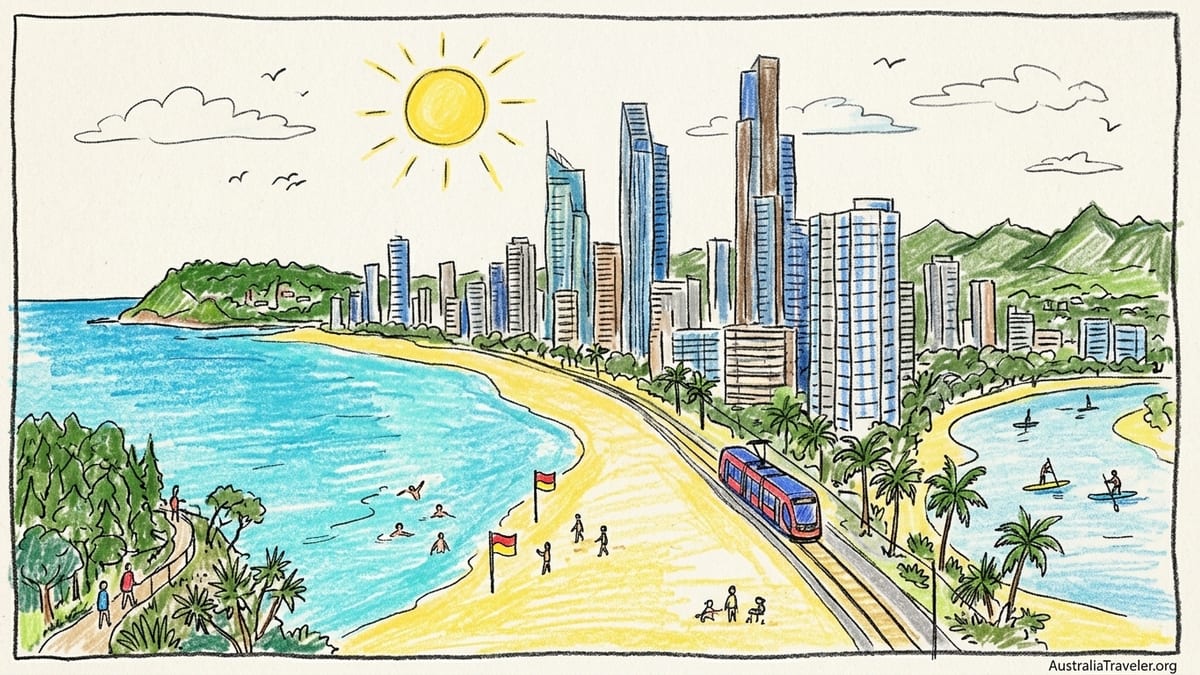
The Gold Coast is often summed up as skyscrapers, surf and theme parks, but Australia’s sixth largest city offers far more variety once you look beyond Surfers Paradise. Stretching from the Broadwater in the north to the New South Wales border and out to rainforest-clad mountains, the region combines beaches, islands, waterways, national parks, wildlife encounters, galleries, markets and lively dining precincts. This guide brings together 25 of the best things to do on the Gold Coast, grouped by area and type of experience, to help you build realistic half-day and full-day itineraries that make the most of the city’s new G:link light rail extension to Burleigh Heads, public transport and driving routes.
How to Use This Gold Coast Guide
This guide is arranged roughly north to south and from coast to hinterland, so you can cluster attractions into easy day plans. Free activities are described alongside ticketed ones, with clear notes on typical visit duration, how to get there, and when advance booking is worthwhile. Where current prices can change at short notice, you will see approximate figures and a recommendation to confirm with the operator before you go.
The expanded G:link light rail now runs from Helensvale in the north through Surfers Paradise and Broadbeach to Burleigh Heads. This makes it easier to experience several coastal areas in a day without a car, combining beach time with shopping, dining and short wildlife or cultural stops. For hinterland destinations such as Springbrook’s Natural Bridge or Lamington National Park, a rental car or organised tour is still the most practical option.
To make planning easier, each section highlights who the experience suits most, such as families, couples, wildlife lovers, adventure travellers or budget visitors, and whether you should treat it as a quick stop of one to two hours or a full day.
Surfers Paradise and Main Beach: City Meets the Sea
Surfers Paradise Beach is the image that sells the Gold Coast to the world: a long sweep of yellow sand backed by high-rise towers. Visiting the beach itself is completely free, and many travellers spend an hour or two swimming between the red and yellow flags, body surfing or simply walking along the foreshore. Families appreciate the lifeguard patrols and the shallow areas near the shoreline, while early risers come for sunrise swims and jogs along the beachfront path. From central Surfers Paradise, it is an easy walk from most hotels or a few minutes on the G:link to Cavill Avenue station.
Above the beach, SkyPoint Observation Deck crowns the Q1 building, one of the tallest residential towers in the world. Visitors ride a high-speed elevator to the observation level more than 200 metres above sea level, where floor-to-ceiling glass reveals a 360-degree panorama of the coastline, hinterland and Broadwater. As of late 2026, online prices for a basic adult observation deck ticket typically sit in the range of 30 to 40 Australian dollars, with discounts for children and families; bundles that include the external SkyPoint Climb cost significantly more. Allow 60 to 90 minutes if you want to linger over coffee or a snack; sunset sessions are popular, so booking ahead in peak school holiday periods is strongly recommended.
Travellers who prefer to avoid higher-priced attractions can still enjoy the same skyline at ground level by walking the esplanade north towards Narrowneck or south towards Broadbeach, stopping at beachfront playgrounds and public barbecue areas. An alternative elevated viewpoint is the public area of Macintosh Island Park near Main Beach, which has grassy lawns, shaded paths, peacocks wandering among the trees and framed views of high-rises across the Nerang River. This park is free to enter, suited to families and couples, and usually worth one to two relaxed hours reached by tram to Main Beach and a short walk.
Nearby Sea World on The Spit combines marine exhibits, family rides and animal presentations. Visitors can expect dolphins, penguins and polar bears in themed habitats, with shows staggered through the day. A typical visit runs from late morning to mid-afternoon, and families often spend the whole day here. Standard one-day tickets for adults are usually over 100 Australian dollars when purchased individually, with multi-park passes bundling Sea World, Movie World and Wet’n’Wild at a relative discount. Because prices and deals change frequently, it is wise to check the official theme park group site in advance and buy tickets online to save queuing at the gate, especially in Australian and New Zealand school holidays.
Broadbeach to Burleigh Heads: Dining, Shopping and Coastal Walks
South of Surfers Paradise, Broadbeach feels more relaxed, with low-rise buildings along the park-fringed shore and a village-like dining scene. Broadbeach is easy to reach on the G:link, and most visitors spend a couple of hours here combining a swim at Kurrawa Beach with coffee, brunch or dinner nearby. Kurrawa Park has modern playgrounds and shady lawns, making this area popular with families. For couples, an evening stroll from Broadbeach South tram stop through the restaurant precinct and onto the sand works well before or after a meal.
Just inland, Pacific Fair Shopping Centre is one of Queensland’s largest retail hubs, mixing international fashion brands with Australian labels, cinemas and casual dining. It is directly beside Broadbeach South tram station, so it makes an easy indoor option on rainy or very hot days. Many visitors allow half a day here, especially those interested in shopping, but you can also treat it as a one to two hour stop combined with beach time. Parking is extensive for drivers, and the complex has clear signage for rideshare pick-up zones for travellers without a car.
Further along the coast, Burleigh Heads marks a shift from urban resort to classic surf town. Burleigh Heads Beach is sheltered by a headland, often giving more manageable waves for beginner surfers, while the grassy foreshore fills with families and groups of friends picnicking under Norfolk pines. The G:link extension to Burleigh Heads has made it far easier to reach without a car, with the tram terminating a short walk from the beachfront. Budget-minded travellers can spend almost an entire day here for little more than the cost of picnic supplies, rotating between swims, headland walks and people-watching.
Burleigh Head National Park protects the forested headland between Burleigh and Tallebudgera Creek. Visitors walk along a well-maintained coastal track with ocean views or climb via a steeper rainforest path to Tumgun Lookout, which offers sweeping vistas south to Coolangatta. The main circuit walk can be completed in about 45 to 90 minutes, but nature lovers and photographers often linger longer to watch for sea eagles, bush turkeys and, in season, whales offshore. Entry is free, although parking at the base of the headland can be tight on weekends; arriving by tram and walking from the Burleigh stop reduces stress and cost.
Tallebudgera Creek to Currumbin: Calm Waters and Close-Up Wildlife
On the southern side of Burleigh Head National Park, Tallebudgera Creek forms a calm, clear channel that is ideal for stand-up paddleboarding, kayaking and relaxed swimming. Families with younger children appreciate the gentle water and sandy banks, while couples often hire boards or kayaks from small operators along the creek for one or two hours. Those simply looking to cool off can enjoy this spot for free, bringing their own towels and snacks and using the public facilities. The creek is easiest to reach by car or local bus; from the G:link terminus at Burleigh it is a reasonably short ride on connecting services.
Closer to Palm Beach, Jellurgal Aboriginal Cultural Centre sits at the base of Burleigh Head. Owned and operated by the local Yugambeh people, it offers guided walking tours that share creation stories, traditional uses of local plants and perspectives on how the coastline has changed. Experiences vary, but many tours run for about two hours and involve an easy-paced walk along the base of the headland with frequent stops. Advance booking is strongly recommended, as group sizes are limited and cultural tours do not always operate daily. This experience suits travellers interested in First Nations history and culture and offers added depth when paired with an independent hike in Burleigh Head National Park.
Continuing south, Currumbin Creek and its adjacent beach provide another mix of surf and sheltered estuary. Stand-up paddleboard schools operate in the calmer section of the creek, giving beginners a stable environment to learn, usually over sessions of 90 minutes to two hours. The creek banks are free to enjoy, with many families setting up for several hours under portable shade tents while children wade and explore the sandbanks. Drivers will find paid and time-limited parking around Currumbin Alley, so arriving earlier in the day is wise during summer weekends and school holidays.
Just inland, Currumbin Wildlife Sanctuary remains one of the Gold Coast’s signature attractions for animal lovers. Visitors walk along shaded pathways connecting large outdoor enclosures, aviaries and show arenas, meeting kangaroos, koalas, lorikeets, crocodiles and more. Daily presentations typically include free-flight bird shows and Aboriginal dance performances, and optional paid experiences allow supervised koala photos or closer encounters. Most travellers should allow at least half a day here, and many families spend five to six hours. Ticket prices change periodically, but adult day admission generally sits in the mid double-digit range in Australian dollars, with concessions, child tickets and online discounts available. Because the sanctuary hosts school and group visits, purchasing tickets in advance can reduce wait times on busy days.
Coolangatta, Snapper Rocks and the Southern Beaches
At the southern end of the Gold Coast, Coolangatta has a more laid-back atmosphere than Surfers Paradise, with a series of linked beaches including Greenmount, Rainbow Bay and Kirra. These beaches are free to access and cater to different experience levels, from mellow rolling waves to powerful barreling surf. Many travellers base themselves in Coolangatta for a few days to combine beach time with short walks and day trips into northern New South Wales. The area is a short taxi or rideshare ride from Gold Coast Airport, and also served by local buses.
Snapper Rocks, near the New South Wales border, is a world-famous surf break that hosts professional competitions such as events in the World Surf League’s Championship Tour when scheduled. Even outside contest periods, visitors enjoy watching local and visiting surfers ride long, fast waves that peel along the point. Access is free, and an hour or two here at sunrise or late afternoon can be a highlight for photographers and surf fans. There is limited shade on the rocks, so a hat and water are important, and parking in nearby streets fills quickly in peak times.
From the Greenmount headland, there is a scenic coastal pathway that wraps around to Rainbow Bay and Snapper Rocks, taking around 30 to 45 minutes at a gentle pace. Families with strollers and older travellers appreciate the smooth, mostly level path, and there are benches placed at intervals to enjoy the view north up the coastline. At the opposite end of town, Kirra Hill Lookout offers a compact but rewarding viewpoint over Coolangatta’s beaches, reachable by a short uphill walk from the main strip. These southern viewpoints are free and can be combined into a half-day of relaxed walking and swimming.
Coolangatta also works well as a base for seasonal whale-watching cruises between roughly June and October, when humpback whales migrate along Australia’s east coast. Several operators run half-day trips departing from the southern Gold Coast and nearby Tweed region, often lasting three to four hours. Prices commonly fall in a mid double-digit to low triple-digit range in Australian dollars for adults, depending on vessel size and inclusions. Advance bookings are advisable in mid-winter school holidays and on weekends, and travellers should factor in the chance of choppy seas by packing warm layers and motion-sickness remedies if prone.
The Broadwater and Northern Gold Coast
North of Surfers Paradise, the Broadwater forms a protected marine playground stretching past Southport towards Paradise Point. This estuarine waterway is sheltered from ocean swells by sand islands, making it popular for boating, jet skis, stand-up paddleboarding and family-friendly swimming. On the Southport side, Broadwater Parklands offers free entry to large playgrounds, a man-made lagoon, barbecue facilities and open lawns. Families often spend two to four hours here, mixing picnic time with water play, while budget-minded travellers appreciate that the only major costs are parking and food.
For those keen to explore the waterway itself, operators at Marina Mirage, Main Beach and other points around the Broadwater offer sightseeing cruises, parasailing, jet boat rides and kayak tours. Cruises might run for 90 minutes to two hours, gliding past luxury homes, mangroves and the skyline of Surfers Paradise. Prices vary by operator and type of vessel, but sightseeing cruises typically sit in the mid double-digit range per adult in Australian dollars. Booking at least a day ahead is prudent in school holidays and on weekends, particularly for smaller-group kayak or sailing tours.
Farther inland, three of the Gold Coast’s best-known theme parks sit along the Pacific Motorway corridor: Warner Bros. Movie World, Dreamworld and Wet’n’Wild. Movie World focuses on rides and shows themed around film and comic-book characters, with roller coasters, stunt performances and family attractions. Dreamworld combines thrill rides with wildlife exhibits featuring tigers and native animals, alongside a separate water park in warmer months. Wet’n’Wild is a pure water park with slides, wave pools and lazy rivers, best enjoyed in late spring to early autumn. Each of these parks can easily fill a full day.
Ticket structures change frequently, and bundled multi-day passes are the norm, particularly for Movie World and Wet’n’Wild, which are under the same ownership as Sea World. Adult prices for one-park, one-day tickets typically approach or exceed 100 Australian dollars, while multi-park passes spread over several days can offer better value if you intend to visit more than one operator. Public transport access involves a combination of G:link to Helensvale and connecting buses, while self-driving visitors use large on-site car parks. Families should factor in additional costs such as locker rental, food and photos when budgeting.
Hinterland Highlights: Springbrook and Lamington
Beyond the coastal strip, the Gold Coast hinterland rises into a world of subtropical rainforest, waterfalls and mountain villages. Springbrook National Park, around one hour’s drive from Surfers Paradise, is famous for the Natural Bridge, where a waterfall plunges through the roof of a cave into a rock pool. Visitors follow a sealed walking circuit of roughly one kilometre that loops through rainforest and down to viewpoints inside and outside the cave. Most travellers allow 60 to 90 minutes for the walk and photography, but the drive there and back makes this best suited to a half-day from the central Gold Coast or part of a full-day hinterland circuit. Entry to the national park is free, although paid tours that include transport are widely available.
In the evening, some guided tours visit Natural Bridge to see glow worms and microbats around the pool. These experiences usually run as small-group outings with hotel pick-up, lasting about four to five hours including driving. Prices vary by operator but commonly fall into a mid triple-digit range for a family. Booking ahead is essential, as glow worm tours have limited capacity and are sensitive to weather conditions; warm clothing is recommended, since temperatures in the hinterland can be significantly cooler than the coast, even in summer.
Lamington National Park, accessed via the winding roads to Green Mountains (O’Reilly’s) and Binna Burra, is part of the Gondwana Rainforests World Heritage area. Here, visitors find a network of walking tracks ranging from short one to two kilometre circuits to full-day hikes across ridges and into remote valleys. Birdwatchers come for the chance to see regent bowerbirds, Albert’s lyrebirds and brightly coloured parrots, while others focus on waterfalls, tree-top walkways and lookouts. Driving from the central Gold Coast typically takes 80 to 90 minutes, and the narrow, twisting roads require patience and care.
Lamington is usually a full-day destination. Many travellers spend their morning on a guided or self-guided walk of three to five hours, have lunch at a guesthouse or café, then visit shorter lookouts in the afternoon. There is no entry fee for the national park itself, but parking around popular trailheads can be tight on weekends. Organised day tours that include transfers, short guided walks and meals are a good option for visitors who are not comfortable driving mountain roads on the left-hand side. Because conditions on the trails can change with heavy rain, it is wise to check local advice on closures and difficulty levels before setting out.
Art, Culture and Relaxed City Experiences
The Gold Coast is gradually building a cultural scene to match its natural assets, and the Home of the Arts (HOTA) precinct is at its centre. Located inland from Surfers Paradise on the banks of the Nerang River, HOTA Gallery houses rotating exhibitions of Australian and international art, including pieces from the city’s own collection. Visitors move through light-filled galleries and can step onto viewing terraces that frame the skyline and hinterland. Entry to the general collection levels is often free, while special exhibitions may carry a modest ticket fee. Most people spend one to three hours here, with the option to combine a visit with coffee by the lake or a walk in the surrounding parklands.
Reaching HOTA without a car is straightforward. You can ride the G:link to Surfers Paradise or Cavill Avenue and then walk for around 20 minutes across the Chevron Island bridge, or use local buses and rideshare services. This makes HOTA a convenient option for a half-day that also includes beach time or a river cruise. Couples and solo travellers often appreciate HOTA’s quieter atmosphere compared to the coastal strip, and it is an excellent rainy-day fallback for visitors of all ages.
Within the coastal suburbs, local markets add a different flavour to the usual shopping-centre experience. Surfers Paradise hosts regular beachfront night markets, while Broadbeach and Burleigh Heads are known for weekend arts and farmers markets where stallholders sell local produce, crafts and street food. These markets are free to enter, and visitors typically spend one to two hours browsing and eating. Because specific days and times change and can be affected by weather, it is important to confirm details with the local council or tourism information centre shortly before you go.
Another low-cost way to experience city and water views is to walk or cycle the shared paths that trace the coastline and the Nerang River. Hiring a bicycle or an e-scooter for a couple of hours can open up sections of the foreshore that feel crowded when travelled by car. For example, a morning ride from Surfers Paradise to Main Beach and the Southport Broadwater Parklands, followed by a swim and picnic, makes a varied but budget-friendly day out for families with older children or active couples.
Planning Your Gold Coast Days: Who Each Experience Suits
Families will likely find their time split between beaches, wildlife encounters and selected theme parks. A practical three-day family plan might include a full day at one major theme park, a day around Currumbin Wildlife Sanctuary and the nearby beach and creek, and a day divided between Broadwater Parklands in the morning and Surfers Paradise or Burleigh Heads in the afternoon. Public barbecues and supermarket-bought picnic supplies help moderate food costs, while free beachfront playgrounds keep children entertained without extra tickets.
Couples and friends travelling without children often gravitate towards Burleigh Heads, Coolangatta and the hinterland. A classic day might start with coffee and a headland walk at Burleigh, continue with a swim at Tallebudgera Creek, and finish with sunset drinks overlooking the surf. Another day could focus on Springbrook’s Natural Bridge and nearby lookouts, with a relaxed dinner back on the coast. For a mix of culture and city energy, pairing HOTA Gallery in the late morning with an evening visit to SkyPoint for sunset views provides variety without too much rushing.
Wildlife enthusiasts will want to prioritise Currumbin Wildlife Sanctuary, whale watching in season, and a full day in Lamington National Park. Starting early in the hinterland avoids afternoon storms in the warmer months and leaves time for slower-paced birdwatching. Those comfortable driving could also add short visits to smaller nature reserves and lookouts on the way, although it is sensible to limit yourself to one significant hike per day.
Adventure travellers can build an itinerary around surfing at Burleigh or Snapper Rocks, learning to stand-up paddleboard on Tallebudgera or Currumbin Creek, taking on some of the steeper hinterland trails and, if budget allows, adding jet boating or parasailing on the Broadwater. Many of these activities last one to two hours in themselves, but factoring in travel, safety briefings and rest time often turns them into half-day commitments.
Making the Most of Your Time and Budget
The Gold Coast can be as expensive or as affordable as you make it. The coastline, national parks, many lookouts and public parks are free, and it is entirely possible to fill several days with swimming, walking and exploring without paying major admission fees. Travellers watching their spending might skip SkyPoint and the larger theme parks, focusing instead on Burleigh Head National Park, Tallebudgera Creek, the Broadwater Parklands, Coolangatta’s beaches, Springbrook’s Natural Bridge and Lamington’s trailheads. Using the G:link tram between Helensvale, Surfers Paradise, Broadbeach and Burleigh helps avoid parking fees and allows you to string together several coastal stops in one day.
For those willing to budget for standout paid experiences, SkyPoint, Currumbin Wildlife Sanctuary, at least one major theme park and a seasonal whale-watching cruise are strong contenders. Each offers something that is difficult to replicate elsewhere: SkyPoint for its vertical perspective on the coastal skyline, Currumbin for up-close yet ethically managed wildlife encounters, the theme parks for concentrated family fun, and whale watching for the chance to see humpbacks breaching and tail-slapping within sight of the beaches. Purchasing tickets online, visiting midweek outside school holidays and bringing your own snacks where permitted are practical ways to reduce overall costs.
When planning, group attractions by geography to minimise unnecessary travel. One full day could pair Surfers Paradise Beach and SkyPoint with Main Beach and Sea World. Another might combine Broadbeach, Pacific Fair and a relaxed afternoon at Burleigh Heads. A southern coastal day tethered to Coolangatta could include Snapper Rocks, Kirra Hill Lookout and, in season, a whale-watching cruise. For the hinterland, treat Springbrook and Lamington as separate full-day trips, allowing generous driving and walking time and avoiding the temptation to rush between too many sites in one day.
For first-time visitors, the strongest initial impressions often come from simple combinations: sunrise on Surfers Paradise or Burleigh Heads Beach, a walk in Burleigh Head National Park or along the Coolangatta headlands, a half-day in Currumbin Wildlife Sanctuary, and at least one sunset viewpoint, whether from SkyPoint, Kirra Hill or a Broadwater cruise. From there, layering in a theme park day, a hinterland waterfall or a whale-watching tour, according to your interests and budget, will reveal that the Gold Coast is much more than the clichés of Surfers Paradise and roller coasters.
FAQ
Q1. What is the best time of year to visit the Gold Coast?
For warm water, long beach days and theme parks, late spring to early autumn is ideal, roughly October to April, although this also brings higher humidity and summer storms. For cooler hiking conditions, whale watching and fewer crowds, many travellers prefer the drier months of May to September.
Q2. Do I need a car to explore beyond Surfers Paradise?
The G:link light rail and local buses cover much of the coastal strip between Helensvale, Surfers Paradise, Broadbeach and Burleigh Heads, so you can reach beaches, shopping centres and some attractions without a car. For hinterland destinations such as Springbrook’s Natural Bridge and Lamington National Park, a rental car or organised tour is usually the most practical option.
Q3. How many theme parks should I visit on a short trip?
On a three or four day visit, many families find that one full theme park day is enough, especially when combined with beach time and wildlife experiences. If you are particularly interested in rides and water slides and have older children or teenagers, adding a second park such as Movie World or Wet’n’Wild can be worthwhile, but you may start to feel rushed if you try to fit in more.
Q4. Is SkyPoint worth the ticket price?
SkyPoint offers the most dramatic single view of the Gold Coast, especially at sunset or at night when the coastline is lit up. Travellers on tighter budgets can skip it and focus on free viewpoints like Kirra Hill Lookout, Greenmount headland or Broadwater Parklands, but those who enjoy city panoramas and photography often consider one visit to SkyPoint a highlight.
Q5. Are Gold Coast beaches safe for swimming?
Gold Coast beaches are generally safe when you swim between the red and yellow flags where lifeguards patrol and pay attention to safety signage. Conditions can change quickly with rips and swell, so weaker swimmers and families with children often prefer more sheltered spots such as Tallebudgera Creek, Currumbin Creek or the Broadwater lagoon at Southport.
Q6. How far are Springbrook and Lamington from the main coastal areas?
Driving from Surfers Paradise or Broadbeach to Springbrook’s Natural Bridge usually takes around an hour, depending on traffic. Lamington National Park trailheads at Green Mountains or Binna Burra are farther, often 80 to 90 minutes by car on winding mountain roads, so it is wise to treat each as a full-day trip.
Q7. Can I see wildlife without paying for a sanctuary ticket?
Yes, native birds, lizards and sometimes wallabies are common in coastal parks and hinterland national parks. However, places like Currumbin Wildlife Sanctuary make it much easier to see a wide variety of animals up close in a single visit, which is why many first-time visitors choose to include at least one paid wildlife attraction.
Q8. What should I pack for a Gold Coast holiday?
Essentials include swimwear, a wide-brimmed hat, sunscreen, sunglasses and comfortable walking shoes, plus light layers for cooler evenings and air-conditioned venues. If you plan to hike in the hinterland, add sturdier shoes, a reusable water bottle, insect repellent and a light waterproof jacket, as inland weather can differ from the coast.
Q9. Is the Gold Coast suitable for budget travellers?
Yes, the region’s many free beaches, parks, coastal walks and national parks mean you can keep daily costs low if you limit paid attractions. Self-catering in apartment-style accommodation, using public transport along the tram corridor and focusing on one or two carefully chosen ticketed experiences help budget-conscious visitors enjoy the city without missing its character.
Q10. How many days do I need to see the main sights?
A long weekend of three days lets you sample Surfers Paradise or Broadbeach, Burleigh Heads, at least one theme park or wildlife sanctuary and a southern or Broadwater coastal area. With five to seven days, you can add hinterland trips to Springbrook and Lamington, more time in Coolangatta and an additional paid experience such as whale watching in season, without feeling rushed.